Showing posts with label gaeilge. Show all posts
Thursday, September 14, 2017
An Ghaeilge faoi Bhláth
I have already commented, in my post on the Jacobs Archive Exhibition, on the creative use of Irish in the presentations.
I am so fed up with seeing dull, repetitive use of the language as a token genuflection to the first national aim, or, perish the thought, its total misuse and distortion to the point of strangulation.
People seem to forget that the reader will have English, that they will read this in preference, and that repeating the English in Irish simply debases the language and makes its token status crystal clear.
Now this exhibition is a breath of fresh air and understanding. In almost every case, advantage is taken of the Irish to complement the English header, or, as in the above case, to put a bit of jizz into it once the English has done its duty in conveying the factual information.
If I had any influence in the matter I would be recommending Monica in the City Council's Irish Language Unit for a medal. In fact, I would take the medal that Bertie loaned the exhibition and give it to her on the spot. Perhaps Bertie could be persuaded to gazump me on this one.
Regarding the header above: Biscuits at the front is one thing. Brioscaí i mBéal an Chatha has a resonance of biscuits under fire and in the heat of battle.
This, from the general introductory poster for the exhibition, neatly plays to its strength in both languages. The Irish fite fuaite conveys the idea of inextricably bound up with each other, while the English version evokes the various biscuit assortments which mirror history over the years but also coveys an element of heterogeneity. Beautiful stuff.
The Irish here reminds us that the Jacobs archive is now in the permanent possession of the Dublin City Library and Archive.
Here, the Irish reminds us that the missing operative, Jim Figgerty, has not been reported to the police as the operation was simply an advertising campaign by the company, and, a hugely successful one, I should add.
This one evokes the Poet Raftery's long trip west to the Promised Land. It brings a smile to the Irish speaker, or even those just barely familiar with the poem from their schooldays.
For me, there is a wee hint here of keeping up with the Joneses, and Jacobs various Royal selections/assortments would seem to bear this out.
This natty little phrase applies not only to the long saga of the invention and marketing of the perfect cream cracker, but to many things in life, even Beckett's fail and fail again or GK Chesterton's if a thing is worth doing it's worth doing badly. You don't always have to hit your target to get some good out of the effort.
The word impact is sort of neutral. The strains and tensions implied in the Irish give you a sort of preview of the event and its aftermath even before you read the rest of this excellent display.
This is what my primary school teacher, Pimple, would have called píosa filíochta i ngan fhios dó féin or as the English of the day would have it he's a poet and he doesn't know it.
Again the Irish puts a bit of life and humour into a pedestrian English header.
The Irish spells out the health and recreation elements implied in the English title.
Finally, the Irish hints at the necessity for Jacobs to split up into two separate companies to survive the complexities of Irish independence. Interestingly, the problem was to occur again, in slightly different form, with the threat of Ireland's withdrawal from the British Commonwealth of Nations many years later.
And Brexit?
Monday, April 17, 2017
Typocast 3
It is reported that Northern Ireland Unionists are put out at the prominence given to Martin McGuinness's leadership of the IRA on his tombstone.
But there is more significance to this.
Sinn Féin's politicisation of the Irish language in the North needs no recapping. The Good Friday Agreement envisaged a Language Act which the Unionists are still resisting and one can understand why. The Irish language in the North has been used in a most cynical way as a stick to beat them with. Nevertheless, as it is in the Agreement it should be implemented.
Sinn Féin's cynicism here is clear from a most cursory glance at one of their own emanations: the tweets of their leader Gerry Adams. Bugger a bit of attention has he paid over the years to getting his gratuitous use of Irish right. He is, in fact, a most serious dis-respecter of the language he is so happy to use to beat up the opposition.
I have had occasion to draw attention to this in the past. It is nothing new.
I can see four typos on the above gravestone - three in Irish and one in English. I found two of them myself and was so upset that I didn't notice the other two until my friend, Vivion Mulcahy, pointed them out to me. Vivion is a man who holds that, if you are going to do something, you should at least try and do it properly.
How these mistakes ended up on a gravestone, that one imagines was intended to be iconic and a place of future pilgrimage, is totally beyond me.
Unless, of course, the use of the language is really just a token and a silver bullet, and its purely provocative use rather than its content is what really counts.
A corrected version of the tombstone is shown below. Sinn Féin, and American papers, please copy.
Ruth Dudley Edwards has picked up this post in her column in the Belfast Telegraph
Related posts: Typocast, Typocast 2.
Sunday, January 18, 2015
The Leaba
I am getting totally pissed off with the token use of bastard Irish.
As this is an equal opportunities blog, I should mention previous criticism of both FG an FF in an earlier post, just in case anyone should think I'm having a pop at Gerry Adams and him alone. I have also taken various bodies (eg) to task over their appalling use of the language in the past.
But Gerry Adams gives it an almost daily trashing in his tweets and this is coming from someone who purports to hold the language dear and have its compulsory use enshrined in Northern Ireland legislation. I needn't point out that pushing the language in the North is even more fraught than promoting it in the South. This is particularly the case when the language is being politicised and used as a silver bullet in the (decommissioned?) armed struggle for Irish unity. Nelson McCausland can testify more eloquently than I in this regard.
I have included a few of Gerry's recent tweets below to illustrate my point. Correct versions of booboos are shown in italics below the tweets.
Now I know the Taoiseach has stated that the next election will effectively be a choice between Fine Gael and Sinn Féin, and his Minister for Foreign Affairs has endorsed this most forcefully in a very gender specific and possibly personally offensive way.
I really am surprised, however, that the Taoiseach, who is reputed to be a fluent Irish speaker, seems to be descending to the level of Gerry Adams's Irish in the current phoney election campaign.
Reproduced below is his entry in the Charlie Hebdo book of condolence at the French embassy.
At least he got his French right, unlike Gerry in the last of the tweets above.
All this garbage Irish reminds me forcibly of George Orwell's NEWSPEAK in 1984. The purpose of that restricted version of the English language was to limit people's ability to think outside a very restrictive and politically correct range of concepts. Current English usage, not only in social media, but in the mainstream media, is already sadly well along this road.
The current use of Irish in many quarters is simply a bad and clumsy transliteration of English. It strips the language of its richness and historical resonances and limits its net contribution to alternative and challenging viewpoints.
If the Irish language is not going to be taken seriously and treated with respect it should just be abandoned to the dustbin of history.
And the title of this post?
Well, the leaba is where Gerry tells us he ends up every night and it is one word in Irish that he always spells correctly.
Wednesday, July 16, 2014
Tá sé fear
Is this the nail in the coffin of the Irish language, or just a statement of the obvious, or both?
The Government has now appointed a junior minister, Joe McHugh, with responsibility for the Irish language, whose Irish is not up to scratch.
The Taoiseach tells us that Joe's first priority is a "refresher" course in Irish but it is not clear how much will be refreshment and how much new learning. He must, at least, have school Irish, which is a sort of a block to build on. But one would have expected him to be beyond the refreshment stage by now as he was already Fine Gael Seanad Spokesperson on Gaeltacht Affairs between 2002 and 2007.
He lives in Carrigart, which is described in Wikipedia as a Gaeltacht village, and it does seem to be part of the official Gaeltacht, though Scoil Eoin Baiste is described as "ar imeall na Gaeltachta". In any event a significant proportion of the area represented by Joe McHugh is Gaeltacht.
As the Taoiseach seemed unprepared for the onslaught that has now hit him, is it possible he was not aware of the Deputy's lack of fluent Irish, given that he was appointing him principally for geographical reasons (to counter Sinn Féin in Donegal)?
In any event it does not say much for the Government's, and in particular Fine Gael's, respect for, or interest in, the Irish language.
Needless to say, the opposition are in a steam and Éamon Ó Cuív was reported to be apoplectic. No shortage of baying hounds there.
Raidió na Life reported that the Government refused to supply a participant for their programme today, Beo@2, which covered the street protest and had contributions from Conradh na Gaeilge, Fianna Fáil and Sinn Féin. The programme's being in Irish can't have helped and the Government could hardly have expected Dinny McGinley,who had just lost the job, to do the needful.
And Fianna Fáil needn't crow either. I remember when a crew from BBC Alba (TV) were in town doing a programme in Irish on the banking collapse, the best Fianna Fáil, then in Government, could do on the day was field Martin Mansergh who did his section in English.
You get an increasing smell of tokenism these days in almost everything to do with the Irish language. For example, Newstalk puts out little shorts in Irish where the reader (very obviously reading) seems to think the quality of Irish is gauged by the frequency of séimhiús and the amount of spittle going into them. His grammar (what's that?) is also atrocious.
The old argument for holding onto, or reviving Irish, was that it gave you access to much of your background which would otherwise be inaccessible and it represented a different way of looking at things.
The current pidgin Irish that I hear around me does nothing for anybody. It degrades any true Irish that might remain and is nothing more than a bad transliteration of the speaker's native English.
Go bhfóire Dia orainn.
Sunday, September 08, 2013
Serum Vitae
Fortunately, or unfortunately, as the case may be, Caesar did not have at his diposal all the modern technology required to generate these high class sexy poster visuals, though no doubt his scribes could have come up with something better than LR2412+LHA.
But then we wouldn't know what was in the stuff. Come to think of it, as it would be in Latin, we wouldn't know anyway, unless we were an ageing pre-Conciliar cleric or bishop or whatever.
Anyway, I spotted the above poster in the window of one of my local chemists this morning. Some little niggle stopped me in my tracks, so I went over for a closer look.
It struck me then that Caesar might have been as well without some of this modern technology. People tend to get carried away with it and then we move a step further away from the real world.
Now, you should stand in front of the mirror and see if you can bite your lip like that. Betcha can't. So how can she.
Well there's this thing called Photoshop, and I'm sure more expensive professional equivalents.
Nuff said.
a mhilse na milse,
is do chruas mo chroí
ar eagla mo mhillte.
Wednesday, May 15, 2013
ASPER

There are always new Government Departments coming on stream these days. This is the Department of Public Expenditure and Reform. It has been split off from the original Department of Finance for a variety of practical, political and personal reasons which it is not necessary to go into here.
My immediate interest here is the logo. Clearly a new logo was required. In recent times, Government Departments and some State bodies have tried to use variations on the harp. I suppose you could say that this retains a sense of consistency across Government but there are clearly limits to the number of variations you can come up with before the thing becomes unrecognisable. Or should I just say limits to the imagination.
Anyway that unstable looking thing above is, I assume, a variation on the harp, though Brian Boru might not quite know what to do with it should he encounter it on a dark night.
That thought provoked me into wondering what else it might be if it was let out on its own, and my thoughts are below. Additional thoughts are welcome. My imagination is limited, or my mind boggled, or I'm just too plain tired to carry on any further.

Before I leave you, I should explain that the new Department likes to be popularly (if that is the appropriate adverb) known as PER and its blog is As PER and ASPER in Latin is rough or harsh, so I'll leave you to mull over that one.
Two redundant motorway junctions plus ten intermediate entrances to ghost estates.
Wednesday, May 08, 2013
The Midas Touch

I have reported elsewhere on the making and screening of the incredible documentary Lorg na gcos: Súil Siar ar Mise Éire from Midas Productions.
The film looked back on the making and success of the original Mise Éire on the fiftieth anniversary of the launch of that film. It was also a tribute to George Morrison who made Mise Éire and the Midas team were very lucky that he was still around and willing to take part in this retrospective. The result was stunning.
After its broadcast on TG4 (28/12/12) the film was entered for a number of awards. By far the most pestigious of these, from an international point of view, was the International FOCAL Awards, the finals of which took place in London last week.
The film won the award in its category Best Use of Footage in an Arts Production The photo above shows Cleona and Colm proudly accepting the award.
The film is also entered for the Gradam Cumarsáide in this year's Oireachtas, and we will then see if the home adjudicators are as discerning as those at the heart of our former empire.
I have to declare an interest here, before someone else does it for me. I have a bit part in the film. But it wasn't that which moved me to tears at the screening. My own small involvement with the making of the film only served to impress me with the creativity and professionalism of the team and of the fantastic use they made of what material was available to them.
This, I'm sure, more than anything else is what carried the day for them at the FOCAL awards.
Tuesday, February 19, 2013
Sé bhur mbeatha


His tweet, with its Irish language content, evoked immediate warm responses from below leading to his own further response above. You can see his original tweet with ground responses here and his own further response and further responses from the ground here.

Commander Chris Hadfield - website
Monday, January 07, 2013
BINMAN 2
You will be familiar with the Me and the Binmen saga from a previous post. If not go read it for background.
You will have gathered that I am not at all thrilled with the crowd Dublin City Council handed over bin collection to. The binmen toss the bins all over the place and the company seems to have a very under-developed sense of customer relations.
Well, I was struck this afternoon when out shopping by the number of red coloured bins which were appearing around the place. On closer inspection these were City bins and it looks like I am not the only one passing an adverse judgement on the present crowd.
These emptied bins were neatly stacked against the wall where they did not impede traffic, pedestrians, or residents exiting or entering their driveway. I must keep an eye on this new crowd. I haven't yet looked at their terms but it is clear that it is worth some people's while changing over.
City apparently have the South Dublin County Council contract and are big in Galway. They are putting the wind up somebody, or some crowd are not happy with their success as evidenced by a recent arson attack on their lorries in Dublin.
This will be one to watch.
Meanwhile you might like to contemplate my own translation of a verse from Patrick Pearse's Ode to a Naked Binman.
| Fornocht do chonac thú | The Naked Binman |
| ... Do chualas do cheol, a bhinne na binne, is do dhúnas mo chluas ar eagla go gclisfinn. ... | ... The sweetest sound in the morning Is made by the emptying bin All that whirring, compressing and churning A furious glorious din. ... |
Friday, August 10, 2012
Programmer's Dilemma
Four years ago I was programming Google maps to illustrate the Military Road from the Loughlinstown Camp (1793-99) to the sea. Just after I passed through the Ballybrack crossroads I noticed that the google-mapped road deviated from its true position and took up a line parallel to the true route but slightly south of it. This could be confirmed by switching to the satellite view.
The dilemma was whether to follow the (true) satellite route or the erroneously mapped one.
I opted to follow the mapped route as this would be the mode most people would be viewing in and I didn't want to look a complete eejit by appearing to veer off the road.
So far so good.
But I had occasion, the other day to check out the map and found Google had corrected their error and there was me veering off the road like an eejit (above).
So I reprogrammed the route to coincide with both the (new) map and satellite views (below).
Truth will out.
Monday, June 11, 2012
Hodie

My phone reminded me, first thing this morning, that it was an anniversary day.
Ninety four years ago today, my grandfather's body was fished out of the Liffey on Eden Quay. It is not an occasion that had been remembered or celebrated in the family over those ninety four years. So I just thought I'd give him a mention on the day that's in it.
But there is another anniversary today. The birth of my son thirty three years ago. Happy Birthday.
The cycle of life and death.
Wednesday, May 23, 2012
Mechanical Accents
I suspect today's younger generation wouldn't quite know what to do with a manual typewriter if they saw one. But there was a time, before even electric typewriters, when the whole operation was purely machanical and manual. Yes, just like the lawnmower.
Well once upon such a time I aspired to be a journalist and I got myself a typewriter. It was actually the one most popular with journalists at the time an Olivetti Lettera 32.
It was great to be able to type stuff. It looked very professional and you could submit it. There was one small problem, however.
Much of the stuff I was doing was in Irish and there was no fada (acute accent) on the typewriter. Now I could have got one with a foreign keyboard, but, the keyboard layout would have been quite different and I would not necessarily have all the accents I needed.
My needs were quite modest, actually. I just needed to be able to type the vowels with a fada (a e i o u). Since the adoption of the Cló Rómhánach in place of the previous "Celtic" script I didn't need any séimhiú (lenition) on the usual set of consonants (b c d f g m p s t). Following the consonant with a "h" now served the same purpose, and this was clearly within the competence of the ordinary typewriter.
I had two choices really. Try and go for a French type solution where I imported already accented letters onto redundant keys, or, come up with some system which independently typed the fada over an already typed letter.
The disadvantage of the first was that I would be working from a slightly different keyboard in Irish, surrendering quite a few "redundant" keys and running the risk of confusing my English language typing. But the second seemed impossible. Sticking a fada on a redundant key would not work, because each time you typed a letter the mechanism advanced to the next space.
So I brought my problem to Hely's in Dame Street, where I think I must have bought the typewriter originally.
No problem. They took one redundant key. Fitted a fada (and a gràve for good measure) and detached that key from the advancing mechanism. Think about it.
Yes, the only problem was to remember to type the fada before the letter rather than after it. Once you got used to that you were in business.
Necessity, they say, is the mother of invention. How true.
I found myself in the National Library of Ireland this evening, a wee bit on the early side for the booklaunch I was attending. So I decided to have a coffee in the Library's Café Joly. Sitting sipping, I noticed two manual typewriters on two of the window sills and, out of curiosity, went over to have a look.
They seem to be props for Yvonne Cullen's 7-week creative writing course, which she has titled From History to Story. While poking at one of them, I noticed an acute accent key on the keyboard, and further investigation revealed that it had been modified in exactly the same way as my own, above, the same key used and the same technique of disconnecting the carriage mechanism.
Exciting and disappointing at the same time. Exciting to find another one like mine, disappointing to find that I wasn't the only one with this ingenious modification.
Monday, July 20, 2009
RTÉ = RTÉ = RTÉ

RTE changes name – spot the difference
Irish Independent
Monday July 20 2009
Radio Telifis Eireann is changing its name to Raidio Telifis Eireann.
...
Spot the difference, indeed. This must be one of the most careless and ignorant pieces of writing in recent times. There are three mistakes in the rendition of the old name and four in the new.
The Independent cites as its source for the new name the new Broadcasting Bill. In section 2 of the Bill is the following:
All they had to do was check out the Bill to get the new spelling,
and check out any of the many existing RTÉ documents on the net to get the old spelling,
Just as well we're not talking paper of record here. Bad as that paper is, this one has been the dregs for years (with the exception of a few notable correspondents). The same paper would be lamenting the decline of the Irish language in the morning. Small wonder when this is all the respect that is paid to it. It's called having your cake and eating it. And making money out of the process.
They offered me a job as a Sub in 1963. Maybe I should have taken it.
Saturday, August 18, 2007
Saoirse nó Daoirse
Tar éis na blianta blianta tá cuma ar an scéal go bhfuil stádas oifigiúil bainte amach ag an Ghaeilge, ní hamháin ina tír dúchasach féin ach san Aontas Eorpach freisin.Mar sin féin, táthar ag gearán nach bhfuil Rialtas na hÉireann dáiríre faoi seo agus go bhfuil Coimisiún an Aontais ag gníomhú in aghaidh an stádais Eorpaigh céanna.
Is fiú breathnú ar cúpla firic bheag a léiríonn, domsa ar aon nós, cé chomh deacair, agus cé chomh dodhéanta is atá sé lán athbheochan na teanga a bhaint amach sa bhfad téarma.
- Níl an Ghaeilge á húsáid mar ghnáth theanga laethúil ach ag mionramh an bheag de mhuintir na hÉireann. Agus fiú acu siúd féin bíonn réimsí den saol a chaitear trí mheán an Bhéarla. Féach ar thorthaí an staidéir is déanaí ar stad na Gaeilge agus na Gaeltachta mar léiriú ar seo.
- Cé go bhfuil Acht na dTeangacha Oifigiúla anois i bhfeidhm tá sé soiléir go bhfuil fadhbanna trádála agus iomaíochta i gceist a léiríonn fíorchostas na hAthbheochana, agus níl sé pioc cinnte go bhfuil muintir na hÉireann sásta iad seo a íoc.
- Ní ghá ach breathnú ar na comharthaí bóithre agus ar ainmneacha na sráideanna as Gaeilge agus tuigfidh tú nach raibh meas madra ag na hÚdaráis ar an dteanga le blianta fada anuas.
Tá éileamh saorga/oifigiúil á chothú i leith na Gaeilge trí Acht na dTeangacha Oifigiúla agus an stádas nua Eorpach. Cinnte cuirfidh sé seo roinnt jobanna ar fáil do Ghaelgeoirí, agus aistritheoirí mar mé féin ina measc, ach bainfidh sé de stádas iomaíoch gheilleagar na tíre.
Feachtas an Lae
Tá feachtas seafóideach ar siúl ag an nuachtán "Lá" ag cur i leith an Choimisiúin Eorpaigh go bhfuil sé i gcoinne na Gaeilge agus go bhfuil sé ag iarraí an bonn a bhaint de nua-stádas na teanga san AE. Ach smaoinigh, tá job dodhéanta tugtha don Choimisiún.Nuair a bhí an Rialtas ag plé leis na hÚdaráis Eorpacha faoi stádas na Gaeilge, de réir mar a thuigim é, chuireadar ina luí ortha gur stádas fiortheoranta a bhéadh i gceist - roinnt míle leathanach den reachtaíocht reatha agus ateangaireacht chomhuaineach ag cruinnithe áirithe. Glacadh leis an stádas ar an mbonn seo agus rinneadh tasca an Choimisiúin a mhaoiniú dá réir.
Anois tá suíomh idirlín á éileamh - na mílte leathanach? - agus níl an Rialtas sásta, nó, níl sé d'acmhainn acu, an "acquis Communautaire" a aistriú iad féin.
Séard atá san acquis ná an reachtaíocht ar fad ar glacadh léithí ó thús an chomhargaidh. I 2002, b'ionann seo agus 70,000 leathanach d'Iris Oifitiúil an Chomhphobail maidir le reachtaíocht phríomhúil agus reachtaíocht thánaisteach. Caithfear a chur le seo thart ar 15,000 leathanach de bhreithiúnais na Cúirte Breithiúnais agus cá bhfios dúinn cad eile.
Conus is féidir reachtaíocht as Gaeilge, ag leasú reachtíocht phríomhúil agus tháinisteach, a phlé nó a fhoilsiú muna bhfuil an bhunreachtaíocht féin ar fáil as Gaeilge i dtosach báire?
In ainm Croim, an ag magadh atá muid? Tá an scéal seo ina mhéis cruthanta agus is deacair réiteach a shamhlú.
Ar aon nós, maidir le hiomaíocht eacnamaíoch na tíre, bréagnaíonn sé an seana mhanna "Éire Saor, Éire Gaelach" (sic). Is é is daoire a bheimíd dá bharr.
Agus san go léir ráite, b'fhéidir go mbéadh suim ag daoine ins na leathanaigh thíos, a bhaineann le cúrsaí na Gaeilge, ar an suíomh idirlín agam.
Deasmhumhain
Uaisle
Iarsmaoineamh
Is fearrde thú an deis
Friday, March 09, 2007
Gaeilge: Fíor, Breac, agus eile
Ós rud é go bfhuilmíd anois i lár Seachtain (Coicís) na Gaeilge mheas mé sraith nasc a thabhairt le chéile do na leathanaigh nó na míreanna agam féin atá as Gaeilge nó a bhfuil baint acu leis an nGaeilge. Seo thíos iad.
As we're in the middle of Irish Language Week (fortnight) I thought I'd draw together links to some of the material on my site/blog in, or related to, the Irish language. Check out below.
These are actually in Irish
Na Duibhirigh
Na hUaisle
Ainmnmú Shráideanna Bhaile Átha Cliath
or bilingual
Rang 1963
These relate to the use or misuse of the language
Gaeilge ón mBroinn
Doicheall
Drochghaeilge Oifigiúil
Deis ar Fáil
Easpa fada contúirteach
These are by way of comment on, or just related to, the language.
Bóithrín na Smaointe
Mar a scríotar bítear
Easpa Shacs-Béarla
Béal doras
Géibheann
Buailte
Iarsmaoineamh
Frithród
As we're in the middle of Irish Language Week (fortnight) I thought I'd draw together links to some of the material on my site/blog in, or related to, the Irish language. Check out below.
These are actually in Irish
Na Duibhirigh
Na hUaisle
Ainmnmú Shráideanna Bhaile Átha Cliath
or bilingual
Rang 1963
These relate to the use or misuse of the language
Gaeilge ón mBroinn
Doicheall
Drochghaeilge Oifigiúil
Deis ar Fáil
Easpa fada contúirteach
These are by way of comment on, or just related to, the language.
Bóithrín na Smaointe
Mar a scríotar bítear
Easpa Shacs-Béarla
Béal doras
Géibheann
Buailte
Iarsmaoineamh
Frithród
Saturday, May 06, 2006
The Oul Boreen
Streetnames in Irish can be quite controversial and provoke serious semantic wars between rival camps of streetnameologists.
Part of the problem is that the original versions of most of the street names, at least in the cities, are in English. Irish versions are frequently nothing more than clumsy transliterations of the original English, and even where a distinctive Irish language name does exist, it has most likely been forgotten and is now replaced with one of the aforsaid abominations. And this is before we even come near the subtle inflexions of Irish grammar.
Séamas Ó Brógáin has a good discussion of some of the issues on his excellent site and he also offers a list of sensible Irish versions for most Dublin streetnames. I have stuck a few examples of current abominations on my own site.
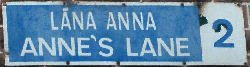
Titles like row, lane and terrace can be problematic in Irish. Lane is normally translated as lána and this lacks a certain elegance and distinctiveness.
While in Galway recently I noticed the use of bóithrín or little road for this and it struck me as very appropriate as the term is not used to render any other English equivalent. So why is it not in wider use in Irish, I asked myself? [translation for my English readers = wondered]
I came to the conclusion that it is all the fault of the Leprechauns who have devalued the term by including an anglicised version in their paddywhackery vocabulary. The Oul Boreen invokes images of poverty, bare feet and even famine itself. Nobody in Ireland today would like this for an address in preference to Southfork or even Mornington Crescent.
So here's the plan. It's time to reclaim the Oul Boreen and recycle it back into the lilting Irish from which it originally came. Lead on Galway!
Part of the problem is that the original versions of most of the street names, at least in the cities, are in English. Irish versions are frequently nothing more than clumsy transliterations of the original English, and even where a distinctive Irish language name does exist, it has most likely been forgotten and is now replaced with one of the aforsaid abominations. And this is before we even come near the subtle inflexions of Irish grammar.
Séamas Ó Brógáin has a good discussion of some of the issues on his excellent site and he also offers a list of sensible Irish versions for most Dublin streetnames. I have stuck a few examples of current abominations on my own site.Titles like row, lane and terrace can be problematic in Irish. Lane is normally translated as lána and this lacks a certain elegance and distinctiveness.
While in Galway recently I noticed the use of bóithrín or little road for this and it struck me as very appropriate as the term is not used to render any other English equivalent. So why is it not in wider use in Irish, I asked myself? [translation for my English readers = wondered]
I came to the conclusion that it is all the fault of the Leprechauns who have devalued the term by including an anglicised version in their paddywhackery vocabulary. The Oul Boreen invokes images of poverty, bare feet and even famine itself. Nobody in Ireland today would like this for an address in preference to Southfork or even Mornington Crescent.
So here's the plan. It's time to reclaim the Oul Boreen and recycle it back into the lilting Irish from which it originally came. Lead on Galway!
Tuesday, May 02, 2006
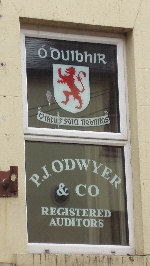
Na Duibhirigh
Bhíos i nGaillimh thar an deire seachtaine agus chonac an fhuinneog seo a chuir ar mo shuaimhneas mé.De réir dealramh tá teacht fós ar na Duibhirigh leasmuigh den phríomh chathair.
Ní hamháin san ach táid ag coinneáil súil ghéar ar a gcomharsain i gcónaí.
Subscribe to:
Posts (Atom)