Showing posts with label Killiney. Show all posts

Sunday, August 27, 2017

HA-LE-LOO-IA


So, what is this interesting looking building?

I first spotted it in 2008 in the public car park beside Killiney railway station.

So what, I hear you wondering.

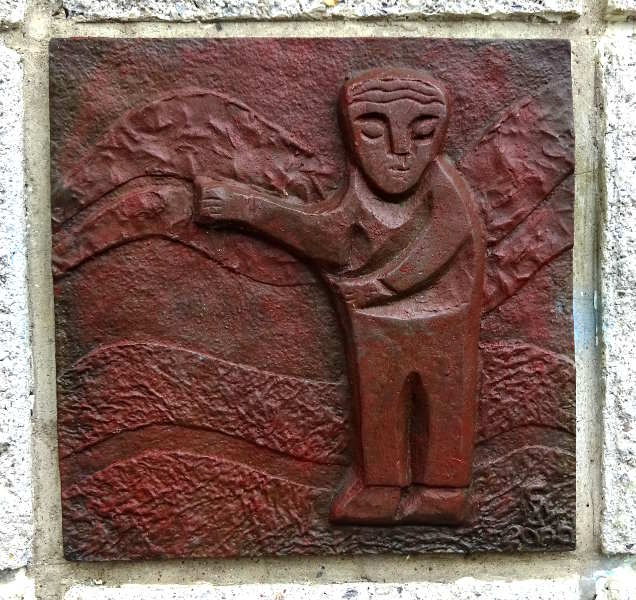
Well, it had these unusual plaques on the wall.


I inquired then of the Council about them. They are by the artist Imogen Stuart and are highly appropriate in the proximity of a sixth century monastic settlement, Cill Iníon Léinín, from which Killiney gets it name.

And yes. This is a public toilet and the signs have a nun for the ladies, a monk in a wheelchair for the disabled, and a standing monk for the gents.

I hear you wonder: just how enlightened can a Council get?

My answer is very, and I wrote to them and told them so in 2008.

But hold on a minute. What is the score today?


The gents is closed.


The disabled is closed.


But the ladies is open.

Now you can look on this a number of ways.

Perhaps the Council forgot the meaning of the signs and wondered why they needed three separate toilets when space was at a premium. So they put two of them to other uses and closed them to the public.

Or, they made a conscious decision to have a unisex toilet and that was the ladies one.

So, perhaps a further phase of enlightenment has dawned?

Next time I'm out there I must check if the ladies has also been modified to suit the diabled and while I'm there I might even check out the length of the queue.

Maybe by then they'll have have shifted the plaques and have Imogen do a few more to welcome all shades of gender and none.

Visit 2008

Visit 2011

Thursday, August 24, 2017

WATSON'S NURSERIES KILLINEY


SO MANY SWEET FLOWERS
From Clontarf to Killiney
Watson's Nurseries - 1884 to 1967

Click on any image for a larger version

In the Dublin City Library and Archive, on 23 August 2007, Bernadine Ruddy, President of the Old Dublin Society, gave a well researched talk on Watson's Nurseries, in the presence of Watson family members.

This is a topic which has not been fully researched up to now.

For example, in my Google searches relating to it I came across this suggestion: that it was called watsons after someone called Mr Watson was murdered there.

Fake news indeed, but enough to provoke a researcher into doing the job right. I'm not sure if Bernadine was aware of this suggestion but her talk will certainly put it to bed in short order.


Bernadine Ruddy

Actually she told us that her initial interest was in the original Watson's Nursery in Clontarf (1884 - 1912) and that she ended up in Killiney (1912 - 1967) purely as a result following the nurseries' move southside.

The Clontarf site of 13 acres eventually became too small for the business but there was no room for expansion. Then in 1912 the 148 acre Kilbogget Farm out Killiney way came up for sale and Watsons jumped at it. The transition took some eight years so it was 1920 before the new nurseries were up to speed.


I should lay one controversy to rest here before I'm dragged into it.

Bono lives in the townland of Killiney, which is within the area of the old Township (subsequently Urban District Council) of Killiney, which, in turn, is within the old civil parish of Killiney.

Watsons is on Kilbogget townland, which is not within the townland of Killiney nor within the old Township of Killiney, but it is within the civil parish of Killiney.

So the description of Watson's Nurseries Killiney is perfectly legitimate. Watson's Nurseries Ballybrack is not. So there.


The original William Watson came over from Scotland but he didn't seem to have had any horticultural training. Apparently Scottish gardeners were much in demand in those days as they were very well trained and could turn their hand to many different aspects of horticulture. Some of these were employed by Watsons.

The nurseries thrived and were held in very high regard. Their produce, apart from supplying the traditional home market, began to be substituted for former imports and was itself exported, mainly to the UK.

By the mid 1960s, with the onset of economic expandion, the price of land in the area rocketed and the Watsons eventually decided to call it a day.

The nurseries' land was sold to Gallaghers builders who then built what is known today as the Watson estate. At least the housing development preserved the Watson name for posterity.


In the QáA which followed the talk it emerged that there were former employees of the nurseries in the audience and we got some anecdotes from them.

It appeared that women from the city centre had become entitled by right to come and pick shamrock at the nurseries, no doubt in the run up to St. Patrick's day, and a lot of them turned up to claim their prizes.

One man in the audience identified himself as having done a paper on the nurseries for the Foxrock Historical Club some time back (Thomas Ruddock?) and Bernadine gave him credit saying she had read it and drawn on it for her talk.

It reminded me of the time I was giving a talk on the military history of Killiney Bay in which the Laughlinstown Military Camp figured. For that aspect I had drawn heavily on an essay by Kevin Murray in the Dublin Historical Record. Kevin turned up for the talk and identified himself in the audience. I was in, quick as a shot, to give him full credit for the material I had used.


[l-r] John, Laura & Colin Watson, Rosamund & Patrick Smith
All direct descendants of William Watson except Laura who is married to Colin.

I was thinking about the nurseries on my way into the talk and it struck me that, despite it being on the route of my paper round, I had no recollection of ever delivering papers there.

After the talk I learned that the family had actually lived in Fortlands on the Killiney Hill Road so if they had got papers delivered that would have been on Maurice O'Connor's route.

Guess who lives in Fortlands now?

The Edge.

In fact three of the U2 four live in fairly close proximity in Killiney.

Fortunately I had left by then for my native Northside.

Thursday, October 15, 2015

VIVE LA CORSE!


By a strange coincidence, the Dublin Martello Towers and Napoleon himself, against whom they were to defend us, both had their origins in Corsica, and that gave me an appropriate title for my recent talk in the Alliance Française in Dublin town.


Napoleon, with the remains of the original "Martello Tower"
at Punta Mortella in Corsica

I had previously given a talk in English on the restoration of Martello Tower No.7 in Killiney, and it struck me that in this year of the 200th anniversary of Napoleon's final defeat at Waterloo, the Alliance might be interested in a talk in French giving the background to the towers in Killiney Bay and the history of Tower No.7 up to its recent magnificent restoration.

I had done a few talks on local and family history and on Gordon Brewster, the artist and cartoonist, but these had all been in English. To do one in French would be a real challenge and either the opportunity or my resolve would pass if I didn't take it up now.

So I went in off the street and offered the talk.

The offer was taken up like a shot and the only thing left was to fix a date. It clearly couldn't be too soon as I had a mountain of work to do beforehand.


The interactive Google map I used in the talk. Here it
summarises relevant aspects of La Chaussée's report and
shows: the 200ft contour; the three coastal weaknesses;
the placement of primary and secondary defences; overlapping
fields of fire; and the Loughlinstown military camp where up to
four thousand troops could be sourced to defend the bay.

While I had the bones of a presentation in English, this one would be a bit different. Apart from it being in French I intended expanding on those angles which would be of interest to the francophone/phile community. A large part of this would be fleshing out Major La Chaussée, the man, and his contribution to the eventual defence network of towers and batteries.

This required some further research and I hit the lode when I found out that, apart from drawing up the initial plans for the defence of Killiney Bay, he had also been a British government paymaster and financed a failed attempt on Napoleon's life which ended with the would be assassins being captured and executed.


Albert Folens, militant Fleming, excellent French teacher,
and educational book publisher

And before I forget to mention him, I dedicated the talk to my first French teacher, Albert Folens. Albert was not only flemish, he was a militant fleming, and he had worked for the Germans during WWII. His story is full of ironies. His collaboration with the Germans was based on their promise of a measure of autonomy for his homeland, Flanders, if they won the war. Irish people should understand this as, over time, we have called on the French and Germans for help, the latter in the middle of a war in which we, as part of the British Empire, were on the other side. I lost an uncle on the Somme in that one (WWI).

Anyway, after WWII, Albert had to leave Belgium and eventually got refuge with the Christian Brothers teaching French. How that must have hurt, as the struggles of the Flemish people had been against the French speaking Walloons who dominated Belgian life at their expense.


Tower No.6, vandalised by Victor Enoch

At the other end of the scale, I got an opportunity to give a derogatory mention to Victor Enoch, who, while professing to be an afficionado of Martello Towers, bought one and ruined it. So much so that he hadn't the nerve to put his own tower on the cover of a pamphlet he published on the Martello Towers.


Joseph Murphy's gravestone
Photo: Niall O'Donoghue
Stone found by David Kirker

And there were little quirks turning up right up to the last minute. We knew that a tenant of the gunner's cottage on the site of No.7 had been Joseph Murphy, the local public lamplighter, who only died in 1960. But, lo and behold, what turns up but this fabulous tombstone in the cemetery in Kiltiernan.


Announcement on the Alliance Française's website

Anyway, as I said, my offer of a talk was accepted with alacrity, and despite some problems as the day drew nearer I think everything turned out right on the night and without a broken leg in site.

I have to say I admire the faith of the Alliance in my ability to deliver. They had never heard me speak a word of French until the night and that occasion was the first time I had ever spoken French in public. So from my point of view it was truly a Café Historique.


The finished product

I got a few gasps from the audience, but none so striking as when I showed the final product of the restored tower. Those present were left in no doubt about the appalling condition of the site when Niall O'Donoghue bought it and they clearly appreciated the miracle he had wrought in the restoration.

And, to cap it all, I rounded off with a video of the inaugural firing of the cannon on the top of the tower to a background of a full rendition, cannon and all, of the 1812 overture.


The marvelous model

During the interval, the audience was able to inspect the fabulous model of the site and tower made by Terry Murray, Niall's son in law, and get the lowdown on both the model and the actual tower from Niall.

If you're interested in following up further on any of this, I have a website on the tower and some related items. There is also a background page to the talk in the Alliance with links to the Powerpoint presentation and my script. There is also a link on that page to a vast range of material assembled for the earlier talk in English on the background page to that talk.

And if you want to go out with a bang, here is a link to the final video referred to above. Best viewed full screen with the sound turned up.

Sunday, December 07, 2014

Killiney


Invitation
Click on any image for a larger version

As I know from my own research, the whole area of Killiney Bay is replete with history. From a 6th century female monastic settlement, through rebellion, plantation, hunting, a fruitlessly awaited French invasion, and, finally, residential development, the area has a rich and varied past.

But this is probably the first time that an attempt has been made to document Killiney village and its immediate environs and it has been undertaken by locals who know what they are about.

As soon as I saw the very professional looking invitation, I knew I was in for a treat, and treat it was.


Simone Walsh

The exhibition was the brainchild of Jimmy Kelly, who was so modest on the night that I didn't even get a photo.

It was held in the Druid's Chair, Killiney village's only pub, and one which has contributed significantly to local activities over the years.

The night's proceedings were kicked off by Simone Walsh who was intensively involved in the project herself.


P J Drudy

The guest speaker was P J Drudy, Emeritus Professor of Economics in TCD. He recalled discovering the sense of community in the village when he moved in many years ago and was full of praise for how that spirit had been maintained down the years. This is shown today by the huge involvement of the local people in providing material for, and supporting, the exhibition.


Imelda Kestell & Charlie Mason

The ribbon was cut and the exhibition formally opened by two longstanding locals, Imelda Kestell and Charlie Mason.


The exhibition panels, and the two monster loose leaf books, clearly showed the depth of the research undertaken. Their presentation was hugely professional and it was clear that those attending were completely captivated by, and absorbed in, the content.


Ger Garland & Emer Brady

I was floored by the professionalism of the panels produced by Ger Garland until, through nefarious contacts and otherwise, I found out that she is a well known and respected "high end graphics artist". No doubt about it.

Emer Brady was an important contributor to the exhibition with her research and editing and, of course, Alice Cullen, Killiney's local historian, made an enormous contribution to the content.

This is a marvellous exhibition and a great example to other local communities of what can be done.

Unfortunately you won't get to see this showing as it finishes today. However, I hope it will get many other well deserved airings, perhaps in DLR county hall and in Dalkey castle.

As far as the latter is concerned, it might remind the people of Dalkey that there is another leg to the greater Dublin Bay beyond the hill.

Tuesday, September 16, 2014

Bono's House


Click any image for a larger version

It's really all the fault of the Vico Road.

Everyone knows that the Vico Road is in Dalkey.
Bono lives on the Vico Road.
Therefore, Bono lives in Dalkey.

I'm fed up of reading that shite.

You see not all of the Vico Road is in Dalkey. Quite a substantial part of it is in Killiney and where Bono lives is in both the former urban district and current townland of Killiney.

Bono lives in Killiney. Enya lives in Killiney.

It's Pat Kenny that lives in Dalkey and who would want to end up in that neighbourhood.

Just so people will know the score, the map below shows the border between the former urban districts of Killiney and Dalkey and it's a good uphill walk from Bono's house, highlighted in yellow at the bottom.


Bono lives on the actual townland of Killiney, one of the constituent townlands of the former Killiney and Ballybrack urban district.


Strathmore Road

And when you take into account that the entrance to Bono's house was moved from its original position, which could have been argued onto the Vico Road, it is now unequivocally on the Strathmore Road. So Bono doesn't actually live on the Vico Road at all.

So there.

Thursday, June 26, 2014

WWI: Killiney & Ballybrack

My main interest in WWI is my uncle's death on the Somme. However, there are some crossovers between my work on my family history and earlier work on local history in the Killiney/Ballybrack area, as the extract from the Irish Times in 1915 shows.

Basically British recruiting officials are pressuring local authorities directly to release eligible employees into the army. They are also exerting indirect pressure through regional recruiting committes to get the local authorities to set up local recruiting committees to exhort locals to join up.

Killiney and Ballybrack feel they have done their bit with 60 volunteers from the area by October 1915. So much so that the local builder is moaning he can't find workers to enable him to carry out building contracts.

You will notice the threat of conscription still hovering in the background.


Click image for larger version

Monday, September 03, 2012

Croix de Lorraine


Click on any image for a larger version

This is my Croix de Lorraine and no, it was not awarded to me by the French Government. That would be the Légion d'honneur for which I am still waiting.

My gold Croix (above), excluding the pin, is exactly 1cm high. I can wear it relatively inconspicuously on the lapel of my jacket.

It has a certain sentimental value as I was given it at my first, and only, Gaullist Assises Nationales (Ardfheis) in Lille in November 1967.


I wore it recently to the inauguration of the cannon on Martello Tower No.14 (Seapoint) in the presence of the French Ambassador. I thought it sort of fitting. The Martello Towers were built by the British in 1804 to defend the Bay against an expected French invasion.

I wore it most recently to my talk on the restoration of Martello Tower No.7 (Killiney) but when I got home it was missing. I was quite upset and assumed it had slipped out of my lapel somewhere, but it was nowhere to be found.

The following day it turned up inside the pocket of my shirt. In Lourdes that would have been considered a miracle, in Dublin it was simply a mystery.


Friday, August 10, 2012

Programmer's Dilemma


Four years ago I was programming Google maps to illustrate the Military Road from the Loughlinstown Camp (1793-99) to the sea. Just after I passed through the Ballybrack crossroads I noticed that the google-mapped road deviated from its true position and took up a line parallel to the true route but slightly south of it. This could be confirmed by switching to the satellite view.

The dilemma was whether to follow the (true) satellite route or the erroneously mapped one.

I opted to follow the mapped route as this would be the mode most people would be viewing in and I didn't want to look a complete eejit by appearing to veer off the road.

So far so good.


But I had occasion, the other day to check out the map and found Google had corrected their error and there was me veering off the road like an eejit (above).

So I reprogrammed the route to coincide with both the (new) map and satellite views (below).


Truth will out.


Friday, July 18, 2008

Les pieds dans le plat


Here we go again. You can't get away from it.

"Ye did the wrong thing and it needs righting."

And his forthcoming visit is shortening by the hour to the loud sound of closing doors.

For a louder sound yet check out the inauguration of the ultimate anti-French device.

This one has been around for over 200 years and seems to have proved effective first time round.