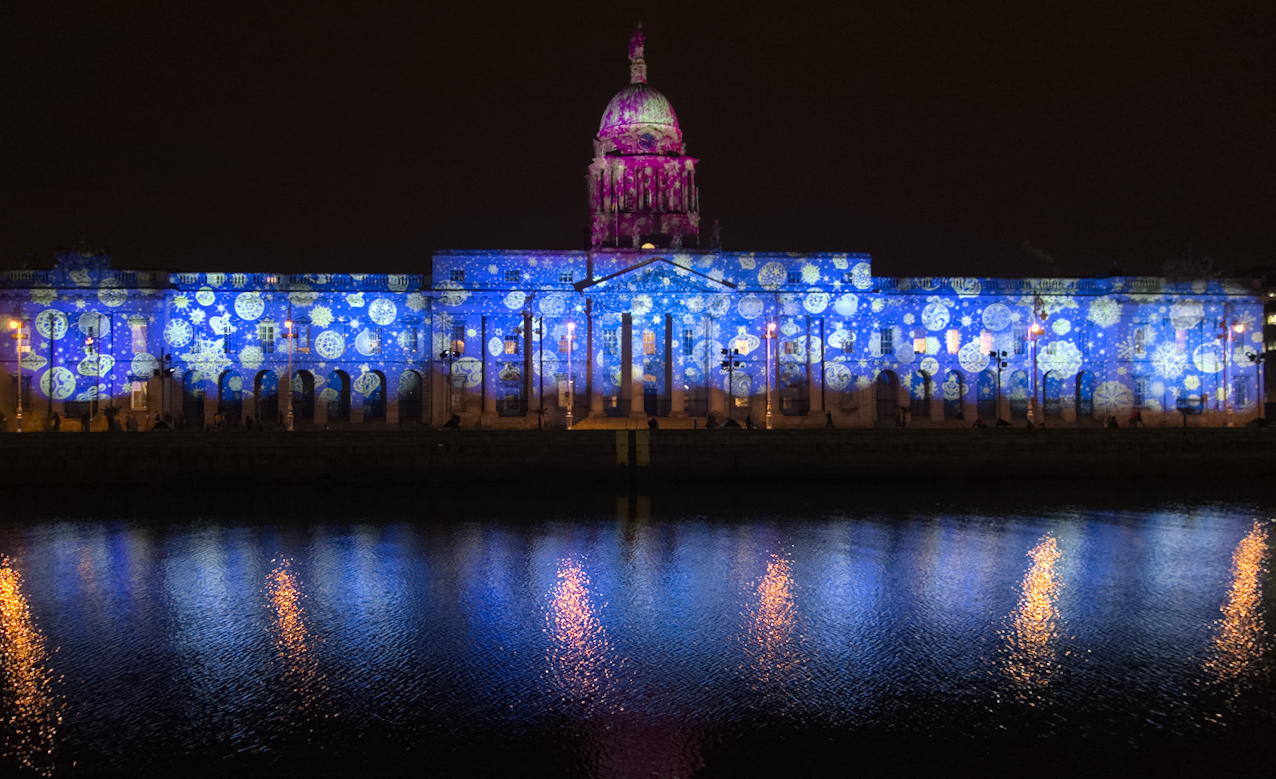
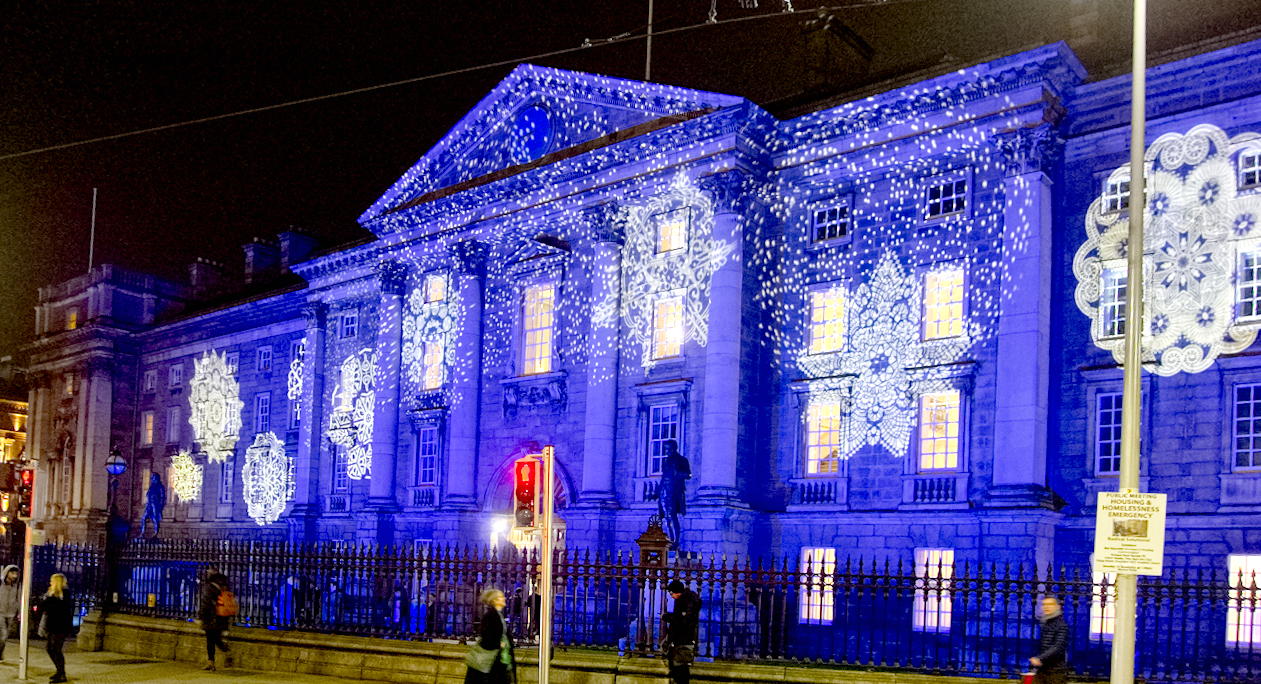
I am calling these Winter Lights because that's what it says on the can. I would have no problem calling them Christmas lights if that's what they were but I don't see why I should be forced to do so.
There are others around the city but these are the only ones I've passed by so far. If I pass by more I will add them in.
I hesitate to combine the university and snowflakes in the one shot. It reminds me of the current intolerance and illiberality sweeping through university campuses with its no platforming and safe spaces.
A university is supposed to be a place of learning (active verb) and not a soviet style brainwshing centre.
Statue de Louis Pasteur, cour de la Sorbonne
pendant les événements de mai 1968
Photo: Philippe Gras
Click on any image for a larger version
When I saw the notice in the Alliance Française newsletter for this Oratorical Jousting final (16/3/2018) I made up my mind there and then to go along. It was actually the final round in an interschools debating contest in the French language. More than 30 schools in the Leinster area had participated and the final was between Coláiste Íosagáin and Loreto on the Green. Two girls' schools, as it turned out.
I arrived a little early and decided to have a coffee in the Alliance café, La Cocotte. However the café was just closing when I arrived but they let me look around the current exhibition of photos by the late Philippe Gras. And what did I see among them but the one at the top of this post. The theme is freedom of expression and the photo was taken during the 1968 student uprising in Paris.
So what, you might say? But bear with me. The subject of the night's debate upstairs in the new mediathèque was LA LIBERTÉ D'EXPRESSION N'EST NI POSSIBLE NI SOUHAITABLE - freedom of expression is neither possible nor desirable. How apt, though I don't recall any of the contestants mentioning 1968. Both the French Revolution (1789) and the UN Universal Declaration of Human Rights (1948) got a few airings in the course of the night.
I had gone along with the intention of taking a few photos and doing a blog post if the night proved interesting. However I gathered the organisers were "wary of social media" which was a bit of a surprise, so I just determined to sit and listen and think.
The night did turn out to be very interesting so I decided to write it up anyway. I'm sure there will be plenty of photos on the Alliance site from the official photographer in due course.
I found the format of the debate intriguing.
I had taken part in the Gael Linn interschools debates in Irish in the 1960s. In those debates you only got the subject twenty minutes in advance. This was way before the internet so you had to rely on your wits and what was already in your head. You had three minutes to present your case. The teams as such did not take sides for or against the motion, that was left to the individuals themselves. Individuals' marks were then combined to give a team total.
In the French case, the subject is known well in advance though I'm not sure when sides are allocated. In any event there is plenty of time for preparation, deciding tactics, and deciding which points would be made by which team member. Don't forget that in this case a coherent case has to be made by the team as a whole.
An interesting variation in the French case is that for a specified period within the three minutes the speaker can be challenged by a member of the opposing team and there follows a spontaneous, and lively, debate between the two contestants until the adjudicator feels that that the point has been exhausted or the exchanges have gone on long enough. This is a interesting variation as, given that the main contributions have been prepared and well rehearsed in advance, it allows the contestants' spontaneous mastery of the language to be put to the test. It also tests their resilience under fire.
Handout: teams on the night & best speakers from previous rounds.
Click image for a larger version
My impression was that the teams were very well matched. Well they would be, wouldn't they. having come through a fair few rounds in this knockout competition
I thought Loreto were more at home in their French though I thought they had the harder side of the argument to defend - promoting untrammeled free speech (and yes Charlie Hebdo got a mention). They were sort of caught in a bind as the opposing team in their opening shot had defined free speech as unlimited freedom of expression and had gone on to argue for reasonable restraints. This put Loreto in the position of arguing in favour of being allowed "to shout fire in a cinema" as it were. Assuming I understood correctly what was going on.
Coláiste Íosagáin had, for their part, defined themselves into a defensible middle ground. I also felt that they had marshalled and structured their arguments better as a team.
If I had one general remark to make it would be that the contestants spoke a little too fast. I know, from my own experience, that you tend to do that when you are nervous and the native French do speak at a rate of knots. Nevertheless.
The advice we were given at the time by the adjudicator was: If you don't feel your speaking too slow, then you're speaking too fast. I'm sure many public speakers, at least the more thoughtful among them, would identify with that. Though when you observe this for a while it becomes second nature.
I'd say the jury found it a very close call in the end as the standard was high all round.
French Ambassador Stéphane Crouzat with Team Íosagáin
Coláiste Íosagáin emerged the winner. Bravo.
I don't know the marking system and, unlike in my case, the jury didn't give any analysis of how they arrived at their decision. I must keep an eye out for this contest next year and maybe talk to a few people in advance.
Below is Sadhbh Ní Ghráda from the winning team. Her father was a classmate of mine in the middle of the last century.
Sadhbh Ní Ghráda with parents Cormac & Máire
The debates have their own website where you can link to the rules and other background material.
There I was on the footpath outside the Dáil on the Merrion St. side, holding a camera through the railings to get a better angle on the transported English Queen's consort, when I saw a Garda approaching fast on my port side.
Best to take the bull by the horns I thought. "That's a fine statue" sez I, and this being Ireland, that's how I ended up in a half hour's conversation with senior Garda Chris Burdock.
Then it was time for him to go as his relief arrived. And at that precise moment we were interrupted by a passing Enda Kenny who, half addressing Chris while looking at me, made a remark that I took to have something to do with football. I still don't know whether he was telling me to be careful with this man as he was a footballing hero in his day or commiserating with me on the ongoing curse on the Mayo team. Enda is a big supporter, him being from Castlebar and all that.
Anyway, by that time my conversation with Chris had covered the transporting of the English Queen to the colony, the burning of the British Embassy in 1972 at which both of us had been present, his ancestor's escapades in the War of Independence and the Civil War, the Dublin and Monaghan bombings and, of course, the best chips in town.
His ancestors were also Pakenhams (yes them ones) and I took great pleasure in explaining to him how I took issue with Pakenham's Year of the French, when it came his evaluation of the Sheares brothers's recruitment of the double agent, Captain Armstrong, in 1798.
He countered with how his relationship to the Pakenhams facilitated his skipping the queue outside St. Paul's in London and ending up getting him the VIP treatment inside.
Before we parted, I pointed out to him the lady breastfeeding above the Attorney General's Office. This arose out of another aspect of our conversation, and he was interested to be made aware that we had been in there at the very beginning of the twentieth century, a whole hundred years before the current controversy erupted into the public sphere.
We could still be there were it not for his relief turning up on time and Enda rudely interrupting us. Kinda broke the spell.
However, we agreed to pick up on the conversation again, next time we meet.
Raheny Camera Club currently have an exhibition in my local (Raheny) library. It is well worth a visit and there are some lovely photos on display.
But I just wanted to draw attention to one aspect of the exhibition in this post, and that is the number of photos of the iconic ESB Pigeon House Chimneys.
While they are quite ugly, it was clearly the right decision not to demolish them when the plant was decommissioned. They have become a Dublin icon over time.
A welcoming sight as you approach the city by sea or by air. And their status is underlined by the extent to which they are photographed from all angles and in all shades of lighting.
Uncle Larry NOT
Click on image for a larger version
Uncle Larry is not my uncle. Nevertheless, although I never even met him, I am calling him Uncle Larry. There is a tradition in our family that virtually all relations in the parents' generation, however distant, are known as uncles or aunts, and he is Mai Medlar's, my mother's cousin's, uncle.
But it's only after reading about and actually listening to his stories that you will really understand why I call him Uncle Larry. He is an open and warm person, has a keen sense of observation and an even keener sense of fun. And he does not take himself too seriously, unlike many of his contemporaries.
You will also understand why I refer to him in the present tense, though has been dead since 1986. He was exactly 90 years of age on the 12th of March 1978 when his son-in-law Dave recorded these stories.
BACKGROUND
I have had Larry's stories up on my website for a good while, but I thought I might bring them to a new audience in this blog post. My format is to give a commentary on the story and then let you listen to Larry himself tell it. These are all first hand stories, straight from the horse's mouth, and they are now part of history.
Larry was one of two children born to John Medlar and his wife Ellen (née Brennan). John was a blacksmith from Paulstown, Co. Kilkenny, and Ellen was from nearby Ballyellen, Co. Carlow. She had been in domestic service in Belvedere Place in Dublin when she married John and they were living in Fenian St. when the children were born, Patrick in 1885 and Larry in 1888.
John then went to America (USA) to his sister and was to send for the family when he found work. Unfortunately he died and Ellen was stranded in Dublin with two young children. So she farmed them out to their grandparents and went back into domestic service, this time in Merrion Square.
Patrick went to the Medlars in Paulstown where he became imbued with the cause of Irish independence, but that is another story.
This is the story, or part of it, of Larry, who was farmed out to the other grandparents on the upper Ballyellen lock on the Barrow River, which was part of the Grand Canal system.
Ellen subsequently remarried and settled in James's Street and the two lads came back to town where they remained and made their careers.
So Larry's stories are located initially in Ballyellen and then in Dublin.
THE STORIES
A Kilkenny Hanging
Larry's granny went to see the last public hanging in Kilkenny. I don't know what year this was but it could well have been a Fenian hanging, or even this one.
Lock, Cot and Barrow
If there's water, kids will fall in. I don't know how many times I fell into the Dodder myself but this sounds a little more serious. I wasn't fished out. I had to find my own way to the bank but fortunately I wasn't spanked when I got home.
Skool
We used to need an election or a freeze up or a bout of flu to get off school. Country life was much simpler. An excess of the gargle the night before and the teacher's hang over meant the day reduced to morning prayers, led by the teacher's sister. And off the pupils scooted home.
Larry's 1st Communion and Confirmation
There are not many people have the wheels come off just after they make their first holy communion. And then there's confirmation where Larry, anything but dressed for the occasion, joined his older brother in church and made a premature confirmation. I don't know if he ratified it two years later.
Locks & Barges
The canal was apparently used for more than just transporting cargo and Larry mentions the party boats with their canopies and well dressed ladies on their way to a day out at St. Mullins.
The lock where Larry was brought up was part of the canalisation of the Barrow river to make it navigable. It was part of the Grand Canal network which actually linked the Ballyellen Lock and the Harbour in Jame's St. where Larry was later to live and where his brother Patrick was to have a thriving undertaker business.
Locks, Eels & Salmon
The size of the lock-keeper's fee clearly necessitated a supplementary source of income. While Larry's grandfather and grandmother were supplying (legal) eels to Billingsgate, his uncle Pat was extending his activities into some slightly trickier areas.
1916
It's easy to forget the difficulties posed for families by the 1916 Rising when parts of the city were under lockdown. James's St. which Larry refers to was the location of the South Dublin Union, one of the flashpoints of the rising. Mrs. Mortimer was my granny. Larry also refers to Seán Connolly who led the abortive attack on Dublin Castle, killed a policeman and was himself shot by a sniper shortly afterwards.
Andy Duffy's Revolver
It was not good to be caught in possession of a revolver during the War of Independence. Andy Duffy was a pawnbroker married to my great aunt Lil. He was nervous about a revolver on the premises and asked Larry to get rid of it. On his way back home Larry nearly got caught by a Tans patrol. He eventually hid the revolver up the chimney in his place of work, the Dispensary. He subsequently passed it on in a pub to another man who promptly shot it off accidentally. Everyone was very nervous as the city was on high alert that day. Nothing came of it though.
Bloody Sunday
Larry was in Croke Park on Bloody Sunday and saw the shooting. On his way out he went to help a man on the ground and gave him some whiskey he had on him - only to find out that the reason the man was on the ground was that he was already drunk and couldn't hold his balance in the surging crowd. Larry was disgusted. But it is probably one of the few, if not the only funny story to come out of Croke Park on that day.
Civil War & The Four Courts
Larry was working in the Tivoli Theatre on Burgh Quay and after a few beers and a nosh up was asleep in his brother's house on Usher's Island when he was woken up, in the early hours of 28 June 1922, by the shelling of the Four Courts which effectively started the Civil War.
Alfie Byrne & Big Jim Larkin
The family had a fair amount of contact with Alfie Byrne. Partly because Larry's brother Patrick was on the Corporation (City Council) with him. They were effectively non-competing because Alfie's base was northside of the Liffey. They used to go to conferences of the Royal Liver Assurance, for whom Patrick was an agent. This story is probably from one such conference.
Alfie Byrne tells Larry that he sold his pub in Talbot St. to fight Jim Larkin in an election, which Alfie won.
God Save the King!
Larry and Alfie Byrne were clearly discommoded when they found themselves standing for "God Save The King",
Russell the Counsellor
Dr. Russel worked in the Dispensary (in Castle St.) and subsequently became the CMO of the Corporation. Larry clearly thought him quite a character.
A neighbour of Larry's got a dose from a woman but didn't want to go to the doctor with it. So Larry brought him in to Russell who inspected the damage and made a most impolite suggestion.
Russell the Dentist
Larry decided that the cure for his toothache was an extraction. Dr. Russell brought him over to the window, got him in a head hold, told him to open his mouth and yanked the tooth out with the "forceps". Larry was left for a week with an abscess which Russell then had to lance.
Russell the Prankster
Russell almost unhorsed a passing officer.
Prices & Shopping
The price of a pint or a packet of Woodbines. Thomas Street good for shops and street traders at Christmas.
Medlar & Claffey, Undertakers
Medlar and Claffey was a significant undertaking business in Dublin with branches in various parts of the city over time. The Medlar/Claffey partnership broke up in 1927.
Larry used to give a hand with the brother's business betimes and here tells of a trip from Clonliffe Rd. to Valentia Island, when the funeral went astray and the hotel had no "food" available.
This is the seventh volume in the series The Making of Dublin City. The books are published by one of the nation's assets, the wonderful Four Courts Press. The volumes vary from a compendium of authors to a single author and they are overseen by the series editors.
They are of a high academic standard and at the same time very readable and well illustrated (b&w). The idea is to cover all aspects of the development of the city and the latest volume deals with the 1950s and 1960s, two very important decades in shaping the city we live in today.
Ruth McManus
The author is Joe Brady, Associate Professor and former Dean of the Arts Faculty in UCD. The occasion was a talk he was giving on the contents of the book and it was taking place in Hodges Figgis bookshop in Dawson St., appropriately enough within sight of the Mansion House.
Joe was introduced by Ruth McManus (DCU) the book's editor. Ruth herself has written Dublin 1910-1940 which taught me a lot about the development of neighbourhoods in which I have an interest. In the case of her book Joe Brady, and Anngret Simms (UCD), were the editors. So you can see a tight dedicated grouping here bringing us a consistent and comprehensive series on the city.
In fact, it was in Ruth's book (p232) that I came across the location of the Medlar Bridge (The Mettler) connecting Maryland to Basin Lane, a bridge championed by my grand-uncle PJ Medlar, in the teeth of fierce opposition from the Grand Canal Company, when he was on Dublin City Council in the 1930s.
Joe Brady
As Joe remarked: We have now arrived at the period between 1950 and 1970. This is close to the time I grew up and it is interesting to revisit the period and see the extent to which my recollections are reflected in the sources.
It is also more or less the period in which I grew up (though there are those who deny that I ever did - but that's a different book).
Joe brought us through a magnificent sweep of Dublin's development in that period. The 1950s was a depressing period, but one during which there were many ideas generated on how the city ought to be developed. In spite of what I remember as a period when money was tight, Joe reminds us that, nevertheless, car ownership was increasing, albeit from a modest base.
And it was the car that dominated much of the planners' thinking. We nearly ended up with spaghetti junctions, complete with overheads, in the middle of the city, but fortunately the Council didn't have the money and that phase had more or less passed by the time it became affordable and the realisation dawned that you couldn't just carry on facilitating increasing car numbers for ever.
This was the period which saw the advent of the self-service store, starting in the city centre but soon to lead to suburban supermarkets and eventually shopping centres. These relied absolutely on the availability of the car, and an aerial photo from the period of the Stillorgan shopping centre was remarkable for the ratio of car parking space to that taken up by the centre's actual shopping area.
These were mind blowing developments. My sister reminded me once that my granny who had relocated from Thomas/James's St. to Orwell Gardens in Rathgar used still go into town by bus to shop in Clanbrassil St. in the 1940s and up to the early 1950s.
And then there was the class thing, or Northside versus Southside. Public housing tended to be developed on the Northside, while private housing and commercial development tended to be on the Southside, though there were always pockets to prove the rule.
One such pocket, though not actually public housing, was Orwell Gardens, Rathgar, which on the dust jacket of Bob Quinn's book is described as a ghetto, implying relative poverty in the midst of plenty. It reminds me of people today referring to the DART accent on the basis of certain assumptions about class which are not borne out if you actually travel the line, as I have done regularly since the DART was invented, and long before.
I haven't actually read the book yet. I've only just become aware of it. But from Joe's presentation and his use of many illustrations from the book itself I know it's going to be a great read.
And while on the subject of illustrations, I was glad to see his extensive use of cartoons from Dublin Opinion. That publication is a serious repository of the nation's and the city's history, and the cartoon is now coming to the fore as a legitimate, and sometimes superior, source for many aspects of history. Cartoons are turning up in the most respectable of books these days. Long may this trend continue.
You can get a copy of Joe's book, as he puts it himself, in all good bookshops and, of course directly from Four Courts Press.
A small oldy worldy bookshop looking out at the Ha'penny Bridge from the north bank of the Liffey.
I had arrived early and was browsing around when I came across this title. Really bring you back (if you were an old man entering his anecdotage). So I put it aside to purchase.
Then I came across this one, which had the same effect on me, and I put that one aside too.
I then paid my €1.50 for these two nostalgic postcards and secreted them inside my jacket.
The place quickly filled up to overflowing and I scanned the faces for any I might know. I saw only two, which will give you an idea of my literary credentials: Mary Clarke and Eoin Bairéad. I subsequently ran into the City Librarian, Margaret Hayes, and much later, the Beresford descendant, whom I had met at the bicentennial celebration and who was now back with her children for the book launch.
The function was organised by Mary Clarke, City Archivist, not surprising as the book is published by Dublin City Council - Dublin City Library and Archive (though Four Courts Press appear to be in there somewhere). Mary was also MC for the evening.
The night kicked off with a ballad from Tony Fitzpatrick.
Eamon Hunt
This was directly followed by another ballad, Dublin Jack of all Trades.
Seán Ó Hearcáin
And the performance then morphed into a sweet version of the Last Rose of Summer.
Declan Collinge gave us his translation of Faoileán Drochmhúinte by Máirtín Ó Direáin where the poet execrates a seagull who has just dropped its load on him. This catastrophe happens by the Liffey and the poet contrasts the vulgar seagull with the noble swan which would never even think of doing such a thing.
The book was then formally launched by Michael Phillips, former City Engineer. Michael clearly had a great love for his subject and his support in bringing the book to fruition has been acknowledged by its author, Michael English.
It was then Michael English's turn to respond and he thanked a load of people for their help and cooperation along the way. The list was as varied as the content of the book itself.
When I was speaking to him afterwards he mentioned that he thought the bridge's bicentenary would have given rise to a clatter of books on the subject, but nothing appeared. So I figure this is now the definitive work.
Book chapters cover:
An introduction from Michael Phillips giving an engineer's perspective of the bridge
Coalbrookdale, in England, where the bridge was designed and cast.
Distinctly pedestrian: the history of the bridge
The bridge under threat from a proposal to replace it with an art gallery for the Hugh Lane collection. There was a design Sir Edwin Lutyens all ready to go.
A new lease of life for the bridge with its 2001 restoration.
The pint of plain: the story of Guinness and the export of stout passing under the brige in the barges. The pint and the bridge - two icons of Dublin.
Cultural awareness reviews the role of the bridge and its connections with various cultural events during its history.
Marking the millennium: the Millennium Bridge design inspired by The Ha'penny Bridge.
Night into day into night captures various views of the bridge at different times of the day and year. These are largly Michael English's own photos.
And I have to include this cartoon from Gordon Brewster at the height of the controversy over the location of the proposed Municipal Art Gallery to house the Lane pictures. He sarcastically remarks that this location would mean the gallery not obstructing any view of the city. Fortunately the gallery eventually ended up in Lord Charlemont's house in Parnell Square where it will now form the linchpin of the new cultural quarter on the northside.
Whatever about Brewster's drawing ability, this one shows up his shortcomings as an engineer (it would fall down), and a people manager (it would take all day to get people up and down the Pillar's 168 steps). But then that is surely part of the point of this cartoon.
As an aside, it is great to see Brewester's cartoons getting an airing. After almost seven decades in hibernation, they have recently featured in Michael Laffan's Judging WT Cosrave and in the Revolutionary Papers and now another one turns up in The Ha'penny Bridge. And you can now view the full collection of nearly 500 cartoons online.
The book is available from all good bookshops and from Four Courts Press
Apparently nobody had ever done it before. A diary type history of Dublin city since Independence.
The Eureka moment was when Tim Carey found himself telling a pair of tourists, who were departing Merrion Row for Co. Clare, that they were heading for the "real Ireland". He didn't really believe that himself but it was the sort of thing people said and he found himself saying it.
That got him thinking about the place of Dublin in the real Ireland and this eventually led to him writing "Dublin since 1922", a book about the modern city which would capture its evolution as a capital, its increasing importance, its characteristics and the traits that define it.
And here we were, in the magnificent surroundings of Dublin's City Hall, on the floor of what had been the old stock exchange, but tonight people were trading compliments instead of stocks and shares.
The book is beautifully produced and well worthy of the exalted surroundings of its launch. I clearly haven't had time to read it but have dipped in and it is a great read. Based mainly on published sources and presented in diary format with a whack of relevant illustrations, it will not only introduce the stranger to the modern capital but will evoke nostalgia in the native reader.
My first reaction looking at some of it was "Jesus, was that so long ago? It feels like just yesterday". And I have enough years behind me to react in this way to roughly three quarters of the book, if you start with my birth, which incidentally doesn't appear to have made it into the final text. I nearly had a photo in the book but that is another story.
Ciara Considine
For me, Hachette was a French publishing house that did dictionaries and other Frenchy stuff. But there is now Hachette Ireland and the company, in one form or another, has been around since 2002. Their list of authors is extensive and you will recognise many of them.
The launch was introduced by Ciara Considine, the book's editor at Hachette. From all the compliments bandied about on the night, there seems to be wide recognition of a job well done.
She first introduced Dublin's current Lord Mayor, Labour Councillor Brendan Carr, who is, of course, our landlord for the night.
Brendan Carr
Brendan entertained us with slices of Dublin life and was enthusiastic in his praise of Tim's book which he was launching.
Joseph O'Connor
The guest speaker was Joseph O'Connor, and if you don't know who he is try here, and pick up when you come back half an hour later. Joseph had missed an occasion in Limerick to be here and this alone merited a round of applause from the audience. He entertained us with a witty and literary speech which everyone afterwards said they hoped would be published.
Tim Carey
Tim himself then took the floor, addressing an audience that included many of his own family. He spoke along the lines of the introductory paragraphs to this post and thanked the many people who had laboured hard to produce the final product.
Tim is the heritage officer with Dún Laoghaire Rathdown County Council and he has been very proactive in this role both promoting and facilitating a wide range of heritage projects in the county.
Tim Carey
After the launch he was running the risk of repetitive strain injury as he signed copies of the book for an ever growing queue of people. Much, I am sure, to the frustration of those towards the end of the queue he was not only signing the books but was chatting at length to the supplicants.
It's one thing to get the author to sign your copy of the book, but the real aficionados then seek out the guest speaker as well. I have a copy of Tim's "Hanged for Murder" signed by the State Pathologist, and of "Grave Matters" (not Tim's) signed by the recently retired Dublin Coroner.
Joseph O'Connor
So I made straight for Joseph O'Connor. At first, he modestly claimed he had nothing to do with the book, but he mellowed when I suggested that his guest speech was an integral part of the process.
I then probably (mildly) embarrassed him by reminding him that he had introduced me to the biggest Mickey in the world in "The Secret World of the Irish Male" and that I still smiled every time I thought of it. [In fact, I have just now reread that piece from the book and still find it convulsive.]
He muttered that this thing was still following him around the place. Perhaps if I had given more thought to his prodigious literary output, to which I have linked above, I would not have alluded to this trivial matter.
I think all may have been forgiven, however, when it turned out that we were both Ballybrackers of a sort.
He is currently Professor of Creative Writing at the University of Limerick (since 2014) and he seems to be enjoying this enormously.