Showing posts with label National Library of Ireland. Show all posts

Sunday, June 23, 2019

A MODERN EYE


Click on any image for a larger version


This exhibition represents a unique partnership between two nationally significant and progressive bodies. The National Library of Ireland (NLI), which is an autonomous cultural institution under the National Cultural Institutions Act, 1997, and the Gallery of Photography, which is a not-for-profit organisation, supported by the Arts Council and Dublin City Council.

The exhibition itself is located across these two organisations and it will run in the NLI’s National Photographic Archive, Meeting House Square, Temple Bar until 2nd November 2019; and in the Gallery of Photography, across the Square, until 1st September 2019.

In fact there is a third prong to Helen Hooker O'Malley's current exposure in the city of Dublin. An exhibition of her maquettes for scenery in the Players Theatre opens on 26 June 2019 in the city archive in Pearse Street and runs to the end of July. I attended the launch and the miniature sets are unbelievable and beautifully restored.
Hooker O’Malley photographed her life in Ireland from 1935 onwards.

The Gallery of Photography presents this early work – explorations made during expeditions with her husband into the Irish landscape, observations of Irish rural life particularly in County Mayo, and portraits of artists and friends – in addition to a fascinating record of her travels in Russia and East Asia.

The National Library’s collection of Hooker O’Malley’s photographs primarily encompasses work produced by the artist during an intensely creative period in the 1970s. These photographs centre on the textures and details of landscapes and heritage sites; Dublin’s bustling urban life; and intimate portraits of close friends and strangers.

Source


Paul Shovlin

Paul is Chairman of the Board of the National Library and he opened the night's event, presumably because it was hosted in the Library's Photo Archive. This would be followed later by a formal book signing session across the way in the Gallery.


Sandra Collins

Sandra is the Director of the National Library and she further outlined what was involved in this dual exhibition:
"Helen Hooker O’Malley’s fascination with Irish life shines out in these photographs. A notable and intriguing figure, she ought to be recognised as a strong and fiercely independent woman, one who travelled the world before settling in Ireland, and a talented artist working across a range of creative mediums.

We are delighted to work with our neighbours at the Gallery of Photography Ireland to present this joint exhibition about Hooker O’Malley, and to shed light on a complex woman and a dedicated artist. I would encourage people to visit both elements of this joint exhibition, and to see Ireland, its history, landscape, culture and people anew, from Hooker O’Malley’s unique perspective."


Luke Gibbons

Luke gave insightful commentary on Hooker O'Malley's work, as befits a Professor of Irish Literary and Cultural Studies at the School of English, Drama and Media Studies, National University of Ireland, Maynooth.

He emphasised that she was primarily a sculptor but that her exhibitions usually also showed a selection of her photographs. He mentioned a few that were included in this exhibition and commented on elements such as composition, detail and lighting. I think he saw all these as strictly premeditated, though I know from my own experience that it is important for a photographer to recognise a stroke of luck when they trip over it.

I was glad he mentioned Father Browne, another photographer who documented aspects of Irish life in the twentieth century. Father Browne's great stroke of luck was missing out on a shot of the iceberg as the Titanic approached it, or vice versa.


Tanya Kiang

Tanya is curator of the Gallery of Photography exhibition together with Trish Lambe
"Gallery of Photography Ireland together with the National Library of Ireland recognise the importance of retrieving and preserving the work of female artists. ‘A Modern Eye’ reveals for the first time the photographs of Helen Hooker O’Malley. The exhibition gives a unique insight into this modern woman’s creative vision of 20th century Ireland."


Cormac O'Malley

Cormac is Helen Hooker O’Malley’s son. He is the repository of her extensive archive, except for that part of it which Helen donated to the National Library in 1992. He has curated exhibitions of his mother's work over the years, and has, incidentally, written extensively about his father, Ernie O'Malley. Yes, that Ernie O'Malley.
"I am delighted to see two important cultural institutions come together to showcase my mother’s life and career. This exhibition captures the cultural state of Ireland from 1935 to 1975, including its heritage and the commonplace aspects of real people – but through the eye of a modernist female lens where mood, structure and form all play an intricate role.”


He looked really proud to launch this exhibition which showed his mother in such a great light and the organisation of which he had been intimately involved in. He certainly looked a happy man to me.


Kathryn McSharry with those you already know


Nikki Ralston

Nikki curated the NLI part of the exhibition with the help of a dedicated team. She clearly looks happy on the day.

Nikki is no stranger to me, her having curated many excellent exhibitions at this venue with the same dedicated and enthusiastic team. I actually figured in one of them myself.

And before I leave this section, can I recommend that if you do visit the exhibition and admire Helen's photos, do read the captions. They are very well written and most illuminating.


Cormac with his sister Étáin

I was tickled when Cormac told Seán Rocks on RTÉ Radio 1's Arena programme that there were lots of unprinted negatives in his mother's collection. This rings true. I have hundreds of never printed negatives. What is the point if you can read the negatives and have no immediate call for prints? Negatives can be quickly printed if required. And remember, these were not commercial assignments. Helen was, by and large, taking the photos for herself.

She did display photos with her sculpture exhibitions and these clearly would have been printed. But these would likely have been an insignificant proportion of the total.

The photos taken here are virtually all of ordinary scenes, except that their taking was sometimes extraordinary because few people, if any, were doing it on a large scale. You also need to remember that what is ordinary today may be extraordinary tomorrow, such is the pace of "progress".

I remember when I was researching Killiney Bay in the 1970s, and drawing on old material like the Lawrence photographs, I thought I should take some contemporary shots to illustrate my points. These photos have in their turn become historical at this stage.


Paddy Moloney & Mick O'Connor


Diarmuid Peavoy


Orla Sweeny & Bríd O'Sullivan


Natalie Harrower


So let's have a look at just a few of Helen's photos to give you a very summary view of what's involved.


Ernie O'Malley


Ernie O'Malley


Liam O'Flaherty


Boat Race


Bringing in the Potatoes


Seanachaí


The Mother in-law Marion Malley

I have to add here that Helen and Marion were great friends and remained so throughout.


Clearly, Helen, like myself surrendered along the way to colour. Or should I say "embraced" it? You be the judge.


Helen Hooker c.1930
Source

We'll say goodbye to Helen Hooker with this shot of how she looked around the time she chased Ernie O'Malley to the Chicago World Fair and subsequently married him in London to the disapproval of her family.


Caught on the job
Photo: @NLIreland

I've been at this a long time and am relatively rarely caught on camera, being myself busy behind the lens.

Saturday, April 20, 2019

BANNED


Sitting on the hedge - the panel
Click on any image for a larger version

Tommy Graham, editor of History Ireland, has been organising Hedge Schools from a good while back. The term originates with informal schools set up for Catholics in penal times. Some of these provided a first class education.

I am not aware of the religious, or otherwise, convictions of the audience on this occasion (9/4/2019) in the National Library of Ireland, but they were a lively lot.

This Hedge School was about censorship and was structured around Edna O'Brien's trilogy Country Girls which was banned in Ireland in the 1960s and which is currently the choice for Dublin City Council's One City One Book initiative.

First to introduce the panel, right to left in this case.


Donal Fallon

Donal is a history gruaduate, best known as a co-author of the fabulous Dublin blog Come Here to Me!. He has recently finished a stint as a Historian in Residence at Dublin City Library and Archive.


Mary Kenny

Mary need no introduction to my generation, having been to the forefront of the Women's Liberation Movement in the 1960s. Her Wiki page tells me she is currently an "author, broadcaster, playwright and journalist" but also points out that "She has modified the radical ideas of her past, but not rejected feminist principles".

Mary, of course, was on the Contraceptive Train to Belfast when a number of prominent women went up there to buy The Pill and bring it back to town in a glare of publicity. I think I remember her saying recently that they did not succeed in getting the pills and came back with a stock of Aspirin substitutes which they passed off and which fooled the cameras, and the Customs Officers. I'm sure that story must be in print somewhere.

It reminded me of The Rose Tattoo and the non-existent frenchie, but that's another story.


Tommy Graham

Tommy is, as always, tonight's MC, or as the French would put it "animateur".


Angela Nagle

I had not come across Angela before. She has a PhD from DCU where her thesis was on 'An investigation into contemporary online anti-feminist movements' and she published a well received book in 2017 entitled Kill All Normies

You can get a flavour of her writing and current preoccupation from this piece from Atlantic in December 2017.


Niall Meehan

Niall is Head of Journalism at Griffith College.


I'm not going to report the various contributions in detail as you can hear the full podcast here. I'll just give a flavour of the contributions below.


Tommy had Mary kick start the evening with a censorship timeline from the foundation of the state to the present day, well, the 1960s when she was most active and the traditional system began to crumble at the edges or shake at the foundations, have it as you will.

She evinced great admiration for Edna O'Brien who she felt broke the old mold. I have not read Country Girls but Mary quotes Edna describing her father as a drunken brute, so I can accept the trilogy as mold-breaking in more ways than one. Of course it was Edna O'Brien's fame, or to put it another way, access to foreign outlets, that brought the thing to a head. Many before her had the potential to crack the mold but they lacked the hammer of exposure.

Mary also mentioned the Lady Chatterley trial in 1960 which gave a wider public access to this literary work. The hard-cover version had not been banned in the UK but its price kept it out of the paws of the proletariat. When Penguin Books published an unexpurgated paperback version all hell broke loose and they were prosecuted. Fortunately the prosecution lost the case and the paperback became widely available.

Of course the publicity had a perverse effect and a work written to extol the beauty and joys of sex was then being bought for the "dirty bits". I have to admit that this was true in my case but it turned out to be a very disappointing and potentially embarrassing purchase (see below).

Mary also mentioned that very few books were banned on the initiative of the Censorship Board itself. They mostly resulted from complaints by the (predominantly Catholic) laity.


The title of this Hedge School is Censorship in Ireland - Then and Now. We've heard a lot about THEN and are in serious danger of forgetting about the NOW. It's not always called censorship, more likely trolling or no platforming but we are every bit as much in favour of censorship now as people then and this is Angela's area - anti-feminism, the rise of the alt-right and so on.

But, as Angela pointed out, there are things going on that we don't notice and take for granted. She reminds us that the Amazon monopoly is a huge censor and that we rely on one monopoly search engine online, Google. And how do Twitter and Facebook assess tweets, posts and comments as fit for posting.

Conformity is now managed by social media platforms. Censorship no longer has to mean State censorship. And I know, myself, from comments I see and complaints about others, that these screening processes can be both arbitrary and biased.

And the alternative? The chaos of the internet - very destabilising and terrifying.

Much food for thought here.


Edna O'Brien thrived because there were alternative media by then for her to get exposure and attitudes were changing.

In preparation for the session, Niall had trawled through the Irish Newspaper Archive online to gauge public reaction to Edna O'Brien at the time of the publication of Country Girls. The archive covers both national and provincial papers with the exception of the Irish Times which has its own separate archive.

Niall found that there was virtually no hostility among the public generally to Edna O'Brien.

In earlier times, people's careers were blighted by censorship & they were embittered - he mentioned Patrick Kavanagh & Flann O'Brien.

In assessing the role of the Church in relation to censorship and such matters, you need to be aware that the Church had a system of control, often exercised through the laity, while they sat back and let it take its course. This system started to break down in the 1960s.


Donal was anxious to raise the question of political censorship, particularly as we are aware of sex based censorship and often boast how it was not political. But what about Section 31 which Donal saw as in a world class of its own.

He also drew attention to how their books being censored affected different authors. For Edna O'Brien it was almost a badge of honour, while John McGahern was devasted when The Dark was banned.

Donal is curating an exhibition on censorship at Dublin City Library and Archive in Pearse Street. It is provocatively titled: Evil Literature: Banned Books in Our Collection. It runs till end-May 2019 and is well worth a visit.


So it's onward and upward to the Q&A.


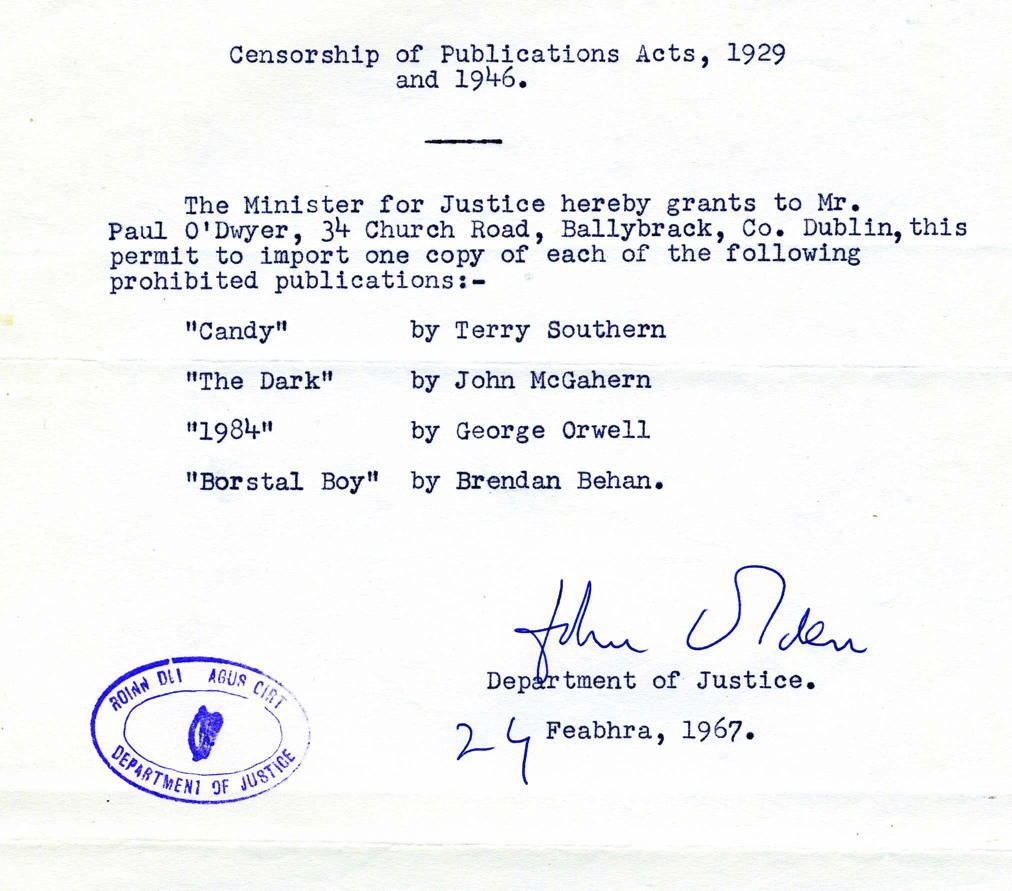
I kicked off the Q&A by reading out my certificate (above).

I also recounted my purchase of Lady Chatterley in Jersey in 1961, how it had been taken from me at Dún Laoghaire on my return and how I went through a period of utter panic when I thought I might end up the centrepiece of an Irish trial in the matter.

I referred to informal systems of censorship in the Dublin diocese and in UCD and to the book-burning of Seán Fagan's book in more recent times. However I also evoked changing times with the survival of multiple copies of the book in the public library system. The symbiosis of Church and State had surely exploded.


You can listen to the full podcast (including the Q&A) at the bottom of this page.

My contribution is at 49:18.


This is my third Hedge School. I have reported on my two previous attendances on Nelson's Pillar and The Somme.

Friday, September 15, 2017

#PhotoDetectives


Click on any image for a larger version

So, who are these Photo Detectives and what do they detect.

Well, the National Library of Ireland has thousands of photos in various collections. Some, like the Lawrence Collection, have been around for more than a century and others have been donated to the library in more recent times.

Wonderful as the images may be, a major lacuna in many of these collections is that they are often not fully documented. Sometimes they are hardly documented at all. So it can be a mystery where the photos were taken, when they were taken and who were the subjects. That's where the Photo Detectives come in.

Little incidentals in the images can suggest a place or a time and, at the end of the day, the subjects may be someone's granny or auntie or suchlike.

But how is the Library to get to know these hidden facts?

The answer is to shoot the photos out into the street and hope that some member of the public sees them, recognises something in them, and comes back with the goods.

So mystery photos are put up, one a day, on Flickr with appeals for information and the result has been stunning.

Some are spotted by people with connections, direct or indirect, to the photos but in other cases complete strangers set about trying to unearth the answers from old newspapers and other historical sources. All are detectives, but the obsessive nature of some soon turns them into Special Agents.


This initiative has been going for a number of years now and the Library thought to celebrate it and get it even wider publicity by having a year long exhibition at the Library's National Photographic Archive in Temple Bar.

I went along to the launch on Wednesday (13/9/2017)


The A Team: (l-r) Maeve, Carol, Sandra, Sabina & Nicola

Let me introduce the team. Maeve Casserly, Carol Maddock and Nicola Ralston are on the staff of the Library, and with the assistance of some others, it is they who have put this wonderful exhibition together.

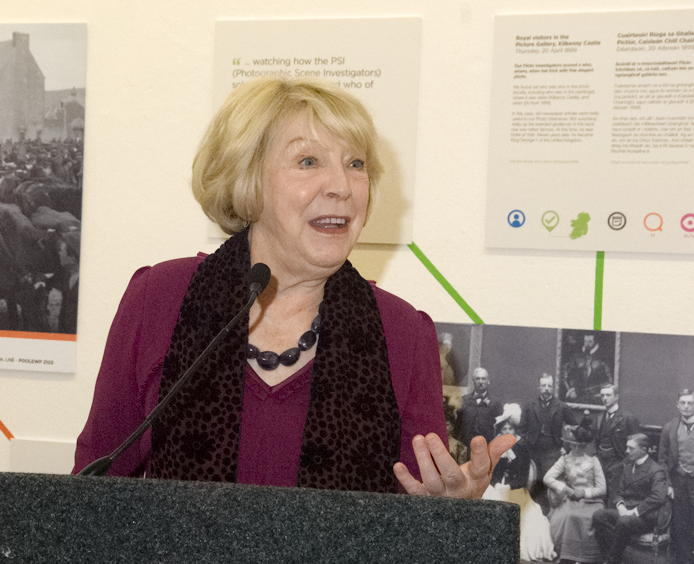
Sandra Collins is the Director of the National Library of Ireland and Sabina Higgins has come to formally launch the exhibition. Sabina is an actor and artist in her own right. She was a founder member of the Focus Theatre. But she also happens to be the wife of the current President of Ireland, Michael D Higgins.


After taking Sabina around the exhibition, of which more later, Sandra opened the proceedings by welcoming all to the Archive.

On behalf of the Library she thanked all those whose work contributed to the success of the initiative and made today's exhibition possible.

She was particularly pleased that much of the audience was made up of those who had become part of the Photo Detective Squad, some of who had travelled long distances to be here.

She looked a very happy lady.


Meanwhile, the First Lady was patiently waiting to take the floor under the watchfull eye of Photo Detective Photopol.


Sabina had brought a script with her and she launched into it, punctuating it with unscripted remarks reacting to the exhibition itself which she had just toured.

Soon her ad lib remarks had made the script redundant and she gave a wonderful, and impromptu, emotional speech on the importance of history and of people connecting with one another.

She drew on the examples on the wall around her and I would have been shouting my support were she not the President's wife and a certain modicum of decorum on the part of the audience was appropriate to the occasion.

You can hopefully sense her involvement and the intensity of her remarks from the images below, not forgetting the glint in her eye and her well developed sense of humour.


You can watch a video of Sabina's speech here, from the Áras website (11 mins).


In her earlier tour, Sabina was introduced to some of the amazing results of the work of the Photo Detective Squad. This was Seán O'Casey's house, pinned down through a myriad of sources.

Incidentally, you can view the photos used in the exhibition in a custom Flickr album here. Just click on the shot you want to examine and you'll get it as part of a slide show with the Library' comments beneath and also the interplay between the Library and the Photo Detective. Click on the photo again to enlarge it and again to return it to its original size. There is a link at the top left of the screen which brings you back to the original album.


Nicola is explaining the background to the moving Bollards at the junction of Parnell St & O'Connell St to Sabina.


Sabina emerges from the Tardis on St Patrick's Hill, Cork City around the year 1900.


But it's not all serious stuff. There's buckets of fun and enjoyment to be got out of the exhibition and you might even be encouraged to become a Photo Detective yourself. Mind you, detective work is 90% hard work and 10% luck, but when it all comes together there's no beating that buzz.


There is a serious side to it, of course.

I don't know what Sandra was expostulating here but Sabina looks receptive. A word in Michael D's ear these days though is not what it used to be when he was Minister for Culture and the Arts with a pot of real gold at his disposal.


One of the Library's strong points these days is catering for young people. I noticed this at their recent birthday party and it's evident here again today.

They are not always this young, but you're looking at a span of four generations here from two month old Finn to his great grandfather Tadhg Devane in the picture on the wall.

The photo above is how I lined the family up.


Mark Stedman

Enter photographer Mark Stedman and the dramatic content shoots through the roof.


This is Mark's line up. I've commented before on Mark's ability to organise a shot. Unfortunatly I was not best positioned to exploit it to the full.


As I said, they're not always that young and the Library caters for a spread of ages at these events. This is a drawing of a lady from one of the exhibition photos ready for colouring in.


For the more analytically minded child there is a maze, also themed on the exhibits.


And for the trainee junior Photo Detective a fold-out quiz based on searching the exhibition, finding the relevant exhibit, and answering questions about it. A sort of a photo treasure hunt.

And I shouldn't forget to mention that the above materials, and the exhibition signage and panels, are in both English and Irish.


After expending all that energy you must be hungry and thirsty. The Library's own Café Joly is on hand with the catering.

The Mortimer's Grocery and Confectionery Shop is part of the exhibition and it particularly caught my eye. Mortimer is not all that common a name. My own grandfather Mortimer was in the grocery trade and rose as far as manager of Lipton's store in Birr, Co. Offaly.

However he dirtied his bib, the how I don't know, ended up back in Dublin as a canteen assistant in Richmond barracks and, within a few years, his corpse was fished out of the Liffey on Eden Quay. I'm sure Mr. (Waterford) Mortimer above had better luck.


But let's not spoil the day that's in it. You want to see a very happy Director. Well, there you are.


Photo: Bríd O'Sullivan

And as for me?

I'm guaranteed a year's immortality on the wall in the company of all the other Photo Detectives.

Epilogue


Photo: Pamela McDermott

Just before leaving I had a conversation with the First Lady regarding Michael D and Tom O'Donnell when he was Aire na Gaeltachta. Her reaction was to insist on having her photo taken with me (or maybe the other way round?). But anyway, there it is, and me thrilled to bits to boot.

And before I forget, kudos to New Graphic for nailing the brief.