Ós rud é go bfhuilmíd anois i lár Seachtain (Coicís) na Gaeilge mheas mé sraith nasc a thabhairt le chéile do na leathanaigh nó na míreanna agam féin atá as Gaeilge nó a bhfuil baint acu leis an nGaeilge. Seo thíos iad.
As we're in the middle of Irish Language Week (fortnight) I thought I'd draw together links to some of the material on my site/blog in, or related to, the Irish language. Check out below.
These are actually in Irish
Na Duibhirigh
Na hUaisle
Ainmnmú Shráideanna Bhaile Átha Cliath
or bilingual
Rang 1963
These relate to the use or misuse of the language
Gaeilge ón mBroinn
Doicheall
Drochghaeilge Oifigiúil
Deis ar Fáil
Easpa fada contúirteach
These are by way of comment on, or just related to, the language.
Bóithrín na Smaointe
Mar a scríotar bítear
Easpa Shacs-Béarla
Béal doras
Géibheann
Buailte
Iarsmaoineamh
Frithród
Showing posts with label signage. Show all posts
Showing posts with label signage. Show all posts
Friday, March 09, 2007
Saturday, May 06, 2006
The Oul Boreen
Streetnames in Irish can be quite controversial and provoke serious semantic wars between rival camps of streetnameologists.
Part of the problem is that the original versions of most of the street names, at least in the cities, are in English. Irish versions are frequently nothing more than clumsy transliterations of the original English, and even where a distinctive Irish language name does exist, it has most likely been forgotten and is now replaced with one of the aforsaid abominations. And this is before we even come near the subtle inflexions of Irish grammar.
 Séamas Ó Brógáin has a good discussion of some of the issues on his excellent site and he also offers a list of sensible Irish versions for most Dublin streetnames. I have stuck a few examples of current abominations on my own site.
Titles like row, lane and terrace can be problematic in Irish. Lane is normally translated as lána and this lacks a certain elegance and distinctiveness.
While in Galway recently I noticed the use of bóithrín or little road for this and it struck me as very appropriate as the term is not used to render any other English equivalent. So why is it not in wider use in Irish, I asked myself? [translation for my English readers = wondered]
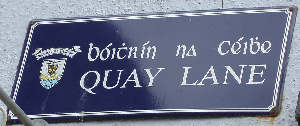 I came to the conclusion that it is all the fault of the Leprechauns who have devalued the term by including an anglicised version in their paddywhackery vocabulary. The Oul Boreen invokes images of poverty, bare feet and even famine itself. Nobody in Ireland today would like this for an address in preference to Southfork or even Mornington Crescent.
 So here's the plan. It's time to reclaim the Oul Boreen and recycle it back into the lilting Irish from which it originally came. Lead on Galway!
Part of the problem is that the original versions of most of the street names, at least in the cities, are in English. Irish versions are frequently nothing more than clumsy transliterations of the original English, and even where a distinctive Irish language name does exist, it has most likely been forgotten and is now replaced with one of the aforsaid abominations. And this is before we even come near the subtle inflexions of Irish grammar.
 Séamas Ó Brógáin has a good discussion of some of the issues on his excellent site and he also offers a list of sensible Irish versions for most Dublin streetnames. I have stuck a few examples of current abominations on my own site.
Titles like row, lane and terrace can be problematic in Irish. Lane is normally translated as lána and this lacks a certain elegance and distinctiveness.
While in Galway recently I noticed the use of bóithrín or little road for this and it struck me as very appropriate as the term is not used to render any other English equivalent. So why is it not in wider use in Irish, I asked myself? [translation for my English readers = wondered]
 I came to the conclusion that it is all the fault of the Leprechauns who have devalued the term by including an anglicised version in their paddywhackery vocabulary. The Oul Boreen invokes images of poverty, bare feet and even famine itself. Nobody in Ireland today would like this for an address in preference to Southfork or even Mornington Crescent.
 So here's the plan. It's time to reclaim the Oul Boreen and recycle it back into the lilting Irish from which it originally came. Lead on Galway!
Tuesday, May 02, 2006
Marbh le Léinte T agus marbh gan iad
 You would think that Galway City Council was telling you not to enter Fallers Sweater Shop. Maybe they thought it was a Sweat Shop and they were doing their bit for the international labour movement.
 In any event it is a very interesting shop. Among other Oirish paraphanalia it has a witty selection of T shirts, some of which are shown below.
 This one nicely sets off the royal black and cream of the pint against the green envy of other beers: do Carlsberg and Heineken spring to mind?
 It also has resonances of blasphemous beers of green beloved by Irish- and pseudo Irish- Americans alike. Not to mention the short lived arrogance of a ten pin bowling set.
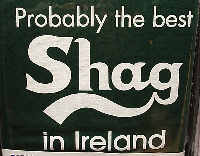
Seeing as how we mentioned Carlsberg you might like to consider this take off. The claim is qualified by "probably" which, if you follow the rationale of the beer ad, means "I think I am but the regulator won't let me say so". Shadows of a repressed youth? The claim is also qualified by being limited to "Ireland", though it is not clear whether this is the State or the island. A cross-border marathon might be required to settle that one.
 And, finally, when it all goes wrong, you have to blame the other fella and dip into the dark recesses of hiberno English (or "Béarla Éigeantach" as it is known in some post-famine millieux).
 There are few terms in any language that can give you the same satisfaction as the word "gobshite". It is an affectionate way of insulting someone absolutely - calling him the absolute dregs (and it is a "him", the word is not applied to women). Mind you,the addition of "fecking" far from making it worse actually mollifies it a bit. I suppose you can't have it every way.
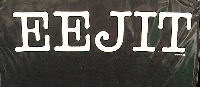 And, finally, finally, the multipurpose "eejit", gender neutral, insulting and affectionate, and seldom on its own. An eejit is usually a f**king eejit, even where the first term is completely silent. Sometimes the final "t" can be silent, as though the deliverer had expended so much force on the first two syllables that he collapses from exhaustion before reaching the final consonant.
So, all in all, a mighty collection of witty indigenous T shirts (the "r" is definitely pronounced here).
Na Duibhirigh
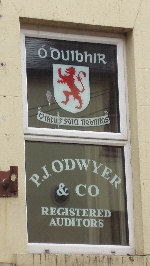 Bhíos i nGaillimh thar an deire seachtaine agus chonac an fhuinneog seo a chuir ar mo shuaimhneas mé.
De réir dealramh tá teacht fós ar na Duibhirigh leasmuigh den phríomh chathair.
Ní hamháin san ach táid ag coinneáil súil ghéar ar a gcomharsain i gcónaí.
Subscribe to:
Posts (Atom)