Showing posts with label ucd. Show all posts

Tuesday, January 24, 2017

THE EVOLVING UNIVERSITY LIBRARY


Click on any image for a larger version

What am I doing going to a talk on the evolving university library? Haven't I left all that behind me long ago?

It's true that in UCD studying politics, in the last century, I had to get a note from my tutor to get out a book which the Catholic church disapproved of and which was stored behind the librarian's counter on a very high shelf indeed.

Well, apparently all has changed, changed utterly and a terrible beauty of sorts has been born.

The challenge is immense: from the need to digitise existing resources, through how they are then made available both to researchers and the wider public, to how are we going to digitally conserve the present for future generations.

You might think that in today's digital world this could be achieved at the mere push of a button.


Sandra Collins

Not so. And nobody knows this better than Sandra Collins, Director of the National Library of Ireland. Sandra introduced Helen Shenton, Librarian and Archivist at TCD, who was going to lead us through this complex territory, explaining the global challenges and how TCD is responding to them.

First, though, I have to recall Sandra's recent TEDx talk in UCD on this very subject, where, in simple language, she explained the parameters of the enormous task facing us.


Helen Shenton

Helen Shenton came to TCD in 2014 and she was well aware of the task ahead. She was, however, undaunted having worked miracles already in the V&A, the British Library and Harvard. Her experience was vast and she was now bringing it to bear on this institution.

She is not only dealing with digitising what is there, she is also busy figuring out how to use the spaces that become available when material is digitised and the physical copies are then consigned to storage.


TCD Long Room

She is unlikely to strip the Long Room of its books, which at this stage are almost part of the structure of the building. She has already told us how much she is in awe of this wonderful room and how she has given up explaining it to visitors. She just steps back and lets the visitor experience the sheer wonder of it.

Whatever about all the digital and virtual stuff, Helen is also a great respecter of physical space and she envisages the function of the library in the widest sense possible. It is not just a place for reading but for learning, networking and socialising. People also learn from each other so socio-academic space is vital.


Library and College's central location

While TCD's physical space is limited by the surrounding streets, the whole digital revolution opens up the possibility of re-conceiving existing space as it is freed up and there can be new premises acquired off campus. All this without losing TCD's great asset of a city centre location.

And, of course, developments go beyond the boundaries of this one college. Each university/college needs to have its own place of excellence in the scheme of things. Substantial duplication, for which there may have been some justification in the past, needs to be eliminated and the capacity released put to creative use.


Helen & Sandra, all smiles

This is just giving you a flavour of what Helen is at. If you are curious for more, the whole thing is spelled out in detail in the library's strategy, the cover of which is reproduced at the top of this post.

And so, after an enthusiastic and fast moving talk from one librarian, hosted by another "librarian", we call a halt with smiles all round.

[Talk was at the National Library of Ireland at 1pm on 19/1/2017]
Friday, December 23, 2016

BADGED


Click on any image for a larger version

I heard the clatter of the envelope in the porch. The postman. More Christmas cards to feed my guilt at not having sent any - hardcopy that is. Maybe a bill or two, just in time for Christmas.

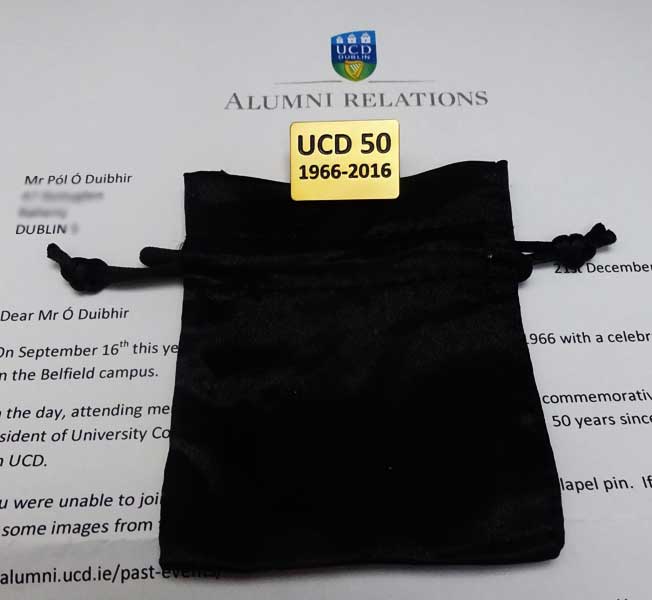
There turned out to be just one envelope in the porch. The logo told me it was from UCD Alumni Relations. Oh dear, so they're still looking for money and hoping to catch me in the Christmas spirit. When they come on the phone they sound like they want to listen to your life story - make you feel important and wanted. Then the penny is gently dropped and it's just another appeal.

I eventually got round to opening the envelope and took out the letter, which looked remarkably short for an appeal.

Well, it wasn't an appeal.

It opened by recalling that there had been a celebration of the Golden Jubilee of the class of 1966 last September at which the President of the College presented attendees with "a commemorative pin acknowledging 50 years since graduation". Whatever about the graduation itself, surviving it for 50 years must be being seen as some sort of achievement. Looking back on it I think I might see what they mean. We had some very odd lecturers in those days and surviving them for this long is probably an achievement of sorts.

Then I felt a roughness inside the envelope as I read that, as I was not present at said commemoration, my presidential award was enclosed. I could see photos of those who turned up for the event on the website (see below) and Alumni Relations hoped I had a very Happy Christmas.

The pin itself came in a little black bag and you can see the whole thing above.

Not exactly my long awaited Légion d'Honneur but some small consolation in the meantime.

Now, who can I impress by wearing this and where and when? Suggestions on a plain postcard please.


Alan and Man with Funny Hat

Friday, November 18, 2016

TOM KETTLE


Click on any image for a larger version

There are a few things to be said about St. Mary's church, Haddington Rd.

It is a beautiful church.

It is the only Roman Catholic church in Dublin, and perhaps in the country, that has a quality plaque on the wall commemorating parishioners who died in WWI. We are used to seeing a profusion of these in Protestant churches but this is different.

The church is also host to a series of very high quality lectures, sometimes on church related topics and sometimes less so. They are part of the "Patrick Finn Lecture Series", so named after the, now sadly deceased, enlightened Parish Priest who instituted them.


Tonight (17/11/2016), it was fitting that the talk was about Tom Kettle, who was one of those parishioners who fell at the Somme on 9 September 1916.


And it was also fitting that the talk was given by Maurice Manning, who, incidentally, was one of my tutors in UCD in the 1960s. I have him to thank for giving me access to what was then a restricted access book by Paul Blanchard. Thanks Maurice.

Maurice has a deep understanding of, and empathy with, the history of this country, and in the course of his talk he also demonstrated a nuanced appreciation of this complicated man, Tom Kettle.


There is a fine bust of Kettle in St. Stephen's Green and that is where I first came across him many years ago. I didn't really know anything about him but assumed he was one of our heroes as a result of something or other. In fact, there was very little talk about him since until more recent times when the country started having to come to terms with the twin legacies of the 1916 Rising and WWI.

I am very aware of this as I was brought up on the Rising only to find, in more recent times, that I had an uncle killed on the Somme in the same year as the Rising.

It is this ambiguity that plagued Kettle in the final years of his life. He was essentially a nationalist and had been sent to Belgium to buy guns for the Volunteers. But the German atrocities he saw there convinced him that there was a wider cause to be supported if civilisation was to be preserved, and this is what motivated him to join the British army.

Initially denied the chance to go to the front, for health reasons, he embarked on an intensive campaign of recruiting for the British Army on the home front. For this he was frequently vilified and on one occasion badly beaten up.

He was jeered at for asking others to do what he himself did not, and this stung. So much so that, despite his abhorrence at the British reaction to the Rising, he contrived to get to the Western Front, and died in this, to him, greater cause.


He did his best not to be misunderstood and, as a result we have as part of his legacy, his poem explaining himself to his newly born daughter at home.

The final lines of the poem have by now become a cliché, but Maurice made the point that the earlier lines are a thing of beauty and to prove it he read the whole poem.
To My Daughter Betty, The Gift of God
by Thomas Michael Kettle
dated ‘In the field, before Guillemont, Somme, Sept. 4, 1916’.


In wiser days, my darling rosebud, blown
To beauty proud as was your mother's prime,
In that desired, delayed, incredible time,
You'll ask why I abandoned you, my own,
And the dear heart that was your baby throne,
To dice with death. And oh! they'll give you rhyme
And reason: some will call the thing sublime,
And some decry it in a knowing tone.
So here, while the mad guns curse overhead,
And tired men sigh with mud for couch and floor,
Know that we fools, now with the foolish dead,
Died not for flag, nor King, nor Emperor,—
But for a dream, born in a herdsman's shed,
And for the secret Scripture of the poor.


As to the rest of his personal life and his career. He was apparently both brilliant and good company. He became professor of political economy at UCD, a component college of the newly established National University. He didn't necessarily know any much economics but had an enquiring mind and an enthusiasm that inspired his students.

He became an MP in the UK parliament but found that a bore. He mixed in London intellectual and literary circles. And then he took to the drink which sadly crucified him and his wife Mary from there on in. This flower of Irish youth was reduced to a serial promiser to quit the booze, again. So sad, and a part of his life that has been downplayed by the nationalist tradition. But it was part of him, and Maurice faced it full on. But he also reminded us that he rose above it, hence the quotation of the full poem.

So let us honour him in his full complexity and that of the times he lived in.


Wednesday, April 11, 2012

Dubliners


Dublin: One City, One Book is an initiative of Dublin City Libraries, where a different book with links to the capital is chosen each year. Citizens are encouraged to read the book during the month of April and a number of events are organised around it.


This year's choice is James Joyce's Dubliners: fifteen stories about the lives, loves, small triumphs and great failures of the ordinary citizens of Dublin.


One such event is a series of lunchtime lectures in City Hall on the theme, Dubliners - in their own words. They are held on four Tuesdays in April starting at 1pm.


City Hall is now in prime nick and entering though the grand foyer, in the august company of the likes of Thomas Davis and Daniel O'Connell (above), instills a great sense of awe and anticipation.


It's only a small step then into the intimacy of the Council chamber, where, last Tuesday, Dr. Criostóir MacCárthaigh, was preparing to give his talk on Tales from the Tenements - The Dublin Folklore Project. This is part of the wider Urban Folklore Project in the UCD Department of Irish Folklore (now the Delargy Centre).


The chamber was packed, the talk very interesting and the Q&A very lively. A good way to spend a lunchtime and well worth skipping lunch for.

Two talks remain: 17/4/2012 - The North Strand Bombing, and 24/4/2012 - Tales from Dublin's Liberties.


Friday, March 23, 2012

STUDIES


I was at a book launch in Newman House the other day.

In the course of his speech, John Bruton made a throw-away remark: "Does anyone remember Louis Smith?"

My answer is most definitely "yes".

Louis was one of my professors in UCD in the 1960s. A bit over my head but a very nice man. I had to make a call on his honesty after I had left UCD and during my "confessions" with the Rector of the College of Europe, Henri Brugmans. Fortunately I made the right call.

But Louis was not as dull as some of his lectures might have led one to believe. He had a good sense of humour and below is a photo of him taking his place among the saints on his own personal island in Paris.


Sad Update: Louis died 25/11/2012. RIP

Wednesday, July 06, 2011

Living History


Is it a sign of advancing age when I find myself with connections to three out of four people photographed at the launch of the history of National Library of Ireland Society? This is a recurring experience.

I worked with Felix in the Departments of Finance and Economic Planning and Development and our paths have recently begun crossing again in the areas of local and family history. I also worked with Ian in both the above Departments though our paths have not (yet) started criscrossing in recent times.

Maurice is a different kettle of fish. I first met him at an essay competition run by the Irish Independent and moderated by the then editor Hector Legge. He won, I lost. He then turned up as my tutor in UCD and duly signed my chit to get Paul Blanshard's book The Irish and Catholic Power off the reserved shelf where is was isolated lest it contaminate the innocent students of the day. Thank you Maurice. I reread the book in more recent times and it is even much better than I remember.

For the record, the guys are (L-R) Felix M Larkin, Vice President of the Society, Maurice Manning who launched the history, Dónall Ó Luanaigh who wrote it, and Ian d'Alton, Treasurer.

Reviews of Friends of the National Library: in Irish Times Irish Catholic


Thursday, May 19, 2011

Garret FitzGerald


Garret was one of the driving forces behind the first MA in European Studies in UCD in 1966/7. And he set about implementing the new course with gusto. This was well before Ireland joined the EEC. In fact it was more than a year before de Gaulle (again) refused us entry (along with the UK, Denmark and Norway).

Garret had a long and enthusiastic interest in Europe and he was on the European Parliament's mailing list. He used to come into class (there were only about 6 of us, as I recall) with big bundles of EP reports under his arm which had just arrived in his morning post. He plonked these on the table and we sifted through them looking for nuggets on which to base our papers. The system worked well. We got a profusion of reliable sources and he got his reports sorted. A forerunner of distributed computing.

He may also have made history in the Berlaymont (Commission HQ in Brussels) during the same course. He had taken us on a study trip to the Commission and was in full flight at one of our briefings, quizzing the Commission official giving the briefing. The official was waffling all over the place and I figured there was nothing useful to learn from him, so I switched over to the French interpretation. As Garret, whose brain constantly outran his tongue, gushed on, the interpreter faltered and eventually lapsed into silence.

"I am sorry but I cannot keep up with this speaker", she said.

Incidentally, at the end of the session, the Commission official apologised for his disorganised presentation and responses, claiming he had hit his head on the side of the swimming pool when playing with his children over the weekend. We all felt very sorry for him until we later learned that this was a story he rehearsed on a regular basis to excuse his poor performance.

Garret had two great qualities for a teacher: great enthusiasm and intellectual curiosity, both of which he shared with his students.

A fault was his assumption that everyone was as interested in minute details as he was himself. And he wasn't the greatest delegator in the world. Very much a hands on manager which, when he was Taoiseach, led to difficulties in his dealings with the Civil Service and to some of the longest Cabinet meetings in the history of the State.

He was a conviction politician and, unlike many of his contemporaries, was conscious of the wider national interest in his dealings both at home and abroad. He will be sadly missed, not only by his family and friends, but by the country, which will be the poorer for his going.

It's a pity he missed his date with the Queen, but it now appears he had a more pressing appointment.

RIP

Lying in State