Showing posts with label obituary. Show all posts

Monday, March 27, 2023

JOHN SIMPSON

John Simpson

I remember John Simpson when he came south to participate in the meetings of the National Industrial Economic Council (NIEC). He was nominated to the Council, as a public interest member, by the Irish government. He was then a lecturer in Queen's to the best of my recollection.

The NIEC was set up in 1963 as part of the Irish planning process then being introduced. It consisted of representatives of employers, trade unions, and public representatives. It was chaired by TK Whitiker, the Secretary was Maurice F Doyle, with Jim McMahon and myself as members of the Secretariat which was located in the Department of Finance.

John Simpson has just died, aged 90. I have read a few pieces about him in the Northern papers today and none mentions his membership of NIEC which I would have thought very significant way back then, with Seán Lemass meeting Terence O'Neill in an attempt to thaw North/South relations.

John had a particular interest in the economies of Northern Ireland and the Republic and the interaction between them. He was virtually alone in this area in the North until Norman Gibson arrived later on the scene.

Norman made his name modelling the Northern economy (I think) and he certainly attracted attention with his calculations of what was known then as the British subsidy to Northern Ireland.

The subsidy was the UK exchequer contribution to bridge the gap between Northern Ireland's public income and expenditure, increasing the former to fund the latter. It was also a highly contested figure, particularly when the the cost of the UK military presence in the North after 1972 was included.

I used to calculate it myself in the Department of Finance over the years and that once got me into trouble with John Kelly TD, then a junior minister.

In the event, with the replacement of the NIEC in 1973 with the National Economic and Social Council (NESC) Norman replaced John as the government's Northern Ireland nominee.

Anyway, John carried on with a distinguished career and appears to have been contributing to the Belfast Telegraph virtually up to his death.

You can catch up on this to a certain extent in the Telegraph's piece on his death.

It's funny, I was just thinking of him out of the blue the other day.

May he rest in peace.

Saturday, February 11, 2023

NIAMH BHREATHNACH RIP

I've chosen this photo of Niamh
because she chose it herself, for her Facebook profile.
Click on any image for a larger version.

Niamh Bhreathnach died on 6 February 2023 bringing to an end a career that had been singlemindedly devoted to combatting disadvantage in education and to advancing women's rights.

You can read about all of this in the lovely tribute Uachtarán na hÉireann, Michael D Higgins, posted on the Presidential website and in the heartfelt eulogy of her husband, Tom Ferris, at her funeral mass in Blackrock church on 10 February 2023.


I simply want to recall here some more personal memories.

In the autumn of 1967, on completing my MA in UCD, I headed off to the College of Europe in Bruges. I was only there a few days when I got the above telegramme from Tom "SHOULD I TAKE BRUGES".

The background here is that the Department of Education were willing to finance two places in the College for Irish people. I was the only one to go and Denis Corboy was trying to get a second person to take up the remaining place. He had obviously persuaded Tom to go and Tom was asking my advice. Now the College is a dual language institution - English and French. You were required to have fluency in one of the two languages and a working knowledge of the other. Many of the lectures were delivered in French and some of the texbooks were in the same language.

Tom didn't have any French, so I advised him not to come and he didn't. I wouldn't have been so sure some weeks later when I discovered the linguistic competence, or should I say incompetence, of some of the students but the damage was done and I carried a sense of guilt over this for many years.

But shortly after this exchange, Tom met Niamh, and had he come to Bruges, I wouldn't be writing this post today.

13 December 1969
Photo: Mr. Connolly, Glasthule.

And I certainly wouldn't be posting this photo. I remember the day well. Niamh was a stunner.

Niamh was very taken with red roses. So am I, particularly single stem red roses. I once took a single stem red rose to Dachau concentration camp. It's a hugely strong statement.


After Bruges, I met Niamh in Ballybrack school where I was doing a slide show for young children recounting various children's stories including the Three Little Pigs and Little Red Riding Hood. I was a bit nervous and mentioned to her that maybe there was too much repetition in the stories.

"That's exactly what young children need", she said, "it gives them a sense of reassurance".

I never forgot that advice and later on when it came to public speaking or debating I remember the same advice but put slightly differently. "Tell them what you're going to say, say it, and tell them what you've said". Works like a dream.

However, there is a more sinister manifestation of the same phenomenon in today's world. In both the Trump administration in the US and recent Conservative governments in the UK, the perception is that if you tell a lie, the best thing to do is repeat it and repeat it, as brazenly as necessary, and then it becomes the truth for a sufficient number of your supporters, at least, for you to be able to ignore all criticism.

I can say, with complete confidence, that none of these awful people came out of any of Niamh's classes.


Niamh, and Tom, were the cause of me once cancelling my subscription to the Blood Bank. Yes, I rang up the Bank and told them they could not use the sample I had provided earlier. I don't know if I am unique in this but if I am it's all Niamh's (and Tom's fault).

I had given blood on the day and later found out that they had both contracted glandular fever, a nasty virus, known by a big long name, but also "the kissing disease". God between us and all harm.

Tom mentioned a few things in his eulogy that I'd like to revisit.

Tom said she "didn’t suffer fools gladly, be they high or low" which reminded me of a story of hers where she simultaneously showed loyalty to her civil service and certainly did not suffer a high fool gladly.

She was meeting the EU Social Affairs Commissioner in Brussels and had along with her the Secretary General of her Department. "Get him out of here" says Pee Flynn. "He stays" says Niamh. And he did. Good on ya girl!

Tom also mentioned a little test she introduced him to which sensitised him to the extent of the existence of discrimination against women. After, or at, a meeting, she would ask him "how many women were present?". I can tell you, that is an instant sensitiser. I had the same experience myself with Brigid McManus who worked with me in the Department of Finance. She trained me to ask myself the very same question, and the results were surprising. I had never noticed the paucity of women at meetings, but I most certainly did from then on. Incidentally, Brigid went on to become Secretary General of the Department of Education, but after Niamh's time as Minister.

He also mentioned that Niamh put the Educational sector on a legislative basis. I took particular note of that. I had been aware, from when I had some responsibility for the Department of Education in the Department of Economic Planning and Development, that the Department of Education was run on the basis of civil service circulars and that it consisted of a host of barely related kingdoms. This was apparent when we were attempting to make pupil forecasts for the different sectors at a time when the community schools were coming to the fore. No sector was conceding numbers to the community schools and this would have resulted in serious overinvestment at the time. I was told that the only place the Department came together was in the Estimates Office - the money had to add up at the end of the day.

So the idea of putting all of this stuff on a firm legislative base was not a trivial matter.

If you want to get a flavour of how assertively Niamh handled her brief in Education you should read her speech in Maynooth on 16 June 2022 where she gives a good idea of the pushback against her introducing The Universities Act 1997. This was almost her last public engagement and it shows up the fighter in her.

And so to the final journey.

I have to diverge here slightly to make a comment on Niamh's death notice. The request for no flowers is not unusual but when I saw "Donations, if desired, to www.goodgrub.ie", I was taken aback. Was this her favourite restaurant and how come it was important enough to figure in a death notice? My head went into a tailspin of smoked salmon socialism until I clicked on the link. The entry was the choice of the family but it gave Niamh a final shot from beyond the grave. Click on it and you'll see what I mean.

Tom giving Niamh's eulogy

There is a link to the eulogy at the head of this post.

Grandchildren Tom & Alice bring up the objects,
a family portrait & a copy of the 1995 White Paper on Education.

It was a touching moment in the ceremony when Niamh's grandchildren brought up the objects symbolising Niamh's life. The White Paper was a surprise but a fitting tribute, and there is no way better to conclude this post than to quote the final paragraph of Niamh's introduction to it:
The ultimate objective of the strategies set out in this White Paper is an education system which will provide every student with fulfilling educational experiences at every stage in a lifetime of learning. As our society becomes more complex, the capacity to learn continuously will determine each individual's life chances and decisively influence the quality and prosperity of our society
Niamh's public life in a nutshell.

Short tribute from the Labour Party.

Niamh was a friend.

May she rest in peace.


Friday, January 13, 2023

BILL CLEMENTS RIP

Bill Clements and Tower No.7 Dublin South

I was sad to learn today of the death of Bill Clements in June of 2022. Bill was a great friend of the Killiney Martello Tower and it was he who encouraged Niall O'Donoghue to enter it for the Europa Nostra heritage competition, where it got a special mention from the Jury.

Bill was a member, and at one time President, of the UK Fortress Study Group and at one stage he organised for the group to inclued the Martello Tower in its visit to southern Ireland, which you can read about here.

Bill was a renowned authority on Martello Towers worldwide, most of which he had actually visited and photographed himself. He has written extensively on them and his most recent (2013) book on the towers is called Billy Pitt had them built: Napoleonic towers in Ireland. Sylvie Kleinman's has reviewed it in History Ireland.

Bill Clements & Niall O'Donoghue at the Dún Laoghaire battery

I recall Bill accompanying myself and Niall and a number of other afficionados on one of the most intensive day tours of my life. Niall had arranged it. It started with Niall's tower. Then on to the Harbourmaster's office in Dún Laoghaire. Followed by a visit to the battery at the end of the West Pier, where the above photo was taken,

Bill Clements on Dún Laoghaire East Pier

also this one of Bill on the pier.

l-r: Bill Clements, myself, Simone Stephenson, ??, Niall O'Donoghue

This was followed by lunch in Simone Stephenson's Bartra Tower (No.10).

Bill Clements emerges onto the crown of the Dalkey Island Martello (No.9)

Then a visit to the tower on Dalkey Island. This is the one where Bill discovered a document which showed a unique outside entrance directly to the crown of the tower itself. Now he could see the real thing at close quarters.

Simone Stephenson & ?? on the crown of the Dalkey Island Tower

The particular day we arrived there had the signs of a campaign to reclaim Dalkey Island from the King of Dalkey and reintegrate it into the Republic.

Bill has sadly left us but his presence remains in so many realms and places.

RIP

Wednesday, December 28, 2022

PHELIM MOLLOY


Phelim's long time colleague and friend in the Department of Finance, Stephen O'Neill, summed him up in his condolence message on RIP.ie
Phelim was a wonderful friend and colleague. He will be remembered with affection by all who knew him in the Department of Finance.
I didn't know Phelim well, hardly at all in fact, in my own years in the Department of Finance, that is until he was nominated to the Board of Directors of the European Bank for Reconstruction and Development in London.

I had been involved in the negotiations setting up the bank in 1990/91 and then served a year on the Board as Irish Alternate Director.

I was resident in Dublin with the day job and travelled to London for Board meetings. This was a most unsatisfactory situation and my Danish Director was not getting the support he needed or deserved. There was a need to appoint a resident Alternate in London, and Phelim got the job.

So he became my successor, residing in London for the next two years, and I was his desk officer in Dublin.

As a desk officer you learn a lot about the abilities and character of those you are looking after and I've experienced the whole spectrum.

From my point of view, Phelim was ideal. We worked as a team and he well understood both the Department of Finance and the Irish national interest. We never had a bit of trouble this end and Phelim was both trusted and respected by the Board. He worked well with the Director of our constituency, Lars Tybjerg, and between them they built up a lot of political capital on the Board.

When Phelim returned to the Department he became my boss, and a better boss you could not ask for. He did not interfere but was always there with good solid advice when you had a problem. And above all, he was very fair.

I was saddened today to hear of his death and will always cherish his memory.

May he rest in peace.

Phelim's death notice on RIP.ie

There was a beautiful funeral mass/ceremony this morning (30/12/22) in Booterstown church. The music was perfectly chosen and performed. Phelim's daughter, Deirdre, gave a wonderful and balanced eulogy.

The recording is likely to be available here for about the next month at least; the eulogy is at 1hour,3minutes,30seconds in.

Monday, October 10, 2022

TOMMY KELLY RIP

Tommy's funeral mass on 21 April 2022

Tommy was a bit older than me and I didn't get to know him very well when we were young. I do remember, though, staying in my granny's house in Ballyhaunis for a short period when Tommy was there. I remember playing trains out in the back field.

I would also have met him in his parents' house in Clontarf where I used to go after school in Belgrove to await picking up by my father on his way home from work.

Tommy and Gretta on their wedding day 18 June 1963

Not long after they were married Tommy and Gretta moved to Trim, where Tommy became the County Court Clerk.

There was subsequently a story that cousin Colette was caught speeding in Tommy's bailiwick and was glad that Trim was a fair distance from Castlebar so there would be no need for family or neighbours to know the story. She had clearly forgotten Tommy, so even I got to know about that.

I visited the family a few times in Trim. To my recollection the only children in the family at that time were Brendan and Susan - "the sheriff" and a very determined young lady.

I remember being introduced to the echo. No, not a local newspaper but a real echo, one with a significant delay, so you really thought it was someone calling you back.

Tommy's son Brendan's eulogy at the funeral mass was a revelation. It included a huge part of Tommy's life that I didn't know at all.

Brendan commented that for a True Blue Dub, Tommy oddly was a huge fan of Mayo GAA. Though he concedes that may not be all that odd given Tommy's Mayo connections, on which, incidentally he beats me.

And he’s one of the few people alive to have seen Mayo win an All – Ireland. Imagine that. The Year of the Curse. Mayo has won three All-Ireland Senior Football Championships; 1936, 1950, 1951. Our uncle Jimmy was on the 1932 team which went to America but sadly missed winning an All Ireland medal. Even sadder, the team has acquired a long-term record for reaching eleven All-Ireland Senior finals only to fall at the ultimate hurdle in 1989, 1996, 1997, 2004, 2006, 2012, 2013, 2016, 2017, 2020 and 2021. Nearly broke my heart in recent years. Of course many believers put this down to The Curse reportedly put on the team by the local PP as they returned through Foxford on their way back from their 1951 win and disrespected a funeral going through the town at the time. The Curse was supposed to last until the last member of that team died. The fact that there was no funeral in Foxford that day is ignored.

Now Brendan, at the time, was advising Tommy's funeral attendees to place bets on, as Mayo were nailed on certainties for Sam this year.

Happily that did not come to pass, as this was the first year to see the team play after the death of the last member of the 1951 team and a win would have given substance to The Curse. Next year, Brendan.

Tommy (1937 - 2022)

Tommy didn't stay for the rest of his life as Court Clerk in Trim. He went on to become Chief Clerk of the Circuit court in the Four Courts in Dublin.

And when he retired from that, remarkably at the age of 63, he qualified as a solicitor and he continued to dabble in the Legal world right up to the time of his death.

Tommy, apparently, was a great traveller and visited far away places including: Moscow, Kiev, Zambia, Florida, London and Birmingham. Nearer home he loved Kerry and also in particular Louisburg in Co. Mayo, the music in Mossie’s and especially the days on Silver Strand & Carrowniskey beach watching his grandchildren surfing.

He was a keen golfer and bridge player and a lover of the Beautiful Game. He had seen Stanley Matthews play and many other heroes. Even I remember the iconic Stanley Matthews and I have little interest in the game. I do remember, though, taking down the pools results from BBC radio for my Da on Saturday afternoons while he was in the plot or in the pub.

At a more personal level, Brendan advises Tommy's ten grand-children when they think of Tommy to think of words like : integrity, humility, authenticity, decency, generosity, and kindness. Amen to that.

Brendan referred to one of the condolences the family received on RIP.ie , which he said summed up his dad completely with the simple phrase … “He was a gentleman, and a gentle man”

This reminded me of Maureen Grant's description of Tommy's father as a gentleman when I spoke with her a good while back in the bar of the Olympia theatre where Tom Kelly had been a barman for many years.

"Tommy took is final breath on Easter Sunday, 17 April 2022, at 6pm surrounded by his 4 children and an incredible amount of love."

May he rest in peace.

Brendan's Eulogy


Saturday, October 08, 2022

COLETTE PURCELL RIP

Colette and Frank on their wedding day in 1959

Colette Fahey was 16 when I was born and she would have been into her twenties by the time I became conscious of my Ballyhaunis heritage. So I never knew her as a young girl, only as an accomplished woman.

My main, sometimes vague, memories are of a self-possessed and stylish lady who played the cello and was a comptometer instructor. The comptometer was the cutting edge mechanical calculator in the business world of its day. It later emerged that she was involved in interior design, including of a well known Ballyhaunis pub, but most impressively, of Canon Horan's Knock Basilica interior, as mentioned by the priest at her funeral mass this morning.

Colett and Frank on their 50th wedding anniversary in 2009

Fr. Stephen, PP Ballyhaunis, encapsulated much of my memory of Colette when he mentioned her elegance, creativity, strong personality and quoted what I think was a Castlebar author describing her as "a class act".

I am personally grateful to Colette for her contributions to my own efforts at family history research. I knew I had an uncle who died on the Somme but Colette, through I think Frank's connections with the Military History Society, introduced me to the background to Uncle John's death.

On another occasion she recounted how Uncle Paddy had died because of his impulsive skinny dipping on a lake, from a boat with mixed company where the boatman wouldn't let him back on board for his want of clothing and in deference to the modesty of the young ladies present.

It wasn't exactly like that, but that did turn out to be the guts of it, sort of, and had I not heard her version of the event I wouldn't have had anything to pursue.

At my present age, my contemporaries, those who have survived this far, are dying all around me. So the experience of other people's deaths and funerals becomes a more emotional experience as time goes on. I have even got to the stage that, when I'm taking leave of a living contemporary at a funeral, I suggest that we might meet at the next funeral providing it is not mine or theirs.

Colette's farewell mass in St. Patrick's Ballyhaunis

Fr. Stephen made it a very dignified and impressive ceremony. Though he hadn't known Colette hardly at all, he had done his homework, and in the absence of family eulogies did her proud.

He concelebrated the mass with Colette's cousin, Fr. Frank Fahey, who had once been a curate in Knock, then in charge of Ballintubber Abbey and is currently retired.

The Irish language also had an innings in the form of the Lord's prayer and the music was tasteful and appropriate.

I'll finish with an image of Fr. Stephen's: "Death is not the end, it is putting out the lamp because the dawn has begun.".

May she rest in peace.

Saturday, January 23, 2021

DOUG ROGERS RIP

Doug and Sylvia
at an appropriate location in happier days
Click on any image for a larger version

My acquaintance with Doug dates from after the inauguration of restored Martello Tower No.7 in Killiney in 2008. Initially, I had no idea of the huge amount of research he, and his wife Sylvia, had put into unearthing vast quantities of documentation in the British National Archives at Kew and in many other archives. They also visited many relevant sites in Britain and were responsible for involving Paul Kerrigan and Martin Bibbings in the project. Without their work, there would have been no project.

 I had discovered Major Le Comte de La Chaussée and his survey of Killiney Bay which set the scene for the later building of the Martello Towers in that bay, but it was Doug who set me on the path filling out La Chaussée's role in British attempts to subvert post-revolutionary France and restore the French monarchy. And it was Doug who found La Chaussée's maps which I had been looking for for thirty years. 

And then there was the EU backed Europa Nostra heritage competition which Bill Clements suggested the Tower might enter. The questionnaire was comprehensive and demanding and required input in narrowly specified terms. It took Doug and me, acting as good cop bad cop, to beat Niall over the head to squeeze the information out of him in an acceptable form. The problem was that the way the restoration was done didn't quite fit the required format and Niall had to be "encouraged" to make some rough estimates. The fact that the Tower was shortlisted and got a special mention from the jury is in no small part due to Doug's insistence and cajoling.

  Most recently, despite being very ill Doug agreed to do a commentary for the online Bloomsday 2020 presentation (16 June) at the Tower on the saga of his and Sylvia's research. In the event he was too ill to present it himself and I read his script into the record. I was very pleased to have been able to honour his and Sylvia's research and it now stands as a tribute to Doug. You can access that particular item in the Bloomsday presentation below or just read the text.


Presentation of Doug and Sylvia's research in the 
Bloomsday 2020 event at the Tower

I was thrilled when Doug himself and Sylvia turned up at our Bloomsday Zoom session at midday. This turned into a great conversation though we only had less than a dozen people at it. I'm sort of half sorry I didn't record it, but it was intended as a free flowing conversation and that's what it turned out to be.

Myself & Doug - Xmas 2016
Royal Marine Hotel, Dún Laoghaire

I will always remember Doug as a gentleman, an Englishman with a wry sense of humour and a twinkle in his eye, a natural co-conspirator.

Doug on a lovely birthday few days
in Le Manoir aux Quat'Saisons

You can read Sylvia's beautiful eulogy of Doug, delivered at his cremation on 1 September 2020, here. There's a lot in it about Doug that I didn't know and I'm very impressed. Clearly, as well as everything else, a very modest man.

You can see Doug's death notice and, if you wish, leave a message of condolence, here.

May he rest in peace.


The Magnificent Martello Tower
No.7 Killiney Bay


Friday, April 05, 2019

JOHN WHELAN


Seán Ó Faoláin
at the class 50th anniversary dinner in 2013.
Click on any image for a larger version.

Sadly, John is no longer with us. He will be missed.

Although living in Adelaide, Australia, his presence was always with us. He was the catalyst for our, more or less annual, class reunions in recent years.

He was planning to come over this June again despite his mounting health problems. Indeed, in the last few years he has braved these and insisted in turning up at the reunions, even regaling us last time with an account of a car crash down the country during that visit home.


John lived just down the road from the Coláiste in Parnell Square in the Galway Arms Hotel. The advertisement above is from our school concert/pageant programme in 1963. You can check out the centrepiece of that programme where you will see John testing the waters as a stage manager, a career he decided not to follow up on!


2014

To say that John enlivened our class reunions would be a serious understatement. He put us on steroids either for or against whatever, often outrageous, often sensible, line he was advancing with his total conviction, bordering on Papal infallibility.


2006

It was this same confidence and perceptiveness which enabled him to build up the mega-business which goes by the deceptively modest title of Hyppo Envelopes.


Sa chlós

There are those among the Iarscoláirí who knew John much better than I did. Some of them have already expressed their appreciation and recounted yarns in private correspondence in recent days. If they were willing, I would be glad to receive such sentiments as comments to this brief blog post. [The blog is moderated so they would not appear immediately.]


John from the 1963 class photo

Even as we all get older and some of us, me included, change shape, we still see each other as we were in Coláiste, defying the evidence of our eyes.

I'm sure we are all united today in expressing our sympathy with Pat and the family.

RIP


For those without Gaeilge, just to clarify that the clós was the schoolyard at the top of which were the toilets, in front of which that photo is taken. After we left, it became the location for the Halla (hall) which, at the time, was a cutting edge building, now due to be demolished as the whole school site is to be developed as the Central City Library. This will depend on very substantial funding becoming available.

The school concert programme is, of course, in Irish, but the critical entry in this context is the Bainisteoirí Stáitse (Stage Managers) at the bottom where John's name is second on the list. One iarscoláire (past pupil) who is himself in that list has made the unkind remark that the stage manager category was a catch all honour for those "who can't sing or dance".

I have photos from some of our class reunions on my Coláiste website but am including some direct links here for convenience.

2006  2010  2013  2014


Seán's avatar on Facebook

Not forgetting Seán's universal passport referred to by An Ruiséalach in the comment below. This guy was acquired in Ennis at the Fleá Ceoil.


Wednesday, April 03, 2019

MAURICE O'CONNELL


(Click on any image for a larger version)
Launch of the EBRD negotiation process in the
Kléber Conference Centre on 15 January 1990.

[l-r] Seán Connolly: D/Finance Principal at Irish Permanent Representation in Brussels. Pól Ó Duibhir: EIB/EBRD Desk in D/Finance. Jim Flavin: D/Foreign Affairs. Maurice O'Connell: Second Secretary General, D/Finance. Dieter Hartwich: Secretary General, European Investment Bank.

Maurice was my boss for a part of my career (well technically my boss's boss's boss, but that's a story for another day).

To quote a colleague, Maurice was "a very decent, honourable man who never sought favours or publicity." I found him great to work for. He was very demanding and did not suffer fools gladly. But he was straight and up front and worked himself assiduously at all hours of the day and night in the service of the State. He was frequently multi-tasking. I remember him writing a Ministerial speech in the course of an unrelated meeting.

He was particularly skilled at briefing (or to put it less politely, directing) Ministers. That sometimes had its drawbacks. I remember Bertie once saying on radio, in the middle of a currency crisis, that he was just doing what Maurice told him.

And then there was the time when Maurice told it like it was but in referring however obliquely to the "safety valve of emigration" sparked off a major political row.

Anyway, I'd just like to make a few comments below to give a flavour of the man as I saw him.


Our most intensive professional relationship was during the few months at the beginning of 1990 when the establishment of the European Bank for Reconstruction and Development (EBRD) was being negotiated. This was essentially a French project, in part carried over from the 1989 French EU Presidency but also to be one of François Mitterand's Grands Oeuvres, a sort of enduring monument to Mitterand's Presidency of the French Republic.

However, this negotiation took place during the Irish EU Presidency so we had quite a central role in the process. Michael Somers was our negotiating plenipotentiary but when it came to the subset of EU caucus meetings Michael was sometimes just the chair and Maurice the national delegate.

The photo above is of the lunch break at our first formal negotiating session in the Kléber Conference Centre in the centre of Paris. I subsequently learned that this had been Gestapo HQ during the WWII occupation.

Anyway, this was where I realised that Maurice ran on a fuel called food. He threw himself so enthusiastically into everything he did that by midday he was running out of steam and spent energy had to be replenished with vital packing. Depending on the day's schedule, this could also recur around tea-time.


Maurice, Jim Flavin (D/Foreign Affairs) and myself did a bit of travelling together to Paris and back during the EBRD negotiations. We needed a team as the negotiations sometimes broke up in to subgroups which had to be serviced by national reps or chaired by the EU Presidency. Seán Connolly (Irish Permanent Representation) was also involved in this but didn't travel with us as he was based in Brussels.

The airport in Paris (de Gaulle) was often a rush for a plane home. The Aer Lingus check-in was usually manned by ADP staff (French)

Anyway, this one day when we were charging for the plane, I was challenged by the ADP lady who said my passport and ticket did not match. This was the last thing we needed - delay. Maurice cut straight across her. "That's his name in Irish" and almost grabbed the papers out of her hand. Now Maurice can be very persuasive, particularly when he's in a hurry, and even this French lady buckled under the onslaught and handed me back my ticket and passport.

It was only later, when we were actually boarding the plane that we discovered that I had Jim's ticket and he mine. We must have just pocketed the tickets without looking at them when they were handed back to us in a bundle on the way over.

So much for ADP and French airport security. But surely an illustration of the force of Maurice's personality when motivated.


I nearly didn't meet Mikhail Gorbachev, and it would have all been Maurice's fault.

It happened like this. We had just returned to Dublin after a few day-long sessions in Paris. Jacques Attali, the EBRD project's head bottle washer, then suddenly decided he had to meet Gorbachev in Moscow for some reason or other.

Moreover, he clearly wanted EU Presidency cover and issued an instruction to my boss's boss's boss that he was to accompany him to Moscow. This involved leaving Dublin more or less straight away for Paris and turning up at a military airport on the outskirts of the city at midnight to fly to Moscow.

As it turned out Michael Somers absolutely refused to go. This refusal was clearly in breach of his brief from Charlie Haughey which, I suspect, was to facilitate Attali in every way possible. Charlie and François were very close. At least that was Charlie's perception of the relationship.

So the buck (poisoned chalice) passed to Maurice. Now, Maurice was as fed up with Attali as were the rest of us, and there eventually comes a limit to everyone's brief and the tolerance attached thereto. So, Maurice refused to go.

And the buck passed to me. Fortied by the breaking dam, I too refused to go.

So Attali went alone and, as far as I know, didn't actually succeed in meeting Gorbachev.

And that's how I nearly didn't meet Gorbachev as a result of Maurice finally running out of patience with Attali. For the record, I should just mention that there was absolute astonishment, and I suspect a wee trace of glee, at the French Treasury when I reported back these unanticipated refusals.


Maurice was also Ireland's Director on the Board of the European Investment Bank, and this involved monthly trips to Luxembourg. His boss, Seán Cromien, was not amused by these absences during which he could not call on Maurice.

So, to ensure he escaped safely to the airport, Maurice developed a stall, stack and send technique. On an EIB departure day he would not put any of his normal communications to Seán in his out-tray (stall), rather he would accumulate them on his desk in a separate pile (stack) and then as he was charging out the door would tip them all into his out-tray (send) and if Seán came back with queries he just wasn't around. That way he couldn't be delayed and miss his flight. If Seán then enquired about Maurice's whereabouts we all pleaded the fifth.

As both men are now no longer with us and hopefully reposing in Valhalla, I'll leave it to them to sort out this revelation between them.


Eventually Maurice went as Governor to the Central Bank from 1994 to 2002.

It just now struck me to wonder if he ever got the chance to sign the Irish banknotes before the Euro did away with that for us.

After some intensive googling I managed to come up with the image below. Not the best quality image but the message is clear. That series was issued between 1994 and 2000 so it's possible his signature appears on a few other denominations also.


The last of the big signatories. A fitting end to a sterling (oops) public service career.


Maurice O'Connell, 1936-2019

RIP

PÁDRAIG Ó hUIGÍNN


Cliceáil le híomhá níos mó a fháil

Tá Pádraig molta agus mise i mo thost.

Séard atá sa téacs ar an leac mharmair thuas ná:
This building is dedicated to
PADRAIG O'HUIGINN
public civil servant whose sole purpose was
the advancement of Ireland and who did so
with patriotism passion and compassion

Tá cúlra an scéil seo le fáil anseo

Cuma anois air go bhfuil an leac i seilbh "global French fund CNP Assurance" ó 2016 i leith.

When Pádraig got his marble gong
I wondered would it stay there long.
When I went back again today
I found that it had gone away.


Ar ndóigh, an rud nár thuigeas ag an am ná go raibh leac eile anois ann. N'fheadar ar cuireadh ann é nuair a baineadh an ceann eile nó an raibh an dá cheann ann i gcónaí. Tá an ceann seo níos discréidí ar bhealach ní hamháin maidir leis an téacs ach lena shofheiciúlacht.

THIS BUILDING IS DEDICATED TO
PADRAIG O'HUIGINN
(BORN 1924)
WHO DEVOTED 50 YEARS OF HIS LIFE TO
THE PUBLIC SECTOR RISING TO SERVE AS
SECRETARY GENERAL AT THE DEPARTMENT
OF AN TAOISEACH FROM 1982 TO 1993

HE WAS CENTRAL TO IRELAND'S GROWTH AND
ECONOMIC DEVELOPMENT AND A MAJOR
PROMOTER OF THE ARTS IN IRELAND
PADRAIG PLAYED A CRITICAL ROLE IN THE
DEVELOPMENT OF THE IFSC WHICH WAS
ESTABLISHED IN 1987 IN DUBLIN'S DOCKLANDS


Tá sé le feiceáil, mar a deirfeá, ar an gcolún ar thaobh na láimhe deise.

Agus tá an t-áiléar tiomnaithe dó fós le feiceáil san RHA áfach.


Deirtear linn sa fógra báis gur éag sé ar "3 Aibreán 2019, go ríméadach, lán brí agus scéalaíochta ar uair a bháis" agus tá teacht ar an tuairisc seo ar an socraid san Irish Independent.

RIP


Uasdátú: 19 Aibreán 2019

Dúradh liom le déanaí go raibh dealbh Phádraig le feiceáil ins an áiléar céanna. Ní fhaca mé ann é agus mé féin san áit - munarb é seo é thíos:


Rud nach dócha. Caithfidh mé cuairt eile thabhairt ar an áit.

Monday, December 03, 2018

LOUDEN RYAN


When I went into the Department of Finance in 1968, Louden had already been involved in the formulation of the Second Programme for Economic Expansion. I remember my boss, Jim McMahon, telling me about how Louden had asked the components of the industrial sector for their projections of expected market share under the programme. This turned out to be a very educational exercise as when added up, the total came to way over 100%. A well worthwhile exercise though, as it gave rise to more sober consideration of what needed to be done.

My first section included responsibility within the Secretariat for the National Economic and Social Council (NIEC) a consultative body, in ways a precursor of the eventual national partnership arrangement. TK Whitaker was the Chair of the Council, but Louden was Chair of the equally important General Purposes Committee, where most, if not all, of the heavy lifting was done.

Louden was magic. He would go away at Easter and come back with a full first draft of the Council's annual economic review in manuscript (and I mean handwriting) without a word crossed out. And 90%, or more, of that draft ended up in the Council's final report.

Louden was also a master at chairing a meeting. He had buckets of patience, which is not the same as suffering fools gladly. But he knew that the various representative elements on the Council needed to take, or be cornered into taking, ownership of the final result. He would patiently watch the various parties back each other into apparently irreconcilable corners as frustration mounted. He would then respectfully propose a form of wording he had drafted earlier which was then gratefully grasped by the participants as the only way out of their dilemma. A real pleasure to watch.

But not everyone appreciated his methods or his success. Charlie Murray, the Assistant Secretary in charge of economic planning, and whose area in the Department was responsible for the Council and its Secretariat, was not a fan, whether from envy or whatever. One day he decided to have a serious go at Louden. He had the Secretariat do timelines for all of the reports that went through the General Purposes Committee to the Council and wrote these up in a way that was designed to show that Louden was inefficient and not pulling his weight. The offending document was circulated to the Council in advance of their next meeting.

Louden was incensed and promptly resigned. Whitaker had a seizure and passed it on to Maurice Doyle who was the Secretary. The document had been circulated without the Chairman's authority and was to be retrieved immediately or heads would roll.

The document was taken off the Council's agenda, copies were retrieved, and Louden was eventually pacified. This was followed by an abject apology to the Council by the Secretariat, no doubt part of the pacification package. Charlie Murray was conveniently out of the country for the apology which fell to Maurice Doyle to make.

Louden eventually went on to become chair of the NIEC's successor, the National Economic and Social Council (NESC).

I have always thought it a bit ironic that Louden became Chair of the Prices Commission. He had very strong views against administrative interference in the market. As he often pointed out, when you interfere at any level of detail you become responsible for the consequences and subject to strenuous lobbying. As we would phrase it today: you break it, you own it.

And here he was enmeshed in detailed price control, no doubt out of a strong sense of public service. There again he was a delight and an education to watch. I was at the Department of Finance end of the operation and we mirrored his ingenious prices marginal input/output model.

Himself and Whitaker made a great team. Fancy, two Northerners running the country back in them thar heady days. Whitaker seemed gratified when I reminded him of this in Dún Laoghaire County Hall in 2014.

Both these men have left us within the last two years. I imagine them up in some heavenly conference room scheming the final abolition of indulgences, the redeployment of those angels involved in the rarefied calculation of partial indulgences, and the reception of the final batch of pre-crucifixion Limbo refugees into holy direct provision.

RIP

Sunday, August 12, 2018

SEÁN CROMIEN


Photo: Cathal Cavanagh 2015
Click on any image for a larger version

When someone you know dies it's like the closing of a window on that part of your life which was connected with them. It's a slow process as reflexes die hard. There is then a period when they no longer exist, sort of forgotten or pushed aside in memory by the competing claims of the nearer present. Until they finally take their place in the archive and ocasionally return in story and myth.

I knew Seán at a professional distance in my work career and at a more personal level after mine, and his, retirement. So before they fade, or I do myself, I'll take the opportunity to revisit a few of these memories below.

La Conjoncture

What the French like to call "politique de conjoncture", a term unknown to most of us before we joined the Common Market, we know as "short-term economic policy". And that's where Seán was within the Department of Finance when I came on the scene. His boss, Brendan Menton, did the short-term economic forecasts, a vital input into the annual budget process, on the back of an envelope.

No doubt Seán, with his intellect and rigour, would not have willingly replicated this feat, but perhaps he had some sympathy with the intuitive versus the formal approach, given the obvious complexity of the latter? Who knows? But it was a mantle he was to inherit and at a time when the dark magic of econometrics was becoming all the rage. Fortunately, he had good backup at the time in this area.

Meanwhile on the other side of the house, the medium term was ticking away and by the time I got there the country was in the process of drawing up its Third Programme for Economic and Social Development, 1969-72.

Now, you should understand that, at that time, the short and medium term economic sections in the Department were at daggers drawn and this continued for many years. The strict demarcation extended even to the tea clubs. I remember at a much later stage being instructed to inform someone from the other side that they were not welcome in our tea club. Cross-fertilisation and joined up thinking were on a par with loose morals in those days.

So, at that stage, Seán was the enemy and I had nothing whatsoever to do with him.

Some years later, with the establishment of the Department of Economic Planning and Development (D/EPD) the situation only got worse. The Government at that time was essentially a triumvirate, consisting of Jack Lynch (Taoiseach), Martin O'Donoghue (Minister for EPD) and George Colley (Minister for Finance). As Martin was pre-eminent in economic and financial matters, his Department found itself frequently over-ruling the Department of Finance, much to the latter's disgust and resentment. My then boss frequently had to call Seán to order, and when the two Departments were amalgamated, that self-same boss who was now working to Seán, stayed out of his way as much as possible. This did not make my job any the easier.

It is to Seán's credit that, when I did have dealings with him, none of this was allowed to come into play. Nevertheless, I was not "one of his people", as he thought of those who had soldiered with him on the short-term side.

One Out, All Out

By the mid 1980s, I was dealing with the Department of Finance's role in relation to the National Economic and Social Council, where Seán was a regular attender.

I was briefing him for an upcoming meeting. It was getting late in the day when Seán said, "We'll leave this for now and take it up again in the morning".
"I won't be here in the morning."
"Where will you be?"
"I'll be on strike, Seán."

Seán was very taken aback. The idea of "one of his people", which, by then I must have become, actually going on strike was foreign to him. However, he took it in good grace and must have realised that he had got a bit out of touch with his staff.

Once the strike was out of the way he decided to reconnect and undertook a series of short familiarisation meetings with his Administrative Officers. This was quite significant as Seán was quite hierarchical in his professional dealings within the Department.

Maurice Doyle

Before he became Secretary of the Department, Seán used to stand in for Maurice Doyle, the then Secretary, at meetings of the National Economic and Social Council. In briefing him for one of these meetings, I mentioned that the Council had requested a paper from the Department on the exchange rate, then, as always, a highly sensitive topic with all sorts of currency market implications.

To fill you in, in his debriefing of the previous meeting, Maurice had left me in no doubt about the vehemence with which he stated to the meeting his absolute refusal to even consider such a request.

Seán was unaware of this and innocently asked me: "Well, did we give them a paper?".
"No."
"And why not?"
"Maurice just refused."
"I'm not sure that was wise of him."

Seán would have avoided an outright confrontation and given them a paper. What enlightenment it might have contained would have been another matter entirely.


My Mother's Funeral

I was quite taken aback when Seán turned up unexpectedly at my mother's funeral in Bray in 1987. It was good of him and has not been forgotten. I pointed him out to my sons as the man who signed the pound notes.


The KGB

I have recounted elsewhere how Seán and I (and, incidentally, Bertie) had our security status upgraded and were allocated a KGB-trained protection officer in Budapest in 1992.

And while I'm on the subject, Tom Kilbane, one of Seán's fellow birdwatchers, recounted at the funeral how they had both been arrested in Romania when photographing a rare bird which happened at the time to be directly in front of a power station. Tom claims that they were only detained for an hour but that the way Seán told it you'd think they'd been to the torture chamber.

Tom also mentioned them killing a sheep as they drove up a mountain road, and having to pay the farmer compensation when they were stopped by the police on the way back. I heard from another source that the farmer, when he heard an approaching car, drove his sheep out onto the road. The healthy ones managed to get out of the way while any sickly one got run down and the farmer demanded compensation. You can't be up to them country folk.


Scrap Saturday

I can remember an episode of the satirical radio programme "Scrap Saturday" which did Seán a serious injustice, portraying him as Sir Humphrey against Bertie as Jim Hacker from the excellent "Yes Minister" TV series. I've blogged my reaction elsewhere. The post is in Irish as I was entered for an Oireachtas competition at the time. Because of renewed interest in it I have provided a translation in a comment on the post.


The New Seán

I had no contact with Seán after his retirement in 1994 until after my own retirement when I met him by chance in the locality one day. In the conversation that followed it turned out that we both had quite different perspectives on many of the goings on in the Department in our day and each of us could add our own little bit to the story.

I was very taken with how chatty and laid back Seán was, compared with his more formal demeanor in the Department. This led to many subsequent conversations when I met Seán in the street and eventually we invited him along to the lunches a few of us had when one of our number was back in town from abroad.

Seán was a great addition to the chat and I think we all, including Seán, benefitted from widening the range of experience at the table. The lunches weren't quite The Last Supper but they did represent a formal festive seal on the reconciliation between the short and the medium term.

Fear uasal. May he rest in peace.


Postscript

The Funeral

Given Seán's age, he was 89, and the fact that most of his contemporaries were no longer with us, there was a very respectable attendance at the funeral. I'm listing below just those that I and my colleagues recognised from our own time in the Department of Finance.

Wally Kirwan
Dermot McCarthy
John Hurley
John Loughrey
Ciarán Connolly
John Corrigan
Gay Veale
Eugene O'Sullivan
Bob Bradshaw
Tony Brown
Pat McCardle
Elizabeth Beckett
Josephine Duignan
Brendan Ryan
Pat Rowan
Joe Doherty
Dermot Quigley
Bridget McManus
Michael Tutty
David Ryan
Liam Murphy
Felix Larkin
Paddy Mullarkey
Noel O'Gorman
Ray Bates
Sean Donlon
Dermot McAleese
Paddy Barry
Tom Considine
Philip Hamell
Anne Vaughan
Joe Mooney
Con Breen
Eoghan Ó hAnracháin
Brendan McNamara
Kieran Grace

There were many others present reflecting Seán's active and varied life.

The President was represented by his ADC and the following politicos were spotted: Bertie Ahern, Michael Woods, Nora Owen.

Ronan McGreevy has a short piece on the funeral in the Irish Times.


St. Brigid's, Killester, awaiting the funeral

Monday, February 05, 2018

AODH


Click on any image for a larger version

Aodh Ó Domhnaill died suddenly on 24 January 2018 at his home in Baile Eaglaise in Corca Dhuibhne. He was waked there over the weekend and this was followed by a funeral service and cremation at Mount Jerome Cemetery in Dublin.

I will comment on his life and work another time. For now I will just address the funeral service. Meanwhile a very fine appreciation appeared in the Irish language online newspaper Tuairisc.ie


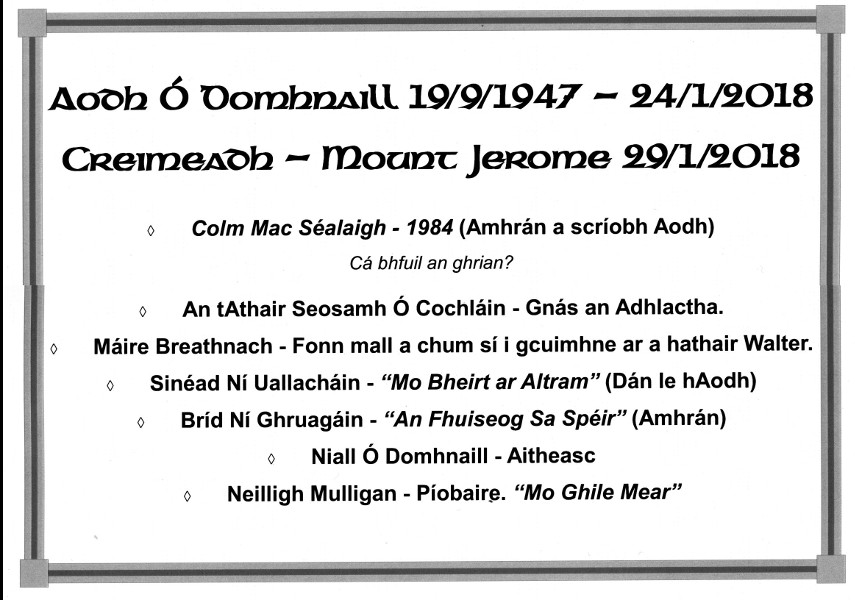
Click on image for a larger version

Above is the day's running order as Aodh himself might have put it. I will just comment on each item briefly.

The ceremony opened with Colm Mac Séalaigh singing one of Aodh's compositions from way back entitled 1984. An inspired choice, it was written for Na hUaisle, Aodh's protest folk group, and was way ahead of its time in the context of Irish language protest songs. It draws attention to the despoiliation of the environment and though it has many great lines, my favourite is:
Ag casachtach le sláinte i gcathair na gcasán
That grenade has a lot of shrapnel in it. But then Aodh was a wordsmith and he always packed a fair bit of punch into a few words.

You can read the words below as you listen to a version from Tŷ Bach, recorded in Belfast in 1974.


Press play below and click on image above for a larger version


1984 - from Tŷ Bach's vinyl LP Téanam Ort

An tAthair Ó Cochláin conducted the service in mellow Gaeilge na Mumhan and paid tribute to Aodh mar is dual.

Máire Breathnach played a plaintif melody on the fiddle which she had composed in memory of her late father Walter. Lovely tone and beautifully played.

Sinéad Ní Uallacháin, who, as a member of Aisteoirí Bulfin, had interpreted Aodh's dramatic writings on stage, read a poem Aodh wrote about his two children, Mo Bheirt ar Altram. This was published in his third volume of poetry Is Araile in 1993. It is on a familiar theme of children not being the property of their parents but just on loan to them for the duration. It had a particular poigancy in the circumstances. Sinéad rendered it beautifully.

It clearly had an emotional impact on the congregation, even on those ar bheagán Gaeilge. Aodh's French nieces missed it entirely and asked me if I would do a translation. The poem is untranslatable. It has an innovative use of words, some I suspect composed by the poet himself, and there are many with multiple meanings, as befits a poem. You can read the original here and, if that still leaves you guessing, get a sense of the content from my rough translation.

Bríd Ní Ghruagáin, who I had never heard sing before, gave us a rendering of An Fhuiseog Sa Spéir which would have done the Lark itself proud.

Niall gave a very emotional, evocative and loving eulogy of his father in which he strongly reciprocated the emotions expressed by his father in the poem above.

The ceremony concluded with a rendering by Neilligh Mulligan of Mo Ghile Mear on the uileann pipes. This was most fitting as Neilligh is a fine piper and the song could be seen as a lament for an absent hero. Neilligh followed it with a lively dance tune as family and mourners filed out of the chapel.

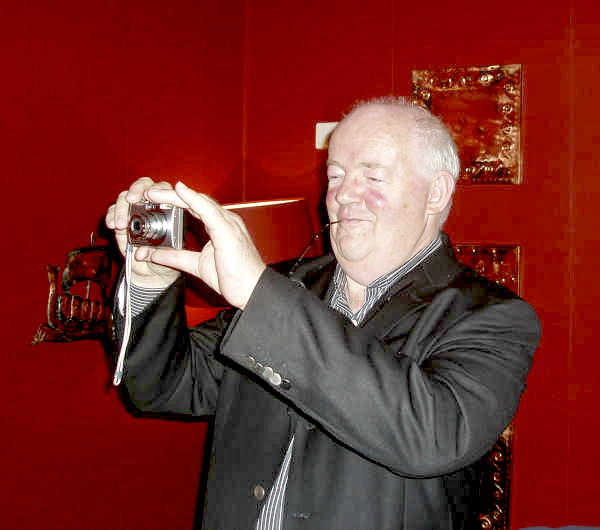
The family wanted to end on an upbeat note and I will do the same with the picture of Aodh below.


RIP


Tribute night for Aodh in the Writers' Centre