Showing posts with label James Joyce. Show all posts

Wednesday, June 27, 2018

BLOOMSDAY 2018


Click on any image for a larger version

Doesn't time fly.

Another Bloomsday is with us and Ulysses is taken down from the shelf for another airing.

This is not Joyce's Martello Tower though I've embedded him on the Battery Plain. This is the commanding tower above Killiney Bay, No.7 Dublin South, with a view of all nine emplacements in the Bay, sort of. This Tower is unique in being a bit inshore and on an elevation. It's in a position identified just before the 1798 Rising by ex-pat French Royalist Nobleman, Major Charles le Comte de La Chaussée.

So there Leo, Buck and Stephen, eat your hearts out.


Photo: Felix Larkin

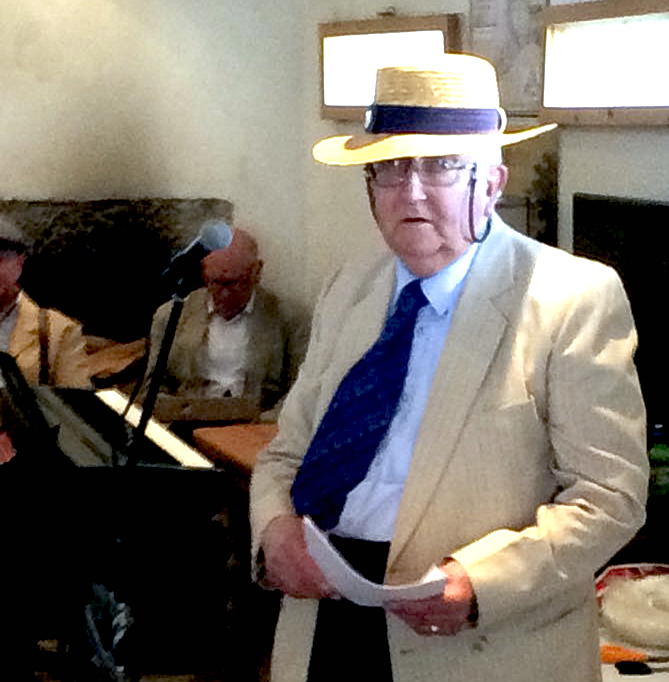
This year I have had to come out from behind the camera into the limelight and do my hastily assembled thing.

I was supposed to have passed on a request for a star performer from Niall O'Donoghue, the Tower's proprietor and Maître d'.

I forgot, and time was then running out so I volunteered myself with only a vague idea of what I was going to do. With touching faith, Niall accepted and the rest is history.


Photo: Sovay Murray

I got an introduction from Felix Larkin which made me wonder why, if what he said was true, I hadn't been avidly pursued by all manner of impressarios throughout my life.

But, of course, a little poetic licence is permitted on occasions such as these and I should have been very relieved that he had not just stuck to the bare truth. He created a wonderful feeling of anticipation for what was to come. So Felix, you are forgiven and thanks for the compliments. I have to admire your faith.

And if you want to check out Felix's contribution to this event last Bloomsday, its on his website.


Photo: Sovay Murray

Anyway, I kicked off my contribution with the most explicitly sexual passages I could find in Ulysses in the time available, me never having read the book.

I suspect some members of the audience were getting a little uneasy at this point, but they needn't have worried. I knew Niall had omitted to put the bromide in the coffee so I toned it down for the rest of my contribution.

I think, from a purely Joycean point of view, I cheated. I shamelessly used Ulysses to impart some of the less well known gems of the history of Killiney Bay to my audience, many of whom were locals.

Well, they laughed in all the right places and a hush descended when I tiptoed around the subject of child abuse. They even made fun of poor Edward Ball's predicament as he waited patiently in the middle of the night to dump his murdered mother's remains into the Bay.

Perhaps they were just too polite, but nobody gave out about the meagre content from Ulysses itself in the whole affair, or about how outrageously I stretched the connections to give me the opportunity to parade my knowledge of some of the more obscure aspects of the Bay.


With me done, we moved on to a little music. Neil gave us some Joyce related songs accompanied by a keyboard that was the nearest to a grand piano I'd ever heard from one of those things.

It was a very pleasant and totally appropriate interlude.


I'd like especially to mention Susan Hedigan. It was her husband David who, along with Niall, started Bloomsday at the Tower. So this was a sad day for her, remembering David who died in March 2015. However the day was Susan's birthday, born on Bloomsday and living in Bloom Cottage in Sadycove, and I had the honour of presenting her with a bouquet on behalf of Niall and those present. Neil the musicman immediately struck up Happy Birthday and everyone enthusiastically joined in.

Niall has recorded a tribute to David which consists mainly of David's presentation on Bloomsday 2014 at the Tower.


A short interlude in the open air, where it all would have happened but for the variability of the weather. Felix, still on duty after a fashion, was quietly recording it all for posterity.


Then back inside for the musical peroration with Truly Divine. I had spotted this amazing lady at another Bloomsday, in the Leeson Inn, in 2016, and she is a wow.

With her accomplished accompanist on acoustic guitar, Eamonn Moran, she entertained us royally with Joyce-related songs, including one, which Joyce himself had put to music, from his collection of love poems, entitled Chamber Music.

So another Bloomsday gone. Let's hope the next one comes round just as quick.

By the way, if you want to tackle my paper you can find it here.

Sunday, June 18, 2017

BLOOMSDAY 2017


Click on any image for a larger version

It's that time of the year again and on last Friday (16/6/2017) Dublin erupted into a thousand Bloomsday events. But none were as special as that held at the Martello Tower on Killiney Hill Road. No, this is not "Joyce's Tower" albeit in sight of the same snot green sea.

This is the magnificent restoration of Martello Tower No.7. Dublin South, by Niall O'Donoghue, a feat recognised as special by the Europa Nostra jury in 2014.

Sandycove is welcome to its annual splash, initiated by Myles na gCopaleen and a few others in 1954. Commemoration of James Joyce on Bloomsday there has now become a habit. But this is only the second Bloomsday commemoration at the Killiney Tower. It was initiated by the late David Hedigan in 2014 and it is a most exclusive affair - invitation only.

As you can see above, this year's celebration was novel in its conception. Felix M Larkin was giving us a miscellany of thoughts on Joyce with particular reference to the Freeman's Journal in Ulysses. Darren Mooney was recreating the drawing room atmosphere which is the background to some of Joyce's work, not forgetting that Joyce himself was no mean tenor and had written a series of love songs under the title Chamber Music.


Felix M Larkin

Felix, who is a former director of the prestigious Parnell Summer School, kicked off by reminding us of Joyce's attitude to Parnell. He puts Joyce firmly the Irish constitutional tradition and makes it clear he rejected any form of militant republicanism and narrow cultural nationalism.

I am a desperate one for connections, however tenuous. Felix tells us that Joyce's republican character, Michael Davin, in the Portrait of the Artist is based on George Clancy, who went on to become Sinn Féin mayor of Limerick and was murdered by crown forces on 6 March 1921, shortly after his election as mayor.

And the connection? Niall O'Donoghue's grandfather had been with Clancy just before his murder and you can read that true story here.


Felix goes on to illustrate the extent to which Ulysses is rooted in actuality by considering the opening sequence of the ‘Aeolus’ episode which is set in the offices of the Freeman’s Journal newspaper in North Prince’s street, Dublin – beside the GPO. But in setting the scene, and remembering that Felix is himself a historian, he reminds us, bluntly it has to be said, that the historian should be a kind of ‘bullshit detector’, with zero tolerance – and that is the spirit in which Joyce approaches his material.


It is at this point that Felix really gets into his stride. He is the historian of the Freeman's Journal and it is a recurring theme in his writings. Woe betide the audience that lets its mind wander and its attention flag at this point.


Preparations have been made to ensure strict attention and wakefulness and if the smaller cannon proves an insufficient threat to the inattentive ...


... then the eighteen pounder on the crown of the tower can be readied in forty-five minutes, somewhat along the lines of Saddam Hussein's rockets as recounted in the Dodgy Dossier. Just for the avoidance of doubt among the uninitiated, that work of fiction was not from the pen of Mr. Joyce.


But if Joyce sets the Aeolus chapter of Ulysses in the offices of the Freeman's Journal it is not out of respect for that newspaper. In fact Joyce held the Freeman and its staff in some disdain. Moreover, he seems to have held most, if not all, journalists in the same disdain, describing them as as ‘weathercocks’ – he writes: ‘One story good till you hear the next’.


We are told that Joyce’s final sneer at the Freeman in Ulysses occurs in the ‘Circe’ episode, set in Dublin’s nighttown: the title of the newspaper and that of its weekly compendium edition, the Weekly Freeman, are transmogrified into the ‘Freeman’s Urinal and Weekly Arsewiper’.

I have to interject here for the benefit of my younger readers who may be familiar with toilet tissue or even toilet rolls for doing the needful. These are a product of what to me is the modern age. They were preceded by medicated toilet paper whose properties led more to the spreading than the absorption of the remnants of No.2.

But before all that it was the practice, at least among the working classes, to cut the previous day's newspaper into small squares, pierce one corner, thread them with twine, and hang them on the lavatory wall. So many a paper in my day would have qualified for the title arsewiper not out of disrespet but out of necessity.

In our house that honour went to the Irish Press.


In his peroration Felix points out that Mr Bloom did not carry Joyce's disdain for the Freeman to its logical conclusion. When he visits the privy behind his home in Eccles Street, he did not use the Freeman to wipe himself clean but instead relied on the popular English magazine, Titbits.

Now there were some knowing giggles among the audience at this last bit. But this reveals a certain temporal problem in the cursory reading of Joyce.

In my day, Titbits was a soft porn magazine, a sort of titillator. In Joyce's time it presented a diverse range of tit-bits of information in an easy-to-read format. It didn't get its first pin-up until 1939.

If you're interested in the serious scholarly version of all this you can read Felix's full paper which he has generously put up on his website.


Darren Mooney

Now it's on to the second phase of the day's event, the music.

Joyce himself was musical. He had a fine tenor voice and, from memory, I think he won a few Feis prizes. There was also music around him. Moore's melodies, for example, were popular at social functions of the day. So Moore's melodies from tenor Darren Mooney were entirely appropriate to this particular commemoration.


Darren is from just down the road in Newtownmountkennedy in Co. Wicklow - somewhat beyond the range of the tower's cannon, but never mind. He charmed the audience so there will be no firing today. A singer whose abode is very much in range of the cannon is Bono, but that's for another day.


Darren's performance led us very nicely into that aspect of Joyce's life that we hear so little of. In fact Moore's melodies had gone somewhat out of vogue in the face of the great trad musical revival of the 1970s.

But, as Darren reminded us, they were the pop songs of their day. And they have some beautiful melodies along with decent lyrics. Even if the melodies were stolen, or recycled, Moore must be given credit for spreading them around and keeping them alive.


Darren had put together a nice selection and there was something very appealing in listening to a tenor out in the open and without electronic amplification half way up Killiney Hill.

If you're curious you can hear Darren sing Mio Caro Ben on his website. Not a Moore's melody but one with strong Irish connections if its claimed authorship is to be believed.


Jillian Saunders

A special mention for Jill.

There are two sorts of accompanists: true accompanists and soloists. Too many of the latter try to pass themselves off as also the former. but you cannot be both at the same time.

Not so Jill - a discreet empathic accompanist and a wonderful complement to the singer's performance. A great pleasure.


We ended up with an unexpected sing along version of Molly Malone when, ignoring the day's script and presumably somewhat over-enthused by the occasion, a Molly presented herself from among the audience and Darren was suitably gallant in his response.


Photo: Maeve Breen

An unexpected duet from Patricia Dolan and Darren Mooney to tie up the musical phase in style.


Family solidarity, Niall's sisters Maeve & Emer
Photo: Sovay Murray


Susan Hedigan

In the course of his performance as a wandering minstrel among the audience, Darren presented Susan with a bloom. This was Susan's birthday and the first time she had been back at the tower since her late husband's great performance here on Bloomsday 2014.


Ingrid & Rob Goodbody, Niall O'Donoghue

Niall had a bad fall a short while before and he was not completely recovered. He is one of those people who does not understand the word convalescence and, despite the possibility of having broken, or at least seriously damaged, some ribs he was out on site at 4am lugging stuff around.

But enough is enough and he was running out of steam. So he deputed Rob Goodbody to convey his appreciation to the participants and to thank the audience for coming, not to mention the caterers, whose catering we were about to sample. Some individuals had actually brought food to share, including lavender biscuits and succulent blueberry muffins.


Maghera Point from the Tower on the Day

I then laid aside the camera and proceeded to wind up the formal presentations by outlining the strong French connections between Killiney and France, carefully avoiding mentioning my own experience as an au pair boy.

The towers were built in 1804/5 to repel an expected French seaborne invasion. Thy owed much of their actual positioning in the Bay to the French Major La Chaussée who surveyed its military vulnerability in 1797. In the event, Napoleon never turned up, though the French appeared briefly elsewhere on the island.

Maghera Point, above, was the largest of the nine defensive emplacements in the Bay. It consisted of a tower and two batteries. It eventually fell victim to coastal erosion but was by then well beyond its use by date. Unlike Ozymandias, whose bits are still being discovered, it is gone forever.

You can also see in the picture where Edward Ball, having murdered his mother with a hatchet in Booterstown. dumped her body in the sea. But that too is a story for another day.


Myself reading from Joyce's Chamber Music
Photo: Sovay Murray

Back to La Chaussée, who went on to better things and became a financial intermediary between the British Government and the French Royalist rebels attempting to restore the monarchy and get rid of Napoleon. La Chaussée was involved in financing an unsuccessful attempt on Napoleon's life by the rebels, for which the perpetrators where duly executed.

So in this way, Killiney had connections with the highest level of the Government of France in the Napoleonic era.


Philippe Milloux

And there's more.

In attendance on the day was Philippe Milloux, Director of the Dublin Alliance Française. I didn't know it when I spoke, but the previous evening Philippe had been knighted by the French Government and was now a Chevalier de l'Ordre national du Mérite.

Short of an appearance of the full complement of the Knights of the Round Table, what more could be wished for to nicely cap the day.


Mark and Diana Richardson had earlier arrived in true vintage style in their 1918 Model T Ford. They were great to let guests have their photos taken in this precious relic of a bygone era. Lovely people.


Des Fahey
Photo: Sovay Murray


Niall's grandsons Matthew & Simon
Photo: Sovay Murray

After the refreshments and loads of chat, time came for us all to wend our weary way homeward. But for some the day was not yet over and Mark and Diana were leaving to participate in the rival ceremonials in Sandycove.

A real Model T Ford, in any colour you like as long as it's black, but complete with hooter.


Wednesday, April 12, 2017

MUSIQUE DE CHAMBRE


Kildare Street Troubadour
Click on any image for a larger version

Another good evening for the Alliance Française and for Director, Philippe Milloux, to add to his record in this, his final year there.

This time round it was a poetry reading, but with a difference. James Joyce had written a set of love poems, entitled Chamber Music, while he was still in Dublin and had some aspirations to becoming a poet rather than a novelist. They are short and simple but with resonances and allusions.

They are also untranslatable, as is the case with most good poetry. That is to say that you can never fully reproduce the original in another language. The most you can do is convey the sentiment and the flavour but in what is essentially a new form. If you are lucky you may also be able to render the rhythm or rhyme and preserve much of the range of ambiguity.

Well, Olivier Litvine, currently Director of the Alliance Française in Pondichéry in India, has just attempted some of this in bringing us a French language version of these poems, entitled Musique de Chambre.


Theo Dorgan, Jean-Philippe Imbert, Olivier Litvine

The evening's format was simple. Essentially Olivier read a French version of a poem and Irish poet Theo Dorgan then read Joyce's original version. This all took place against a background crafted by Jean-Philippe Imbert, from DCU, who took on the role of animateur


Noel O'Grady

We didn't hear any of the Joyce poems set to music in either language but, in a marvellously controlled tenor rendering of There's no Place like Home, Noel O'Grady set the musical ambiance of the time within which the poems were written.


Then Jean-Philippe kicked off with an animated introduction which, following a quick poll of the audience, swayed effortlessly between English and French.


It wasn't long before we got to the first reading and though I had some difficulty following it on the spot - my French is not that good and I'm not a poetry buff - I have since read over both the original English and the French versions of many of the poems and Olivier seems to have made a very good fist of it.

He mentioned two aspects of these particular poems which posed a problem for the translator.

Joyce tended from time to time to use old forms like "thee" and "thou" which are not readily carried over fully into a translation. So he opted to just ignore this particular conceit.

A more difficult one is when Joyce invents words. You are never sure of the range of ambiguity in them precisely because they are new and are meant to be a bit of a shock to the system.

I thought I had come across one in these lines and wondered how Olivier would deal with it.
And softly to undo the snood
That is the sign of maidenhood.
Olivier's version
Avant de doucement défaire cette résille
Symbole de ta virginité.
I had to look up "résille" never having had the pleasure of meeting it in French. It turned out to be a "hairnet" and I thought Olivier had caught something there - gossamer, maidenhood and all that. I was convinced that Joyce had made up "snood" though, for the life of me, I couldn't figure out the connotations. Then I looked it up and it turned out to be an actual word denoting a coarse kind of hairnet that hung down over the back of the neck. It definitely fell short of the gossamer evoked by Olivier's simple choice of words.

But the next one is made up.
How sweet to lie there,
Sweet to kiss,
When the great pine forest
Enaisled is!
So is this an island, isolation made by water, like Yeats's Lake Isle, or is it a church aisle flanked by pine trees?
Comme il est doux de s'allonger
Doux de s'embrasser
La où la grande forêt de pin
Fait un lit clos!
And the bed aside, has Olivier evoked "behind closed doors" and "fate" with resonances of Sartre's "Huit Clos"? Who knows? And that's the fun of it.


Theo gave us a very robust reading of the originals. He even wondered at one stage whether Joyce was parodying himself, consciously or unconsciously, but he concluded that, in this case, the poem had actually been rescued by its French translation anyway.

His commentary on Joyce throughout the readings was most illuminating. I think he was a bit taken aback when I described it as provocative, but I meant it as a compliment and, in fact, I was referring to the whole evening, which I found very stimulating.


Having consulted his script, Jean-Philippe figured we had come to the stage where some audience participation might be a good idea.

So I jumped in as suggested that it might be a good thing that Joyce was not with us this evening as the poet himself is not the best translator of his own work. I cited Pearse's poem Fornocht do chonac thú where the poet himself has given us a woeful English translation of a beautiful, and perfect, poem in Irish. The panel seemed to go along with me on that one. You can follow up my angle here.

Jean-Philippe wondered whether a poet could reasonably claim to translate from a language of which he had no understanding whatever. Apparently this is not quite as uncommon as you might think and it takes place through an intermediary who explains the bones of the original.

The audience, including myself, were inclined pour scorn on any such venture until Theo piped up and recounted how he had got stuck once with translating a poem from Slovenian, a language of which he knew absolutely nothing. The result has been hailed as one of the best translations of a poem from Slovenian to English. You'll have to get him to tell the story if you come across him. It's a good one and I'm not going to spoil it here.

If you haven't picked up the flavour of this vibrant and provocative evening the remaining photos below may help.


Une très belle soirée, or as we'd say, "a good time was had by all".


Wednesday, October 05, 2016

RE-TUNING THE HARP


Felix awaits his moment
under the watchful eye of Stanislaus Joyce
Click any image for a larger version

The full title of the talk was Harped History: Joyce, 1916 & Revisionism
and it was given by Felix Larkin at the James Joyce Centre on North Great George's Street on Monday evening (3/10/2016). It was a ticket affair and delivered to a packed and highly attentive audience.


Mark Traynor

The introducer of the speaker was introduced by Mark Traynor, director of the James Joyce Centre.

Just a word first on the Centre: Number 35 was saved from demolition by Senator David Norris who lives on the street. With the help of many others and with funding from a variety of sources the building was renovated and the Centre opened in June 1996. For over ten years the Centre was run by members of the Joyce and Monaghan families, descendants of Joyce’s brother Charles Joyce and sister May Monaghan. It is now run as a limited company, with charity status, and the support of the Department of Arts, Heritage and the Gaeltacht.

It is, not only in title but in fact, the centre of Joycean activity in Dublin and a visit is a must for Joycean tourists.


Anne Fogarty

But to more important matters. Felix was introduced by Anne Fogarty, Professor of James Joyce Studies in UCD. Apart from mentioning his accomplishments in the field of history, Anne revealed that Felix was a former civil servant. Now that is really something to have to live up to. I should know.


Felix Larkin

Didn't take a feather out of Felix, though, and he launched into a well crafted and controversial talk. Just for the avoidance of doubt, he first made it clear he was not a Joycean scholar. You can't be too careful when you're not sure who may be in the audience.

Felix started with Joyce, and painted him as a constitutional nationalist. And he did return to Joyce towards the end of the talk. But in between he dealt with a controversial issue that has been pre-occupying him during this year of commemoration: the morality, or otherwise, of the 1916 rising.

He ranged from quoting Eoin MacNeill, in the lead up to the Rising itself, to that great mendicant friar, historian and activist, F X Martin, at the time of the 50th anniversary of the Rising, to show that, whatever about the motives of those who organised it, the Rising itself was not morally justified. And lest anyone in the audience still harboured any doubts about it, he press ganged St. Thomas Aquinas into service in the cause.

He stressed the difference between collective memory, which is what we choose to remember and how we celebrate it, and history, which is an attempt to get at evidence based truth. Transitioning from the former to the latter, as we have hopefully been doing in the course of this year, is not revisionism as there was no real history to be revised, only discovered.

So that's the Joyce, the 1916 and the revisionism bits dealt with, but what of the harp in the title. Well, that has been invoked as a symbol of Ireland from way back and, with a bit of re-tuning, provides the required continuity through the centuries.

Felix graciously acknowledged an input of some photos from myself, which along with other visual material, including a fairly vicious and prophetic cartoon from Gordon Brewster, discreetly underscored the subject matter.

If you weren't there, you won't get to read the script just yet, as it will hopefully appear later in a hardcopy publication and take its place among the significant body of research and scholarship emanating from this year of commemoration.


The talk was followed by a lively question and answer session in which Felix held his own against some expert literary criticism.

He confessed afterwards that he had been apprehensive during the talk about how it was going down with this inscrutable audience, but the enthusiasm and volume of the applause when he finished will surely have reassured him on that score.


I had arrived a wee bit early as is my wont. I had in mind to discuss a few things with Felix but he was completely taken up with preparations for the talk. So I wandered into the room next door only to find a fascinating exhibition of Emma Byrne's illustrations of Ulysses.

Each illustration was accompanied by a relevant text but I have omitted the texts here, the better to illustrate the pictures in the small space available on screen.

Three of the illustrations especially caught my fancy. These were of locations in which I had a particular interest.


Joyce Martello Tower, Sandycove

I have an interest in the Martello Towers around Dublin Bay, and those along Killiney Bay in particular. The network of Towers was built in 1804/5 as a defence against an expected French invasion. Some of them became private residences, as did the Joyce Tower though it is now a museum. Some were simply left derelict and a few have been restored in varying degrees.


Nelson's Pillar

I have an interest in the Pillar since I photographed its post-explosion demise in 1966 and had some of my photos published in a recent book on the subject.


St. George's Church, Hardwicke Place

My interest in this former church arises from my efforts to trace the memorials around the city to Richard Brewster, brother of Gordon the cartoonist. The city is fortunate to have found a purchaser for this former church in the person of Eugene O'Connor who has done an absolutely brilliant, albeit costly and lengthy, restoration.

Viewing these evocative sketches in advance heightened the atmospherics of Felix's talk and it's a big thanks to Emma Byrne for letting me reproduce them here.