Showing posts with label booklaunch. Show all posts

Monday, February 19, 2018

FREE STATE PARTIES


General election September 1927
Link to cartoon in NLI collection
Click on any image for a larger version


General election September 1927
Link to cartoon in NLI collection


General election September 1927
Link to cartoon in NLI collection.

All three cartoons above relate to the general election of 15 September 1927. They are all by Gordon Brewster in whom I have an interest.

They appear in Mel Farrell's new book "Party Politics in a New Democracy - The Irish Free State, 1922-37" and they were the initial cause of my interest in this book, which was launched in the RIA on 8/2/2018.

The 1927 election was extremely important in the evolution of the Irish parliament into the two party system which has persisted up to the present day, more or less.

We have had coalition governments but they have been effectively dominated by one of the two major parties, Fine Gael (formerly Cumann na nGaedheal) and Fianna Fáil. The year 1927 saw the anti-Treaty party abandon its policy of abstention and take its seats in the Dáil. It went on to oust the Cumann na nGaedheal government in the subsequent election in 1932.


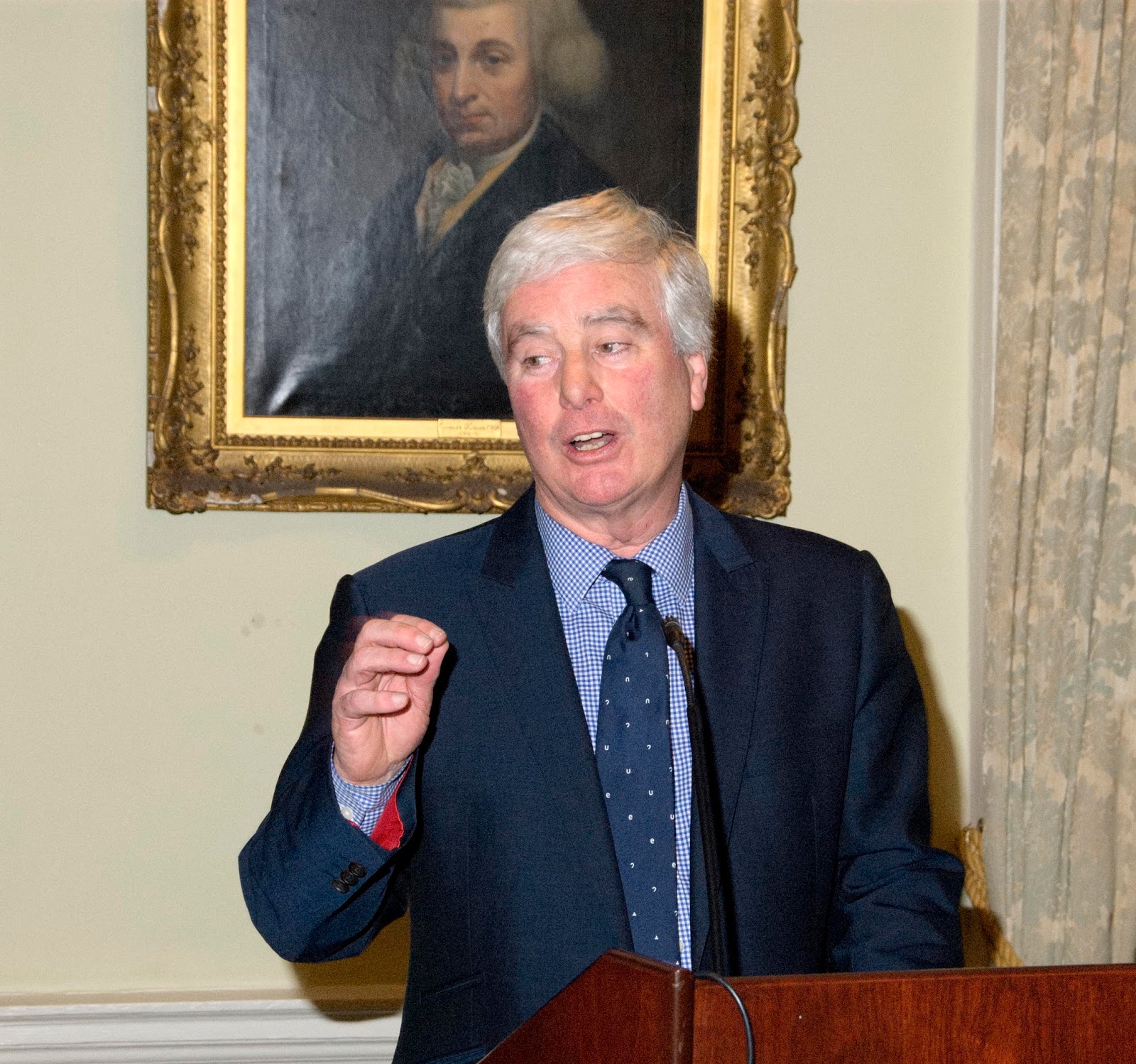
Stephen Collins

Stephen Collins, former political editor of the Irish Times, was the guest speaker and the big name draw. Stephen gave some background to the Irish political party system, and recounted how he, like Mel, became fascinated by it He has spent much of his life to date writing about it and his columns are well respected. He is also related to Mel so his contribution was a mix of the professional and the personal.


Filipe Ribeiro de Meneses

A most interesting speaker was Mel's professor and supervisor in this endeavour. Filipe's interests include Portugese and Spanish history, decolonisation, and the First World War. He recently (2009) published a biography of Salazar.

His approach to Mel's work was to see it in the broader European context. Ireland was a new state which bucked the European trend towards fascism, establishing and maintaining a robust democratic political party system.

Mel's approach, on the other hand, was very much to concentrate on the purely domestic aspects of the evolution of political parties in the Free State.

In the event, the tension between these two approaches has produced a work that synthesises them and firmly sets the development of the Irish Free State in its European context. In doing so, it underlines the tremendous work done by the political leadership during this period.


Mel Farrell

When it came to Mel's own innings he recounted his fascination with party politics from an early age and he thanked so many people that my head was starting to spin. It subsequently spun a bit more when I read the acknowledgements in the book itself - a tribute to the thoroughness of Mel's research and to his modesty in his wide crediting of its fruits.

I was very pleased to see him acknowledging Lynne Pentlow, Gordon Brewster's grand-daughter for the use of the cartoons. In fact, I was very pleased to see the well chosen cartoons in the book.

After his sudden death in 1946, and given that his wife and children subsequently lived in England, Brewster had slipped from the Irish consciousness. It is good to see increasing recognition of his work in recent times.

I am only at an early stage in reading the book but I can already see that it is authoritative and very tightly written.


The Longford Contingent

There was a strong showing from Longford at the launch and the event merited a significant report in the local paper. The Longford connection also gave me the opportunity to tell my police cell story to an appreciative audience in the conversations that followed the official launch.


Mel with his parents Anne and Paddy

As I was ostentatiously sporting my camera I was pressed into service for some group photos. This one of Mel's parents, Anne and Paddy, made it to the current issue of the Longford Leader.


Anna Duignan

Mel had a special word of thanks to Anna Duignan, for her unfailing support, for her remarkable reserves of patience, and for her understanding of his desire to finish the book. Now that that is out of the way I think they'll be seeing a lot more of each other in the future.

Friday, February 16, 2018

IRISH MEDIA


Me with Joe MacAnthony
Photo: Anne Harris (thanks)
Click on any image for a larger version

Another book launch but a very special one as it turned out. The launch was in the RIA on 14/2/2018. The book was the second edition, seventeen years after the first, of Irish Media - A Critical History.

A second edition because:
Since the first publication of this book in 2001, the pace of change has accelerated dramatically, and has made the publication of a second revised edition particularly timely. The switch from analogue to digital, the growth of social media, the new dominance of mobile, the increasing dominance of aggregators like Google and Facebook, and accelerated patterns of mergers and acquisitions following the 2008 economic crash have all impacted drastically on the media landscape and have raised questions about the future to which few, if any, analysts or media managers have yet managed to construct answers.

The earlier edition was written by John Horgan alone. In this edition he partners with Roddy Flynn. Going on their individual remarks at the launch they seem to have been the dream team for this book.

John is emeritus professor at the School of Communications in DCU. He was the first press ombudsman in Ireland and prior to that had a distinguished career in journalism and politics. Roddy is a lecturer at the School of Communications in DCU, where he is chair of film and television studies. He has written extensively on Irish screen policy, with a particular focus on media ownership and media regulation.


Kevin Rafter

Kevin Rafter is the current head of the School of Communications in DCU, John's old job. He outlined the contribution the School is making to current Irish journalism.

I would add that DCU has so far been a great success as a new university, outclassing its "betters" in many fields. I would hold up their linguistic research and technological application in the Irish language as one of the other interesting areas into which they have ventured.

It was once described to my son, who had a very successful and happy innings there, as "The Nerds University". Those so describing it were attending a southside university from which he had fled so that he could actually get a bit of work done. All kinds.


John Horgan

John gave us many stories and themes from the book. One of these was the story, way back, of Joe MacAnthony and his exposé of the corruption inside the Irish Sweepstakes. He paid dearly for that and has been one of my heroes since. And John said he was there with us in the audience.

I immediately resolved to have my photo taken with him and later press ganged Anne Harris, whom I had just met, to do the needful. Thank you Anne. Eternally grateful. You can see the result at the head of this post.

John made a very optimistic and encouraging point - the legacy media were fighting back and now looked like they were actually coming back. Perhaps in not quite the same form but nevertheless. Their decline had bottomed out and they were on the rise. This was down to two factors. The proliferation of "fake news" and undisciplined and shoddy reporting had led to a desire for solid authoritative copy. At the same time the legacy media were developing business models which would be sustainable in the cyber age.

There would clearly be exceptions but the overall vibe was positive.


Roddy Flynn

There were two new aspects to this book over its predecessor: the period covered was extended back way beyond the establishment of the Free State, to the seventeenth century in fact; and the range of coverage was extended to include online media.

I think Roddy covered the latter extension but it was clear from his respect for John, which John had reciprocated earlier, that this was really a joint and largely seamless effort.


Joe Duffy

In launching the book, Joe Duffy made a number of significant points about media in general and in paticular about the interplay between the State and the broadcaster, an area John had touched on earlier. Joe's career in broadcasting goes back a long way and he has always been involved in bringing the show to the people and the people to the show.

Many of my own colleagues in the civil service saw him simply as a stirrer-upper to be avoided at all costs. I did not share that view. It was clear to me that he was giving a voice to the voiceless and if that required a bit of showmanship from time to time so be it.

It did not surprise me, when I read his autobiography, that he had come from a modest background, or that he had been a probation officer. He has a quality which is rare enough among broadcasters: he actually listens and he is not afraid of on-air silences. These attributes, aside from serving a higher purpose, go a long way towards making for great radio.


Joe MacAnthony

I mentioned Joe MacAnthony already. Best to expand that reference by again quoting from the book. But first to set the context. There was speculation at the time that the ailing Independent Newspaper Group might be bought by the McGrath family whose wealth was based largely on a Goverment franchise to run the Irish Hospitals' Sweepstakes:
On 21 January 1973, however, this possibility evaporated in the wake of the publication in the Sunday Independent of that date of one of the most remarkable pieces of investigative journalism that had ever appeared in an Irish newspaper up to that time and indeed for many years afterwards. This was an exposé by the journalist Joe MacAnthony of the activities by McGrath's sweepstakes company, many of them illegal, in the foreign jurisdictions in which sweepstakes' tickets were sold.

The article, which ran to some 8,000 words and over three pages of the paper, had been planned originally as a two-part series. `The editor of the paper, however, realised that if the first half was published that the second half, in all probability, would never see the light of day; accordingly he decided to run it all in one article. The McGraths were incensed and withdrew all their lucrative advertising from the group for some weeks.

MacAnthony resigned not long afterwards, after it had been made clear to him by a regretful O'Brien that his career within the organization had effectively reached a full stop, at least in terms of promotion.
Joe MacAnthony also investigated Ray Burke for planning abuse but the establishment closed ranks and it was some quarter of a century later before MacAnthony was vindicated. Meanwhile he had emigrated to Canada where he had a very successful career as an investigative journalist.


Anne Harris

And that brings me neatly to Anne Harris, who took the photo of me and Joe at the launch. It is not the act for which she will be most famous. That must surely be in her standing by her criticism of Denis O'Brien after he acquired a major interest in her newspaper. She is no longer its editor.

It's quite amazing the people you meet on these occasions. I spoke to a man I didn't know who was standing alone at the time. It turned out to be an interesting encounter. He is currently the editor of Books Ireland but in an earlier existence he founded the Newry and Mourne Museum, now in its thirtieth year and in a much expanded form. I happen to be a great fan of the museum and was fascinated to meet its founder.

The museum is currently on the site of Bagnal's Castle. For many years the location of the castle was unknownn. This man, Tony Canavan, worked out where it was and brought his discovery to Heritage HQ in Belfast but they dismissed it. He was later vindicated when the ruins of the castle were discovered when the Victoria Bakery which had been covering them up was being renovated.

Tony also turned out to be a brother in law of Brian Goggin, with whom I had previously been corresponding in the course of my family history research.

And my interest in all of this?

Well, once upon a time, I was a newspaper proprietor and editor myself.

Saturday, December 23, 2017

COMHAR


COMHAR mór-eagrán na Nollag 2017
Click on any image for a larger version

I went to yet another launch in the RIA on 11 December last.

Part of my interest was in the launch of the bumper Christmas issue of COMHAR. It is hard to describe this publication and the contribution it has made to life and literature since its foundation but its Wikipedia entry gives an idea of what it is about:
Comhar has as its stated aims to be a journal of first choice for writers, scholars, critics and readers of Irish, to publish the best of new writing in Irish, to be a high-quality forum for analysis and discussion of current affairs, to provide intellectual stimulation and be a platform for debate.

It was founded in 1942, and has published work by some of the most notable writers in Irish, including Máirtín Ó Cadhain, Seán Ó Ríordáin, Máirtín Ó Direáin, Máire Mhac an tSaoi and Brendan Behan.
I have been twice published myself in its hallowed pages.

My first contribution in 1974 had the byline "by our political correspondent". That was me, but I was working in the Department of Finance at the time and did not think it appropriate to have my name appearing under a political article however innocuous. Among other things the article pointed out that the then current use of the SWINGOMETER for analysing interparty swings in UK elections was not suited to analysing the Welsh returns. At UK level the display showed swings between tories and labour whereas the real swing within Wales was between labour on the one hand and Plaid Cymru (the Welsh nationalist party) and the Liberals on the other.

My second contribution was in 2001 when I reported on some significant features of the Welsh National Eisteddfod of that year. It was at this Eisteddfod that the coveted Bardic Chair was first won by a woman and the festival generally had many features which could profitably have been taken up by the Irish language movement.


Also being launched that evening was the book Leathbháideoirí by Marie Whelton. I doubt if I'll get round to reading this as I have a pile of unread books a mile high at home.


Taoiseach Leo Varadkar

In the interest of transparency, however, I should probably reveal the covert purpose of my attendance. The publications were being launched by Taoiseach Leo Varadkar and the evenings proceedings would be in Irish. I was curious about his level of competence in the language.

After all, his predecessor, Enda Kenny, was renowned for his fluency in the language, though as I have pointed out, his grammar was not always up to scratch. Enda, it will be remembered, appointed a Minister for the Gaeltacht and the Irish language whose command of it was at best ropey at the time. Leo has appointed a Minister for Culture (including the language) whose Irish is ropey and who does not intend to do anything about it.


So what is Leo's Irish like? Well, to give him his due, it is fluent. The grammar could do with some polishing, though not having spoken to him myself, I'm not sure where to draw a line between his script and his oral performance. However, he seems enthusiastic, is unashamedly learning, and is committing himself to use Irish at every available opportunity. He won't save the language but may acquit himself well on this score.

In this summing up I think I am on the same wavelength as Breandán Delap who has written the following in this year's COMHAR:
"Tá smeadar Gaeilge ag Leo Vardkar agus bíonn sé toilteanach í a labhairt leis na meáin cé go bhfuil sé briotach go maith go fóill"
Comhar Márta 2017 lth8/9

"Bhí an Taoiseach, Leo Varadkar, i measc 70 duine ar bronnadh teastais sa Ghaeilge Ghairmiúil orthu ag searmanas i dTeach an Ard-Mhéara i mBaile Átha Cliath i mí Meán Fómhhair. Cúrsa deich seachtaine de chuid Gaelchultúr a bhí i gceist."
Comhar Nollaig 2017 lth 18


Marie Whelton & Leo Varadkar


While I was there I spotted Aodh Ó Domhnaill on the cover of the March issue and my acuity earned me a free copy. I have reported elsewhere on the content relating to Aisteoirí Bulfin in this issue.

Friday, December 15, 2017

THE CLONTARF ATLAS


Dublin from railway bridge at Hollybrook,
c. 1850, by Edward Radclyffe

The Clontarf Atlas is a magnificent work of art.

It is the first volume in a new series of Town Atlases dealing with the suburbs. I have not seen the town atlases themselves so this is my first introduction to the series and it blew my mind.

The illustrations are really high class and seeing them across a two page spread is wonderful. You can really appreciate them at that size.

There are black and white engravings like the one from which I reproduce a detail above.


Beached boats at Clontarf
looking north, 19th cent., by O. M. Latham

There is this beautiful watercolour from which I have just reproduced a detail.


Royal Charter School, Clontarf Road
looking east, 1794, by William Ashford

And there are full blown pictures like that from which the above is a detail.


Late 17th Century, Clontarf

Then there are the specially drawn thematic maps in a clear and very attractive style.


Parish of Clontarf 1868

And the more conventional OS type maps, but in great detail and relating to different periods.

This is probably the right place to mention that every page in the volume is perforated at the inner margin so pages can be taken out and arranged to form eg larger maps.

The detail above shows the building of my first school as it was in 1868. When I go to the comprehensive text I find that it was built in 1823 and acquired by the RC Church for a school in 1940. I spent a year there in 1949/50 in Miss Hayde's class (babies). In fact, during my relatively brief stay, I actually kicked teacher. I also find that Dollymount Park, where I lived then, was built in 1949, so it all comes together.

The text takes you through Clontarf from a fishing village, through a Township and finally a classy suburb. The gazetteer type entries (if that's what they're called) give you comprehensive information on roads, buildings, institutions and the like.

I must really compliment the authors here for picking up (p 56) the typo on the gate of Brian Boru's Well. This was first pointed out to me by Seán Cromien, a former Secretary of the Department of Finance, who has an eye for such matters. Even some local historians missed this one.

Some photos below from the launch in RIA on 6 December 2017.


Colm Lennon, author


Mícheál MacDonncha, Lord Mayor & Michael Peter Kennedy, President RIA


Lord Mayor shares a joke with Colm and Raymond Gillespie

Raymond is an editorial board member of the Irish Historic Towns Atlas.

Full marks to all concerned in the production of the CLONTARF ATLAS


Check out Colm's video on the volume

Friday, December 01, 2017

MORE FOOD OR I'LL APPEAR


Click on any image for a larger version

Another feather in their cap for Four Courts Press. This time it's Food Rioting, no less, and James Kelly's book thereon was launched last evening (30/11/2017) in the prestigious surroundings of the Members Room in the Royal Irish Academy.

The book introduces us to a subject which has been much neglected in the Irish context and about which there had been many misconceptions, not least by the historian E P Thompson.

So James Kelly did what good historians do. He combed the sources and came up with a whole new story.


Cormac Ó Gráda

The book was launched by Cormac Ó Gráda, himself no slouch at rewriting, or I should more correctly say writing, history. Joe Lee has praised Cormac for his intensive milking of even the skimpiest of evidence to open new windows on the past.

So when Cormac is lavish in his praise of "Jimmy's" work you have to take Jimmy seriously.


James Kelly

It had been thought that Irish food riots in Ireland were few and far between. And this was put down to a lack of "political space" and, presumably, of leadership.

James has shown, on the contrary, that in the century and a half before the famine there were lots of food riots, varying in size from a few score people to thousands.

The riots posed a serious challenge to the authorities who saw them as an interference with the free market system which was their bible. Nevertheless, riots demanding more food posed less of a threat to the establishment than the agrarian agitation which was to follow.

So the food riots were met with more tolerance than their successors.


James scoured a large number of primary sources, but he stressed in paticular the wealth of material to be garnered from the newspapers of the day. These however had to be carefully and extensively mined and this called for a dedicated historian who was willing to be put through his paces.


Corrmac, James & Martin from Four Courts Press


Brendan Twomey & audience


Catríona Crowe & David Dixon


Wednesday, November 22, 2017

BONJOUR !


Click on any image for a larger versionn

Another book launch at the Alliance Française in Dublin town. This time it's The Bonjour Effect by Julie Barlow and hubby Jean-Benôit Nadeau.

Its thesis is that conversation is an art form in France, guided by a complex set of rules, codes, conventions and taboos. In exploring these the book is a primer in the psychology of the French and it gives you pointers on how to cope with this very strange race of people.

It lets us in on the secret that talking to the French is not about communicating or being nice, its about being interesting. With this as a starting point the exalted state of "se démerder" becomes attainable to even the rankest amateur.


Director

The evening was introduced by the Institute's new Director Thierry Lagnau who succeeds former Director Philippe Milloux, who has now returned to Paris HQ.


Jean-Philippe Imbert


The evening was structured as an interview by Jean-Philippe Imbert with of one of the book's co-authors, Jean-Benoît Nadeau. Jean-Philippe is from DCU where he bears the intriguing title of Lecturer in Comparative Literature and Sexuality Studies in the School of Applied Language and Intercultural Studies (SALIS).

Jean-Philippe has appeared on this blog before, interviewing Olivier Litvine on the launch of his book Musique de Chambre.


Jean-Benoît Nadeau

So, let's get one thing out of the way first, the book's title. What's all this Bonjour stuff?

Well, believe it or not, this one little word is the key to the pearly gates of French conversation, and, as we learn, cooperation. Omit this simple greeting on meeting a French person and you're in the doghouse from that point on. A foreigner might just be given some latitude on a fine day but for the French it is de rigueur.

So maybe you think that's a bit thick. Well, believe you me, even in Ireland, there can be more to a simple greeting than meets the eye. Consider this little incident from the Mayo Gaeltacht early in the twentieth century.
Colm O'Gaora was a young teacher and a timire for Conradh na Gaeilge. He was new to the Irish speaking Bangor Erris disrict in Co. Mayo when he met a man along the road. "Dia dhuit" (God be with you) says he, in the traditional Irish equivalent of Bonjour. The immediate and vehement reply took him aback: "May God and Mary bless you and may bad luck strike you down you dirty old Protestant".
It really does matter how you greet people and if you want to understand Colm's faux pas check out this incident in more detail in my review of his book.


Julie Barlow

Before I go any further, do remember that the book is co-authored by Jean-Benoît and his wife Julie.

Clearly then, they are both responsible in equal measure for its content. However, when it comes to describing an incident to illustrate a particular point, it is described by whichever of them was involved in it. This is both a constant reminder throughout the book of its dual authorship and it makes for more interesting reading..

As Julie was not involved in the actual launch in the Alliance, I'm giving her a look in here.


It is important to know that the French put a lot of pass on what I'd call polish: speaking with supreme confidence, wit and loads of grammar. In fact the ideal is to speak written French. Bearing this in mind will enhance your understanding of the incident below which I have reproduced from my website.
Learning French was no less bizarre. I arrived in France, in 1963, with very good Leaving Cert written French (there were no orals in those days). The family were, sort of, nobility. There had been a general in the family on the mother/granny's side and all the adults spoke proper. The granny was very concerned with the deterioration in the quality of French spoken by the youth of the country in general and her own daughter's children in particular.

Meanwhile I was trying to converse in French, my ultimate ambition being to effortlessly speak the same colloquial brand of French spoken by the children and of which the granny was so critical. I had to think in English, translate into French in my head, mentally repeat the result three times and then deliver it before it evaporated.

Clearly in granny's view I was speaking prose, as had de Gaulle before me, and the house resounded to her loud exhortations to the children "Écoutez Paul", listen to Paul (ie speak prose). The irony of it.


And the wit bit.

Well, let's take Jacques Attali, economic consigliere to François Mitterand and subsequently President of the European Bank for Reconstruction and Development (EBRD).

Now there was a frenchman of sublime refinement who had trained his wit to a fine edge. He also had an abnormally large ego, the largest I ever met in fact, and clearly could never afford to let himself be outwitted, so to speak.

This incident, from the Board of the EBRD, on which I served briefly, will give you a flavour.
On one occasion, Tony Faint, the UK Director, who was from DIFID, had a mild go at him, when he suggested that the Bank should give some consideration to what niche might be appropriate for its operations. This was red rag to a bull as far as Attali was concerned and he responded that in French a niche was a kennel where you kept a dog. Tony replied that where he came from a niche was a space that housed the statue of a saint. "Yes, but they're all dead" was Attali's quick retort and that killed that intervention stone dead, so to speak.
Clearly Attali had fully absorbed this desideratum of the French education system. However, he didn't always have it his own way.
One of the Board's concerns was a feeling that the economic analysis underpinning some of the projects was a bit thin. A result, no doubt, of the speed at which matters were being pushed along. The cudgel here was taken up by the Spanish Director, José Luis Ugarte . He was a nice man with a slightly dry sense of humour. He had a background in economics, in academia and in the OECD, so he was well qualified for this encounter. "Mr President" says he "I think we might take this project a little more slowly and deepen the economic analyis underpinning it". "Not at all." says Attali "Economics is dead. I know. I taught it for years". "Ah yes, Mr President, but that was socialist economics". The Board collapsed with laughter. A beautiful rapier of a sentence. Attali had been socialist President Mitterand's economic mentor over the previous 15 years, even before he came to power. And the Bank was set up to supplant the failed "socialist" economics of the Soviet era. Even Attali had to muster a conceding smile.
That was one of only two occasions I have seen Attali bettered in repartee, a skill in which he prided himself.


The french education system lays great stress on philosophy as a subject, even in the early stages. By this is meant teaching pupils how to think. This doesn't mean that rote learning is absent. It isn't and there is a lot of it. But it does lead to the French having respect for public intellectuals.

Attali frequently boasted that he was a member of two minorities: he was a Jew and an intellectual. But that in my view was not the whole story.

The French have a binary view of the answer to the question: "where are you from?" which makes the question problematic. We Irish have no great problem asking the question, often followed by "who are your people?". Though I have to admit I once met a man who was ashamed to be from Mayo (God help him).

Posing that question to a Frenchman, however, can be very insulting. The binary is French or not French and asking the question could be seen as questioning the respondent's frenchness.

In listing his membership of minorities, Attali was careful to avoid mention of his membership of the third minority. He was born in Algiers. Clearly the less said the better.


The book comments on Madame de Staël who was known for running top class salons of conversation. She had interesting views on various national characteristics having herself lived all over the place.

Apparently she was stunned to learn that German conversation did not tolerate interruptions. The authors point out this was probably because, in German, the verb invariably comes at the end of the sentence.

I have included this random observation because it made me smile. Sort of a German joke.

Did you know that French is not a language? Seriously. At least that is the French view. It is simply an aspect of their culture.

For example we would describe French learned by a former monoglot English speaker as their second language, Turn this around to a former monoglot French speaker learning English. The English is described as their first language.

I sort of knew about all of this from my days in Mlle Giudicelli's class in the Alliance in the sixties - Langue et Civilisation Française and all that.


I also knew that in France political leaders are allowed a certain level of gilded luxury. It also applies to very senior civil servants. This whole group are seen as leaders in cultural discernment. It is actually a part of what brought down Attali in the end - his Carrara Marble (another story).

I learned some new things from this book about what I'd call permanent French attitudes, but also about how meanings had in some cases shaded from my time.


For instance I read that Copain now has acquired sexual connotations. In my day, the newly published pop magazine, Salut les Copains, could be translated as a sort of Hi Guys among young people. God knows how you'd have to translate it now.


So lets end on a good sexist note - a book called La Femme Parfaite est une CONNASSE, The Perfect Woman is a Bitch (putting it politely - Larousse gives you Stupid Cow as an alternative!).

Gotcha there, maybe. It is actually a pro-woman book written by two women. So there.


The main man spoke French to me afterwards and I have to say the Canadian version is different and I'd have needed more time to tune in. Must brush up on my Céline Dion.

Anyway, the book is a most enjoyable, and sometimes hilarious, read.

It will firm up your prejudices and explain why you don't have to feel guilty about them any more.

It will also arm you for any future ventures into that cockpit of cultural conflict which is the French language.

Buy it