Showing posts with label Enda Kenny. Show all posts

Wednesday, November 14, 2018

GRANUAILE


Click on any image for a larger version

When I was in school, as far as I can remember, our national heros were all male - from Fionn Mac Cumhaill to Patrick Pearse. There was Queen Maeve but all we knew about her was that she was a cattle rustler. There might have been mention of Granuaile (Grace O'Malley) but if there was it was as a pirate more than a queen.


The lady from Gill Books

It was only when I went to a talk on Granuaile by Anne Chambers, a good while back, that I realised what a magnificent chapter in our national history had been missed out. I don't know if the omission had anything to do with me being at a Christian Brothers school - they weren't very good dealing with women - or whether it was simply that it was the men who wrote the history. And I've no idea how Granuaile fared with the nuns.

But, anyway, now she's back on the map with thanks to Anne Chambers and Gill Books. The seventh edition of Anne's great book was launched in the Royal Irish Academy on 12/11/2018 and I wangled myself an invitation.


Ellen O'Malley Dunlop

The choice of speakers for the night was inspired. First we had Ellen O'Malley Dunlop who is no daw when it comes to standing up to people either on her own behalf or on behalf of her gender.

If I picked it up right, she is an actual descendant of Grace O'Mally, and she clearly has the Pirate Queen's fighting spirit. Both herself and Grace are surely ideal role models for today's young girls, and many of the boys to boot.


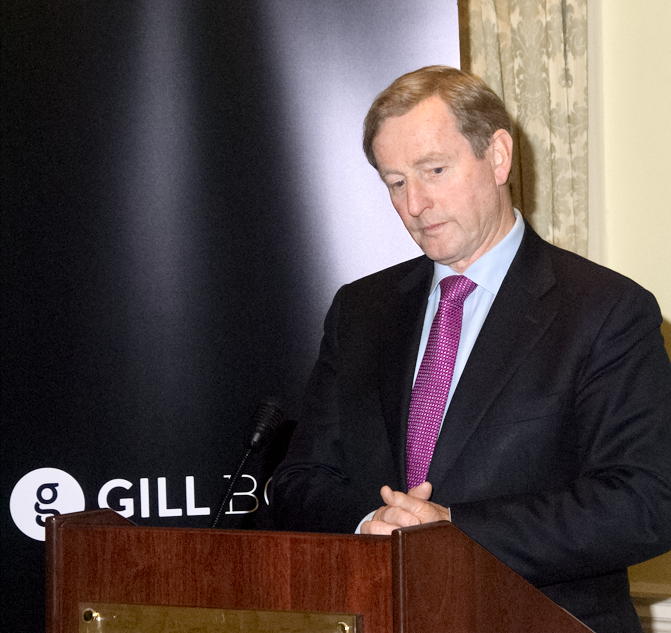
Enda Kenny

Then we had the "King of Castlebar", (no not Pee Flynn - the King is dead, long live the King), Iarthaoiseach Enda Kenny.

Now Enda is a mild mannered, and some would say boring, public speaker. But not tonight. You could feel his passion for the Connaught Queen, who had sailed up the Thames and confronted the British queen, Elizabeth I on equal terms.


He reminded us of the next time this happened between Mary Robinson and Elizabeth II, and again with Mary McAleese and Michael D. And of the Queen bowing and laying a wreath in the Garden of Remembrance in 2016. Confrontation is not the appropriate word here, and the combination of exchanged visits and the Queen's wreath-laying in honour of those who through military action shook off the English yoke, is inspirational, tokenism or not.


British protocol has it that you should never repeat anything the monarch says to you in private, though nowadays this is more honoured in the breach than in the observance. Anyway, it didn't stop Enda sharing a royal confidence. Apparently, on her departure from Cork, Elizabeth II confided in the then Taoiseach that she had been particularly looking forward to that visit for a long time.


Anne Chambers

We then heard from Anne herself about her discovery of Granuaile and how she assiduously pursued every avenue to document, and effectively get to know, her.


Grace's widespread presence in the British archives is an indication of, and a tribute to, her importance in her day.

I left a review on the Amazon page of the current edition.


Other photos from the night


1


2


3


4


5


6


7


8


9


10


11


12


13


14


15


16


Saturday, December 23, 2017

COMHAR


COMHAR mór-eagrán na Nollag 2017
Click on any image for a larger version

I went to yet another launch in the RIA on 11 December last.

Part of my interest was in the launch of the bumper Christmas issue of COMHAR. It is hard to describe this publication and the contribution it has made to life and literature since its foundation but its Wikipedia entry gives an idea of what it is about:
Comhar has as its stated aims to be a journal of first choice for writers, scholars, critics and readers of Irish, to publish the best of new writing in Irish, to be a high-quality forum for analysis and discussion of current affairs, to provide intellectual stimulation and be a platform for debate.

It was founded in 1942, and has published work by some of the most notable writers in Irish, including Máirtín Ó Cadhain, Seán Ó Ríordáin, Máirtín Ó Direáin, Máire Mhac an tSaoi and Brendan Behan.
I have been twice published myself in its hallowed pages.

My first contribution in 1974 had the byline "by our political correspondent". That was me, but I was working in the Department of Finance at the time and did not think it appropriate to have my name appearing under a political article however innocuous. Among other things the article pointed out that the then current use of the SWINGOMETER for analysing interparty swings in UK elections was not suited to analysing the Welsh returns. At UK level the display showed swings between tories and labour whereas the real swing within Wales was between labour on the one hand and Plaid Cymru (the Welsh nationalist party) and the Liberals on the other.

My second contribution was in 2001 when I reported on some significant features of the Welsh National Eisteddfod of that year. It was at this Eisteddfod that the coveted Bardic Chair was first won by a woman and the festival generally had many features which could profitably have been taken up by the Irish language movement.


Also being launched that evening was the book Leathbháideoirí by Marie Whelton. I doubt if I'll get round to reading this as I have a pile of unread books a mile high at home.


Taoiseach Leo Varadkar

In the interest of transparency, however, I should probably reveal the covert purpose of my attendance. The publications were being launched by Taoiseach Leo Varadkar and the evenings proceedings would be in Irish. I was curious about his level of competence in the language.

After all, his predecessor, Enda Kenny, was renowned for his fluency in the language, though as I have pointed out, his grammar was not always up to scratch. Enda, it will be remembered, appointed a Minister for the Gaeltacht and the Irish language whose command of it was at best ropey at the time. Leo has appointed a Minister for Culture (including the language) whose Irish is ropey and who does not intend to do anything about it.


So what is Leo's Irish like? Well, to give him his due, it is fluent. The grammar could do with some polishing, though not having spoken to him myself, I'm not sure where to draw a line between his script and his oral performance. However, he seems enthusiastic, is unashamedly learning, and is committing himself to use Irish at every available opportunity. He won't save the language but may acquit himself well on this score.

In this summing up I think I am on the same wavelength as Breandán Delap who has written the following in this year's COMHAR:
"Tá smeadar Gaeilge ag Leo Vardkar agus bíonn sé toilteanach í a labhairt leis na meáin cé go bhfuil sé briotach go maith go fóill"
Comhar Márta 2017 lth8/9

"Bhí an Taoiseach, Leo Varadkar, i measc 70 duine ar bronnadh teastais sa Ghaeilge Ghairmiúil orthu ag searmanas i dTeach an Ard-Mhéara i mBaile Átha Cliath i mí Meán Fómhhair. Cúrsa deich seachtaine de chuid Gaelchultúr a bhí i gceist."
Comhar Nollaig 2017 lth 18


Marie Whelton & Leo Varadkar


While I was there I spotted Aodh Ó Domhnaill on the cover of the March issue and my acuity earned me a free copy. I have reported elsewhere on the content relating to Aisteoirí Bulfin in this issue.

Friday, March 17, 2017

BACKSTORY


Click on any image for a larger version

I am often told that I compress stuff too much, so much so that it becomes unintelligible to everyone bar myself. I am also told that I indulge in unnecessary and longwinded explanations, and when the addressee is female I end up being accused of mansplaining.

So just to be on the safe [?] side, I thought I'd better give some background to two images I tweeted today. The first relies on a perception of irony and the second on some local geographical knowledge along with no little scepticism regarding the achievements of our current Repulblic.

So to picture No.1 (above). I was reading Miriam Lord's account of yesterday's press scramble in the Oval Office when I came across her remark that, during the attempted ejection of the press corps, one journalist, Senan Molony, went for broke and uttered the R word. The President apparently then asked the Taoiseach in a whisper "Is he one of yours?".

It was a Carole Coleman moment which no doubt will have Senan join her in the list of White House martyrs.

I'm sure Senan will get due exposure in the Mail for his brave act. At least on this occasion the object of the remark was alive and in the room and could have answered the challenge. Unlike Albert Folens who had gone to meet his maker by the time Senan succeeded in broadcasting his flimsily supported and damaging Nazi accusation on the national media.


This is the resultant tweet. So go figure.


And so to picture No.2. We are a priceless country when it comes to street name signage. This is usually at its most acute where the Irish language is involved and I have referred to this on many previous occasions. On this occasion I'll leave the Irish alone, there's nothing wrong with it. Today I have a wider agenda.

In the course of my reading of our national history I have been very taken by how the English were blamed for virtually all of our ills, from the famine to the profusion of prostitutes in the area of Dublin then known as Monto.

Now there was probably some justification for those two observations. The English administration could certainly have responded better to the threat and fact of famine, but it clearly didn't suit their agenda or ideology at the time. That there should have been a profusion of prostitutes in a town boasting a number of barracks with a large military presence would not be unusual.

What really got me about all this though was the prevailing nationalist wisdom that once we got rid of the English the latent purity of the Irish race would blossom and we'd live happily ever after. Well we don't. We're no more moral than the next crowd and we have sections of our dearly loved people starving or homeless or both.

The street nameplates here encapsulate all of this for me. We sent the English back home so the Queen Square West plate was redundant. We replaced it with glorious bilingualism honouring one of the foremost heroes of the Rising. But it was a cheap plate, and the paint peeled, and that's how it looks today.

I posted the tweet with the text "No comment. Go figure.

Wednesday, October 22, 2014

Judging W T


Click on any image for a larger version

The Royal Irish Academy published the latest book in their "Judging ..." series last evening. This is Michael Laffan's "Judging W T Cosgrave". I haven't yet read the book but if the speakers are to be believed it is not one to be missed.


Michael Laffan, Liam Cosgrave, Enda Kenny

WT Cosgrave was the first "Taoiseach" (President of the Executive Council) and he was in office from 1922 to 1932 at the head of the pro-Treaty Cumann na nGaedheal government.

He was not himself at the launch, as he died in 1965, but we had one current and two former Taoisigh present. WT's son Liam, now 94 and a former Taoiseach himself, gave a touching and illuminating speech about his father. Current Taoiseach, Enda Kenny, also spoke, more eloquently than usual, and formally launched the book. And the author, Michael Laffan, gave us some background and praised Liam for his cooperation in the writing of the book, though he said Liam might not like some of what he wrote. Former Taoiseach, John Bruton, was also present in the body of the audience.


Dolores and myself
Photo: Johnny Bambury

I have to come clean and admit that I was not really there for the book launch as such. I had learned that Dolores Brewster (m. Scott) and her daughter, Lynne Pentlow, had been invited and were flying in from Bristol to attend.

Dolores is the daughter of Gordon Brewster, the artist who was chief cartoonist and subsequently Art Editor in Independent Newspapers, including during WT's period as "Taoiseach". During those years he took at least 21 pokes at WT in his cartoons. Michael has included five of Brewster's cartoons in his book and these are set out below.


See cartoon in NLI collection
Thanks to National Library of Ireland

This one has WT painting a "selfie" showing himself as the "knight in shining armour" slaying the dragon of foreign competition with the Sword of Tariff, all to protect native Irish industry.


See cartoon in NLI collection
Thanks to National Library of Ireland

This one takes a poke at Finance Minister, Ernest Blythe's taking the shilling off the old age pension in 1924, reminding us that, at the same time, the politicians were coining it at the taxpayer's expense.


See cartoon in NLI collection
Thanks to National Library of Ireland

This one is sort of dynamite. It was published on 28 May 1927 and shows public opinion advising the Justice Minister, Kevin O'Higgins, to stop raking up past bitterness. He was assassinated just six weeks later.


See cartoon in NLI collection
Thanks to National Library of Ireland

WT Cosgrave's St. Patrick's day broadcast in 1931 to some 40,000,000 Americans.


See cartoon in NLI collection
Thanks to National Library of Ireland

The censorious state, which was around in Brewster's time, continued into my own youth.


Today's Irish Times carries a report on the occasion with extracts from the speeches.

Michael Laffan talks to Seán O'Rourke this morning on RTÉ radio 1.

I will be giving a talk in the National Library of Ireland on the library's collection of the Brewster cartoons at 1.05pm on 17th November 2014. All welcome.

Update: review by Felix M. Larkin in Irish Catholic.

Friday, June 06, 2014

Inside RTÉ


Click image for a larger version

I love everything about this book, from the cover to Betty herself.

I was going to say it's a real radio person's book, but, of course, Betty moved on to television. So, it would be more accurate to say it's a public service broadcaster's book.

Betty is committed to a very strong social agenda, but in the context of her broadcasting work, which seems to be most of her life, she is committed over all else to a public service agenda.

She has seen the organisation from so many vantage points, radio, television, trade unions and membership of the Authority itself, that the story carries a quiet authority of its own. The writing is crisp and crafted, and it is very personal.

I particularly enjoyed her concise and perceptive cameos of people, perhaps because her assessment coincided with mine where I had either met the person or already had a view on them.

Starting with Mícheál Holmes, whom I met in recent years, and whom I had down as a real radio man, one of my highest compliments. "Mícheál was not the campaigning type, but he had a fascination with good stories, and with the use of technology and gadgets to help find ways of illustrating people's lives." Sounds just like a younger version of the mature, but still curious, radio man that I encountered.

And Charlie Haughey, who, when Taoiseach, turned up unexpectedly at the studio in person, instead of being at the other end of a phone line, for an interview with John Bowman: "I want to see the whites of the fucker's eyes". Typical gobshite. I don't know whether that was before or after an occasion I remember when Haughey hung up the phone on Bowman, live on air, because Bowman was pushing him beyond a limit he thought he'd agreed with the producer. Betty doesn't refer to that one so she was probably not involved. She does make it clear, though, that John Bowman did not do interviews whose limits were determined by the interviewee.

On another occasion Haughey threatened to cut the licence fee if a programme on his covert and potentially controversial method of acquiring an electriciy generator for his private island was aired.

Then there's Ray Burke. Another obnoxious character. During a 1989 election programme, the "then Minister for Communications, Ray Burke, came up behind me, patronisingly tapped me on the shoulder, and said 'Yes dear, the Minister will have a cup of coffee, white, no sugar'". Broke Betty's concentration completely. But then Burke was never really interested in broadcasting as such.

And Eoghan Harris, who alternated bullying and charm and shouted people down at meetings, playing the Provo card when all else failed. She quotes Harris's own remark in a Today Tonight interview "I'm a propagandist, and always have been", he said, "that's what I do". And Betty's comment, "It is hard to argue with that self-assessment". Beautiful.

And Dick Roche. After telling us, for example, that "Tony Gregory was always apprehensive about his performance and about letting down his constituents", she goes on to say that "Others, like Wicklow Fianna Fáil TD Dick Roche, had no self-doubt or concerns before the show".

She thought highly of Pat Kenny, which I used to myself when he was on radio years ago. She had one really major bust up with him. Susan McKay had agreed to appear on the Late Late Show at very short notice to restore balance to an item where one of the participants was suddenly unable to appear. It was agreed, including by Pat, that Susan would be confined to outlining the excellent work done in the past by Dr. Maura Woods and that she would not be dragged into the wider emotionally charged and controversial discussion. Pat, on air, very pointedly did not honour this agreement and persistently tried to get Susan to comment beyond what had been agreed. No surprise there then. I always felt, in more recent times, that Pat considered himself more important than those on his show and behaved accordingly. Effectively the opposite of a good broadcaster. I had the same thing done to me on air once and it is not very nice.

Anyway, I enjoyed Betty's to-the-point observations on some of these people, but I'm not going to go through the whole book of them.

The book deals with weightier matters, including the future of broadcasting and the more recent controversies, such as the disgraceful character assassination of Fr. Reynolds in Mission to Prey and the famous supposedly Sinn Féin tweet aired on Frontline during the run up to the last Presidential election.

I found the book unputdownable and may even read it a second time.

You will see from the illustration of the cover of my copy above that Betty will not be getting any royalties from my reading of the book, but I'm sure, as a public service broadcaster par excellence, she will be sufficiently supportive of our wonderful public library service to forgive me.


Updates to 16/6/2014

Amazon censored my review.

I attempted to post the above as a book review to Amazon but without success. Now, I have 65 book reviews up on Amazon and never had a bit of bother with any of them. In fact, they normally came through within minutes. But not this one.

Amazon don't specifically tell you they are rejecting a review, but if it doesn't appear within 48 hours you are advised that it is unlikely to appear at all and you should go and check out their guidelines. So I surmised that there was a problem with this particular review and that it was the quote from Charlie Haughey regarding John Bowman. The possible sensitivity of my text had not struck me until the review failed to appear.

As it did not appear after well over the 48 hours specified, I resubmitted the review in a bowdlerised version (F word censored) to see what would happen. And Wow! The bowdlerised review came straight through, like a shot, though the word "gobshite" was asterisked to "gobs***e". So I think I was botted the first time round and am apparently not on any watch list as a result.

While the F word does appear in book titles on Amazon, this is an area over which they themselves have control and the book title in the reviews is inserted automatically from their own data base.

So now we know.

Bowdlerised review with editorial note here.


I'm sure Charlie would be absolutely thrilled, the oul bollix.


Update 22/5/17 Checkout my post on Maverick


Friday, November 18, 2011

No French Kissing


Hot on the heels of Benetton being forced to abandon its latest outrageous ad campaign which showed prominent people on opposite sides of the fence kissing, Enda Kenny has decided to spice up the Eurocrisis by giving Angela an oul peck, or is he nibbling her ear, or perhaps even telling her the latest Irish joke.

Remains to be seen if it will go up on his next election poster.


Saturday, January 09, 2010

Was I Somebody?

I make no apologies for pinching and amending the title of one of the late Nuala O'Faoláin's books. The book dealt with biography in the more or less present tense. This post deals with it in the definite past tense.

I thought it might make sense to do a sort of mini-review of developments in my pursuit of my family history and to draw attention to some odd angles.

Famous Relations
When I started out on this adventure I assumed we were nobodies, in terms of national fame and celebrity that is. And indeed we are for the greater part. But I recently discovered relationships to three national VIPs. Unfortunately they are all inlaws rather than blood relations so they really belong to someone else's family, but, what the hell. They're all I've got. So here goes.


The first, and most celebrated, is Eoin Mc Neill, the man who tried to cancel 1916 and who was subsequently Minister for Education in the Free State Government. The second is Michael Tierney, former President of UCD, who presided over a conservative Roman Catholic university and collaborated closely with John Charles McQuaid, Archishop of Dublin, to enforce strict religious and social conformity on campus. The third is Eoghan Fitzsimons, SC, who became Attorney General in the very brief period between the resignation of Harry Whelehan following the Fr. Brendan Smyth affair and the fall of the Government a mere month later.

Michael Tierney's son married a descendant of my grandfather's brother, and Tierney in turn was married to Eoin McNeill's daughter. Eoghan Fitzsimons's grandfather's sister married my granny's brother.

Distant enough, you might say, but at the rate relations are coming out of the woodwork I may have a longer and more closely related list for the hall of fame at the next review.

New Contacts through the Internet
One of the great things about putting your family history up on the web is that people find you. I have had three major breakthroughs from people finding me through internet searches.

Nora Meehan: I was in Kilkenny when I got an email from Nora saying we were related. I turned up on her doorstep the following day. She was living on the old homestead in Cappanahanagh in East Limerick. Thanks to her I was able to trace my father's people back to around 1789, the year of the French Revolution.

Helen Thornton: is descended from my grandfather's sister and she filled in another gap on my father's side, which led to Tierney and McNeill (see above). Helen is also helping me in my efforts to fill in details on the Mortimers of Creewood (Co. Meath) on my mother's side. They appear to be Protestants. Helen's next door neighbour is a member of the Navan Select Vestry and has opened an avenue to Canon John Clarke, Rector of Navan.

Marie van Thiel: another email out of the blue, this time from Bavaria. This was actually Marie Burgess, a second cousin on my mother's side, who, unknown to me, used to live down the road, had married a German and is now living in Bavaria.

Crossovers
My personal pursuit of history has had two threads.

The first was a local history one. I started digging into the history of Ballybrack (Killiney) in the early 1970s, published a few articles, hawked a slideshow around a number of local history societies and, last year, gave a talk in the Dublin City Library and Archive on about 400 years of history in 45 minutes.

The second, and more recent thread, was a family history one. Nothing to do with Ballybrack, or so I thought. I had lived in Ballybrack between 1954 and 1975, but I had no roots there.

However as time went on I came across a number of what I call crossovers connecting my Ballybrack and Family histories. Tenuous though some of them were they fascinated me.


John Barrington: was a tallow merchant with a residence and factory in Parnell St. He was Lord Mayor of Dublin in 1865, the year of the Great Exhibition and the visit of Prince Albert, and he was knighted the following year. My great grandmother was in domestic service in his household when she married in 1866. Barrington eventually moved to Killiney (St. Annes and Santa Severina, now Summer Hill). After his death his widow moved to Campanella and a descendant of his was living there when we moved to Ballybrack in 1954. My mother, who ran the local newsagents, delivered papers to Barrington's descendant. Service over a century.

Antóin Mac Unfraidh: I was in school with Antóin but only recently found out that his father's people are from Murroe parish in East Limerick, which includes the townland of Cappanahanagh, and that we may even be related. That's on both our family history sides. Antóin's great grandfather on his mother's side turned out to have been Stationmaster in Killiney/Ballybrack from 1878 to 1895. That's the local history crossover.

Fr. Gerry Fleming: is a newly acquired second cousin (family history side) and he was for a period Parish Priest in Shankill, which in my day was a chapel of ease to Ballybrack (local history side). Incidentally, Shankill became a fully fledged separate parish after the fruits of the first "planned giving" experiment had financed that chapel's extension. Ballybrack was not amused.

Bono: how could I possibly leave him out? Bono's people lived two doors down from my great uncle John in Cowper Street. John's mother (my great grandmother) was a Rankin as was Bono's mother. My side were Catholics from Queen's County, while his were Protestants from Belfast. Bono is now living in Temple Hill, Killiney. This was formerly the residence of the USA Military Attaché and situated just on the outer limit of my mother's newsagent's catchment area.

New Sources
I think it is worth briefly mentioning some online sources which have recently become available. They don't always replace the original records but the capacity to search them digitally is a huge advantage and greatly speeds up the research.

The greatest boon in recent times must surely be the 1911 Census of Population online. This is a tremendous piece of work, beautifully executed, and is a great credit to the National Archive of Ireland. Another boon is the pilot digital family search which includes indexes to Irish civil records and also to a lot of records from RC and some Protestant parishes. It covers a wide selection of sources worldwide. A new service, Irishgenealogy, hosted by the Department of Arts, Sport and Tourism, contains a selection of records from churches in Dublin and Kerry, and while incomplete, could just happen to cover that elusive event.

Another great arrival free online are the Ordnance Survey historical maps of Ireland. [The lower box on the right hand side gives you access to both modern and historic maps: "HISTORIC" is the ~1840s in colour and "HISTORIC B&W" is the same without the colour; "HISTORIC 25i" is the ~1900s series. The really clever bit is that you can overlay the new on the old: every time you click "Modern Map Overlay" the modern becomes slightly more prominent until eventually the historic disappears (one more click brings it back)]. Guaranteed hours of fun.

I should also take this opportunity to compliment the National Library of Ireland. They recently faced down one RC Bishop, in particular, who was refusing permission for the viewing of the Library's microfilm collection of parish records from his diocese. This was forcing researchers to use the regional heritage centre whose database was not always completely reliable and who also charged a whack for their services.

Statistics
And finally a few stats. I am amazed myself every time I look at these.

There are 837 individuals, 249 marriages and 198 different surnames recorded in my family tree on the computer. The longest span covers 9 generations and the earliest entry is Ellen Humphries, born around 1789, and married to John Dwyer of Murroe parish, East Limerick.