Showing posts with label Colm Lennon. Show all posts

Friday, December 15, 2017

THE CLONTARF ATLAS


Dublin from railway bridge at Hollybrook,
c. 1850, by Edward Radclyffe

The Clontarf Atlas is a magnificent work of art.

It is the first volume in a new series of Town Atlases dealing with the suburbs. I have not seen the town atlases themselves so this is my first introduction to the series and it blew my mind.

The illustrations are really high class and seeing them across a two page spread is wonderful. You can really appreciate them at that size.

There are black and white engravings like the one from which I reproduce a detail above.


Beached boats at Clontarf
looking north, 19th cent., by O. M. Latham

There is this beautiful watercolour from which I have just reproduced a detail.


Royal Charter School, Clontarf Road
looking east, 1794, by William Ashford

And there are full blown pictures like that from which the above is a detail.


Late 17th Century, Clontarf

Then there are the specially drawn thematic maps in a clear and very attractive style.


Parish of Clontarf 1868

And the more conventional OS type maps, but in great detail and relating to different periods.

This is probably the right place to mention that every page in the volume is perforated at the inner margin so pages can be taken out and arranged to form eg larger maps.

The detail above shows the building of my first school as it was in 1868. When I go to the comprehensive text I find that it was built in 1823 and acquired by the RC Church for a school in 1940. I spent a year there in 1949/50 in Miss Hayde's class (babies). In fact, during my relatively brief stay, I actually kicked teacher. I also find that Dollymount Park, where I lived then, was built in 1949, so it all comes together.

The text takes you through Clontarf from a fishing village, through a Township and finally a classy suburb. The gazetteer type entries (if that's what they're called) give you comprehensive information on roads, buildings, institutions and the like.

I must really compliment the authors here for picking up (p 56) the typo on the gate of Brian Boru's Well. This was first pointed out to me by Seán Cromien, a former Secretary of the Department of Finance, who has an eye for such matters. Even some local historians missed this one.

Some photos below from the launch in RIA on 6 December 2017.


Colm Lennon, author


Mícheál MacDonncha, Lord Mayor & Michael Peter Kennedy, President RIA


Lord Mayor shares a joke with Colm and Raymond Gillespie

Raymond is an editorial board member of the Irish Historic Towns Atlas.

Full marks to all concerned in the production of the CLONTARF ATLAS


Check out Colm's video on the volume

Wednesday, April 16, 2014

1014 - 2014


Click on any image for a larger version

The title of tonight's (14/4/2014) talk was "That Field of Glory - Historical and Antiquarian Perspectives of the Battle of Clontarf".


Pete St John

But before the talk, we heard the newly composed "March for Brian Boru" by Pete St. John. We had been promised this two talks ago, but for one reason or another it didn't materialise. So tonight was the night and we were treated to a stirring march and ballad, introduced by the composer in person.


Colm Lennon

The talk turned out to be very interesting and neatly complemented those that went before it.

Colm Lennon looked at how the Battle of Clontarf, and the events around it, had been portrayed down the years. Previous talks had made us aware that the actual site of the battle had been disputed and that the details with which we were all familiar came from a piece of propaganda put out by Brian's descendants some hundred years after the actual event itself.

However the whole thing got a lot trickier when you added in other sources including those from the Vikings themselves. You began to wonder about the scale of the battle and it's significance and even who had actually won it. Dublin, for example, which was supposed to have been the prize, remained under Viking rule for many years later. So while it may not have been an outright victory for Brian's side, it did seem to stem the tide of Viking conquest, particularly when viewed against the background of what was happening in Britain at the time.

Reference was made to the many artistic representations of the personalities involved and of the battle itself. One member of the audience commented on the presence of Spanish Galleons in the bay in the Frazer picture.

And then there was Brian's Well on Castle Avenue, very convenient, and the bones dug up at Conquer Hill which turned out to be those of animals. So, at the end of the day, the conclusion was, if we can't say just where the battle actually occurred, we might as well settle for Clontarf, even if this location was first mentioned only in much later sources.


Chairs of Clontarf and Raheny Societies & Speaker.

A fascinating aspect of the talk was tracing how the various "nationalist" movements, starting as early as the Norman "invasion", adopted interpretations of the battle, and of the forces involved, to suit their own needs. So, over the years, the tale has been hijacked, evolving from a piece of family PR to the holy legend I learned in school, where St. Brian Boru defeated the Danes who had shamelessly raped our women and plundered our monasteries. The complexity of the real story is only now emerging into public consciousness and it is staggering to those of us brought up on the simplistic version. Had I had any inkling of all this stuff, I might not have given up history after the Inter Cert.


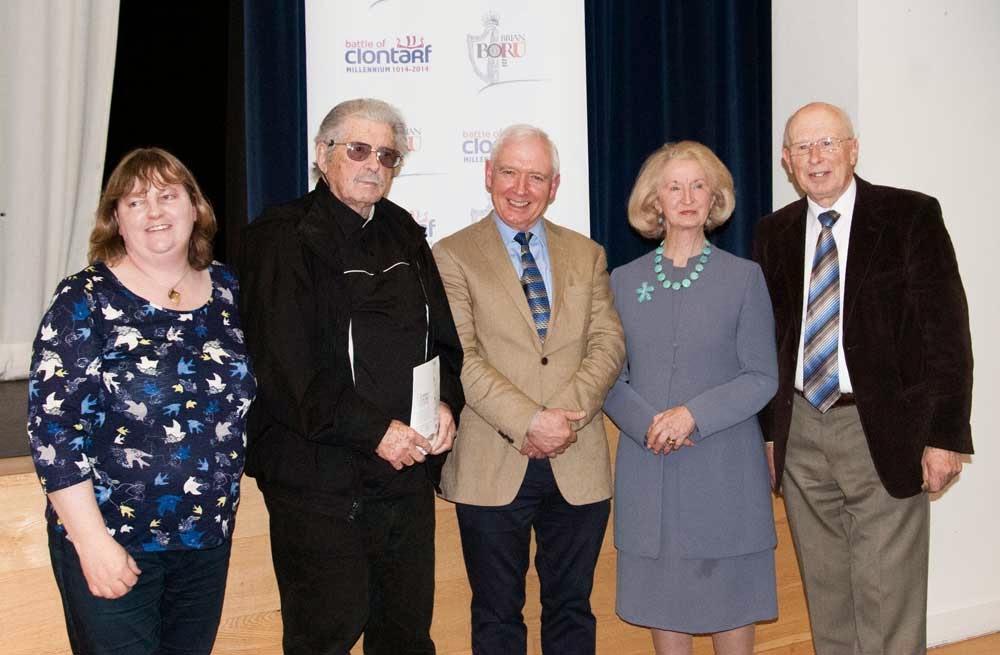
Collette Gill, Pete St John, Colm Lennon,
Kay Lonergan & Douglas Appleyard


I suppose this is an appropriate place to refer to a few wider matters.

There are whacks of things related to Brian Boru and the Battle of Clontarf going on all over the place this year and particularly over the Easter Weekend. The Battle of Clontarf Festival is on in St. Anne's Park, Raheny, on 19/20 April, and promises to be the mother of a jamboree, including a massive re-enactment of the battle.

TCD have just launched a new website which must be one of the best there is anywhere. It combines authoritative material with beautiful presentation along with links to sources and to a hugely entertaining and innovative use of Twitter, which brings you, day by day, through the run up to the battle and the battle itself as seen through the eyes of the characters involved.

Colm Lennon has a book coming out, which not only deals with these aspects of Clontarf, but also examines the wider evolution of the area.


Link to other 1014 related posts, including two other talks in the series.