Showing posts with label Four Courts Press. Show all posts

Sunday, December 09, 2018

THE SUNDAY PAPERS


The above book was launched on Tuesday (4/12/2018) in the "new" Irish Times office in Tara Street in town.


Mark O'Brien, Leo Varadkar, Joe Breen
Click on any image for a larger version

Joe Breen was researching the Sunday Review, published by the Irish Times from 1957 to 1963, when he realised that the Sunday papers as a category had been under-researched so he teamed up with Mark O'Brien and between them they have come up with this book, of which they are both editors and part contributors.


The contents sound pretty comprehensive.
This book includes chapters on the Sunday Freeman, 1913–16 (Felix M. Larkin); Sunday Independent, 1905–84 (Mark O’Brien); Sunday Press (Ray Burke); Sunday Review (Joe Breen); Sunday World (Siún Ní Dhuinn & Regina Uí Chollatáin); Sunday Journal (Mary Muldowney); Sunday Tribune (Pat Brennan & Brian Trench); Sunday Independent, 1984–2012 (Kevin Rafter); Sunday Business Post, 1989–2001 (Ed Mulhall); and Sunday Times (Michael Foley).


Taoiseach Leo Varadkar launched the book.

I'm not sure how he was chosen other than to raise the profile of the launch and of the book itself. Perhaps it was his preoccupation with communications as evidenced in his short lived Spin Unit or maybe he's just a good launcher

He took the opportunity to tell us that the Government has an enormous responsibility to protect the free press and democracy. I hope his conviction lasts and that he will welcome the press speaking truth to power even if it ends up having a crack at himself and his Government.

He mentioned Charlie Hebdo and brought to my mind the Je suis Charlie march in Paris of Heads of State and Government (HOSG) which included some of the most repressive leaders on the planet.


He also referred to what he termed the best historical slogan of a Sunday Paper: the Sunday World's "Are you getting it every Sunday?".

Oops, did I really say that?

Of course, he said, the Sunday World would not have gotten away with such a slogan in today's PC world.

My own favourite, which is not accompanied by a wink-wink is that of the now defunct Scéala Éireann: The Truth in the News. But that wasn't a Sunday Paper so he didn't need to cite it. Anyway, what would he be doing bringing Dev into the conversation and praising the Opposition when it was his night.
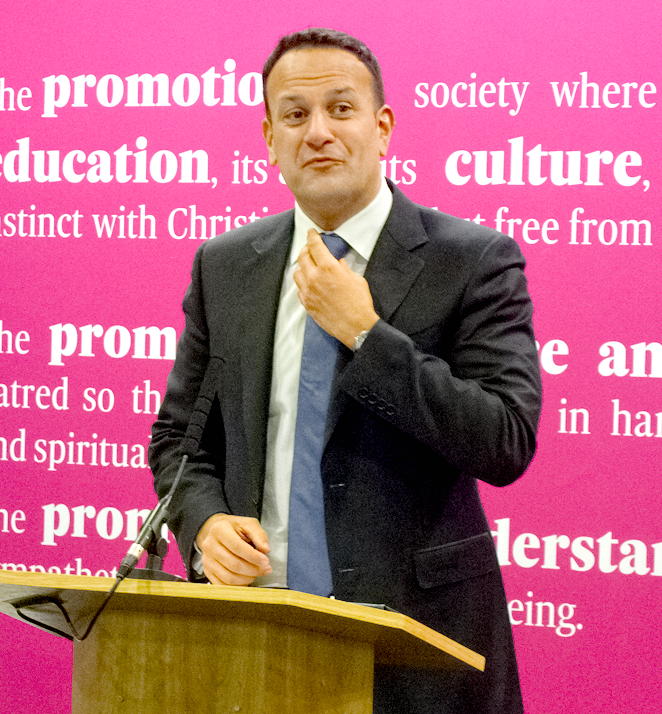


While stressing that journalists had a crucial role in scrutinising claims, whether they came from institutions or individuals, it was also up to the media to cover personal stories responsibly,
By their nature personal stories are compelling, and they help bring focus on issues and that’s why they need to be reported. But by their nature any story that is personal or emotive is subjective, and it is the journalist’s job to inject objectivity into it, so the public get the full story and not just one side of that story.


It was a polished performance, giving rise to whispers of "Patrick Geoghegan" circulating among the cognoscenti.

Anyway the book got launched which is what most of us were there for, and if you want to see what the Taoiseach really said check it out.


Mark thanked Leo for doing the needful, launching the book into the deep.


And he thanked everyone else for coming along


But seriously, though, this was a huge collaborative effort, and he was grateful to all who participated in it one way or another. Special mention was made of Four Courts Press who actually got it onto the streets (as they say in the newspaper business).


Photographers


In the beginning was the word, and then came the pictures.

I have never been at anything with as many photographers present. A murmuration comes to mind but that would be a gross exaggeration. Nevertheless there was enough of them for me to notice.


I managed to get in this shot of three of them which I have christened THE ADORATION OF THE MAGI.


But variety has its limits, and for this guy, it looks like it's all over. Every angle covered, terabytes notched up for processing, creativity spent.

Any chance Leo would do a handstand? Or Joe or Mark do some more speechifying in semaphore?

Not worth the wait. The editor only wants one shot for page three. Time to pack up and find the next gig.

Meanwhile the action goes on.

Signing


Haven't I seen you somewhere before?


Felix, is that Latin? Where are you from?


No, I mean where are you really from?


The cat that got the cream.

Out & About

I knew almost nobody at the do despite my own close connections with the business.

I was, myself, a class of a newspaper proprietor, editor and contributor in a past life, though admittedly on an ultra modest scale and long, long ago.

I have actually written for the Irish Times and ROSC (now defunct, I think).

I was even a sub-editor with the Welsh Nation, Plaid Cymru's English language newspaper, which incidentally seems to have packed up in 1978. That lasted for about ten minutes on the Eisteddfod field. But I did succeed in composing one headline to fill a specific place on the page, all under the expert tutelage of Clive Betts.

My close connection with Sunday papers over much of the 1950s and 1960s was through my mother's shop in Ballybrack (Killiney Bay) where we not only sold the Irish Sundays but much of the English filth which is recalled in more general histories of Sunday papers at large.

There was always a frisson of a Sunday morning as we waited to see how many and which of the English Sundays made it past the Customs and into the waiting vans of Dixons distributors. Purely incidentally, the man at Dixons was a Mr. Shakespeare. You couldn't make it up.

Then, of course there is blogging, a modern form of citizens' "newspapers" and I have been known to write the odd blog post on a Sunday, as I am doing at this very moment.

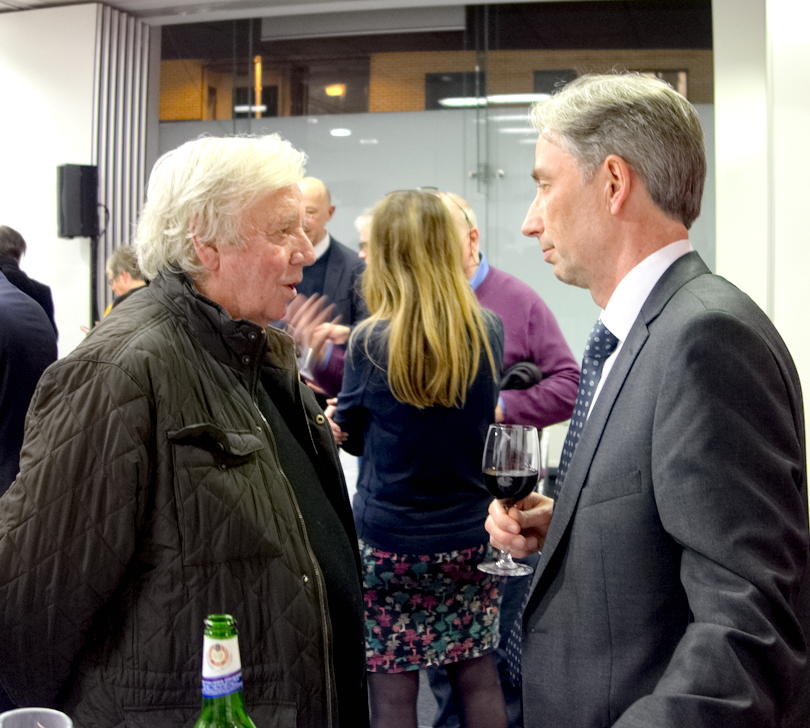
Anyway, as I said, I knew hardly anybody at the event, so I'll just throw in the photos below and you can see who you might recognise.


And we mustn't forget that the publishers need to sell their books to keep the flow coming.

There is a really amazing number of "serious" books being published in Ireland at the moment with Four Courts Press to the fore, if you'll pardon the weak golfing pun.

You can read the Irish Times report on the event for yourself.

There is also a short background piece by the book's editors in the Irish Times.

Thursday, May 03, 2018

WATERFORD'S REDMOND DYNASTY


Click on any image for a larger version

I could have titled this post "From Fenian to Blueshirt" but then I hadn't read the introduction to Pat McCarthy's book when I booked this spot for the post. To be fair to Pat he did spell this out very clearly at the launch where he introduced me to the term "Blueblouses".

And what's all this Waterford thing. I have been to Wexford and seen both the impressive Redmond Square with its memorial and the graveyard where stands Redmond's vault, then in fairly delapidated condition but now happily tarted up following the visit of Michael D. Remind you a bit of whole towns being tarted up in Britain for the visit of the Queen, or even dare I say it, Moneygall. And didn't John Redmond live in Wicklow.

Anyway, let's not trivialise this magnificent work which traces the Redmond dynasty, John, William and Bridget and its amazing symbiosis with Waterford. This was Redmond's political base and one which remained loyal to the family through thick and thin for over half a century.


The Three Musketeers

Standing ready to launch the book in the hallowed surroundings of the Members' Room in the Royal Irish Academy are the three actors in tonight's performance: Harman Murtagh, President of the Military History Society of Ireland, Michael Laffan, the foremost historian of the period in question, and Pat McCarthy, author of this fine and challenging volume.


Harman Murtagh

My connection with Harman Murtagh goes back to 1974 when he was editor of The Irish Sword and I had submitted a piece on a military survey of Killiney Bay in 1797 by a French major, Charles le Comte de Lachaussée. I had peppered it with derogatory references to the British authorities and Harman passed the text for review to GA Hayes McCoy, who, though he passed my text, took out all the derogatory references. I must say that, from my now more mature perspective, this did improve the text enormously and enhanced its academic respectability.

Harman was here on the evening to introduce the speakers and add some wisdom of his own to the proceedings.


Michael Laffan

Michael praised Pat's book both for its scholarship and its storytelling. While there have been various biographies of Redmond this book both treats the full political dynasty and minutely examines Redmond's dependence on, and interaction with, his political base.

Michael recounted a story from his own past when, in 1966, briefly and for the only time he was a member of a political party, he hitched down to Waterford to help with the canvas. One generous motorist who picked him up was Michael Hilliard, then Minister for Defence. As Hilliard was from the other crowd, Michael's mission promptly went undercover for that portion of the journey.


Pat McCarthy

Pat gave a vigorous and indeed humorous presentation of the Redmond dynasty.

He introduced us to the Ballybricken Pig Buyers Association. The what?, I hear you ask. Well, despite their anomalous sounding name this is serious stuff. This crowd were the backbone of Redmond's support in the area. You crossed them at your peril.

The pig factories, which were the predominant industrial activity in Waterford at the time, were not able to buy direct from the local farmers. The Association asserted its position as middleman and that with whatever it took.

Pat recounted the time, illustrated in his book, when the factories tried to import pigs from outside the area. The pigs had to be escorted by Peelers but the Association was ready for them, attacking from the side streets and driving both pigs and Peelers into the river. Pat reports the comment of one old lady: "the poor pigs, sure they could have drowned".

Pat told us that a suggestion had been made that the minutes of the Association must be a great historical resource. Pat had no problem dealing with this, reminding us that cartels do not, as a rule, keep minutes of meetings. Though I have to say that, in today's technological age, some of them have proved to have been very negligent, as shown by the results of various EU Commission dawn raids across the EU.


Pat recalled one of his memories from the the 1966 election in Waterford, already mentioned, where he observed the unique canvassing style of one, Vincent Browne. I'm afraid I'm sworn to silence on this one.

Another memory was from Garret FitzGerald relating to that same year and his introduction to Waterford city politics. Garret, wearing a big Fine Gael rosette, knocked on his first door. The lady answered, took one look at his rosette and said: "you needn't worry sir, we always vote Redmond in this house".


Anthony Tierney, Four Courts Press

Once Pat had finished there was a mad rush to buy copies of the book at the one-night-only knockdown price of €20.


Fortunately Anthony had come prepared and I just managed to snap this neatly wrapped reserve bundle before frontline copies ran out.


Then there was the second queue to get Pat to sign copies of the book.


Meanwhile, the other two Musketeers were mixing with the fans. Harman was clearly in laid back conversation.


While Michael was clearly seized of some important point which he was strenuously trying to get across.


Finola Kennedy

I spotted Finola in the crowd. The last I had heard of her was her advocacy of Frank Duff's name for the Liffey bridge which has now been named after Rosie Hackett.

Finola has written the definitive biography of Frank Duff, known popularly as the founder of the Legion of Mary, but a very rounded man with ecumenical views and independence of spirit.

She has also published a book on the Irish family which was reviewed in the following terms by Diarmaid Ferriter:
Not only historians, but economists, sociologists, lawyers, legislators and general readers owe a huge debt to Finola Kennedy who has researched and explored so many avenues and opened many new doors in this timely, fascinating, and brilliant book.

I have not met Finola but knew of her through her late husband Kieran who had started his career in the Department of Finance and was subsequently Director of the ESRI.


Martin O'Donoghue, Mel Farrell, Niamh Puirséil

Elsewhere the conversation was briefly interrupted to pose for the camera.

Martin is the Director of the Parnell Summer School, which at this stage has widened beyond Parnell himself and is responsible for some first class papers/presentations on a variety of themes often only gently linked to the person of Parnell. It is held mainly in Parnell's old house, Avondale, where I did once myself spend a French (wink, wink) weekend though I have regrettably never attended the School.

Mel has just published a path-breaking book on political parties in the Irish Free State which has just today got a "rave" review on the highly respected website The Irish Story. I attended Mel's launch in this very room and have blogged that launch. An element of Mel's book, not mentioned in the review, is his perceptive use of three of the cartoons of Gordon Brewster in whom I have an interest. I should say that he was pipped at the post here by Michael Laffan who used five in his Judging WT. This public recognition of Brewster, and his relevance to his time, after more than half a century of obscurity, has brought great joy to his family. You can see some of my blogging involving Brewster here.

Niamh is a historian and critic and I would have been familiar with her name. She was author of The Irish Labour Party 1922-1973 and she has an active presence on Twitter. Niamh told me that her latest book, Kindling the Flame. 150 Years of the Irish National Teachers Organisation, features a Brewster cartoon, though I don't yet know which one.


Mel Farrell, Felix Larkin

Where there is Parnell there is Felix Larkin. Felix was the Director of the Parnell Summer School for a number of years and was much lauded for is stewardship of that venerable institution. Felix is a friend and mentor and I have referenced him on my blog many times. We share an interest in cartoonists, particularly of the political kind. Felix is the author of Terror and Discord: the Shemus cartoons in the Freeman’s Journal, 1920-1924 and it was he who introduced me to the Brewster cartoons in the National Library.


Click on image for a larger readable version.

I leave Felix with this gravestone inscription which I'm sure he'll appreciate.

Friday, February 16, 2018

IRISH MEDIA


Me with Joe MacAnthony
Photo: Anne Harris (thanks)
Click on any image for a larger version

Another book launch but a very special one as it turned out. The launch was in the RIA on 14/2/2018. The book was the second edition, seventeen years after the first, of Irish Media - A Critical History.

A second edition because:
Since the first publication of this book in 2001, the pace of change has accelerated dramatically, and has made the publication of a second revised edition particularly timely. The switch from analogue to digital, the growth of social media, the new dominance of mobile, the increasing dominance of aggregators like Google and Facebook, and accelerated patterns of mergers and acquisitions following the 2008 economic crash have all impacted drastically on the media landscape and have raised questions about the future to which few, if any, analysts or media managers have yet managed to construct answers.

The earlier edition was written by John Horgan alone. In this edition he partners with Roddy Flynn. Going on their individual remarks at the launch they seem to have been the dream team for this book.

John is emeritus professor at the School of Communications in DCU. He was the first press ombudsman in Ireland and prior to that had a distinguished career in journalism and politics. Roddy is a lecturer at the School of Communications in DCU, where he is chair of film and television studies. He has written extensively on Irish screen policy, with a particular focus on media ownership and media regulation.


Kevin Rafter

Kevin Rafter is the current head of the School of Communications in DCU, John's old job. He outlined the contribution the School is making to current Irish journalism.

I would add that DCU has so far been a great success as a new university, outclassing its "betters" in many fields. I would hold up their linguistic research and technological application in the Irish language as one of the other interesting areas into which they have ventured.

It was once described to my son, who had a very successful and happy innings there, as "The Nerds University". Those so describing it were attending a southside university from which he had fled so that he could actually get a bit of work done. All kinds.


John Horgan

John gave us many stories and themes from the book. One of these was the story, way back, of Joe MacAnthony and his exposé of the corruption inside the Irish Sweepstakes. He paid dearly for that and has been one of my heroes since. And John said he was there with us in the audience.

I immediately resolved to have my photo taken with him and later press ganged Anne Harris, whom I had just met, to do the needful. Thank you Anne. Eternally grateful. You can see the result at the head of this post.

John made a very optimistic and encouraging point - the legacy media were fighting back and now looked like they were actually coming back. Perhaps in not quite the same form but nevertheless. Their decline had bottomed out and they were on the rise. This was down to two factors. The proliferation of "fake news" and undisciplined and shoddy reporting had led to a desire for solid authoritative copy. At the same time the legacy media were developing business models which would be sustainable in the cyber age.

There would clearly be exceptions but the overall vibe was positive.


Roddy Flynn

There were two new aspects to this book over its predecessor: the period covered was extended back way beyond the establishment of the Free State, to the seventeenth century in fact; and the range of coverage was extended to include online media.

I think Roddy covered the latter extension but it was clear from his respect for John, which John had reciprocated earlier, that this was really a joint and largely seamless effort.


Joe Duffy

In launching the book, Joe Duffy made a number of significant points about media in general and in paticular about the interplay between the State and the broadcaster, an area John had touched on earlier. Joe's career in broadcasting goes back a long way and he has always been involved in bringing the show to the people and the people to the show.

Many of my own colleagues in the civil service saw him simply as a stirrer-upper to be avoided at all costs. I did not share that view. It was clear to me that he was giving a voice to the voiceless and if that required a bit of showmanship from time to time so be it.

It did not surprise me, when I read his autobiography, that he had come from a modest background, or that he had been a probation officer. He has a quality which is rare enough among broadcasters: he actually listens and he is not afraid of on-air silences. These attributes, aside from serving a higher purpose, go a long way towards making for great radio.


Joe MacAnthony

I mentioned Joe MacAnthony already. Best to expand that reference by again quoting from the book. But first to set the context. There was speculation at the time that the ailing Independent Newspaper Group might be bought by the McGrath family whose wealth was based largely on a Goverment franchise to run the Irish Hospitals' Sweepstakes:
On 21 January 1973, however, this possibility evaporated in the wake of the publication in the Sunday Independent of that date of one of the most remarkable pieces of investigative journalism that had ever appeared in an Irish newspaper up to that time and indeed for many years afterwards. This was an exposé by the journalist Joe MacAnthony of the activities by McGrath's sweepstakes company, many of them illegal, in the foreign jurisdictions in which sweepstakes' tickets were sold.

The article, which ran to some 8,000 words and over three pages of the paper, had been planned originally as a two-part series. `The editor of the paper, however, realised that if the first half was published that the second half, in all probability, would never see the light of day; accordingly he decided to run it all in one article. The McGraths were incensed and withdrew all their lucrative advertising from the group for some weeks.

MacAnthony resigned not long afterwards, after it had been made clear to him by a regretful O'Brien that his career within the organization had effectively reached a full stop, at least in terms of promotion.
Joe MacAnthony also investigated Ray Burke for planning abuse but the establishment closed ranks and it was some quarter of a century later before MacAnthony was vindicated. Meanwhile he had emigrated to Canada where he had a very successful career as an investigative journalist.


Anne Harris

And that brings me neatly to Anne Harris, who took the photo of me and Joe at the launch. It is not the act for which she will be most famous. That must surely be in her standing by her criticism of Denis O'Brien after he acquired a major interest in her newspaper. She is no longer its editor.

It's quite amazing the people you meet on these occasions. I spoke to a man I didn't know who was standing alone at the time. It turned out to be an interesting encounter. He is currently the editor of Books Ireland but in an earlier existence he founded the Newry and Mourne Museum, now in its thirtieth year and in a much expanded form. I happen to be a great fan of the museum and was fascinated to meet its founder.

The museum is currently on the site of Bagnal's Castle. For many years the location of the castle was unknownn. This man, Tony Canavan, worked out where it was and brought his discovery to Heritage HQ in Belfast but they dismissed it. He was later vindicated when the ruins of the castle were discovered when the Victoria Bakery which had been covering them up was being renovated.

Tony also turned out to be a brother in law of Brian Goggin, with whom I had previously been corresponding in the course of my family history research.

And my interest in all of this?

Well, once upon a time, I was a newspaper proprietor and editor myself.