Click on any image for a larger version
I could have titled this post "From Fenian to Blueshirt" but then I hadn't read the introduction to Pat McCarthy's book when I booked this spot for the post. To be fair to Pat he did spell this out very clearly at the launch where he introduced me to the term "Blueblouses".
And what's all this Waterford thing. I have been to Wexford and seen both the impressive Redmond Square with its memorial and the graveyard where stands Redmond's vault, then in fairly delapidated condition but now happily tarted up following the visit of Michael D. Remind you a bit of whole towns being tarted up in Britain for the visit of the Queen, or even dare I say it, Moneygall. And didn't John Redmond live in Wicklow.
Anyway, let's not trivialise
this magnificent work which traces the Redmond dynasty, John, William and Bridget and its amazing symbiosis with Waterford. This was Redmond's political base and one which remained loyal to the family through thick and thin for over half a century.
 The Three Musketeers
Standing ready to launch the book in the hallowed surroundings of the Members' Room in the Royal Irish Academy are the three actors in tonight's performance: Harman Murtagh, President of the Military History Society of Ireland, Michael Laffan, the foremost historian of the period in question, and Pat McCarthy, author of this fine and challenging volume.
 Harman Murtagh
My connection with Harman Murtagh goes back to 1974 when he was editor of The Irish Sword and I had submitted a piece on a military survey of Killiney Bay in 1797 by a French major, Charles le Comte de Lachaussée. I had peppered it with derogatory references to the British authorities and Harman passed the text for review to GA Hayes McCoy, who, though he passed my text, took out all the derogatory references. I must say that, from my now more mature perspective, this did improve the text enormously and enhanced its academic respectability.
Harman was here on the evening to introduce the speakers and add some wisdom of his own to the proceedings.
 Michael Laffan
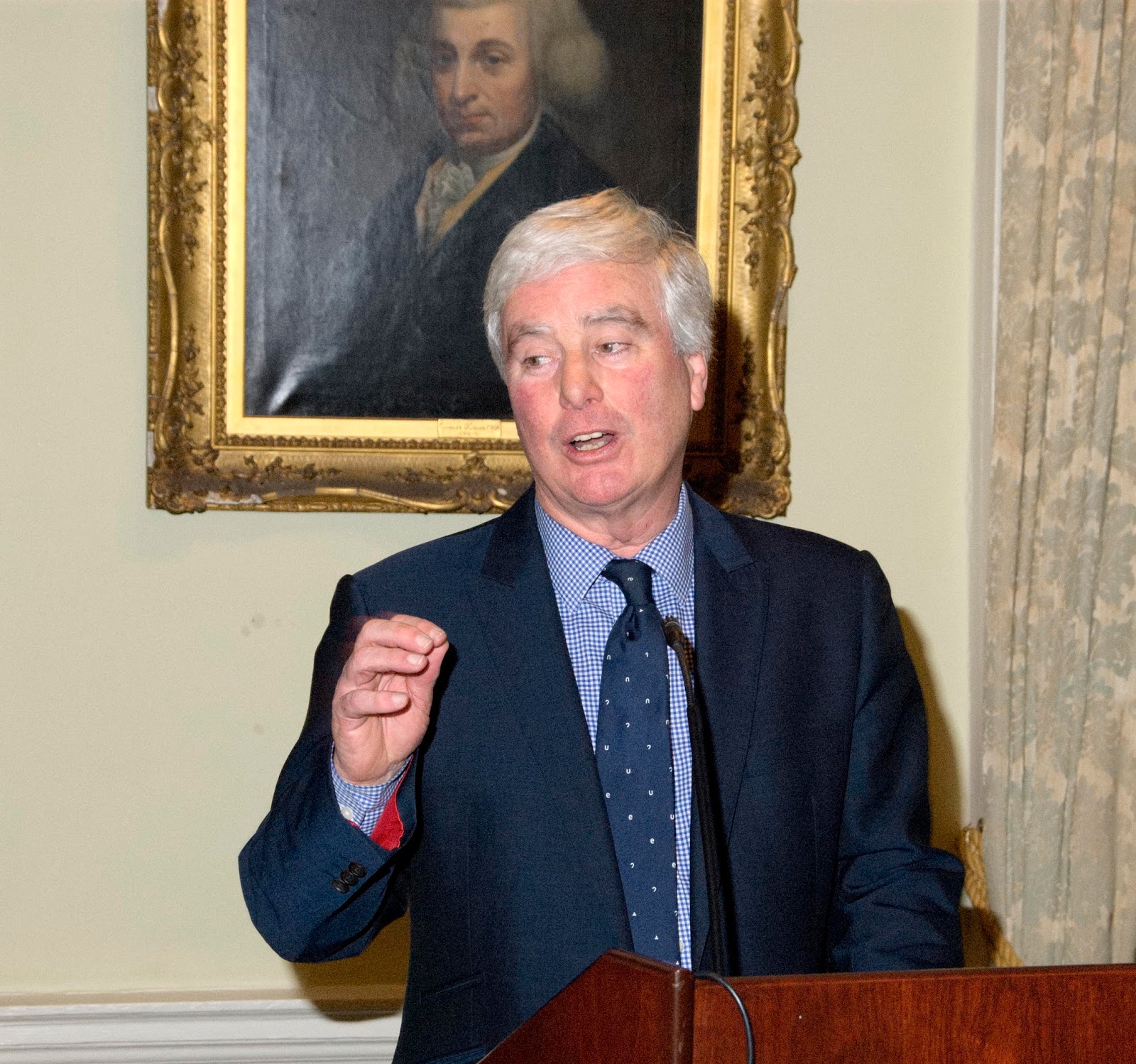
Michael praised Pat's book both for its scholarship and its storytelling. While there have been various biographies of Redmond this book both treats the full political dynasty and minutely examines Redmond's dependence on, and interaction with, his political base.
Michael recounted a story from his own past when, in 1966, briefly and for the only time he was a member of a political party, he hitched down to Waterford to help with the canvas. One generous motorist who picked him up was Michael Hilliard, then Minister for Defence. As Hilliard was from the other crowd, Michael's mission promptly went undercover for that portion of the journey.
 Pat McCarthy
Pat gave a vigorous and indeed humorous presentation of the Redmond dynasty.
He introduced us to the Ballybricken Pig Buyers Association. The what?, I hear you ask. Well, despite their anomalous sounding name this is serious stuff. This crowd were the backbone of Redmond's support in the area. You crossed them at your peril.
The pig factories, which were the predominant industrial activity in Waterford at the time, were not able to buy direct from the local farmers. The Association asserted its position as middleman and that with whatever it took.
Pat recounted the time, illustrated in his book, when the factories tried to import pigs from outside the area. The pigs had to be escorted by Peelers but the Association was ready for them, attacking from the side streets and driving both pigs and Peelers into the river. Pat reports the comment of one old lady: "the poor pigs, sure they could have drowned".
Pat told us that a suggestion had been made that the minutes of the Association must be a great historical resource. Pat had no problem dealing with this, reminding us that cartels do not, as a rule, keep minutes of meetings. Though I have to say that, in today's technological age, some of them have proved to have been very negligent, as shown by the results of various EU Commission dawn raids across the EU.
Pat recalled one of his memories from the the 1966 election in Waterford, already mentioned, where he observed the unique canvassing style of one, Vincent Browne. I'm afraid I'm sworn to silence on this one.
Another memory was from Garret FitzGerald relating to that same year and his introduction to Waterford city politics. Garret, wearing a big Fine Gael rosette, knocked on his first door. The lady answered, took one look at his rosette and said: "you needn't worry sir, we always vote Redmond in this house".
 Anthony Tierney, Four Courts Press
Once Pat had finished there was a mad rush to buy copies of the book at the one-night-only knockdown price of €20.
Fortunately Anthony had come prepared and I just managed to snap this neatly wrapped reserve bundle before frontline copies ran out.
Then there was the second queue to get Pat to sign copies of the book.
Meanwhile, the other two Musketeers were mixing with the fans. Harman was clearly in laid back conversation.
While Michael was clearly seized of some important point which he was strenuously trying to get across.
 Finola Kennedy
I spotted Finola in the crowd. The last I had heard of her was her advocacy of Frank Duff's name for the Liffey bridge which has now been named after Rosie Hackett.
Finola has written the definitive biography of Frank Duff, known popularly as the founder of the Legion of Mary, but a very rounded man with ecumenical views and independence of spirit.
She has also published a book on the Irish family which was
reviewed in the following terms by Diarmaid Ferriter:
Not only historians, but economists, sociologists, lawyers, legislators and general readers owe a huge debt to Finola Kennedy who has researched and explored so many avenues and opened many new doors in this timely, fascinating, and brilliant book.
I have not met Finola but knew of her through her late husband Kieran who had started his career in the Department of Finance and was subsequently Director of the ESRI.
 Martin O'Donoghue, Mel Farrell, Niamh Puirséil
Elsewhere the conversation was briefly interrupted to pose for the camera.
Martin is the Director of the
Parnell Summer School, which at this stage has widened beyond Parnell himself and is responsible for some first class papers/presentations on a variety of themes often only gently linked to the person of Parnell. It is held mainly in Parnell's old house, Avondale, where I did once myself spend a
French (wink, wink) weekend though I have regrettably never attended the School.
Mel has just published a path-breaking book on political parties in the Irish Free State which has just today got a "rave" review on the highly respected website
The Irish Story. I attended Mel's launch in this very room and
have blogged that launch. An element of Mel's book, not mentioned in the review, is his perceptive use of three of the cartoons of Gordon Brewster in whom I have an interest. I should say that he was pipped at the post here by Michael Laffan who
used five in his Judging WT. This public recognition of Brewster, and his relevance to his time, after more than half a century of obscurity, has brought great joy to his family. You can see some of
my blogging involving Brewster here.
Niamh is a historian and critic and I would have been familiar with her name. She was author of
The Irish Labour Party 1922-1973 and she has an active presence on Twitter. Niamh told me that her latest book,
Kindling the Flame. 150 Years of the Irish National Teachers Organisation, features a Brewster cartoon, though I don't yet know which one.
 Mel Farrell, Felix Larkin
Where there is Parnell there is Felix Larkin. Felix was the Director of the Parnell Summer School for a number of years and was much lauded for is stewardship of that venerable institution. Felix is a friend and mentor and I have
referenced him on my blog many times. We share an interest in cartoonists, particularly of the political kind. Felix is the author of
Terror and Discord: the Shemus cartoons in the Freeman’s Journal, 1920-1924 and it was he who introduced me to the
Brewster cartoons in the National Library.
 Click on image for a larger readable version.
I leave Felix with this gravestone inscription which I'm sure he'll appreciate.