Showing posts with label Cartoons. Show all posts

Saturday, January 06, 2018

SUFFRAGIST CITY


Click on any image for a larger version

Dublin City Library & Archive have done it again.

A very interesting and thought-provoking exhibition on the Suffragist movement. The movement had an initial success when women were given the vote in parliamentary elections in Britain and Ireland in February 1918. The voting age for men was 21 with no property qualification. For women it was 30 with a property qualification. Equal access to the vote for women and men was achieved in the UK in 1928. It had already been the case in the Free State from the beginning.

I'll just hit a few spots below but, if you get a chance, do drop in and have a look.

But first, a more general observation. This exhibition clearly demonstrates the relevance of cartoons to the developments of the day. It is great that there has been a revival of interest in the role of the cartoonist in recent times. Felix Larkin led the way with his politically perceptive book on Ernest Forbes Terror and Discord: The Shemus Cartoons in the Freeman's Journal 1920-1924. The collection is available online from the National Library of Ireland. This was followed by James Curry's book Artist of the Revolution: The Cartoons of Ernest Kavanagh (1884 - 1916), Kavanagh (EK) was the cartoonist for Larkin's Irish Worker until his unfortunate death in 1916. Then we had both James's and Ciarán Wallace's beautiful book The Lepracaun Cartoon Monthly. The Lepracaun contained mainly the cartoons of its founder and editor Thomas Fitzpatrick, but it also featured those of Frank Reynolds (S.H.Y.). And finally, there is Gordon Brewster, in whom I have taken an interest, a collection of originals of some 500 of whose cartoons have become accessible online from the National Library of Ireland, and whom I have recently publicised in a talk, also available online. Felix has a post in the now sadly inactive blog Pues Occurrences which mentions a number of other works on cartoons.

So you won't be surprised to see the works of at least three of the cartoonists mentioned above figuring in this exhibition. If a picture is worth a thousand words, most cartoons are probably worth much more.


The Suffragettes were generally depicted in the public media of their day as a crowd of violent harridans, and the illustration above and the two below certainly attempt to give this impression. Mind you, I'm not saying they weren't above the odd bit of violence (unlike the men?).


This history is in a glass case at the exhibition so I didn't get a chance to leaf through it. I'm sure its content is adequately reflected in the exhibition panels.


This is the verse on the cover of the pamphlet.


And this version of "the storming of the Bastille" by the knitters brigade has a certain air of spontaneity about it.


This development in 1911 when John Redmond's party in Westminster abandoned the women in favour of Home Rule really got them going. I can do no better than to quote from James and Ciaran's book here:
In January of 1911 the unpredictable nature of electoral politics left the Irish Parliamentary Party holding the balance of power in Westminister. At last, or so it seemed, Redmond's moment had come. In this particularly sharp cartoon Fitz plays on a famous advertisement for Sunlight Soap drawing the Liberal Prime Minister Asquith as a traffic policeman holding back two great forces in British Politics, the House of Lords and the Women's Suffrage campaign, to allow a delightfully prim John Redmond to carry his Home Rule parcel safely across. The label 'Soft Soap' on both the parcel and the cartoon shows that the Irish public were not fully convinced.


As a special favour to my readers I am reproducing the original ad above. This is not in the exhibition but is in the book. Gordon Brewster took similar liberties with one of his political cartoons but in that case it was Pears and not Sunlight soap.


In another of Fitz's cartoons featured in the exhibition poor Tom Kettle comes in for a hard time. Here he is, a year before the Redmond cartoon, promising the female population the vote.

I have to confess that this cartoon reminded me of Brexit, at least insofar as the twin promises of the vote for women and Home Rule proved incompatible and in making his choice Redmond opted for Home Rule first. The cartoon is based on the Gilbert and Sullivan operetta, Patience. You can see the full cartoon here.


I just couldn't resist this photo from the exhibition of Constance Markievicz as Joan of Arc. Call me cruel if you will.


This cartoon from the pen of Grace Gifford poses the question less asked, if ever. Indeed, why would men ask it. Her point i'm sure. Grace was an artist and cartoonist in her own right but she is probably better known to the public today for her marriage to Joseph Mary Plunkett in Kilmainham jail the night before his execution in May 1916.


A few small quibbles. I was not gone on the green and orange colour scheme. I thought it took from the impact of the content. There is an ongoing problem with the high large windows. They are not always suitable as a light source and they can make it difficult to view the exhibits, particularly against the light. I had some niggles on the Irish. "Sufragóir" is neither the singular nor the plural genitive, and I don't think you can use "um" when there is a sense of purpose involved. I have seen the meaning translated as "about" rather than "for" and I think that is a good guide for its use.

Small things truly. That said, this is another great exhibition in the series commemorating the Ireland of one hundred years ago. And it is a worthy contribution to ensuring that women getting the vote, albeit on a restricted basis, will not be overshadowed by either the ending of WWI or the UK General Election of 1918.


Kim Bielenberg has a very good piece in the Indo

Monday, May 29, 2017

GORDON BREWSTER & SPORT


General election September 1927
Link
to cartoon in NLI collection.
Click on any image for a larger version

Sporting analogies have long been used to describe various aspects of life outside the realm of sport itself. They are a godsend to the cartoonist and allow what might otherwise be wise but dull observations to be made in a dramatic and impactful way.

Certainly Gordon Brewster made great use of them and there are nearly forty "sporty" cartoons in the almost five hundred of his cartoons in the National Library collection.

And Gordon was no armchair sports cartoonist. His daughter, Dolores, told me at one stage that
He was no mean athlete. He swam in the island race (Ireland’s eye) and also played water polo. I have the gold medal he won with the Clonliffe Harriers. 


Boxing is probably one of the best sports analogies for depicting conflict whether between individuals or between the individual and hostile forces ranged against him.

This one shows President Hoover, using public works to combat pessimism engendered by a Stock Exchange wobble (or as Brewster puts it "jazz finance on Wall St.") in 1927. However, they didn't know what was coming then and the subsequent crash in 1929 had long lasting devastating consequences.


By the end of 1930 it was clear that Uncle Sam was on the floor.
Caption: "A characteristic of the slump of 1930 in America is that all parts of the country, and all classes are suffering, and not merely sections, which has been the case in some previous depressions".


The area of labour relations was one where Brewster's view had mellowed over the decades from the confrontational to the conciliatory. Clearly he is making an exception here, in 1928, in the case of the moderate militants in the shadow of the bitter 1926 General Strike.
Caption: The General Council of Trade Unions Congress held a special meeting in London to consider the position. The moderates drew first blood. They defeated by 15 votes to 6 a motion by Mr. Hicks to terminate the peace in industry discussions with the Mond group of employers".


By June 1930 some action was called for to clean up boxing itself.
Caption: Owing to the alarming number of decisions on fouls in boxing championships, our artist suggests half-suits of armour for future contests.


Already by 1928 football referees were having serious problems on the field of play and imaginative innovation, however impractical, was also the order of the day.
Caption: "During last weekend there were on three different football grounds and at games played under two different codes, Gaelic and association, disgraceful scenes the referee in each case being violently assaulted because his decision did not satisfy the supporters of one or the other of the teams".


This one from late 1929 suggests that matters had not much improved in the intervening year and a half.


Perhaps the absence of a street ref in 1926, and earlier, might have contributed to the problems on the senior field of play.

I can't look at this cartoon without thinking of Johnny Giles, who, if I remember, started into football in precisely this way on Dublin's northside.


And then there was rugby and the big one in those days was winning the triple crown. The teams playing were England, Ireland, Scotland and Wales, and any team beating the other three won the triple crown.

There are three Triple Crown cartoons in the collection.This one is 1926 and at this point (7 March) we had beaten England, but had been beaten by Scotland and were to go on to lose to Wales. So we were already out of the running.


This one is 1930 and at that point (1 March) we had beaten England, but had been beaten by Scotland and were to go on to lose to Wales. So we were already out of the running.


This one is 1931 and at that point (7 March) we had already beaten Scotland and were to go on to beat Wales. But we had already been beaten by England and were not in the running at this stage.

Just looking at the cartoons alone you would think all we had to do in those three years (1926, 1930 and 1931) was to beat Wales and we were home and dry. But in all three cases we were already a goner.

So knowing the score when the cartoons appeared what do they tell us? In each case there was the Welsh match still to play, and perhaps that is the only concern of the cartoons. We went on to beat Wales in 1931 and lost to them in the other two years.

As it turned out there was no winner of the Triple Crown in any of the three years. Ireland had not won since 1899 and was not to win again until 1948.


That's enough guff for the rugby afficionados. This one is rugby in the service of politics.
Catption: So strong was the opposition in the Dáil to the Civil Service Regulations (Amendment) Bill that the Government could only obtain a majority of five for the second reading in a division list of 67.

The underlying issue was an interesting one. The Government had discovered that the existing primary legislation - Section 4.2 effectively prohibited recruitment to the Civil Service on a gender basis. The only discrimination allowed was based on age, health, character and whether the appropriate examination fee had been paid.

But the Government didn't want male clerk typists and it didn't want female customs officers. So the word "sex" had to be added to the primary legislation to allow the regulations to discriminate on this basis.

I am including a sprinkling of other sports which figure in Brewster's cartoons below:


Butterfly hunting (August 1929).

I have another example included in my post on Brewster and the Flu.


Bullfighting (July 1931).
Caption: "Not a single Communist has won a seat in the new Spanish Parliament".


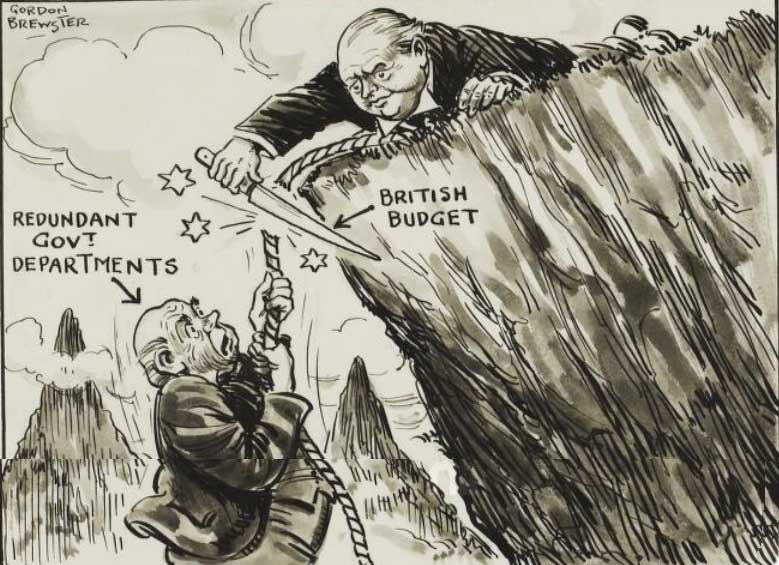
Mountaineering (April 1927)
Caption: "In regard to the abolition of redundant departments the Free State Government might take a lesson from the British Government"


Grouse Shooting (January 1930)
Caption: "The various Governments put their names to pacts of peace, but seem to hesitate about honouring their signatures. While the prospects of complete agreement on all points at the London Disarmament Conference are not very rosy, one need not be in a hurry to predict absolute failure".

The remaining sporty cartoons cover a raft of areas, such as: wrestling, fishing, balooning, cricket, greyhound racing, sailing, kite-flying, tennis, ten pin bowling, punting, sailing, and flying.

Thursday, January 28, 2016

DISTURBANCES IN HOWTH

Following report by O'Brien

Background

The Howth Peninsula Heritage Society, a respectable and long-established group in Howth, had invited a certain P. Ó Duibhir, an itinerant rabble rouser orator of indeterminate qualifications, to give a talk on the cartoons of one Gordon Brewster, a professional artist and cartoonist who, many years ago, had apparently died in a commercial premises managed by the parents of the aforementioned orator.

Had they been consulted in advance, the Gárdaí would have cautioned against inviting such an individual into a private club.

The Event


The Orator

Ó Duibhir arrived promptly enough and was of reasonably respectable appearance (see Photo "The Orator").


Intro Shot 2

Having tried to ingratiate himself with some of the women in the audience, he then set up his stall (see Photo "Intro Shot 2")


Into His Stride

and embarked upon a comprehensive and, it must be said, interesting exposition on the life and works of Gordon Brewster (see Photo "Into His Stride").

Up to this point, the audience was generally quiet and attentive, although there was a certain amount of ominous shuffling of feet and muttering from the cheap seats in the back row.

It was when Ó Duibhir started to comment in detail on various Brewster cartoons that the trouble began. Many of these cartoons were, in the opinion of this Member, scurrilous and of low quality, in that they insulted many eminent personages and commented in a vulgar manner on the political and social events of the time.


The First Heckler

At this point the audience, especially those in the cheap back row seats, was getting restive. Feet were stamped, there were catcalls, and heckling began (see Photo "The First Heckler").


The Second Heckler

The organisers, commendably, tried to shut off the Orator's microphone but were fought off by Ó Duibhir, who continued to shout down the growing volume of heckling (see Photo "The Second Heckler").

Matters came to a crisis point when Ó Duibhir exhibited a cartoon depicting Ernest Blythe in the act of removing a shilling from the Old Age Pension.

This enraged the audience and mayhem ensued. Chairs and bottles were thrown and a scuffle involving fisticuffs broke out in the back-row cheap seats. Several ladies fainted.

The Gárdaí, Fire Brigade and ambulances were called and arrived promptly.


A Last Effort To Restore Order

To his credit and in mitigation of any charges that may be brought when he is apprehended, Ó Duibhir made a final, desperate, effort to quell the disturbance (see Photo " A Last Effort To Restore Order"), before fleeing the scene through an open window.

Sequel and Lines of Enquiry

Seven people were taken to hospital and eleven others were treated at the scene. Most of their injuries are not life-threatening. The premises was burnt to the ground.

Ó Duibhir is still at large. The public are warned not to approach him. He may be being assisted and hidden by one Finbarr Crowley, a local ne'er-do-well who is also being sought.

An individual in a blue patterned hoodie who was seen running from the premises is also being sought, although it is believed that this person may already have left the jurisdiction.

(signed) O'Brien.

Saturday, January 23, 2016

Gordon Brewster and the 1916 Rising


Gordon Brewster at his desk in Independent Newspapers
Courtesy of the Brewster family

This is the year where everyone drags up whatever connections they can muster to the 1916 Rising and exposes them to the light of day. I don't really have any such connections myself but I would like to avail of the opportunity to remember a forgotten artist who had.

Gordon Brewster vanished from the public consciousness after his sudden death in 1946. Perhaps the fact that his parents and two of his three brothers had died by then and his widow and children lived in England afterwards had something to do with his public oblivion.

And if he has been brought back into the spotlight more recently, through the acquisition by the National Library of Ireland of a collection of originals of some 500 of his cartoons, it is as a cartoonist rather than an artist that he is likely to be recognised.

But Brewster was primarily an artist. He had been trained in the Dublin Metropolitan School of Art (now NCAD) and in 1916, aged 27, he had exhibited in the Royal Hibernian Academy (RHA).


List of Brewster's exhibits at Royal Hibernian Academy

In fact, he exhibited there in both 1916 and 1917 and his exhibits in both those years were connected with the Rising.


RHA on fire during 1916 Rising
Courtesy of Mick O'Dea, artist.

Unfortunately his 1916 exhibits were destroyed during the Rising as an unmanned rebel barricade close to the RHA premises was shelled by British Forces. In the course of this attack the RHA building, in Lower Abbey Street, was gutted and all 500 exhibits in the annual exhibition, along with much other precious material, were lost.

That was the end of Brewster's The Tavern Fire and The Wayfarer.


Former RHA building as it is today

Francis Johnston's elegant building is now minus its ground floor elegance and hosts a SPAR shop and some CIE offices.


Note on use of shrubbery for cover in
St. Stephen's Green during the Rising
Courtesy of Bureau of Military History

So what about Brewster's 1917 exhibit and its connection to the Rising which was well over by then?

This was a painting of a dead rebel whom he saw in St. Stephen's Green during Easter week.

While the trees and shrubbery in St Stephen's Green gave some initial cover to the rebels, this was devalued when British Forces opened up with machine guns from the Shelbourne Hotel and the rebels had to retreat to the College of Surgeons building. They left one of their dead behind. Brewster came across him and later did a painting of him.

The Dead Rebel was listed in the 1917 RHA exhibition at more than twice the price of his two earlier exhibits which suggests it was a larger canvas.


The Grove, Sutton, where The Dead Rebel hung 1920 - 1946

The Dead Rebel survived that year's exhibition and hung on the wall of his house in Sutton until his sudden death in 1946. I have not been able to trace it and the fear is that it was destroyed in the general clear out after his death.

So what of Brewster's other artistic output?


Irish Peasant Woman,
only known extant painting by Brewster
Courtesy of Dr Margarita Cappock, Hugh Lane Gallery.

At this remove, the only piece I could trace was this portrait of an Irish Peasant Woman which is stored in the Hugh Lane Gallery in Parnell Square.

This painting, along with his having exhibited two years running in the RHA, should copperfasten his reputation as an artist, but I suspect that, of necessity, it will be through his cartoons that his reputation will live on from this point.

I know that, for his descendants, he is primarily Gordon Brewster the artist, and clearly that will remain the case.

There is, however, nothing wrong with being remembered as a cartoonist when your cartoons are of such exceptional quality.


Selfie?
Courtesy of National Library of Ireland

You can read more about Gordon Brewster's life and his cartoons here.

I have also done a talk on him recently on his home ground on the Howth peninsula which was the subject of a dramatic report by O'Brien, here.

Tuesday, November 17, 2015

Two Top Toons

In recent times I have started doing more cartoons. These are not drawn cartoons, I can't draw. They are photo-montages put together with the aid of Photoshop. Since I discovered how to use the layers feature in my latest, if truncated, version of the package I have been having a ball.

So I just thought to reproduce here two of the cartoons which required an extensive use of layers in their composition and which I am particularly proud of.


Ruairí Quinn drawing his own real life cartoon in Place du Tertre

The cartoon appeared as part of a series on Enda's first cabinet. Ruairí is portrayed as Toulouse Lautrec and is drawing a cartoon of his own, which he actually did draw at a Government meeting in 1986.


Bishop Tim Dakin in the flooded vault of his own Cathedral

This cartoon was one of a number prepared for a set having a go at Bishop Dakin of Winchester. The bishop was ducking dealing with a serious complaint from a lady who had been abused on the island of Jersey which was then in the Winchester diocese. The trickier feature here is the reflections in the water. As it happened I included a slightly different version in the set on the bishop. The full series of Jersey cartoons gives a birds eye view of some of the corruption and general incompetence involved in the running of the island. It has not been updated for a while.

Thursday, November 12, 2015

The Law's an Ass


John Holohan, Chairperson, RDS Speaker Series

This is the man, who introduced the man, who introduced the man, who introduced the speaker, Felix M Larkin.

The occasion was a talk in the RDS last evening (11/11/2015) in the Hugh M Fitzpatrick series of lectures on legal bibliography.

Felix was giving a talk entitled The Asinine Law: Irish Legal Cartoons, c.1800 - 2015.


Hugh M Fitzpatrick initiator of the legal bibliography talks series

Hugh M Fitzpatrick explained how he had hoped to introduce the subject of legal cartoons into the series and finally settled on Felix as speaker as he knew Felix had the knowledge, interest and wit to carry it off.

He in turn introduced the MC for the evening, Peter Feeney, currently the Press Ombudsman.


Peter Feeney, Press Ombudsman

Peter explained that he had to think twice before accepting the invitation in case the subject conflicted with his current job, but he took consolation in the fact that most of the cartoons would be a hundred years old. He may have got a shock when Felix coasted into Martyn Turner territory at the end of the talk, but that's life.


Felix M Larkin, speaker

Felix gave us a great romp through two hundred years or so of legal cartoons. He passed seamlessly from theme to theme with a dazzling selection of cross-fades and segues. The point came across clearly that while they may contain some humour, cartoons are not exclusively funnies. Some can be by way of subtle commentary and others plain downright vicious.

I was very impressed by the quality of some of the cartoons both in their conception and presentation and I was introduced to a load of cartoonists I had never heard of.

I was glad to see the space given to Ernest Forbes (Shemus) on whom Felix is the expert, and also to Ernest Kavanagh, who is only recently getting credit for his hard hitting political cartoons in Jim Larkin's Irish Worker, and finally to Gordon Brewster, a skilled cartoonist in whom I have a particular interest myself. All of these had risked being lost sight of before the current wave of interest in their cartoons.

Felix also drew on the Dublin Opinion, on which he has done some heavy lifting himself in recent times. Besides his recent talk to the Irish Historical Society at Boston College, Dublin, he has contributed a chapter on the Dublin Opinion to the excellent volume on Periodicals and Journalism in Twentieth-century Ireland which he has also edited with Mark O'Brien.


So I'll round off with one of the two Brewster cartoons from the talk. Chief Justice Kennedy is lampooned in the Evening Herald of 27 March 1926 for rejecting the Court Officers Bill which would put court employees under the jursidiction of the Civil Service rather than the courts. The irony being that the bill arose from a recommendation of a committee of which Judge Kennedy had himself been a member.

The talk was delivered with great aplomb to a packed, distinguished and appreciative audience.

Wednesday, October 22, 2014

Judging W T


Click on any image for a larger version

The Royal Irish Academy published the latest book in their "Judging ..." series last evening. This is Michael Laffan's "Judging W T Cosgrave". I haven't yet read the book but if the speakers are to be believed it is not one to be missed.


Michael Laffan, Liam Cosgrave, Enda Kenny

WT Cosgrave was the first "Taoiseach" (President of the Executive Council) and he was in office from 1922 to 1932 at the head of the pro-Treaty Cumann na nGaedheal government.

He was not himself at the launch, as he died in 1965, but we had one current and two former Taoisigh present. WT's son Liam, now 94 and a former Taoiseach himself, gave a touching and illuminating speech about his father. Current Taoiseach, Enda Kenny, also spoke, more eloquently than usual, and formally launched the book. And the author, Michael Laffan, gave us some background and praised Liam for his cooperation in the writing of the book, though he said Liam might not like some of what he wrote. Former Taoiseach, John Bruton, was also present in the body of the audience.


Dolores and myself
Photo: Johnny Bambury

I have to come clean and admit that I was not really there for the book launch as such. I had learned that Dolores Brewster (m. Scott) and her daughter, Lynne Pentlow, had been invited and were flying in from Bristol to attend.

Dolores is the daughter of Gordon Brewster, the artist who was chief cartoonist and subsequently Art Editor in Independent Newspapers, including during WT's period as "Taoiseach". During those years he took at least 21 pokes at WT in his cartoons. Michael has included five of Brewster's cartoons in his book and these are set out below.


See cartoon in NLI collection
Thanks to National Library of Ireland

This one has WT painting a "selfie" showing himself as the "knight in shining armour" slaying the dragon of foreign competition with the Sword of Tariff, all to protect native Irish industry.


See cartoon in NLI collection
Thanks to National Library of Ireland

This one takes a poke at Finance Minister, Ernest Blythe's taking the shilling off the old age pension in 1924, reminding us that, at the same time, the politicians were coining it at the taxpayer's expense.


See cartoon in NLI collection
Thanks to National Library of Ireland

This one is sort of dynamite. It was published on 28 May 1927 and shows public opinion advising the Justice Minister, Kevin O'Higgins, to stop raking up past bitterness. He was assassinated just six weeks later.


See cartoon in NLI collection
Thanks to National Library of Ireland

WT Cosgrave's St. Patrick's day broadcast in 1931 to some 40,000,000 Americans.


See cartoon in NLI collection
Thanks to National Library of Ireland

The censorious state, which was around in Brewster's time, continued into my own youth.


Today's Irish Times carries a report on the occasion with extracts from the speeches.

Michael Laffan talks to Seán O'Rourke this morning on RTÉ radio 1.

I will be giving a talk in the National Library of Ireland on the library's collection of the Brewster cartoons at 1.05pm on 17th November 2014. All welcome.

Update: review by Felix M. Larkin in Irish Catholic.