Showing posts with label Merrion Square. Show all posts

Sunday, July 22, 2018

DUBLIN MAKER 2


Click on any image for a larger version


I blogged my visit to last year's DUBLIN MAKER which I found fascinating. So, this year, in spite of being in the middle of a major project of my own, scanning some 600 50 year old 35mm B&W negatives, I tore myself away and headed for town

This time I came in the back door to DUBLIN MAKER 2018. The event is for both adults and children but there is a huge emphasis on the young folk. It's wonderful to see their curiosity and enthusiasm, no less than the warm and wholehearted response of those manning the stands.

This is one huge open collaborative effort which would nearly restore your faith in human nature.


It wasn't long before this oul codger was invited to participate at one of the stands. I must have looked interested. I jumped at the invitation. But before I go any further I would just draw attention to my wee predecessor in the photo above. There must be over sixty years between us.


My thanks to the lady who captured me in this photo
and in the corresponding one at the head of this post

Printing is not new to me. I used to be a letterpress printer, briefly in my pre-career, but I'd never done screen printing. And clearly I didn't get to do the whole thing in the short time available.

Just like (sic) in the National Print Museum, the jigs were already set up and you just did the inking and printing. I have to record that, despite never having done this type before, I was commended on my expertise.
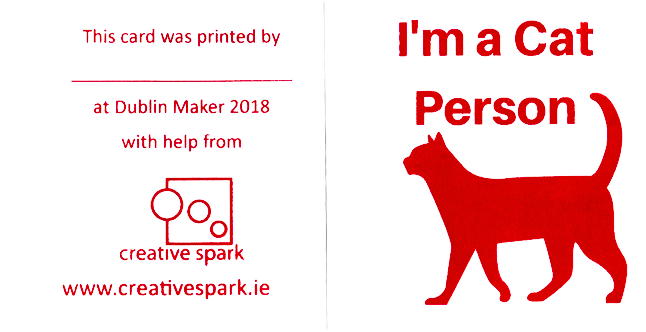


And the result, above, speaks for itself.


My attention was next drawn to the spinning wheel. They had two spinning wheels on display last year but I hadn't given them much attention. They have become something of a national symbol to be noted just. But in a world which increasingly emphasises the craft approach, be it to beer or fabrics, they have taken on a new sigificance.


So I stopped to talk to Grace O'Neill about how it all works. This not a post on spinning so I'll not dally with photos showing the original fleece and its carding prior to it being spun. You'll get the drift of the actual spinning from looking at Grace at work in the photo above. The wheel is driven by foot pedals, just like the harmonium or an older version Singers Sewing Machine, and the trick is to control its speed on the one hand and the tension in releasing the fleece on the other to produce exactly the result you want.


When I'd figured all this out, I was again thrown into confusion when the diplay switched from spinning plain yarn to the bouclé version. Fascinating stuff.

Check it out for yourself.


There was more 3D printing on show this year. The two printers I saw were going for small single colour objects.


This one was making a sort of cage which would end up with a freely moving object inside it. And don't forget that these objects are printed in one single go.

The trick is that they print in ascending layers. It always takes me a few seconds to get my head around this every time it comes up.

I was just thinking about a Schroedinger's Babushka, a series of Russian dolls contained within each other, only in this case there would be no way of opening them to check the output. Hmmm.


Next was this avuncular gent explaining electrical polarity to these clearly fascinated young lads.


Meanwhile, there was this semi-transparent lady perched on a workbench behind him. I didn't stay round long enough to see how she earned her living.


On to yet more participative stuff with no shortage of young takers.


This pair, with a little assistance, are making Galaxy Stones, or in this case pebbles. The idea is to coat one smooth surface of a stone in multi-coloured acrylic to represent a galaxy, or nebula, or whatever. You were invited to bring along your own stone if you wanted. Pebbles were provided on the spot.


As you can see, the results on these larger stones are very impressive. Unfortunately this presentation is in only two dimensions but these are real stones you see before you.


KNIT YOUR ROW

As you can see not everything here is hi-tech, though there is a fair amount of electronic stuff around, from variously controlled robots to flashing bulbs.

This is KNIT YOUR [OWN] ROW, but I didn't stay round long enough to fully tease it out. In any event it's a skill that's been around for a long time and handed down the generations - usually on the female side.

I learned to knit when I was young. Consumed I was at how my granny was producing knitted fabric from plain wool through a series of clickety clacks.

Me and the mother and the granny once knitted a school scarf. We took it in turns as and when time was available. The widest parts (most relaxed stitching) were the granny's and the narrowest mine (a combination of tension and, I'm sure, dropped stitches). The mother was somewhere in the middle.

I wonder how that lady did.


My general impression was that the attendance was greater than last year. It was sometimes difficult to get near some of the stands. Maybe the organisers might think of a two day event sometime in the future?


There was more than just the stands to the day's event. There were various food vans around the large open picnic space.


And Dublin City Rounders gave us great pulsating quality country from the hill.


Full marks to Rohan,


and brother Al.


Finally, leaving by the front entrance. Back next year.


Sunday, July 23, 2017

DUBLIN MAKER


Click on any image for a larger version

Yesterday my son brought me to DUBLIN MAKER in Merrion Square. This event has been going on for a few years but I had never made it until yesterday. It is for young and old alike. The only requirement is that you are curious and have, hopefully, not lost your initial sense of wonder at the magic of every day "science".

You could get lost here for a whole day. The exhibits are fascinating and the exhibitors are not only helpful and good humoured, most of them are young and all of them are nearly as excited by your interest as you are by their exhibits.

I've just picked out a few below to give you a flavour of my own experience.


I well remember making little stick men out of pipe cleaners. My Da smoked a pipe but you wouldn't dare interfere with his cleaners. You actually bought bunches of them for the express purpose. But life has moved on and the pipe cleaners have moved into high art. Simple to do but very effective, even after the Da gives up the pipe.


From the simple to the complex. This little guy is a 3D print. The arms can move. And he has been printed all in one go, ready assembled. Amazing. Until you realise that the printing is done by building up layers and so anything is possible.


You can programme this parrot with your own sound and it's beak moves as it speaks.

My perverse ambition would be to have it annunciate the sermon from Joyce's Portrait of the Artist as a Young Man when the Parish Priest came visiting, in the hope that the same sermon would scare the shit out of him as is did me when I was young and impressionable.

Only one flaw. The PP doesn't come visiting any more and if he did I could probably not resist the temptation of filling the parrot up with the foulest language at my disposal.


To prove that I am not just spectating and that I have never grown up I undertook to join up the dots myself. This is done with a pen and conducting ink, and they go from 1 to 23. The result is a visible circuit board which illustrates the required shape, in my case an airplane.


This is then plugged into the computer and an appropriate "working" image comes up on the screen. My prototype is unlikely to fly in real life, but it did clunk its way across the screen and, anyway, I'm only a novice.


Time for a beer break and the only cúpla focal I came across. It's a bit early in the day and I think the emphasis here is more on manufacture than on consumption.


This unlikely object is a trio harp. It's made out of piping, with builder's twine for the strings. I would consider it more an idea in the making than a final product. There is clearly scope for developing the strings, both in terms of material and variable tension. It might even be turnable into a mini orchestra with the addition of a fret board.


There is also a need for the development of the sound chamber and possible addition of further amplification. I suggested a microphone and speaker but that didn't go down well as it involved electricity and a departure from the homemade/discarded material approach. As an alternative I suggested some further piping/funnel work on the lines of His Master's Voice and I think this is being looked into.


This lady showed me a blindingly simple device. Suppose you are deaf but you have to get up early in the morning and are unlikely to hear your alarm going off.

In days gone by the hard of hearing or deep deep sleepers could always put the wind up alarm clock in a metal basin or bucket and the noise would bring the house down. But they don't make them like that any more and, anyway, if you are completely deaf it would be no use.

In today's world you simply put the red bracelet on your wrist, set your phone alarm, and Bluetooth does the rest. I tried it and the vibration on your wrist is guaranteed to bring the dead back to life.


I have blogged on MAKESHOP before so I didn't stay too long at their stand. They are an outreach of TCD's Science Gallery and are currently located in the old Lennox Chemicals building in Clare St. where I used to buy my bomb-making, stink bomb and amateur detective raw materials.


Not sure what these do. Maybe a fight to the death.


This is FABFOUNDATION IRELAND. They have a network of FabLabs throughout Ireland where people can come to learn and do stuff. They do all conceivable kinds of printing and the green robot above is one of theirs. Check out their video. Having said that they could do with some serious work on their website.


I'm sure most people have at least seen a picture of a spinning wheel. Many may even have seen the real thing in a museum or in one of Synge's plays. But what does this iconic piece of furniture do?


Well you can't knit with all those sheared pieces of wool. They have first to be turned into string (or knitting wool as we know it) and that's where the spinning wheel comes in.

But that's not the end of the story.

In the old days, when Clery's was Clery's, you used to buy wool in folded form which had then to be rolled into balls for knitting. I well remember holding my arms extended with the wool, until they ached, while the Mammy or the Granny rolled it into a ball.


This is paper folding with a vengeance. Just look at those pets, duly shot and mounted. Only joking. No pets have been hurt in the making. Check out Laura's blog post on DUBLIN MAKER.


Instead of hiring a magician for your children's parties why not hire a bus load of lego and let them at it. This just goes to prove there's always a niche in the market.

I could go on but I'm sure your attention is flagging at this stage. Best thing you could do is to go along next year and I'll guarantee you'll stay the day.

Friday, June 02, 2017

UNCLE LARRY


Uncle Larry NOT
Click on image for a larger version

Uncle Larry is not my uncle. Nevertheless, although I never even met him, I am calling him Uncle Larry. There is a tradition in our family that virtually all relations in the parents' generation, however distant, are known as uncles or aunts, and he is Mai Medlar's, my mother's cousin's, uncle.

But it's only after reading about and actually listening to his stories that you will really understand why I call him Uncle Larry. He is an open and warm person, has a keen sense of observation and an even keener sense of fun. And he does not take himself too seriously, unlike many of his contemporaries.

You will also understand why I refer to him in the present tense, though has been dead since 1986. He was exactly 90 years of age on the 12th of March 1978 when his son-in-law Dave recorded these stories.

BACKGROUND

I have had Larry's stories up on my website for a good while, but I thought I might bring them to a new audience in this blog post. My format is to give a commentary on the story and then let you listen to Larry himself tell it. These are all first hand stories, straight from the horse's mouth, and they are now part of history.

Larry was one of two children born to John Medlar and his wife Ellen (née Brennan). John was a blacksmith from Paulstown, Co. Kilkenny, and Ellen was from nearby Ballyellen, Co. Carlow. She had been in domestic service in Belvedere Place in Dublin when she married John and they were living in Fenian St. when the children were born, Patrick in 1885 and Larry in 1888.

John then went to America (USA) to his sister and was to send for the family when he found work. Unfortunately he died and Ellen was stranded in Dublin with two young children. So she farmed them out to their grandparents and went back into domestic service, this time in Merrion Square.

Patrick went to the Medlars in Paulstown where he became imbued with the cause of Irish independence, but that is another story.

This is the story, or part of it, of Larry, who was farmed out to the other grandparents on the upper Ballyellen lock on the Barrow River, which was part of the Grand Canal system.

Ellen subsequently remarried and settled in James's Street and the two lads came back to town where they remained and made their careers.

So Larry's stories are located initially in Ballyellen and then in Dublin.

THE STORIES

A Kilkenny Hanging

Larry's granny went to see the last public hanging in Kilkenny. I don't know what year this was but it could well have been a Fenian hanging, or even this one.


Lock, Cot and Barrow

If there's water, kids will fall in. I don't know how many times I fell into the Dodder myself but this sounds a little more serious. I wasn't fished out. I had to find my own way to the bank but fortunately I wasn't spanked when I got home.


Skool

We used to need an election or a freeze up or a bout of flu to get off school. Country life was much simpler. An excess of the gargle the night before and the teacher's hang over meant the day reduced to morning prayers, led by the teacher's sister. And off the pupils scooted home.


Larry's 1st Communion and Confirmation

There are not many people have the wheels come off just after they make their first holy communion. And then there's confirmation where Larry, anything but dressed for the occasion, joined his older brother in church and made a premature confirmation. I don't know if he ratified it two years later.


Locks & Barges

The canal was apparently used for more than just transporting cargo and Larry mentions the party boats with their canopies and well dressed ladies on their way to a day out at St. Mullins.

The lock where Larry was brought up was part of the canalisation of the Barrow river to make it navigable. It was part of the Grand Canal network which actually linked the Ballyellen Lock and the Harbour in Jame's St. where Larry was later to live and where his brother Patrick was to have a thriving undertaker business.


Locks, Eels & Salmon

The size of the lock-keeper's fee clearly necessitated a supplementary source of income. While Larry's grandfather and grandmother were supplying (legal) eels to Billingsgate, his uncle Pat was extending his activities into some slightly trickier areas.


1916

It's easy to forget the difficulties posed for families by the 1916 Rising when parts of the city were under lockdown. James's St. which Larry refers to was the location of the South Dublin Union, one of the flashpoints of the rising. Mrs. Mortimer was my granny. Larry also refers to Seán Connolly who led the abortive attack on Dublin Castle, killed a policeman and was himself shot by a sniper shortly afterwards.


Andy Duffy's Revolver

It was not good to be caught in possession of a revolver during the War of Independence. Andy Duffy was a pawnbroker married to my great aunt Lil. He was nervous about a revolver on the premises and asked Larry to get rid of it. On his way back home Larry nearly got caught by a Tans patrol. He eventually hid the revolver up the chimney in his place of work, the Dispensary. He subsequently passed it on in a pub to another man who promptly shot it off accidentally. Everyone was very nervous as the city was on high alert that day. Nothing came of it though.


Bloody Sunday

Larry was in Croke Park on Bloody Sunday and saw the shooting. On his way out he went to help a man on the ground and gave him some whiskey he had on him - only to find out that the reason the man was on the ground was that he was already drunk and couldn't hold his balance in the surging crowd. Larry was disgusted. But it is probably one of the few, if not the only funny story to come out of Croke Park on that day.


Civil War & The Four Courts

Larry was working in the Tivoli Theatre on Burgh Quay and after a few beers and a nosh up was asleep in his brother's house on Usher's Island when he was woken up, in the early hours of 28 June 1922, by the shelling of the Four Courts which effectively started the Civil War.


Alfie Byrne & Big Jim Larkin

The family had a fair amount of contact with Alfie Byrne. Partly because Larry's brother Patrick was on the Corporation (City Council) with him. They were effectively non-competing because Alfie's base was northside of the Liffey. They used to go to conferences of the Royal Liver Assurance, for whom Patrick was an agent. This story is probably from one such conference.

Alfie Byrne tells Larry that he sold his pub in Talbot St. to fight Jim Larkin in an election, which Alfie won.


God Save the King!

Larry and Alfie Byrne were clearly discommoded when they found themselves standing for "God Save The King",


Russell the Counsellor

Dr. Russel worked in the Dispensary (in Castle St.) and subsequently became the CMO of the Corporation. Larry clearly thought him quite a character.

A neighbour of Larry's got a dose from a woman but didn't want to go to the doctor with it. So Larry brought him in to Russell who inspected the damage and made a most impolite suggestion.


Russell the Dentist

Larry decided that the cure for his toothache was an extraction. Dr. Russell brought him over to the window, got him in a head hold, told him to open his mouth and yanked the tooth out with the "forceps". Larry was left for a week with an abscess which Russell then had to lance.


Russell the Prankster

Russell almost unhorsed a passing officer.


Prices & Shopping

The price of a pint or a packet of Woodbines. Thomas Street good for shops and street traders at Christmas.


Medlar & Claffey, Undertakers

Medlar and Claffey was a significant undertaking business in Dublin with branches in various parts of the city over time. The Medlar/Claffey partnership broke up in 1927.

Larry used to give a hand with the brother's business betimes and here tells of a trip from Clonliffe Rd. to Valentia Island, when the funeral went astray and the hotel had no "food" available.


THAT'S ALL FOLKS

Sunday, August 07, 2016

JUBILEE MARTYRS


Click on any image for a larger version

While O'Connell St. was hosting the fall of Nelson and the 1916 Jubilee march past, another drama with revolutionary reverberations was playing out in Kildare St. and Merrion Square.

It was 1966 and the Irish Creamery Milk Suppliers' Association (ICMSA) had had enough. Milk prices were rock bottom, farmers and their families were suffering badly, and they were determined to force the Government to do something about it.

They decided to picket the Dáil, a move that was grossly illegal and seen at the time as threatening the foundations of the State. The precincts of parliament were sacrosanct and legally protected.


So they were arrested in their droves as reinforcements were called up to take the place of those arrested. Charlie Haughey, as Minister for Agriculture, was displaying a Napoleonic defiance of one of the two most powerful farmers' forces in the land.

In the end, the farmers carried the day but not without cost. Bitterness between the two major associations lasted for years afterwards. And no doubt Charlie Haughey did not forget the damage to his macho image.

Why did I use the word Jubilee in the title of this post. Well, 1966 was the 50th anniversary of the 1916 Rising, which was being commemorated at the time and this is the 50th anniversary of the protest. Incidentally, it turned out to have been a signifcant year in my photographic career, but that's another story.

You may notice the service medals on the veteran protester in the photo above. Both leaders of the ICMSA were veterans of the War of Independence. Interesting that they were then all defying the law outside the very parliament they were instrumental in bringing about.

For a blow by blow account of the protest and its aftermath check out this excellent piece in The Examiner by Ray Ryan.

Friday, April 22, 2016

Where is it ? No. 45


Solution

As nobody has had a go at this I'm just giving the solution.

It is in Merrion Street Lower and is part of the Mont Clare Hotel. The connection is with Oscar Wilde. It is just across the road from Oscar's statue in Merrion Square Park and from his father's house. It is also not far from the house where he was born on Westland Row.

To see all the quiz items click on the "Where?" tag below.

To see all the unsolved quiz items click on the "unsolved" tag below.

Thursday, April 21, 2016

Where is it ? No. 44


Solution

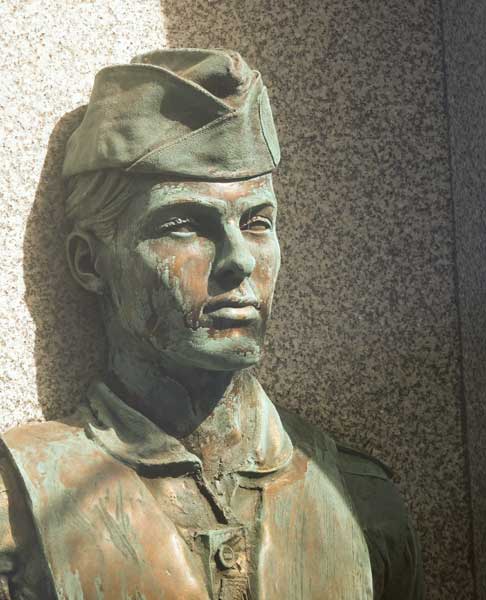
This was admittedly a bit of a tricky one, even for fairly seasoned Dubliners. It is one of the figures inside the monument to members of the Irish defence forces who have died in the service of the State and it is situated on the west side of Merrion Square.

To see all the quiz items click on the "Where?" tag below.

To see all the unsolved quiz items click on the "unsolved" tag below.

Thursday, February 04, 2016

HIDDEN PAGES 1916


Welcome to St. Thomas & St. George Parish Church

This is how the occasion was announced to the press:
"The Irish Society for Archives in conjunction with An Post will host a novel seminar Hidden Pages From the 1916 Rising, at which five archival curators will engage with the public to explore some of the little-known archival sources about this momentous event."
If anything it was an understatement. There were fascinating presentations of new archives, and old ones put to new use, in the exploration of what really happened in 1916.

The venue itself was a piece of history. Its location, structure and financing owed everything to the revolutionary period.
"The Church of St George and St Thomas, Cathal Brugha Street, Dublin (located alongside the Gresham Hotel) was rebuilt in the 1930s following the destruction of an older church (originally located in Marlborough Street) during the Revolutionary period in 1922."
I had been in this most unusual church once before. Originally St. Thomas's, it inherited the parish of St. George from Hardwicke Place when that church ceased to have a religious function and the two parishes were amalgamated. My interest was in St. George's where Richard Brewster, a parishioner who died in WWI was commemorated. While some of the relevant plaques still remain in the old St. George's building, one has transferred to St. Thomas's. You can read all about this here.


Rector Revd Obinna Ulogwara

The Rector, Revd Obinna Ulogwara, made us all very welcome. And with nothing short of an Irish sense of humour told us which two exits to use in case of an emergency. Use of the third exit could lead to us being run over by a bus.


Dr. Raymond Refaussé

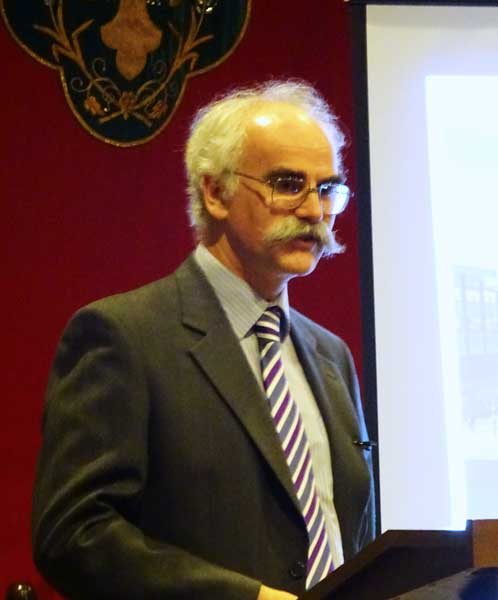
Raymond Refaussé, Librarian and Archivist at the Representative Church Body (RCB) and a man with archives in his blood, introduced the occasion and gave us some idea what was in store for us.


Patsy McGarry

Our MC for the night was Patsy McGarry, more usually the religious affairs correspondent of the Irish Times, but currently engaged in resisting an attempted landgrab by Co. Westmeath of a not insubstantial chunk of Co. Roscommon, his home county.

Patsy guided us smoothly and entertainingly through the evening's speakers.


Colm O'Riordan

Our first stop was the Irish Architectural Archive in Merrion Square. I've been in there and they have whacks of very interesting stuff on the built environment. Colm took us through some of the structures relevant to the 1916 Rising, not forgetting the GPO and the RHA HQ in Lower Abbey Street. Both these buildings were destroyed in the rising, making for two out of three hits on the works of Francis Johnston in the city centre. The third strike on his city center work had to wait for the 50th anniversary of the Rising - Nelson's Pillar.

I was particularly interested in the enormous bakery that was destroyed at the bottom of O'Connell Street. It had been a most out of place building. Its successor became the central cinema with its controversial canopy defying city ordinances, though Colm didn't mention this particular mortal sin by Councillor O'Farrell.

Colm told us how, in the reconstruction of O'Connell St., the Corporation for the first time insisted on controlling the façades of the new buildings. This led to some serious rows but the Corpo held their ground. If this "enlightened" approach had continued into independence we might have been spared some of the abominations that were permitted in the name of progress in the latter half of the 20th century.


Ellen Murphy

Ellen Murphy, Senior Archivist at Dublin City Library and Archives, revealed ‘Reactions to the Easter Rising in the Monica Roberts Collection at Dublin City Library and Archive’ under the heading: "It was grand to see our Tommies".

This archive is a collection of correspondence between Monica Roberts and the troops at the front in WWI along with a short diary of Monica's own contemporaneous reactions to the Rising. The tone is British and Unionist and the sentence quoted above was her reaction to the arrival in the city of British army reinforcements.


Gráinne Doran

Wexford County Archivist, Gráinne Doran took us to one of the other parts of the country outside Dublin where there was significant action during the Rising. Her current project is ‘The collective effort of the men and women in County Wexford, Easter 1916’, and it is concentrated on the action in Enniscorthy. There is an emphasis on oral history as well as the usual written and visual sources. She will be covering not just the activity in Co. Wexford itself but also action by Wexford people in the capital.


Pádraig Allen

Pádraig Allen took us through the emergency medical response to the Rising, as revealed through the newly discovered archives of St John Ambulance Ireland. These are full of fascinating stuff. They are particularly relevant in the context of redressing the current gender imbalance in the reporting of the Rising.The medical response was an area in which women distinguished themselves at all levels.

Pádraig wore the 1916 John's Ambulance uniform which he had specially made for this centenary year.


Stephen Ferguson

Stephen Ferguson, Assistant Secretary at An Post, was talking about ‘The staff of the GPO during Easter Week, 1916". In fact he gave us a thrilling sequence of stories on how the Rebels neutralised the city's communications hub and on the ingenuity of some of the staff in re-establishing alternative communications routings.

He also drew our attention to the current importance of the central Post Office archive in London, given the destruction of so much material in the GPO.


There was a very lively and lengthy Q&A at the end where the questions and answers competed with a host of new stories recounted by members of the audience.

The Irish Society for Archives and An Post are to be commended for sponsoring a great evening. And particular thanks are due to Dr. Susan Hood, Assistant Librarian and Archivist at the RCB, for a flawless piece of organisation.