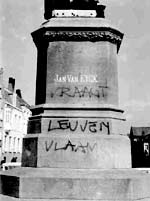
Showing posts with label french. Show all posts

Saturday, March 17, 2018

JOUTES ORATOIRES


Statue de Louis Pasteur, cour de la Sorbonne
pendant les événements de mai 1968
Photo: Philippe Gras
Click on any image for a larger version

When I saw the notice in the Alliance Française newsletter for this Oratorical Jousting final (16/3/2018) I made up my mind there and then to go along. It was actually the final round in an interschools debating contest in the French language. More than 30 schools in the Leinster area had participated and the final was between Coláiste Íosagáin and Loreto on the Green. Two girls' schools, as it turned out.

I arrived a little early and decided to have a coffee in the Alliance café, La Cocotte. However the café was just closing when I arrived but they let me look around the current exhibition of photos by the late Philippe Gras. And what did I see among them but the one at the top of this post. The theme is freedom of expression and the photo was taken during the 1968 student uprising in Paris.

So what, you might say? But bear with me. The subject of the night's debate upstairs in the new mediathèque was LA LIBERTÉ D'EXPRESSION N'EST NI POSSIBLE NI SOUHAITABLE - freedom of expression is neither possible nor desirable. How apt, though I don't recall any of the contestants mentioning 1968. Both the French Revolution (1789) and the UN Universal Declaration of Human Rights (1948) got a few airings in the course of the night.

I had gone along with the intention of taking a few photos and doing a blog post if the night proved interesting. However I gathered the organisers were "wary of social media" which was a bit of a surprise, so I just determined to sit and listen and think.

The night did turn out to be very interesting so I decided to write it up anyway. I'm sure there will be plenty of photos on the Alliance site from the official photographer in due course.

I found the format of the debate intriguing.

I had taken part in the Gael Linn interschools debates in Irish in the 1960s. In those debates you only got the subject twenty minutes in advance. This was way before the internet so you had to rely on your wits and what was already in your head. You had three minutes to present your case. The teams as such did not take sides for or against the motion, that was left to the individuals themselves. Individuals' marks were then combined to give a team total.

In the French case, the subject is known well in advance though I'm not sure when sides are allocated. In any event there is plenty of time for preparation, deciding tactics, and deciding which points would be made by which team member. Don't forget that in this case a coherent case has to be made by the team as a whole.

An interesting variation in the French case is that for a specified period within the three minutes the speaker can be challenged by a member of the opposing team and there follows a spontaneous, and lively, debate between the two contestants until the adjudicator feels that that the point has been exhausted or the exchanges have gone on long enough. This is a interesting variation as, given that the main contributions have been prepared and well rehearsed in advance, it allows the contestants' spontaneous mastery of the language to be put to the test. It also tests their resilience under fire.


Handout: teams on the night & best speakers from previous rounds.
Click image for a larger version

My impression was that the teams were very well matched. Well they would be, wouldn't they. having come through a fair few rounds in this knockout competition

I thought Loreto were more at home in their French though I thought they had the harder side of the argument to defend - promoting untrammeled free speech (and yes Charlie Hebdo got a mention). They were sort of caught in a bind as the opposing team in their opening shot had defined free speech as unlimited freedom of expression and had gone on to argue for reasonable restraints. This put Loreto in the position of arguing in favour of being allowed "to shout fire in a cinema" as it were. Assuming I understood correctly what was going on.

Coláiste Íosagáin had, for their part, defined themselves into a defensible middle ground. I also felt that they had marshalled and structured their arguments better as a team.

If I had one general remark to make it would be that the contestants spoke a little too fast. I know, from my own experience, that you tend to do that when you are nervous and the native French do speak at a rate of knots. Nevertheless.

The advice we were given at the time by the adjudicator was: If you don't feel your speaking too slow, then you're speaking too fast. I'm sure many public speakers, at least the more thoughtful among them, would identify with that. Though when you observe this for a while it becomes second nature.

I'd say the jury found it a very close call in the end as the standard was high all round.


French Ambassador Stéphane Crouzat with Team Íosagáin

Coláiste Íosagáin emerged the winner. Bravo.

I don't know the marking system and, unlike in my case, the jury didn't give any analysis of how they arrived at their decision. I must keep an eye out for this contest next year and maybe talk to a few people in advance.

Below is Sadhbh Ní Ghráda from the winning team. Her father was a classmate of mine in the middle of the last century.


Sadhbh Ní Ghráda with parents Cormac & Máire

The debates have their own website where you can link to the rules and other background material.

Wednesday, May 29, 2013

Eternal Vigilance


As everyone (ie the few) who reads my blog knows, I am obsessed with the upside down flying of flags, and in particular the EU flag.

I wish people would stop feeding my obsession.

The above photo of the EU flag flying upside down outside the European Parliament was carried without comment in yesterday's online edition of the Irish Independent.

Of the European institutions themselves, that now makes two, the European Commission and the European Parliament, not to mention the French and Hungarian embassies in Dublin and a few others like Sinn Féin and TG4.

Or do I smell Photoshop here and does it matter?

Eternal vigilance is the price of rightwayupness.

Thursday, January 31, 2013

Crisis Eile


This image appears in the current edition of Phoenix magazine. It is in the jollity section where the magazine takes the mickey bigtime. It has grafted Ireland's real Minister for Europe, Looselips Lucinda Creighton, onto a press conference by the fictional Irish EU Commissioner, Maeve Kelly Clarke (Bláthnaid Ní Chofaigh), in the TG4 tv series Crisis Eile.


So far so good. But look at the EU flag on the lectern. It's upside down. How clever of Phoenix to add this little satirical touch. We all know flying the flag upside down indicates a crisis. Nice touch.


This is how it should be in real life. The top point in the five pointed star always points upwards. As someone who has had to deal with EU Commission demands for signage, and with protocol for distinguished visitors, it wasn't long before I realised that this, apparently vertically symmetrical, flag could actually be flown upside down, but that this had better not happen on my watch.


So, out of curiosity, I went and had a look at the original TG4 shot, and, lo and behold, it was the guys in TG4 who did the clever thing.

Well done guys (incl gals). I have already drawn attention on this blog to the upside down flying of the EU flag at the French and Hungarian embassies in Dublin and at the Dublin office of the EU Commission itself. Sinn Féin are probably also in the sin bin in this regard. So it's nice to see this little lapse put to constructive use for a change.

At least, I assume TG4 did it on purpose. Otherwise we will surely have a real crisis eile on our hands.

Saturday, June 02, 2007

In defence of Froggy

In more recent times (2023) information has surfaced which gives increased depth to this story and effectively turns Folens from a simple collaborator, albeit justifying his collaboration as motivated by the prospect of independence for Flanders, into a fully fledged patriotic Flemish hero. Instead of being incarcerated he should have been given a medal.

For the full update on this new evidence and on the new book written by his daughter Leentje and just published, see this blog post.

The book itself reveals that far from simply collaborating with the Germans in Brussels, Folens was working undercover for the Flemish Resistance. It also shows that his participation in the Flemish Legion was not by choice but by accident.

These new developments make a certain amount of the material below, and that referenced in some other of my blog posts on Folens obsolete. So if you are reading this blog post or any of the others, please remember that he has emerged in an even more favourable light than originally portrayed.

Also I have set up a totally new blog specifically linked to the book where individual posts expand on aspects of the story including for the post 1958 period which is not covered in the book: https://albertandjuliette.blogspot.com/

-o0o-


As of June 2007, I am republishing this post with some additions, as follows:
  • the first section is the original post unamended;
  • the second section is my own follow up comment posted after the transmission of the programme; and
  • the third section contains some new comments on subsequent material relating to the programme appearing in the periodical History Ireland

The Original Post posted 12 January 2007, before the broadcast There is a report in the Irish Times (12/1/2007) which says that Albert Folens's widow secured a temporary (ex parte) High Court injunction preventing RTÉ from using a 1987 interview with her husband in a TV programme titled Ireland's Nazis, scheduled to be aired next week as part of the Hidden Ireland series.

Mr. Senan Molony, who was then working for the Sunday Tribune had taped the interview with Mr. Folens. Mr Rogers, counsel for Mrs. Folens, said that a representative of the newspaper, Mr Molony and Mr Folens had signed an agreement allowing Mr Folens to see any article before it was published and also giving him the right of reply.

His client was seeking the injunction restraining the defendants from using, broadcasting and publishing the subject matter of that interview, otherwise than in accordance with the terms of the agreement in 1987. Report was also carried in Irish Independent.


Albert was my French teacher in school. He was a very good teacher. He taught French through French. He was supposed to be teaching it through Irish but he didn't have the Irish.

He published a series of textbooks for learning French through Irish which we used in class. Donncha Ó Céileachair did the Irish end of these. Folens also started publishing cog notes for exams which were first class, even if they were totally subversive of the supposed aims of the education system. This activity progressed to publishing actual text books, particularly on new subjects like civics, and the business eventually expanded into a high class, and very worthy, publishing empire.

We called him Froggy, which must have been the ultimate irony for a militant Fleming. We didn't know his background then but it was fairly wide knowledge in Dublin that he had fled Belgium because of support for the Germans during WWII. It would have been understood here, though, that any such support was bound up with the struggle for Flemish independence. The Germans had promised both the Flemish and Bretons greater independence under Germany than they then enjoyed under Belgium and France respectively. A number of Bretons also got sanctuary in Ireland after WWII and some became actively involved in the Irish language movement.

Albert wrote a book which set out his position quite clearly. He published it himself in 1958. It is called "Aiséirí Flóndrais" (Flanders Rising). It was published in Irish, translated from the English by Donncha Ó Céileachair. It shows that he was a true Flemish nationalist and abhorred the extremes perpetrated by the Nazis, some of which extremes, he says, were also mirrored by the then Belgian authorities. Along with tens of thousands of Flemings he supported the Germans as a means of achieving some measure of rights and ultimate independence for Flanders. Most of these were ultimately disillusioned by the later stages of the war by which time they were faced with Hobson's choice.

It would be strange indeed for the Irish, of all people, to be critical of his good faith in this venture when Ireland herself sought the help of the French (na Francaigh ag teacht thar sáile!) and the Germans (Banna Strand!) in her own fight against national, cultural, economic, linguistic and religious oppression. Our Head of Government even signed the book of condolences for Hitler after his atrocities were known. The Flemings were a long oppressed race, none the less so by their own cobbled-together and vindictive Belgian state.

I spent time in Flanders in 1967/68 at the height of the "linguistic wars" and I must say my sympathy was entirely with the Flemish. They had been derided, exploited, used for cannon fodder, denied office and forced to bend the knee to a francophile coterie which, thankfully by then, was beginning to resemble the fading remnants of a post colonial ascendancy.

I don't know if RTÉ made any effort to consult with his widow regarding the content of the programme or to give the family a chance to put Albert's view across. It doesn't look like it from the tone of the report in today's Irish Times and Mrs. Folens's statement.

There is a class of supposed exposé journalism, and it is not new, which seems very reluctant to afford the subject of criticism the right of simultaneous reply.

This, after all, is only natural justice and to be all the more expected in a flourishing democracy like ours. It is, unfortunately, usually safe enough to take the lazy way out when the subject is dead! Fortunately there may be a prospect of some legal redress in this particular case. We'll see.

I don't know if Albert's book was ever re-published after 1958 or if the original manuscript in English ever saw the light of day. But, in this age of universal access to the internet, it would be worth publishing both, if only online.

There are even lessons to be learned from it on the linguistic front which might still be relevant to both the Welsh and Irish efforts at language development.

If RTÉ want to exhume Albert let them resurrect the whole man and pay some attention to what he actually has to say rather than setting him up as an easy aunt sally.
My comment posted following the broadcast

I wondered why the original taped interview had not been used at the time (1987) as the basis for a story, or flogged to RTE as was done recently. It is interesting to see the reasons given at the time by the then editor of the Sunday Tribune, Vincent Browne, for not using the material: " ... we have decided not to publish anything concerning your involvement in the Second World War, at present. This decision was taken on the following basis: that, given the absence of harder information concerning any impropriety it would be wrong to expose you to the turmoil that would inevitably ensue if we published the information which we presently have in our possession." Source The only additional information available since then is the entry in the US/UK Crowcass manual listing Folens as an "interpreter" rather than a "translator" at the Sicherheitspolizei premises in Brussels. However Folens himself said that the part he worked in was "lectorale" which involved translation rather than interpretation. The dropping of a "reconstruction"/fabrication of an interrogation sequence from the transmitted programme speaks volumes in this regard.


Further Comments posted 2 June 2007

The programme was reviewed in the March/April issue of History Ireland by Eamon O'Flaherty who lectures in history in UCD. He mentions Cathal O'Shannon's annoyance at Irish neutrality and at not being allowed to wear his British uniform when home on leave in Dublin from the RAF during the war.

I can understand why O'Shannon might have resented the welcome given to collaborators after the war when, at the same time, the contribution of Irish people who enlisted in the Allied cause was swept under the carpet. Some of my own family experienced this after WWI.

Regarding the actual programme, O'Flaherty does suggest, however, that in O'Shannon's case "perhaps the journalist's desire to tell a good story won out over the maintenance of proportion in the latter stages of the film". I certainly think that was the case. O'Flaherty himself, however, also asserts that "the controversial nature of the revelations even at this remove was shown by the efforts of the widow of Albert Folens, one of the subjects of the film, to prevent it from being broadcast". I understood that Mrs. Folens's action was an attempt to ensure a right of reply and fairness of treatment in the case of her husband. Her counsel was seeking to have the broadcast of the tape stopped except in accordance with the existing agreement which guaranteed advance knowledge and a right of reply - hardly new concepts in the area of justice.

A further piece in the May/June issue of History Ireland, by Daniel Leach, a scholar and PhD candidate at the School of Historical Studies in the University of Melbourne, takes a broader look at the factors influencing the behaviour of the Irish State during WWII, and, in particular, our covert pro-Allied neutrality. Leach underlines the importance of symbols of sovereignty to a small newly emerging state, particularly where the former colonial master and its major ally do not appear to take such sovereignty seriously.

The piece also refers to the practice of some of the victorious Allies of tarring all collaborators with the war-criminal label as a tactic for suppressing separatist movements. Obvious examples here were France and Belgium.

There are many lessons to be learned from this unfortunate episode, and they need to be learned sooner rather than later in a world that is increasingly making light of the very human rights for which people fought and died in two "World Wars" and many other struggles between and since.


Some more recent posts

Turkish Delight 17/1/2012

Do you remember Froggy 23//2013

Pro Patria 8/2/2016

Was Roger Casement a Nazi 2/4/2016

Bloomsday 2016 12/6/2016

New Blog

I have set up a totally new blog specifically linked to the book where individual posts expand on aspects of the story including for the post 1958 period which is not covered in the book:
https://albertandjuliette.blogspot.com/