Showing posts with label censorship. Show all posts

Saturday, April 20, 2019

BANNED


Sitting on the hedge - the panel
Click on any image for a larger version

Tommy Graham, editor of History Ireland, has been organising Hedge Schools from a good while back. The term originates with informal schools set up for Catholics in penal times. Some of these provided a first class education.

I am not aware of the religious, or otherwise, convictions of the audience on this occasion (9/4/2019) in the National Library of Ireland, but they were a lively lot.

This Hedge School was about censorship and was structured around Edna O'Brien's trilogy Country Girls which was banned in Ireland in the 1960s and which is currently the choice for Dublin City Council's One City One Book initiative.

First to introduce the panel, right to left in this case.


Donal Fallon

Donal is a history gruaduate, best known as a co-author of the fabulous Dublin blog Come Here to Me!. He has recently finished a stint as a Historian in Residence at Dublin City Library and Archive.


Mary Kenny

Mary need no introduction to my generation, having been to the forefront of the Women's Liberation Movement in the 1960s. Her Wiki page tells me she is currently an "author, broadcaster, playwright and journalist" but also points out that "She has modified the radical ideas of her past, but not rejected feminist principles".

Mary, of course, was on the Contraceptive Train to Belfast when a number of prominent women went up there to buy The Pill and bring it back to town in a glare of publicity. I think I remember her saying recently that they did not succeed in getting the pills and came back with a stock of Aspirin substitutes which they passed off and which fooled the cameras, and the Customs Officers. I'm sure that story must be in print somewhere.

It reminded me of The Rose Tattoo and the non-existent frenchie, but that's another story.


Tommy Graham

Tommy is, as always, tonight's MC, or as the French would put it "animateur".


Angela Nagle

I had not come across Angela before. She has a PhD from DCU where her thesis was on 'An investigation into contemporary online anti-feminist movements' and she published a well received book in 2017 entitled Kill All Normies

You can get a flavour of her writing and current preoccupation from this piece from Atlantic in December 2017.


Niall Meehan

Niall is Head of Journalism at Griffith College.


I'm not going to report the various contributions in detail as you can hear the full podcast here. I'll just give a flavour of the contributions below.


Tommy had Mary kick start the evening with a censorship timeline from the foundation of the state to the present day, well, the 1960s when she was most active and the traditional system began to crumble at the edges or shake at the foundations, have it as you will.

She evinced great admiration for Edna O'Brien who she felt broke the old mold. I have not read Country Girls but Mary quotes Edna describing her father as a drunken brute, so I can accept the trilogy as mold-breaking in more ways than one. Of course it was Edna O'Brien's fame, or to put it another way, access to foreign outlets, that brought the thing to a head. Many before her had the potential to crack the mold but they lacked the hammer of exposure.

Mary also mentioned the Lady Chatterley trial in 1960 which gave a wider public access to this literary work. The hard-cover version had not been banned in the UK but its price kept it out of the paws of the proletariat. When Penguin Books published an unexpurgated paperback version all hell broke loose and they were prosecuted. Fortunately the prosecution lost the case and the paperback became widely available.

Of course the publicity had a perverse effect and a work written to extol the beauty and joys of sex was then being bought for the "dirty bits". I have to admit that this was true in my case but it turned out to be a very disappointing and potentially embarrassing purchase (see below).

Mary also mentioned that very few books were banned on the initiative of the Censorship Board itself. They mostly resulted from complaints by the (predominantly Catholic) laity.


The title of this Hedge School is Censorship in Ireland - Then and Now. We've heard a lot about THEN and are in serious danger of forgetting about the NOW. It's not always called censorship, more likely trolling or no platforming but we are every bit as much in favour of censorship now as people then and this is Angela's area - anti-feminism, the rise of the alt-right and so on.

But, as Angela pointed out, there are things going on that we don't notice and take for granted. She reminds us that the Amazon monopoly is a huge censor and that we rely on one monopoly search engine online, Google. And how do Twitter and Facebook assess tweets, posts and comments as fit for posting.

Conformity is now managed by social media platforms. Censorship no longer has to mean State censorship. And I know, myself, from comments I see and complaints about others, that these screening processes can be both arbitrary and biased.

And the alternative? The chaos of the internet - very destabilising and terrifying.

Much food for thought here.


Edna O'Brien thrived because there were alternative media by then for her to get exposure and attitudes were changing.

In preparation for the session, Niall had trawled through the Irish Newspaper Archive online to gauge public reaction to Edna O'Brien at the time of the publication of Country Girls. The archive covers both national and provincial papers with the exception of the Irish Times which has its own separate archive.

Niall found that there was virtually no hostility among the public generally to Edna O'Brien.

In earlier times, people's careers were blighted by censorship & they were embittered - he mentioned Patrick Kavanagh & Flann O'Brien.

In assessing the role of the Church in relation to censorship and such matters, you need to be aware that the Church had a system of control, often exercised through the laity, while they sat back and let it take its course. This system started to break down in the 1960s.


Donal was anxious to raise the question of political censorship, particularly as we are aware of sex based censorship and often boast how it was not political. But what about Section 31 which Donal saw as in a world class of its own.

He also drew attention to how their books being censored affected different authors. For Edna O'Brien it was almost a badge of honour, while John McGahern was devasted when The Dark was banned.

Donal is curating an exhibition on censorship at Dublin City Library and Archive in Pearse Street. It is provocatively titled: Evil Literature: Banned Books in Our Collection. It runs till end-May 2019 and is well worth a visit.


So it's onward and upward to the Q&A.
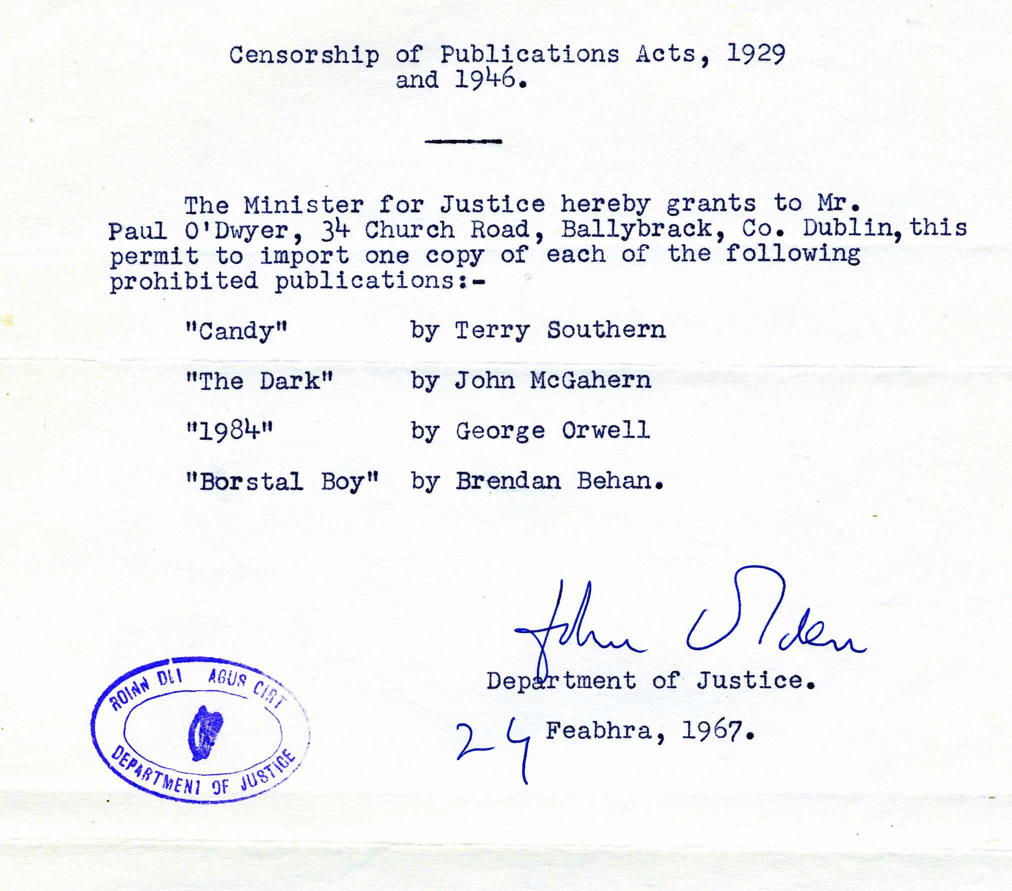


I kicked off the Q&A by reading out my certificate (above).

I also recounted my purchase of Lady Chatterley in Jersey in 1961, how it had been taken from me at Dún Laoghaire on my return and how I went through a period of utter panic when I thought I might end up the centrepiece of an Irish trial in the matter.

I referred to informal systems of censorship in the Dublin diocese and in UCD and to the book-burning of Seán Fagan's book in more recent times. However I also evoked changing times with the survival of multiple copies of the book in the public library system. The symbiosis of Church and State had surely exploded.


You can listen to the full podcast (including the Q&A) at the bottom of this page.

My contribution is at 49:18.


This is my third Hedge School. I have reported on my two previous attendances on Nelson's Pillar and The Somme.

Wednesday, March 21, 2018

ANNE BIEŻANEK


Anne Bieżanek leaving Westminister Cathedral
after confronting Archbishop Heenan on 1 May 1964.
Click on any image for a larger version

I would just like to add a postscript to the recent International Women's Day (8 March 2018). It concerns one of my heroes, Anne Bieżanek.

She was a great woman and a formative influence.

She was a Roman Catholic doctor and married woman who opened a birth control clinic in Liverpool in the early 1960s. She was refused communion at her local church and only succeeded in receiving the sacrament when she took herself to the altar rails at Westminster Cathedral and outfaced Archbishop Heenan (as he then was). You can see her leaving the church after that confrontation in the photo above.


She then wrote a book which was in two parts. The first part detailed her efforts to set up her birth control clinic (St. Anthony of Padua) and her brushes with the RC church. The second part set out the history of the RC church's second class treatment of women down the ages.


Click on image for a larger version


The book, which was a Pan paperback, was banned in Ireland (under the contraceptive schedule). I requested a permit from the Department of Justice to import a copy, and, much to my amazement, actually got one. You can see a copy above.

I have referred to Anne a number of times since.

I did a short blog post when I discovered in 2012 that she had died a little over a year earlier.

Then, in February, Four Courts Press were canvassing on Twitter for people's female heroes and I put her forward. I didn't get either of the two prize volumes but at least she got an airing.

I then got to wondering to what extent she was remembered across the channel. I suspected not very much. But working out of the newspaper cutting on her death, and with the help of Google, I traced her grand-daughter and wrote to her to say her grand-mother was not entirely forgotten on this side of the channel.

I have just got a lovely reply from her explaining that she had always loved and admired her grand-mother but that it was only as she grew up and had a family herself that she came to realise the full extent and significance of her grand-mother's bravery and her achievement.

It is heartwarming to read her admiration and praise for her gran.


At prayer


Anne Bieżanek was a pioneer and a person of integrity and deserves to be remembered.

PHOTOS

The photos above are from the newspaper and the internet but there are six photos in the book itself and you can see these below.


Sunday, March 26, 2017

GORDON BREWSTER & CENSORSHIP


Link
Click on any image for a larger version
Links under cartoons are to online originals in NLI

There was an intense preoccupation with the question of censorship in the course of the first ten years of the Irish Free State's existence, 1922-32. This happens also to be the period covered by the wonderful collection of cartoons by Gordon Brewster hosted by the National Library of Ireland (NLI). The cartoons are specific to that period and some of them reflect this preoccupation with censorship. Of these some will surely also resonate with the modern reader.

In any event, they introduce us to a very interesting period when the new state was attempting to establish both a political and cultural identity for itself.

I have referred before to the belief of many, if not most, of the Irish revolutionaries that when we got rid of the English they would take with them all our social evils and we would then be able to construct and live in a fully moral society.

Well, we know that's not how it turned out, but the illusion was there, and after the British left the focus switched to stemming the flow of evil literature and films flooding back into the new state from "pagan England".

The caption on the above cartoon tells us that by May 1928:
"President Cosgrave at the Cumann na nGaedheal Convention, announced that a Bill to deal with the evil literature peril would probably be brought before the Oireachtas within the next few months".

The censorship question was hotly contested, which probably explains why it was only relatively late in the decade that the relevant legislation began to emerge.

But I'm getting ahead of myself. Let me first establish my credentials for this exercise in the first place.


I have both played, and been a victim of, the Irish censorship régime, albeit during a later period.

In 1961 I had my copy of Lady Chatterley confiscated by the Customs in Dún Laoghaire, but some few years later I got my revenge by extracting from the system two certificates to import banned books. You can see the main one above and the list of requested titles, all of which were banned at the time, may surprise you.


Of course, there is seldom a supply without a corresponding demand. Brewster is here stressing the complicity of the reading public, although looking at the personalities involved it seems to apply as much to the theatre as to the world of modern dirty novels. But more of that later.


We are fortunate that Brewster sometimes sketched out ideas for new cartoons on the back of old ones and this is his original idea for the filth cartoon shown alongside the final outcome.


I have wondered who the guys on the balcony are. I'd hasard a guess that the two little guys may be the Shields brothers (William and Arthur), the guy top left Lennox Robinson and the guy top right W B Yeats. If I'm right then all these guys would have been involved in (fighting) censorship in one form or another.


In any event, the campaign against evil literature got off to an early start and the Irish League of Decency were very active on all fronts.


At one stage there appears to have even been the prospect of serious official censorship of journalists. But you have to remember that there was always an undercurrent of censorship in a society dominated by an ultra-conservative Roman Catholic Church.


Yeats refuses O'Casey's Silver Tassie
Link

While there was no official theatre censorship in the Irish Free State, it turned out that there was more than one way to skin a cat.

Directors, producers, theatre proprietors, actors and even audiences (not to mention those who had never been at a play in their life) exerted influence over ultimate content, though objections were as often over perceived insults to Irish nationhood as they were to moral impropriety.

While the Plough and the Stars just about survived in somewhat modified form and despite disruption during the performance, O'Casey's next play, The Silver Tassie, was completely blocked from the Abbey by W B Yeats himself.


Alan Simpson's arrest at the Pike Theatre in 1957

The principal (or only?) attempt by the State to officially censor the stage involved Alan Simpson's staging of Tennessee Williams's Rose Tattoo at the Pike Theatre in 1957.

The run was effectively shut down when the police arrested Simpson and the State subjected him to a year long pre-trial hearing before he was acquitted/vindicated. He had been accused of "presenting for gain an indecent and profane performance" despite a fair number of model citizens, including a Jesuit priest, attesting to the acceptability of the script.

Simpson was even held to be advocating an unnatural form of birth control. This arose from a scene where a packet of contraceptives falls out of a seducer's pocket in the middle of a seduction scene. The seductee is horrified and sends the guy packing. A seriously moral piece of acting you might think.

In fact there was no actual contraceptive exposed on the stage though many people afterwards swore they'd seen one. It reminded me of the Late Late controversy over the Bishop and the Nightie, where there was neither bishop nor nightie involved on the night of the offence.

For a more extensive treatment of the anomalous absence of theatre censorship in Ireland, particularly in the first half of the twentieth century, see Joan FitzPatrick Dean's essay in the South Carolina Review.


Meanwhile, back to Brewster, who on 18 September 1930 celebrated the lifting of press censorship in Spain. The caption reads:
"The censorship of the press in Spain ended yesterday and the newspapers published to-day will be the first to appear unfettered by restrictions for seven years"

But it took a full two decades after Brewster's death for significant liberalisation of the book censorship régime to be legislated in Ireland with the Censorship of Publications Act 1967.


I'll finish with this evocative cartoon from the early stages of the censorship campaign as it is a good illustration of the prevailing conservative attitude regarding "dirty books" right own to my own time. The caption reads:
"At the Catholic Truth Conference, Judge O'Brien K.C. denounced the plague of immoral literature from abroad."

But before I go I'd just like to add a footnote on Brewster's fine art output. I have mentioned elsewhere that I have only been able to trace one piece. For the rest nobody knows where any surviving pieces might be. What we do know for sure is that some of his own fine art output was destroyed by fire - first, in the burning of the RHA by the British in 1916 and, second, in the farewell bonfire after his death.


I would like to take this opportunity to thank the National Library of Ireland for conserving and digitising this wonderful collection of almost 500 of Gordon Brewster's original cartoons and for their forbearance in letting me use them in this series of blog posts.

Saturday, December 15, 2007

Towards a New Theocracy?

Catholic Ireland's dead and gone,
it's with John Charles in the grave.


I have just finished reading two books.

The first is a book I read in college many years ago. It was a sort of a banned book. You needed a licence to read it (yes, in a university — a Catholic university, that is). It was called "The Irish and Catholic Power" and was an intellectual "Catholic Irish for Dummies".

It was written by Paul Blanshard, partly in response to an assertion that the Ireland of its day represented the perfect marriage between the civil power and the Roman Catholic Church, and partly as a means of explaining their Irish Catholic heritage to Irish Catholic Americans.

For those of us brought up in the repressive and closed atmosphere of Ireland in the fifties and early sixties, it was a shocking read, and while I found it an education, I was not impressed by what I took to the be the author's style of bitter diatribe.

On a recent re-read I was, on the contrary, very taken with its restrained presentation and the academic robustness of its argument.

And the banning? Well the book was available in the University library but was kept in a special location and to get hold of it you needed a letter from your tutor stating your "bona fide" reasons for needing to consult it as part of your studies. Thank you Maurice Manning.

Incidentally, the copy I acquired recently originally belonged to the library of the Southern State Teachers College, Springfield, South Dakota. They seem to have acquired it in 1955 and it was in circulation (once every few years) until 1975 when it appears to have been withdrawn. Whether this was from lack of sufficient demand to warrant the storage space or whether there was any other ulterior motive involved I don't know. That institution has since been assimilated into the University of South Dakota, but enquiries to that source have so far elicited no response.

The second book is a biography of "John Charles McQuaid - Ruler of Catholic Ireland". John Charles was Archbishop (RC) of Dublin from 1940 to 1972 and by far the most influential Irish churchman in this period as he strove, by hook or by crook, to mould Irish society to his image of Christian living. It is written by John Cooney, a former religious correspondent with the Irish Times. It draws extensively on the recently released papers of John Charles himself. It is a gripping read, at least for those of us who lived through this period, and you can sense the author just barely keeping his temper in check throughout the book.

I did not set out to read these two books together. I decided recently to try and get a copy of Blanshard and re-read it to see what would be my reaction from the perspective of today when so much has moved on and so much has stayed the same. Then a priest cousin of mine, who was reading Cooney's book, expressed surprise at how all-pervasive had been John Charles's control of Irish society during his Archbishopric.

Reading these two books close to one another really brought me back to the fifties and sixties. You can very easily forget how repressive things were then, particularly as we have now swung, probably a bit too far, in the opposite direction.

The Nation

To understand the background, you must remember that the Irish, or at least a certain influential proportion of them, have long considered themselves an oppressed race and most, if not all, of their woes and deficiencies were the fault of the English oppressors. Being the first country to achieve independence from within the British Empire (1921) was no mean feat and shaped the Irish psyche from then on. That this independence was intially only partial and that it provoked a bitter civil war is neither here nor there. The main point is that we were newly independent and the psyche was delicate and prone to paranoia.

The second thing to remember is the role of the Catholic Church in all of this. While the institutional church frequently condemned Irish rebels to hellfire, particularly if it saw them as a threat to its own position, the church on the ground was, more often than not, sympathetic to the rebels and at times even led the revolution. So there was a strong identity, and coincidence of interests, between nationalism and catholicism.

No surprise then that the State, when set up, was Irish and Catholic. What is surprising is the extent to which these two strands were interwoven, the repressive and stunting effect this had on Irish society and the self confidence of the nation, and the ruthlessness with which the Catholic Church set out to exterminate all other religions and enshrine Catholic teaching in the law of the land.

You can't help thinking "Sharia" as you read these books and you would have to admire the sheer diabolical efficiency of the Church which succeeded, for a considerable period, in moulding Irish society to the dictates of Rome and the "informed" Catholic conscience. I have already touched on this theme in an earlier post.

These books are recommended reading for all budding Ayatollahs. This is how it's done lads.

The Protestants


What really shocked me on reading these books from today's perspective was the sheer ruthlessness with which John Charles set about exterminating the Protestants. That this extermination was of the religion rather than the people themselves makes the word no less appropriate. Protestants were, after all, heretics, mired in subversive error and a blot on the nation's newly polished escutcheon. You (me, a Catholic) were almost not allowed to talk to them for fear they would contaminate your faith. You were forbidden, on pain of mortal sin (eternal hellfire), to debate religion with them (except to convert them and then you needed another licence), or to enter their churches, or to attend their services (including your next door neighbour's funeral). Like the state in the final triumphant phase of communism they were supposed to wither away, and wither away most of them did. Had they been ethnics this would have been ethnic cleansing on a grand scale. And don't mention the Jews. Having crucified Christ what could they hope for from this new theocratic state?


The Catholics

Some Catholics stood out against this. For the most part these were literary people and were banned, and banned again, for their trouble. John Charles was effectively a co-author of the 1937 Constitution though he did not always get his way and on occasions de Valera either ignored him or defused his point with a gesture. But, make no mistake, this was a Catholic Constitution for a Catholic people. It enshrined the "special position of the Catholic Church" in what may have been intended as a gesture with no legal effect, but this provision informed the way people thought and, sometimes, the way the law was applied.

Most Catholic's, went along with this. Some out of fear, others from conviction. One institution which shamefully proved to be the handmaiden of the Archbishop, or as we would say today the Archbishop's poodle, was the University. No, not Trinity College, with its charter from an English queen, the bastion of Protestant proselytism in Ireland. Yes, University College Dublin, where you needed a licence to read Blanshard, where Noël Browne was banned from speaking, and where most of the chaplains and the philosophy professors were spies for the Archbishop.

A particularly close eye was kept on the L&H (the Literary and Historical Society) which was a major potential subversion spot in the intellectual and religious life of the capital. Speakers were regularly banned at the common behest of Palace and President.

In looking back now, I am a bit surprised that my own contribution in 1967 passed divine muster, or maybe it was that nobody knew who I was, nobody had seen the script, and the influence of the Palace was on the wane - though John Charles was nominally in charge up to 1971. His influence at this stage was diminishing and in the light of the nation's gradual coming to terms with the changes following Vatican II, he was probably proving an embarrassment to his colleagues. Still, it is nice in retrospect to have gotten in while the shutters were still down.

Tomorrow

Taken together these two books evoke an era which is way beyond the ken of today's younger generation. Try and explain it to them and they would think you were off your head.

It would be nice to forget all about this aberrant era but, unfortunately, there are signs it may not have entirely gone away. The gradual backsliding from the enlightenment of Vatican II, combined with the perceived challenge of Islam, may yet see a resurgence of the theocratic state.

If you find the above depressing, or beyond your ken, go here and have some fun, at the church's expense.

Monday, June 18, 2007

Irish Solutions - Confucius, him say

I got to thinking recently about some Irish solutions to Irish problems over the years and thought I should share the fruits of our native inventiveness with a wider audience, so here goes.

Traffic lit roundabouts
I always thought roundabouts and traffic lights were alternative solutions to a traffic flow problem.

If, for example, you are trying to sort out traffic coming from four directions you can use a roundabout.

This has the following benefits:
  • it is eco-friendly - no electricity used - static signage
  • it does not delay traffic when there is no one on the roundabout
But it can have one big disadvantage. If the traffic flow on one axis predominates, such as with a main highway versus a minor crossing road, the low priority road may never get a look in.

In this case you need to use traffic lights, even if the timing needs to be varied depending on time of day or observed traffic flows.

Ireland has combined these two methods to give us the roundabout with traffic lights. The lights are just at the entry, and exit, points of the roundabout, and the chaos is appaling.

The site of one, at least, of these monstrosities, is at Ireland's first official roundabout in Artane on the northside of Dublin. Since writing this I have been through the roundabout at Dublin Airport which reminded me that this must be the mother of all trafficlit roundabouts. A webcam at this roundabout would provide weeks, if not months, of uninterrupted entertainment to rival anything Big Brother has to offer.

Oddly even numbers
I have seen street numbered in many different ways.
  • Numbers can go up on one side and come back down on the other.
  • numbers can progress along a street with odd numbers on one side and even numbers on the other, but both ascending in the same direction. These can sometimes get out of phase depending on the incidence of number interrupters, like other streets, on either side, but it is usually manageable.
  • you can have the odd effect in a cul de sac of numbers starting at the far end on one side, rising as they come towards you at the entrance, jumping across the entrance, and going on up the other side. You then see two adjacent numbers at the entrance and it can be difficult to know whether it is worth entering the cul de sac in pursuit of a particular number.
But I really came across a gem recently when trying to match up numbers before and after a number of separately numbered terraces were inegrated into a unified numbering system for the road.

The odd numbers start at one end of the road and go along one side, while the even numbers start at the other end and go in the opposite direction on the other side.

Mindboggling, but, perversely in my case, very welcome as for some reason, the terrace I was interested in started from 1 and had only odd numbers, which it fortuitously kept under the new system. So No. 31 was still No.31 after the changeover. My thanks to the mad hoor who thought that one up. [The terrace was Park View Terrace, and the road Brookfield Road, in the Old Kilmainham quarter of Dublin city.]

Bona fide contraception
In the first half of the last century the environment in Ireland was very repressive. There was strict censorship (sex not violence) and contraception was not available, unless you opted for abstention, coitus interruptus (also known as Vatican Roulette), or oral or anal sex, and the last two of these were considered immoral and abhorrent.

A woman could get the pill, supposedly to regularise periods, but this not only put the onus on the woman, it also left her open to the long term side effects of the medication.

Then Charlie Haughey thought up an Irish solution to an Irish problem. Contraceptives (ie condoms) would be made available on prescription to married couples who were practicing bona fide contraception.

In other words only those who were entitled to have babies were allowed to avoid having them. QED.


The empty oath
One of the things that kept Fianna Fáil out of the Dáil (Irish parliament) in the latter half of the 1920s was the requirement for deputies to to take an oath of allegiance to the Free State and of fidelity to the British King in his role as a symbol of the Commonwealth.

De Valera realised that to get into power he would have to take the oath, so he announced in advance that he considered it an empty formula and abolished it once he came to power.

Túsáite
There are two official languages in Ireland. The first one (Irish/Gaeilge) and the other one (English/Sacsbhéarla).

For the most part, or virtually entirely, the country lives its life through the medium of English and has done so for the last 200 years. As a result, its laws are conceived in English, drafted in English, debated in English, adopted in English and ultimately implemented in English.

There is a constitutional requirement that versions should also be available in the Irish language and these are invariably produced as translations from the English and published with a lag, which can be up to a fair number of years.

But here's the rub. In the event of a dispute over the meaning of a piece of legislation, the Irish language version takes precedence.


Believe it or not.