Showing posts with label Hedge School. Show all posts
Saturday, April 20, 2019
BANNED
Tommy Graham, editor of History Ireland, has been organising Hedge Schools from a good while back. The term originates with informal schools set up for Catholics in penal times. Some of these provided a first class education.
I am not aware of the religious, or otherwise, convictions of the audience on this occasion (9/4/2019) in the National Library of Ireland, but they were a lively lot.
This Hedge School was about censorship and was structured around Edna O'Brien's trilogy Country Girls which was banned in Ireland in the 1960s and which is currently the choice for Dublin City Council's One City One Book initiative.
First to introduce the panel, right to left in this case.
Donal is a history gruaduate, best known as a co-author of the fabulous Dublin blog Come Here to Me!. He has recently finished a stint as a Historian in Residence at Dublin City Library and Archive.
Mary need no introduction to my generation, having been to the forefront of the Women's Liberation Movement in the 1960s. Her Wiki page tells me she is currently an "author, broadcaster, playwright and journalist" but also points out that "She has modified the radical ideas of her past, but not rejected feminist principles".
Mary, of course, was on the Contraceptive Train to Belfast when a number of prominent women went up there to buy The Pill and bring it back to town in a glare of publicity. I think I remember her saying recently that they did not succeed in getting the pills and came back with a stock of Aspirin substitutes which they passed off and which fooled the cameras, and the Customs Officers. I'm sure that story must be in print somewhere.
It reminded me of The Rose Tattoo and the non-existent frenchie, but that's another story.
Tommy is, as always, tonight's MC, or as the French would put it "animateur".
I had not come across Angela before. She has a PhD from DCU where her thesis was on 'An investigation into contemporary online anti-feminist movements' and she published a well received book in 2017 entitled Kill All Normies
You can get a flavour of her writing and current preoccupation from this piece from Atlantic in December 2017.
Niall is Head of Journalism at Griffith College.
I'm not going to report the various contributions in detail as you can hear the full podcast here. I'll just give a flavour of the contributions below.
Tommy had Mary kick start the evening with a censorship timeline from the foundation of the state to the present day, well, the 1960s when she was most active and the traditional system began to crumble at the edges or shake at the foundations, have it as you will.
She evinced great admiration for Edna O'Brien who she felt broke the old mold. I have not read Country Girls but Mary quotes Edna describing her father as a drunken brute, so I can accept the trilogy as mold-breaking in more ways than one. Of course it was Edna O'Brien's fame, or to put it another way, access to foreign outlets, that brought the thing to a head. Many before her had the potential to crack the mold but they lacked the hammer of exposure.
Mary also mentioned the Lady Chatterley trial in 1960 which gave a wider public access to this literary work. The hard-cover version had not been banned in the UK but its price kept it out of the paws of the proletariat. When Penguin Books published an unexpurgated paperback version all hell broke loose and they were prosecuted. Fortunately the prosecution lost the case and the paperback became widely available.
Of course the publicity had a perverse effect and a work written to extol the beauty and joys of sex was then being bought for the "dirty bits". I have to admit that this was true in my case but it turned out to be a very disappointing and potentially embarrassing purchase (see below).
Mary also mentioned that very few books were banned on the initiative of the Censorship Board itself. They mostly resulted from complaints by the (predominantly Catholic) laity.
The title of this Hedge School is Censorship in Ireland - Then and Now. We've heard a lot about THEN and are in serious danger of forgetting about the NOW. It's not always called censorship, more likely trolling or no platforming but we are every bit as much in favour of censorship now as people then and this is Angela's area - anti-feminism, the rise of the alt-right and so on.
But, as Angela pointed out, there are things going on that we don't notice and take for granted. She reminds us that the Amazon monopoly is a huge censor and that we rely on one monopoly search engine online, Google. And how do Twitter and Facebook assess tweets, posts and comments as fit for posting.
Conformity is now managed by social media platforms. Censorship no longer has to mean State censorship. And I know, myself, from comments I see and complaints about others, that these screening processes can be both arbitrary and biased.
And the alternative? The chaos of the internet - very destabilising and terrifying.
Much food for thought here.
Edna O'Brien thrived because there were alternative media by then for her to get exposure and attitudes were changing.
In preparation for the session, Niall had trawled through the Irish Newspaper Archive online to gauge public reaction to Edna O'Brien at the time of the publication of Country Girls. The archive covers both national and provincial papers with the exception of the Irish Times which has its own separate archive.
Niall found that there was virtually no hostility among the public generally to Edna O'Brien.
In earlier times, people's careers were blighted by censorship & they were embittered - he mentioned Patrick Kavanagh & Flann O'Brien.
In assessing the role of the Church in relation to censorship and such matters, you need to be aware that the Church had a system of control, often exercised through the laity, while they sat back and let it take its course. This system started to break down in the 1960s.
Donal was anxious to raise the question of political censorship, particularly as we are aware of sex based censorship and often boast how it was not political. But what about Section 31 which Donal saw as in a world class of its own.
He also drew attention to how their books being censored affected different authors. For Edna O'Brien it was almost a badge of honour, while John McGahern was devasted when The Dark was banned.
Donal is curating an exhibition on censorship at Dublin City Library and Archive in Pearse Street. It is provocatively titled: Evil Literature: Banned Books in Our Collection. It runs till end-May 2019 and is well worth a visit.
So it's onward and upward to the Q&A.
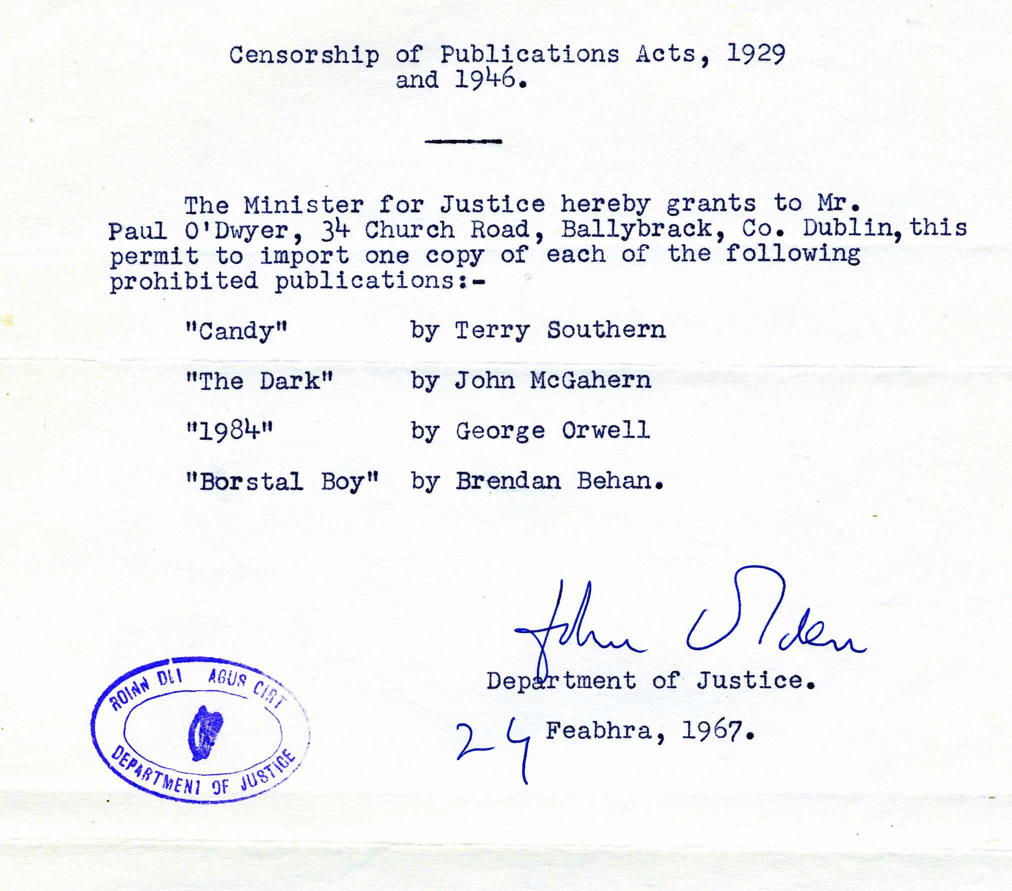
I kicked off the Q&A by reading out my certificate (above).
I also recounted my purchase of Lady Chatterley in Jersey in 1961, how it had been taken from me at Dún Laoghaire on my return and how I went through a period of utter panic when I thought I might end up the centrepiece of an Irish trial in the matter.
I referred to informal systems of censorship in the Dublin diocese and in UCD and to the book-burning of Seán Fagan's book in more recent times. However I also evoked changing times with the survival of multiple copies of the book in the public library system. The symbiosis of Church and State had surely exploded.
You can listen to the full podcast (including the Q&A) at the bottom of this page.
My contribution is at 49:18.
This is my third Hedge School. I have reported on my two previous attendances on Nelson's Pillar and The Somme.
Wednesday, July 20, 2016
HEDGE SCHOOL
This (19/7/2016) was my second hedge school. The first, also in the National Library of Ireland, was on Nelson's Pillar and I have done a blog post on that.
This one was on the Somme, which anniversary we are also in the middle of commemorating. The Pillar was only fifty years ago but the Somme was a full hundred years ago.
While we awaited the arrival of the hedge school master and his panelists the screen was showing the propaganda film of the Somme made in August 1916 and which is getting a showing around the place at this time.
The team finally arrived not long after we had all trouped back into the room following a brief evacuation at the sounding of the house alarm. What you might call a fairly dramatic entrance in the circumstances.
The team consisted of Tommy Graham (The Master), David Murphy (Maynooth), Lar Joye (National Museum), Jennifer Wellington (UCD), and Tom Burke (Royal Dublin Fusiliers Association).
You can see them taking last sips of water and getting mic'd up above.
The discussion flowed dynamically round the panel as Tommy dipped into his carefully prepared list of provocative questions. So I won't attribute remarks but simply record such items as particularly caught my attention.
The envelope, so to speak, had already been set out in the advance publicity for the school.
Fought between 1 July and 1 November 1916 the Somme Offensive was one of the bloodiest battles in history, costing the lives of more than 1.5 million men. On the first day alone the British Army suffered c. 60,000 casualties, many of them members of the 36th (Ulster) Division, and later soldiers of the 16th (Irish) Division were involved. While the involvement of the former continues to be extensively commemorated (especially in the North), Southern nationalist involvement has left a more ambiguous legacy.One of the most interesting new (for me) bits to emerge was the contrast between how the two armies (British and German) were structured. The Germans had a team approach. They all knew what they had to do including in contingencies such as losing their commanding officers. It had all been rehearsed ad nauseam. And the men were party to the rationale behind what was being done. They had been doing this for decades and it was very effective.
The British, on the other hand, had a strictly hierarchical system which ran on an excessively tight need to know basis. The officers more or less knew what they were supposed to be doing but most of it was kept secret from the men. So, when the officers were taken out the men were running around like headless chickens.
The Germans also operated deep defence, which meant if they were pushed back they already had further defensive positions prepared into which they could retreat. This system operated up to around five kilometers and could in some cases extend even to ten.
As it turned out the whole battle of the Somme, from June to November 1916, for all the slaughter, was limited to a front line which only advanced six miles in all.
In fact the Germans were almost happy enough to retreat if the price they could exact from British forces in the meantime remained high enough.
Verdun and the Somme had not been chosen for their strategic value. The Germans chose to attack Verdun because of its symbolic value since the time of Charlemagne. The British chose the Somme because it was at the point where the British and French armies came together. But it was only a bit of land and not particularly important in itself, one way or another. Haig had apparently wanted to fight in Flanders and finally got his way later in the war.
The value, or otherwise, of commemorating major events, such as the Somme, was discussed and the general feeling was that this was worthwhile if properly done. People should be aware of all aspects of their past and as well as this giving them a sense of identity they might actually learn some lessons from it. Reference was made to the value of recent North/South cooperation on the Somme project as having broken down some previouly existing barriers.
There was, however, a warning note sounded about commemoration unjustifiably turning into excessive celebration. The example quoted was Gallipoli which was an unmitigated disaster but was apparently commemorated in Australia, with a degree of national fervour and a high public spend, as though they had won and not lost that one.
Tommy invited the audience to pitch in at various points in the discussion. Interventions were substantive and one that stayed with me was the degree of intelligence (military not intellectual) available to both sides. They almost knew the names of the guys opposite (warning: poetic licence!).
I should mention in passing that David and I nearly shared a platform at the Alliance Français's Café Historique on the Martello Towers but it was not to be. So the Hedge School gave me an opportunity to say hello.
The panel were excellent and no one was in the least fazed by any of Tommy's googlies.
The above is only a small flavour of what went on at the Hedge School. The audio is now up here where you can catch up with the whole thing.
Tuesday, March 15, 2016
SCOIL SCAIRTE

Hedge School onstage [l-r]: Tommy Graham, Dennis Kennedy,
Donal Fallon, Fergus Whelan, Carole Holohan.
Click on any image for a larger version
I had never been to a Hedge School. Far from it: Belgrove, St. Louis Rathmines, Coláiste Mhuire. But interestingly enough, the one thing that was never questioned in any of these places, certainly not in my classes, was adherence to the physical force tradition.This was the womb of 1966, the long gestation (1950-63) of the triumphalism that was to burst onto the scene in the 50th Anniversary Celebration of the 1916 Rising.
There was, of course, an ironic undercurrent to all this as we modernised like mad during the 1960s and threw out babies, embryos and old farts along with the kitchen sink (or trough as we used to call it) and the old wooden pub interiors.
In ways, the coming of the plastic era was a fitting background to the last unquestioning celebration of the Rising. Then came Frs. Shaw and Martin putting their heads above the parapet with some deeper moral questions, and the likes of Ruth Dudley Edwards, arch-revisionist, daring to write anything other than an unqualified panegyrical biography of Pádraig Pearse, dear saint of our isle.
Then the troubles in the North called us all out. We suddenly started to listen to the words of the rebel songs we had been gaily singing for years, not excluding the national anthem itself, and some of us turned down the volume quite a bit.
Now, this may seem a long and wandering introduction to a simple post on a simple event, a hedge school on Nelson's Pillar in the National Library last evening (14/3/2016), but believe you me, muted as it may have been, all this stuff surfaced there. A great vindication of Tommy Graham who has been running these themed hedge schools with high class participation for a good while now.
The format is simple. Assemble a panel of good and controversial speakers. Take them through the subject in a structured Q&A sort of way. If they start a fight let them at it. Then bring in some audience participation to pour petrol or water on the flames, as the case may be. And QED, you have a hedge school, where everyone, including the Master, learns a little.
A thoroughly enjoyable and educational event for all concerned. And it would want to have been. I forewent (if I may be allowed the lapse into pedantry) an event across the road in Dawson Street to be there. Kevin Myers was putting Ruth Dudley Edwards through her paces on her new book, Seven Lives, assessing the seven signatories of the 1916 Proclamation.
I know, not exactly the Battle of the Boyne, but nevertheless.
Of all the panellists, Dennis Kennedy, was probably the most controversial, particularly against the background of the 1916 celebrations outside the front door. Dennis, like fellow panellist Donal Fallon, has written a book on The Pillar (Dublin's Fallen Hero, 2013) but I think these two would be coming at it from slightly different angles, to say the least. Dennis would be seen by many as simply a Northern Unionist, though he would see himself in somewhat broader and more complex terms.
Dennis has a long background in journalism, north and south and elsewhere, he has been the head of the EU Commission's Northern Ireland office and an academic in QUB.
He was the only panel member to be interrupted by a shout of "rubbish" from a member of an otherwise civilised audience.
I got the impression he was a bit nostalgic after the Pillar, although not necessarily entirely happy at its precise location. One of the basic questions he raised was how we should deal with memorials from history which were often judged not relevant to the present day or incompatible with the current ethos. Nelson was a case in point, but there were, of course, others.
Fergus Whelan is an author and trade unionist of long standing and as well as contributing to the history and lore of The Pillar he gave us fine renderings of two of the well known ballads about Nelson (after the fall, I'm not sure if there were any before it).
Carole Holohan, historian of the 1960s, gave us all a fright when she mentioned those who were injured on the night of the first Nelson explosion. I had understood that nobody had been injured and that the only person in the vicinity when the explosion occurred at 1.32am was a passing taxi driver whose taxi was struck by falling masonry but who escaped injury himself.
Turned out Carole was only teasing us and the injuries she referred to did occur on the night, but at Dublin Airport in the crush of fans welcoming Dickie Rock home after his coming fourth in the Eurovision song contest with "Come back to stay".
Carole also filled in some of the background to the newly emerging economic progress of the 1960s.
Donal Fallon had the look of a man who'd been bowled a googly, but, at the end of the day, he's well able to bat them.
He regaled us with examples of other monuments which had been gotten rid of through force of arms and even of previous attempts on the boul Nelson, including one vetoed by the British Army during the Rising. He tempted fate by quoting one of the ruder lines from an already rude ballad about General Gough's statue, but he got away with it.
He was asked an apparently innocent question from the audience about the relative damage done by the original Pillar explosion and the subsequent army one. He disposed of that one quickly enough but you still had a feeling that the more entertaining urban myth had taken such deep roots in Dubliners' subconscious that it would never be scotched were the Pope himself to denounce it.
In the end, a great night was had by all and, for those who would prefer a more balanced and comprehensive account of the proceedings,the podcast is now available here.
I have link to a whack of Nelson stuff here.
Subscribe to:
Posts (Atom)


