Showing posts with label free state. Show all posts
Friday, July 31, 2015
Nobody's Children
Yesterday's (30/7/2015) lunchtime talk in the National Library of Ireland was entitled Nobody's Children:The treatment for Shell-Shocked Great War veterans in the Irish Free State and it was given by Michael Robinson of the University of Liverpool's Institute of Irish Studies. The talk was based on part of his research for his PhD.
I always enjoy going to these talks. Even if I don't learn something directly relating to my family history or local history, or meet with new contacts, there is always some aspect of the thing to file away for the future.
I had an uncle who died on the Somme and a grand uncle who returned from WWI wounded. While I gather the latter's wounds were physical, I don't think there is any way anyone could return from at least three years in the trenches and still be completely right in the head.
So I was really interested in Michael's take on how the shell shocked returnees fared.
I was aware of the shame of it: them having fought for the monarch who was occupying Ireland and against our potential ally, the Germans. Indeed, had I known about either of the above soldiers at the time I would certainly not have mentioned them in the school I went to and would probably have felt quite bad about the whole matter. Thankfully, however, they have been allowed down from the attic for some time now and we have a better appreciation of the reality of those times.
What I hadn't appreciated was some of the nuances that Michael highlighted.
For example, had these shell shocked returnees been given special treatment by the Free State, would the same have been required for those who suffered in the War of Independence, and in the Civil War (including, God forbid, the anti-Treatyites)?
Also, poverty and unemployment were rampant at the time and there would have been very little inclination to give special treatment to the returnees anyway. While Michael has established that they were not actively discriminated against they certainly did not benefit from any positive discrimination such as we might see as desirable today.
And if there had to be any prioritisation, it would surely have been for the physically disabled whose disabilities would be more obvious to all.
And then there was the general stigma attaching to mental illness at the time, not just for the victim but for the whole family.
There were only three institutions in the whole of Ireland at the time which took in these shell shocked returnees. That clearly was only a drop in the ocean.
There was a scheme called the King's National Roll which employers signed up to and where they guaranteed to allocate 5% of jobs to ex-servicemen with disabilities. However, that scheme was not implemented in the Free State where the attitude was that these men fought for the British so the British could look after them.
Also, the benefits the British Legion brought to those in Britain and Northern Ireland were not replicated in the South where the Legion was very disorganised and underfunded.
Some employers, such as Guinness, did undertake at the outset to re-employ returnees and they did honour this undertaking, but that still left a lot of returnees fending for themselves or living a life of panic and despair under the cloak of caring families.
The story of my wounded grand uncle, John Burgess, is an interesting one. His father Christopher was a master bootmaker with premises in James's Street. The father was approaching retirement and John, who worked in the business, and even had a company house provided nearby, was the heir apparent.
When John enlisted, possibly as late as early 1915, his father disinherited him and threw his wife and children out of the company house. They took refuge in Oxmantown Rd. on the northside and when John eventually came home wounded he was unemployed.
He got a temporary job with a shoemaker in Capel Street whose sons were not quite old enough at the time to do the work. That didn't last and he subsequently got a job in the Gas Company and eventually in Dublin Corporation. I suspect his getting the latter two jobs were not unconnected to his campaigning for Alfie Byrne in Corpo and Dáil elections and to a brother-in-law being a prominent member of the Corporation itself.
So, at the end of the day, he could have come out worse. But, of course, most of the returnees wouldn't have had those sort of connections.
Since originally doing this post yesterday, I have just come across John Burgess's medical card, issued by the Irish Department of Social Welfare, but based on his WWI military disability discharge. So despite what was said above, the Irish State, albeit at a later stage, did seem to accept some responsibility or agency in the matter.
Monday, June 18, 2007
Irish Solutions - Confucius, him say
I got to thinking recently about some Irish solutions to Irish problems over the years and thought I should share the fruits of our native inventiveness with a wider audience, so here goes.
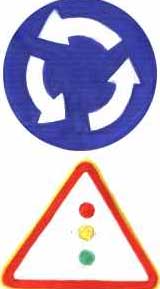
Traffic lit roundabouts
I always thought roundabouts and traffic lights were alternative solutions to a traffic flow problem.
If, for example, you are trying to sort out traffic coming from four directions you can use a roundabout.
This has the following benefits:
In this case you need to use traffic lights, even if the timing needs to be varied depending on time of day or observed traffic flows.
Ireland has combined these two methods to give us the roundabout with traffic lights. The lights are just at the entry, and exit, points of the roundabout, and the chaos is appaling.
The site of one, at least, of these monstrosities, is at Ireland's first official roundabout in Artane on the northside of Dublin. Since writing this I have been through the roundabout at Dublin Airport which reminded me that this must be the mother of all trafficlit roundabouts. A webcam at this roundabout would provide weeks, if not months, of uninterrupted entertainment to rival anything Big Brother has to offer.
Oddly even numbers
I have seen street numbered in many different ways.
The odd numbers start at one end of the road and go along one side, while the even numbers start at the other end and go in the opposite direction on the other side.
Mindboggling, but, perversely in my case, very welcome as for some reason, the terrace I was interested in started from 1 and had only odd numbers, which it fortuitously kept under the new system. So No. 31 was still No.31 after the changeover. My thanks to the mad hoor who thought that one up. [The terrace was Park View Terrace, and the road Brookfield Road, in the Old Kilmainham quarter of Dublin city.]
Bona fide contraception
In the first half of the last century the environment in Ireland was very repressive. There was strict censorship (sex not violence) and contraception was not available, unless you opted for abstention, coitus interruptus (also known as Vatican Roulette), or oral or anal sex, and the last two of these were considered immoral and abhorrent.
A woman could get the pill, supposedly to regularise periods, but this not only put the onus on the woman, it also left her open to the long term side effects of the medication.
Then Charlie Haughey thought up an Irish solution to an Irish problem. Contraceptives (ie condoms) would be made available on prescription to married couples who were practicing bona fide contraception.
In other words only those who were entitled to have babies were allowed to avoid having them. QED.
The empty oath
One of the things that kept Fianna Fáil out of the Dáil (Irish parliament) in the latter half of the 1920s was the requirement for deputies to to take an oath of allegiance to the Free State and of fidelity to the British King in his role as a symbol of the Commonwealth.
De Valera realised that to get into power he would have to take the oath, so he announced in advance that he considered it an empty formula and abolished it once he came to power.
Túsáite
There are two official languages in Ireland. The first one (Irish/Gaeilge) and the other one (English/Sacsbhéarla).
For the most part, or virtually entirely, the country lives its life through the medium of English and has done so for the last 200 years. As a result, its laws are conceived in English, drafted in English, debated in English, adopted in English and ultimately implemented in English.
There is a constitutional requirement that versions should also be available in the Irish language and these are invariably produced as translations from the English and published with a lag, which can be up to a fair number of years.
But here's the rub. In the event of a dispute over the meaning of a piece of legislation, the Irish language version takes precedence.
Believe it or not.
Traffic lit roundabouts
I always thought roundabouts and traffic lights were alternative solutions to a traffic flow problem.
If, for example, you are trying to sort out traffic coming from four directions you can use a roundabout.
This has the following benefits:- it is eco-friendly - no electricity used - static signage
- it does not delay traffic when there is no one on the roundabout
In this case you need to use traffic lights, even if the timing needs to be varied depending on time of day or observed traffic flows.
Ireland has combined these two methods to give us the roundabout with traffic lights. The lights are just at the entry, and exit, points of the roundabout, and the chaos is appaling.
The site of one, at least, of these monstrosities, is at Ireland's first official roundabout in Artane on the northside of Dublin. Since writing this I have been through the roundabout at Dublin Airport which reminded me that this must be the mother of all trafficlit roundabouts. A webcam at this roundabout would provide weeks, if not months, of uninterrupted entertainment to rival anything Big Brother has to offer.
Oddly even numbers
I have seen street numbered in many different ways.
- Numbers can go up on one side and come back down on the other.
- numbers can progress along a street with odd numbers on one side and even numbers on the other, but both ascending in the same direction. These can sometimes get out of phase depending on the incidence of number interrupters, like other streets, on either side, but it is usually manageable.
- you can have the odd effect in a cul de sac of numbers starting at the far end on one side, rising as they come towards you at the entrance, jumping across the entrance, and going on up the other side. You then see two adjacent numbers at the entrance and it can be difficult to know whether it is worth entering the cul de sac in pursuit of a particular number.
The odd numbers start at one end of the road and go along one side, while the even numbers start at the other end and go in the opposite direction on the other side.
Mindboggling, but, perversely in my case, very welcome as for some reason, the terrace I was interested in started from 1 and had only odd numbers, which it fortuitously kept under the new system. So No. 31 was still No.31 after the changeover. My thanks to the mad hoor who thought that one up. [The terrace was Park View Terrace, and the road Brookfield Road, in the Old Kilmainham quarter of Dublin city.]
Bona fide contraception
In the first half of the last century the environment in Ireland was very repressive. There was strict censorship (sex not violence) and contraception was not available, unless you opted for abstention, coitus interruptus (also known as Vatican Roulette), or oral or anal sex, and the last two of these were considered immoral and abhorrent.A woman could get the pill, supposedly to regularise periods, but this not only put the onus on the woman, it also left her open to the long term side effects of the medication.
Then Charlie Haughey thought up an Irish solution to an Irish problem. Contraceptives (ie condoms) would be made available on prescription to married couples who were practicing bona fide contraception.
In other words only those who were entitled to have babies were allowed to avoid having them. QED.
The empty oath
One of the things that kept Fianna Fáil out of the Dáil (Irish parliament) in the latter half of the 1920s was the requirement for deputies to to take an oath of allegiance to the Free State and of fidelity to the British King in his role as a symbol of the Commonwealth.De Valera realised that to get into power he would have to take the oath, so he announced in advance that he considered it an empty formula and abolished it once he came to power.
Túsáite
There are two official languages in Ireland. The first one (Irish/Gaeilge) and the other one (English/Sacsbhéarla).
For the most part, or virtually entirely, the country lives its life through the medium of English and has done so for the last 200 years. As a result, its laws are conceived in English, drafted in English, debated in English, adopted in English and ultimately implemented in English.There is a constitutional requirement that versions should also be available in the Irish language and these are invariably produced as translations from the English and published with a lag, which can be up to a fair number of years.
But here's the rub. In the event of a dispute over the meaning of a piece of legislation, the Irish language version takes precedence.
Subscribe to:
Posts (Atom)