Showing posts with label school. Show all posts

Saturday, June 02, 2007

In defence of Froggy

In more recent times (2023) information has surfaced which gives increased depth to this story and effectively turns Folens from a simple collaborator, albeit justifying his collaboration as motivated by the prospect of independence for Flanders, into a fully fledged patriotic Flemish hero. Instead of being incarcerated he should have been given a medal.

For the full update on this new evidence and on the new book written by his daughter Leentje and just published, see this blog post.

The book itself reveals that far from simply collaborating with the Germans in Brussels, Folens was working undercover for the Flemish Resistance. It also shows that his participation in the Flemish Legion was not by choice but by accident.

These new developments make a certain amount of the material below, and that referenced in some other of my blog posts on Folens obsolete. So if you are reading this blog post or any of the others, please remember that he has emerged in an even more favourable light than originally portrayed.

Also I have set up a totally new blog specifically linked to the book where individual posts expand on aspects of the story including for the post 1958 period which is not covered in the book: https://albertandjuliette.blogspot.com/

-o0o-


As of June 2007, I am republishing this post with some additions, as follows:
  • the first section is the original post unamended;
  • the second section is my own follow up comment posted after the transmission of the programme; and
  • the third section contains some new comments on subsequent material relating to the programme appearing in the periodical History Ireland

The Original Post posted 12 January 2007, before the broadcast There is a report in the Irish Times (12/1/2007) which says that Albert Folens's widow secured a temporary (ex parte) High Court injunction preventing RTÉ from using a 1987 interview with her husband in a TV programme titled Ireland's Nazis, scheduled to be aired next week as part of the Hidden Ireland series.

Mr. Senan Molony, who was then working for the Sunday Tribune had taped the interview with Mr. Folens. Mr Rogers, counsel for Mrs. Folens, said that a representative of the newspaper, Mr Molony and Mr Folens had signed an agreement allowing Mr Folens to see any article before it was published and also giving him the right of reply.

His client was seeking the injunction restraining the defendants from using, broadcasting and publishing the subject matter of that interview, otherwise than in accordance with the terms of the agreement in 1987. Report was also carried in Irish Independent.


Albert was my French teacher in school. He was a very good teacher. He taught French through French. He was supposed to be teaching it through Irish but he didn't have the Irish.

He published a series of textbooks for learning French through Irish which we used in class. Donncha Ó Céileachair did the Irish end of these. Folens also started publishing cog notes for exams which were first class, even if they were totally subversive of the supposed aims of the education system. This activity progressed to publishing actual text books, particularly on new subjects like civics, and the business eventually expanded into a high class, and very worthy, publishing empire.

We called him Froggy, which must have been the ultimate irony for a militant Fleming. We didn't know his background then but it was fairly wide knowledge in Dublin that he had fled Belgium because of support for the Germans during WWII. It would have been understood here, though, that any such support was bound up with the struggle for Flemish independence. The Germans had promised both the Flemish and Bretons greater independence under Germany than they then enjoyed under Belgium and France respectively. A number of Bretons also got sanctuary in Ireland after WWII and some became actively involved in the Irish language movement.

Albert wrote a book which set out his position quite clearly. He published it himself in 1958. It is called "Aiséirí Flóndrais" (Flanders Rising). It was published in Irish, translated from the English by Donncha Ó Céileachair. It shows that he was a true Flemish nationalist and abhorred the extremes perpetrated by the Nazis, some of which extremes, he says, were also mirrored by the then Belgian authorities. Along with tens of thousands of Flemings he supported the Germans as a means of achieving some measure of rights and ultimate independence for Flanders. Most of these were ultimately disillusioned by the later stages of the war by which time they were faced with Hobson's choice.

It would be strange indeed for the Irish, of all people, to be critical of his good faith in this venture when Ireland herself sought the help of the French (na Francaigh ag teacht thar sáile!) and the Germans (Banna Strand!) in her own fight against national, cultural, economic, linguistic and religious oppression. Our Head of Government even signed the book of condolences for Hitler after his atrocities were known. The Flemings were a long oppressed race, none the less so by their own cobbled-together and vindictive Belgian state.
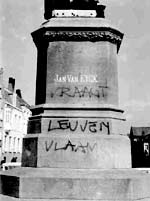
I spent time in Flanders in 1967/68 at the height of the "linguistic wars" and I must say my sympathy was entirely with the Flemish. They had been derided, exploited, used for cannon fodder, denied office and forced to bend the knee to a francophile coterie which, thankfully by then, was beginning to resemble the fading remnants of a post colonial ascendancy.

I don't know if RTÉ made any effort to consult with his widow regarding the content of the programme or to give the family a chance to put Albert's view across. It doesn't look like it from the tone of the report in today's Irish Times and Mrs. Folens's statement.

There is a class of supposed exposé journalism, and it is not new, which seems very reluctant to afford the subject of criticism the right of simultaneous reply.

This, after all, is only natural justice and to be all the more expected in a flourishing democracy like ours. It is, unfortunately, usually safe enough to take the lazy way out when the subject is dead! Fortunately there may be a prospect of some legal redress in this particular case. We'll see.

I don't know if Albert's book was ever re-published after 1958 or if the original manuscript in English ever saw the light of day. But, in this age of universal access to the internet, it would be worth publishing both, if only online.

There are even lessons to be learned from it on the linguistic front which might still be relevant to both the Welsh and Irish efforts at language development.

If RTÉ want to exhume Albert let them resurrect the whole man and pay some attention to what he actually has to say rather than setting him up as an easy aunt sally.
My comment posted following the broadcast

I wondered why the original taped interview had not been used at the time (1987) as the basis for a story, or flogged to RTE as was done recently. It is interesting to see the reasons given at the time by the then editor of the Sunday Tribune, Vincent Browne, for not using the material: " ... we have decided not to publish anything concerning your involvement in the Second World War, at present. This decision was taken on the following basis: that, given the absence of harder information concerning any impropriety it would be wrong to expose you to the turmoil that would inevitably ensue if we published the information which we presently have in our possession." Source The only additional information available since then is the entry in the US/UK Crowcass manual listing Folens as an "interpreter" rather than a "translator" at the Sicherheitspolizei premises in Brussels. However Folens himself said that the part he worked in was "lectorale" which involved translation rather than interpretation. The dropping of a "reconstruction"/fabrication of an interrogation sequence from the transmitted programme speaks volumes in this regard.


Further Comments posted 2 June 2007

The programme was reviewed in the March/April issue of History Ireland by Eamon O'Flaherty who lectures in history in UCD. He mentions Cathal O'Shannon's annoyance at Irish neutrality and at not being allowed to wear his British uniform when home on leave in Dublin from the RAF during the war.

I can understand why O'Shannon might have resented the welcome given to collaborators after the war when, at the same time, the contribution of Irish people who enlisted in the Allied cause was swept under the carpet. Some of my own family experienced this after WWI.

Regarding the actual programme, O'Flaherty does suggest, however, that in O'Shannon's case "perhaps the journalist's desire to tell a good story won out over the maintenance of proportion in the latter stages of the film". I certainly think that was the case. O'Flaherty himself, however, also asserts that "the controversial nature of the revelations even at this remove was shown by the efforts of the widow of Albert Folens, one of the subjects of the film, to prevent it from being broadcast". I understood that Mrs. Folens's action was an attempt to ensure a right of reply and fairness of treatment in the case of her husband. Her counsel was seeking to have the broadcast of the tape stopped except in accordance with the existing agreement which guaranteed advance knowledge and a right of reply - hardly new concepts in the area of justice.

A further piece in the May/June issue of History Ireland, by Daniel Leach, a scholar and PhD candidate at the School of Historical Studies in the University of Melbourne, takes a broader look at the factors influencing the behaviour of the Irish State during WWII, and, in particular, our covert pro-Allied neutrality. Leach underlines the importance of symbols of sovereignty to a small newly emerging state, particularly where the former colonial master and its major ally do not appear to take such sovereignty seriously.

The piece also refers to the practice of some of the victorious Allies of tarring all collaborators with the war-criminal label as a tactic for suppressing separatist movements. Obvious examples here were France and Belgium.

There are many lessons to be learned from this unfortunate episode, and they need to be learned sooner rather than later in a world that is increasingly making light of the very human rights for which people fought and died in two "World Wars" and many other struggles between and since.


Some more recent posts

Turkish Delight 17/1/2012

Do you remember Froggy 23//2013

Pro Patria 8/2/2016

Was Roger Casement a Nazi 2/4/2016

Bloomsday 2016 12/6/2016

New Blog

I have set up a totally new blog specifically linked to the book where individual posts expand on aspects of the story including for the post 1958 period which is not covered in the book:
https://albertandjuliette.blogspot.com/

Sunday, February 11, 2007

Kicking Teacher

It seems to have become fashionable to have gone to Belgrove National School despite its being located on the northside of Dublin.

John McGahern taught there and was sacked from there for having written a dirty book. Neil Jordan is a past pupil and I recollect seeing a load of other names quoted recently of well known people whose education started in this school.

I think I was there before before most, if not all, of them. That would have been around 1949 when I was living in Dollymount Park.

People are always writing nowadays about how they went across the fields to school, or to the shops, or to anywhere. Crossing the field has almost attained the status of a literary conceit.

Well, I went across the field to school and I'll bet there are very few people who have had as big a monument erected on their field as I have had on mine. A spanking new church, no less, named after the angel who brought the good news to Mary.

There was nothing wrong with Belgrove, I just hated school and availed of any opportunity not to go.

One day, I set out for school across the field and by the time I got to the other side I realised I had left my schoolbag behind. I turned around and set out for home. By the time I got home, about two minutes later, I had convinced myself that I was now so late that there was no point in going to school at all that day. My mother thought otherwise. But I dug in and refused to go to school. She grabbed me by the ear, or somewhere, and literally dragged me all the way to school.

She knocked on the class door, which class was now well underway. Teacher opened the door. My mother said "This fellow says he's not going to school today". "We'll see about that" said the teacher, making to grab me as my Mother handed me over.

By this time I was beyond all reason and kicked the teacher sharply in the shin. "Get him out of here" shouted the teacher.

My Mother reluctantly led me home, across the field, of course.

QED.

The teacher's name is being withheld at the request of the family. Not her family, my family, in case her estate decides to sue even at this late hour.

Saturday, November 04, 2006

Central Model School


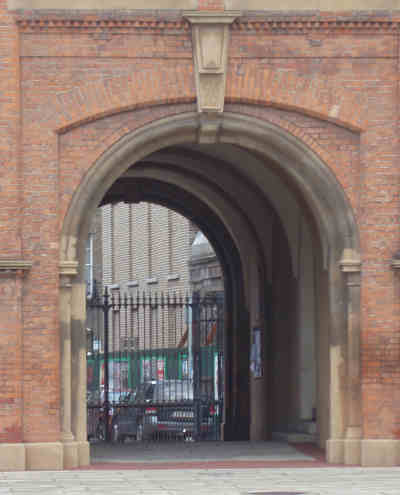
Having raised the subject of the Central Model School in Dublin's city centre in a post on George Bernard Shaw, I was invited by a commenter to expand on my association with this venerable institution, so, here goes.

I had just got my primary degree and had no particular plans for the summer when a fellow student asked me if I would do him a favour. He had a friend who had secured a job as a teacher in the Central Model School, but the friend still had some practical exams to do and would not be available until ten days after the start of term. Would I stand in for him for those ten days?

Whatever about initiative, I still had a sense of adventure in those far gone days and I rose to the challenge.

When I arrived on my first day everything looked normal and under control. I was given a class; I think it was fifth class which would have meant about 11 year olds.

I was full of great ideas about getting and holding the pupils' interest and presenting the subjects in the most interesting way possible.

My first instruction from the head teacher was to give a child a shilling and send him down to Capel Street to buy a bamboo cane. This was to be my symbol of authority and the instrument of retribution on any pupil who chose not to obey instructions, who was lazy, or who did not adequately focus his mind on the learning process. I must say this was not quite what I had in mind, but I forked out the shilling and got the cane.

My second surprise was the range of ability in the class. This ranged from very intelligent children who were anxious and willing to learn to those whom I felt should have been in a special school which would cater directly for their learning disabilities, or a reformatory which might remedy their insolence or sheer disobedience.

There were two brothers in the class, one at either end of the scale. The less well endowed one used to take off at lunchtime to Woolworths department store, nick a load of little plastic boats, and spend the afternoon loudly pulling them apart at the bottom of the class. When I suggested he lay off the noise, his brother, who turned out to be his minder, threatened to get his bigger brother to sort me out. Given the flats in which the family lived, this was a consummation devoutly to be avoided.

Another little fellow came up to me a half hour before the official lunchtime with a request. "Please sir, can I go early. Me mammy's sick an' I have to do the messages before lunch". "OK" said I and saw him out the door. About ten minutes later there was a knock on the class door and a procession entered: in the lead, the headmaster, followed by the lollipop man who was dragging my little fellow by the ear. "This (unmentionable) says you said he could go home early" said the head, fully expecting that I would contradict this outlandish story. The little fellow had been caught shinning down the rear spiked gate by the lollipop man who was coming on duty for the lunch break. Imagine the head's incredulity and frustration when I confirmed the little fellow's story.

I eventually gave up trying to teach anything and contented myself with simply holding their attention with stories and demonstrations of primary scientific phenomena. My successor could concentrate on improving their lot - after all that is what he was trained to do.

Meanwhile, I woke up each morning in a cold sweat at the thought of battling through another day in this bootcamp.

I did learn one thing from this "teaching" experience. Insofar as I had any competence as a teacher it was purely to teach the "willing to learn". Perhaps, it wasn't quite as bad as that. I subsequently found out that the particular class I had been allocated had borne the brunt of teacher changes in the immediately preceding years and this, no doubt, contributed to their, and my, difficulty.


There is an unexpected postscript to this adventure. I was in the habit of eating in Gaj's restaurant at teatime on those evenings I stayed in town after work. Gaj's was not only the most socialist restaurant in town, it was also the most sociable. It was a hotbed of constitutional revolution and civil disobedience in the cause of advancing the lot of the working class. Anti-establishment activists, such as Máirín de Búrca, of the Dublin Housing Action Committee, frequented the place. You went in and sat at any table and struck up with the most unlikely bedfellows. I once met a man there who was ashamed to have come from Mayo. God Help Us!

Anyway, the point of my dragging Gaj's into this post is that, one evening, I was coming out of the place, and on the pavement by the doorway was a young fellow playing the tin whistle. Nothing strange in that, you might think. But this guy had his manager/impressario at his side, and who was it? Yes, the guy who broke up the boats in class.

So I also learned that performance and behaviour in class is a poor predictor of success in the commercial end of the arts at any rate.

Monday, July 17, 2006

GBS @ 150

It is now 150 years since the birth of George Bernard Shaw (1856–1950) and various plans are underway in Ireland to commemorate the great man.

Apart from a general awareness of his existence and of his contribution to Anglo-Irish literature, I have had three personal experiences which relate to him (sort of).

My Fair Lady

In his will, GBS left the proceeds from his works to a number of institutions, among them the National Gallery of Ireland. The amount involved increased significantly with the success of "My Fair Lady" which was based on his play "Pgymalion".

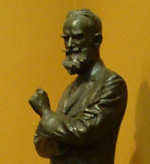
It is reported that, of the institutions benefitting from his will, only the National Gallery of Ireland realised its entitlement in full. As I remember it, the money was used to finance a substantial extension to the Gallery. At this time, a statue of GBS residing in the obscurity of the Gallery's basement was relocated to outside the south eastern corner of the Gallery, to which it was a striking addition. I photographed it as part of my general photo-romp through the city (see photo). When the money was spent, and the extension constructed, the statue vanished from its outdoor pedestal. I was originally cynical about this turnabout: out of the basement, into the lawn, gone from the lawn. I have learned, since originally writing this post in June, that the story is a bit more complicated and not at all uncomplimentary to the Gallery.

It appears that GBS took umbrage that this fine statue was wasting its sweetness in the basement and attempted to have it put on display. The Gallery, at that time, had a policy which limited displays to people already dead. Shaw, however reluctantly, understood this and commented that it would "all shut up OK" by which he presumably meant when he was dead. Meanwhile, when John White became curator, the statue was put on display outside, where it remained for thirty years. Unfortunately it then started to weather and was brought back inside for restoration and a coat of wax.

Now that the Gallery is honouring the author in this commemorative year, the statue is the centrepiece of the current exhibition. Fair dues.

As an aside, it is interesting to note that the statue in the first photo above has its back turned to the national parliament building where the level of mastery of the English language still leaves a lot to be desired.

Phonetic English

GBS took a great interest in the English alphabet and offered a significant prize for anyone who could come up with a phonetic alphabet to replace the existing rather ramshackle arrangements.

As someone who has tried to teach English to foreigners (who else), I have every sympathy with this approach. English pronounciation is appallingly difficult to learn and can be perfected only by rote. Even then it is rampant with distinctions based on location (an enriching element) and on class (a disgrace).

A competition was announced 1957 and 450 entries were received in the course of 1958. No single entry was deemed winner and the prize was shared by four contestants. Penguin Books published a version of Shaw's "Androcles and the Lion" in parallel text as an aid to learning the new alphabet.


You covered up the new text, translated the standard English text, and then compared your results with the "official" version. I had a go at it and was quite impressed at its economy and consistency. However, try as I did, I could never quite get it quite right. I found this very discouraging until I realised that the phonetic alphabet reflected the phonetics of the author or standard-maker and his pronounciation of certain words were not the same as mine. Standard English spelling has now been accepted as representing a range of different pronounciations and introducing a new standard would open up a pandora's box.


The new alphabet never caught on and one of the contestants described it as "a slimming down of written English to the point of anorexia". You can go into more detail here.

Central Model School

The final connection between me and him seems to be the Dublin Central Model School. This is a remnant of a daring experiment in the 1800s of which only very few remain today. Virtually all of the primary school sector was owned and managed by the Churches (overwhelmingly the Roman Catholic Church) despite being financed for the greater part by the State (taxpayer). The Central Model School, in contrast, is owned and directly managed by the Department of Education.

GBS "studied" there for some seven months in 1869. I taught there for some ten days in 1966. It is an open question as to which of us was most affected by the experience. I was certainly shattered by it and, now that I have mentioned it, will write it up in the near future.

Conclusion

Happy birthday George, ní bheidh do leithéid ann arís.


UPDATE 26/7/2016

Hard to believe it is ten years since I did the post above and that it is 160 years today since the birth of the great man.


I just came back to report that the statue is now reposing in the foyer of the Gallery for all to see. I'm not sure if it will be a permanent feature there as the internal decor is a bit fluid due to extensive renovations of the Gallery itself.

Wishing the great man another Happy Birthday, this time on the day.