Showing posts with label DCLA. Show all posts

Friday, January 25, 2019

MEDIATRIX


Click on any image for a larger version

This was the 22nd annual Gilbert Lecture in Dublin City Library and Archive in Pearse Street.

The lecture series is named after John Thomas Gilbert (1829-1898) who did much to chart the history of Dublin. His valuable library of books and manuscripts, relating to Dublin and Ireland, was bought by Dublin Corporation after his death and this forms the nucleus of the special collections in Dublin City Library.

It is an honour to be invited to give the Gilbert Lecture and this year that honour fell to Marie-Louise Coolahan, Professor of English Literature at NUI Galway. Her lecture was titled:
"as was taken out of his own mouth in Dublin":
Autobiography and Life Writing in Early Modern Ireland


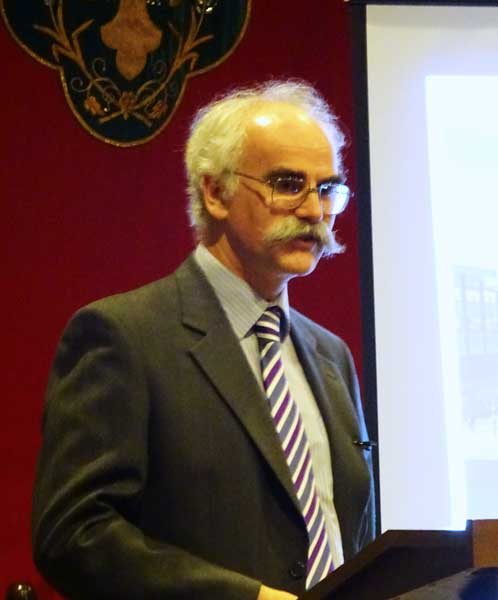
The day was organised by Enda Leaney, Senior Librarian, seen here in his Clarke Kent outfit. Enda has taken over from Máire Kennedy, to whom I am grateful for her many invitations for me to give (ordinary) talks there over the last decade.


Brendan Teeling, Acting City Librarian, gave us a rundown on the Library and on the Gilbert Lectures. He had much praise for Dublin's public libraries and their dedicated staffs. The libraries provide a wide variety of essential services to the public free at the point of use and it is vital that this be maintained.

Speaking as a former inhabitant of the Department of Finance, I know that the libraries were always at the top of the list for cuts in times of stringency and it is nothing short of a miracle that the free service has been maintained over the years.


Dermot Lacey was representing the Lord Mayor, and no better man for an entertaining master of ceremonies. And he didn't disappoint.

He recounted how he nearly didn't make it as he had to visit his dentist with a sore tooth (him not the dentist). After the procedure the dentist remarked that he had a very small mouth. This brought forth a burst of laughter from the audience who had come to know Dermot well over the years.


Anyway his first duty was to present Professor Michael Griffin, who gave last year's Gilbert Lecture, with a copy of the lecture in book form. Each year the Gilbert Lecture is turned into a book and published on the occasion of the following year's lecture.

And then it was down to business with Marie-Louise.


It was the word "autobiography" in the title combined with the status of the lecture which brought me along. As usual I hadn't read the title carefully and thought I might get a few hints for writing my own autobiography, assuming I last another few years.

Well the talk turned out to be more interesting than that. Marie-Louise was looking at the emergence of autobiographical and life writing in the sixteenth and seventeenth centuries.

She examined the motivation, format and content of a wide variety of texts. Now, this is not my period and I am not a historian, but one thing emerged clearly to me. All this writing was mediated. None of it was unrestrained stream of consciousness. Each item was defined by its context. Texts were backing up favours sought, exculpation of past misdeeds and so on. They each had a clearly defined purpose. So presentation of autobiographical information was mediated to suit the purpose at hand.

A bit like the way the winners write the history or the church mediated reporting of the Knock apparition of 1879.

So a timely warning to historians to always be aware of the agenda. There is always an agenda.

I have titled this post "Mediatrix" because the lecture was about mediation and it was itself mediated with extraordinary vivacity. If you don't believe me, just skim down the series of photos of Marie-Louise in action below.
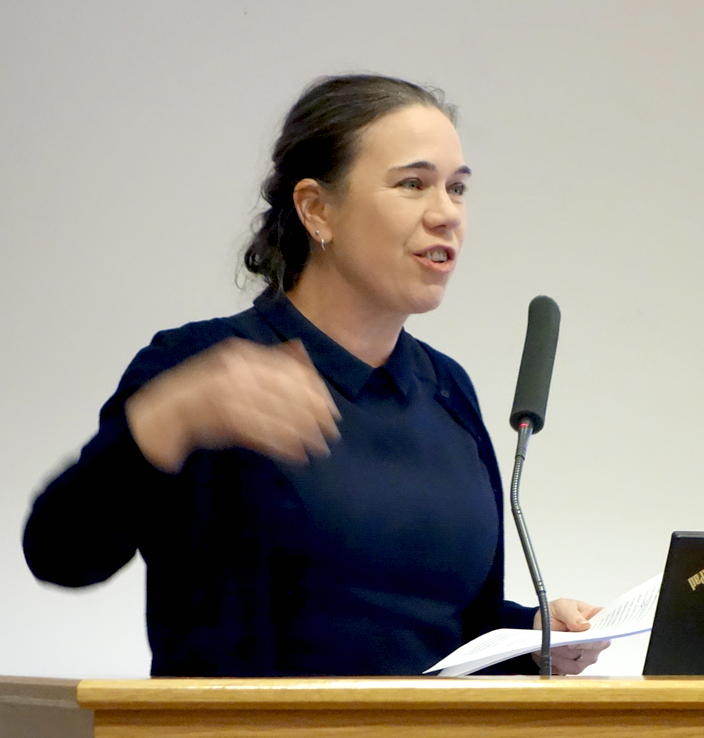


The audience listened and watched with rapt attention.


This included Dermot ...


... and Máire Kennedy herself ...


... and Enda.


And all too soon it was over and time for posed photos.

Marie-Louise, with Dermot (and the book), and Michael Griffin (the author).
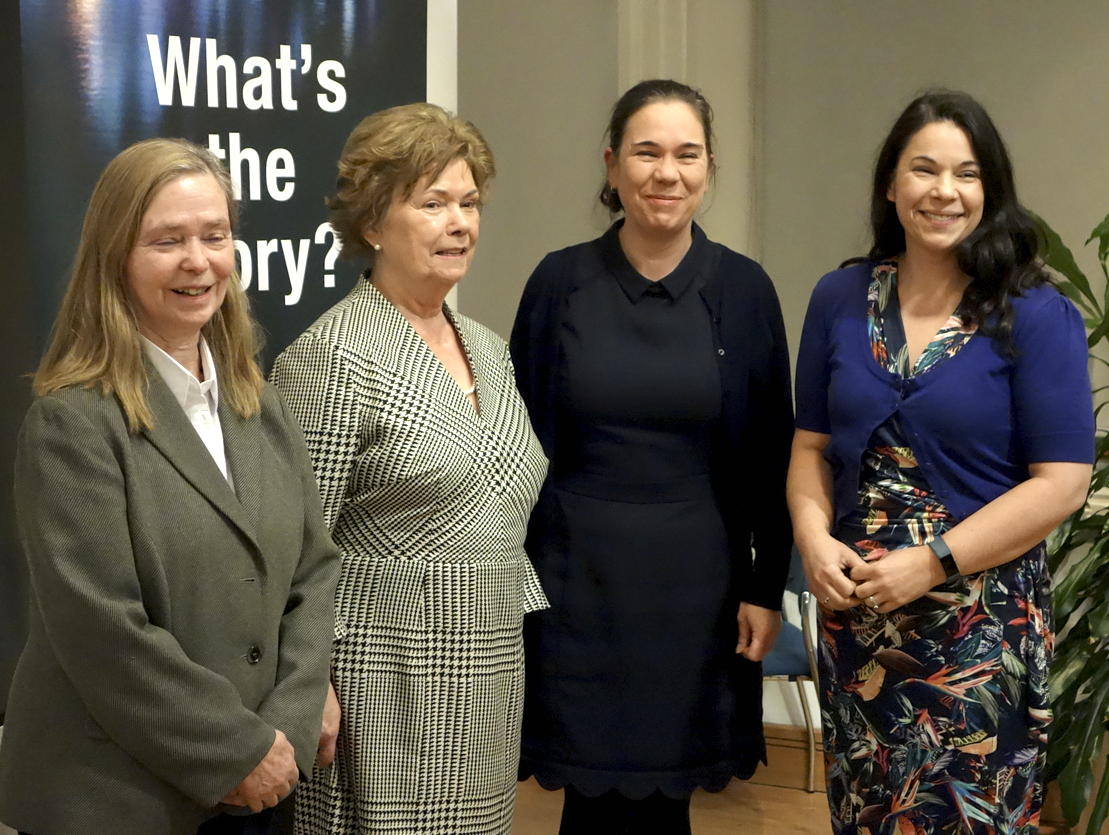


(l-r) Deirdre Ellis King (former Dublin City Librarian),
Mary Coolahan (mother), Marie-Louise and Iseult (sister)
.
I hadn't realised until much later that Marie-Louise was John Coolahan's daughter. I had been at John's talk, on the undenominationalising of the primary schools, in the Patrick Finn Lecture series, in St Mary's, Haddington Road, a few years ago. It was an excellent lecture which I reported on at the time, and for which I attracted some flack from the RCC rearguard.

Sadly, John died last June, RIP

Thursday, February 04, 2016

HIDDEN PAGES 1916


Welcome to St. Thomas & St. George Parish Church

This is how the occasion was announced to the press:
"The Irish Society for Archives in conjunction with An Post will host a novel seminar Hidden Pages From the 1916 Rising, at which five archival curators will engage with the public to explore some of the little-known archival sources about this momentous event."
If anything it was an understatement. There were fascinating presentations of new archives, and old ones put to new use, in the exploration of what really happened in 1916.

The venue itself was a piece of history. Its location, structure and financing owed everything to the revolutionary period.
"The Church of St George and St Thomas, Cathal Brugha Street, Dublin (located alongside the Gresham Hotel) was rebuilt in the 1930s following the destruction of an older church (originally located in Marlborough Street) during the Revolutionary period in 1922."
I had been in this most unusual church once before. Originally St. Thomas's, it inherited the parish of St. George from Hardwicke Place when that church ceased to have a religious function and the two parishes were amalgamated. My interest was in St. George's where Richard Brewster, a parishioner who died in WWI was commemorated. While some of the relevant plaques still remain in the old St. George's building, one has transferred to St. Thomas's. You can read all about this here.


Rector Revd Obinna Ulogwara

The Rector, Revd Obinna Ulogwara, made us all very welcome. And with nothing short of an Irish sense of humour told us which two exits to use in case of an emergency. Use of the third exit could lead to us being run over by a bus.


Dr. Raymond Refaussé

Raymond Refaussé, Librarian and Archivist at the Representative Church Body (RCB) and a man with archives in his blood, introduced the occasion and gave us some idea what was in store for us.


Patsy McGarry

Our MC for the night was Patsy McGarry, more usually the religious affairs correspondent of the Irish Times, but currently engaged in resisting an attempted landgrab by Co. Westmeath of a not insubstantial chunk of Co. Roscommon, his home county.

Patsy guided us smoothly and entertainingly through the evening's speakers.


Colm O'Riordan

Our first stop was the Irish Architectural Archive in Merrion Square. I've been in there and they have whacks of very interesting stuff on the built environment. Colm took us through some of the structures relevant to the 1916 Rising, not forgetting the GPO and the RHA HQ in Lower Abbey Street. Both these buildings were destroyed in the rising, making for two out of three hits on the works of Francis Johnston in the city centre. The third strike on his city center work had to wait for the 50th anniversary of the Rising - Nelson's Pillar.

I was particularly interested in the enormous bakery that was destroyed at the bottom of O'Connell Street. It had been a most out of place building. Its successor became the central cinema with its controversial canopy defying city ordinances, though Colm didn't mention this particular mortal sin by Councillor O'Farrell.

Colm told us how, in the reconstruction of O'Connell St., the Corporation for the first time insisted on controlling the façades of the new buildings. This led to some serious rows but the Corpo held their ground. If this "enlightened" approach had continued into independence we might have been spared some of the abominations that were permitted in the name of progress in the latter half of the 20th century.


Ellen Murphy

Ellen Murphy, Senior Archivist at Dublin City Library and Archives, revealed ‘Reactions to the Easter Rising in the Monica Roberts Collection at Dublin City Library and Archive’ under the heading: "It was grand to see our Tommies".

This archive is a collection of correspondence between Monica Roberts and the troops at the front in WWI along with a short diary of Monica's own contemporaneous reactions to the Rising. The tone is British and Unionist and the sentence quoted above was her reaction to the arrival in the city of British army reinforcements.


Gráinne Doran

Wexford County Archivist, Gráinne Doran took us to one of the other parts of the country outside Dublin where there was significant action during the Rising. Her current project is ‘The collective effort of the men and women in County Wexford, Easter 1916’, and it is concentrated on the action in Enniscorthy. There is an emphasis on oral history as well as the usual written and visual sources. She will be covering not just the activity in Co. Wexford itself but also action by Wexford people in the capital.


Pádraig Allen

Pádraig Allen took us through the emergency medical response to the Rising, as revealed through the newly discovered archives of St John Ambulance Ireland. These are full of fascinating stuff. They are particularly relevant in the context of redressing the current gender imbalance in the reporting of the Rising.The medical response was an area in which women distinguished themselves at all levels.

Pádraig wore the 1916 John's Ambulance uniform which he had specially made for this centenary year.


Stephen Ferguson

Stephen Ferguson, Assistant Secretary at An Post, was talking about ‘The staff of the GPO during Easter Week, 1916". In fact he gave us a thrilling sequence of stories on how the Rebels neutralised the city's communications hub and on the ingenuity of some of the staff in re-establishing alternative communications routings.

He also drew our attention to the current importance of the central Post Office archive in London, given the destruction of so much material in the GPO.


There was a very lively and lengthy Q&A at the end where the questions and answers competed with a host of new stories recounted by members of the audience.

The Irish Society for Archives and An Post are to be commended for sponsoring a great evening. And particular thanks are due to Dr. Susan Hood, Assistant Librarian and Archivist at the RCB, for a flawless piece of organisation.

Sunday, March 29, 2015

Family History Day 2015


Greg Young
Click on any image for a larger version

Family History Day in the Dublin City Library and Archive (DCLA) in Pearse Street is always a great occasion.

It gives a number of those who are pursuing their own family history, or that of others, an opportunity to present their results to a receptive audience. I have done three family history presentations on these occasions and they are a wonderful way of getting you to organise your material for getting it across to an audience. They also give you the incentive to quality control your research and to pursue further avenues that suggest themselves in the course of preparation.

DCLA, and Máire Kennedy in particular, are to be commended for providing this wonderful service.

And it is a service, not only to those who have results to present, but to others who are not quite there yet, and to those who have not yet started into this branch of research but who might be inspired to do so by days like these. Even for those who are not involved in research, and who don't intend to be, most of the presentations are sheer entertainment and an education in themselves.

Anyway, nuff pontificating and down to this year's event.

Greg Young, who has been in the family and local history area for a good few years now, kicked off the day with a talk on the Smyth family of Dublin who were parasol and umbrella makers. This had been the subject of his thesis for his Certificate in Local History, a course run by NUI Maynooth in collaboration with DCLA. I have commented on another student's output in an earlier blog post.

Greg's presentation was hugely interesting. His pursuit of the Smyth family brought us through the family's highs and lows: a new start up family business; expansion of the business and its extension to many city locations; it's decline and the descent of the family into poverty; the Bishop's religious prejudice which removed the children from their (non-denominational) schooling to be taken into care, an act which further fragmented the family. Make you sad and angry at the same time.

And then there was the product. The umbrella evolved from the parasol, from keeping off the sun to keeping off the rain. They were originally clumsy heavy things but Smyth's steel technology for the ribbed umbrella made them a more viable proposition. They were made on the premises and some of the locations crossed over with my own family's shoemaking traditions, such as at Wood Quay. In those days particular trades grouped in particular streets.

Greg was clearly anxious to give the best presentation possible. This was his first talk of this sort. He needn't have worried. The next step is the book.


Joan Sharkey

He was followed by Joan Sharkey, from Raheny Heritage Society. Joan is an old hand at this and for her contribution on this occasion she told us how she set about filling some apparently intractable gaps in her own family history.

She was chasing up missing Usshers (the family, not the theatrical employees). She took us on a fascinating trail of detective work, squeezing blood out of the stones of boring official records. Many of these were in the USA & Canada where some of the missing family members had ended up. She also relied heavily on the online records (subscription) of the Irish Petty Sessions (or what has now become the District Court). If someone appeared there, never mind what he was up for, she now knew that he existed and where he was at the time. And if, like me, you are still searching for an ordinary decent criminal (ODC) in the family this is clearly the place to go. This sort of stuff is addictive.


Conor Dodd

Conor Dodd, who is now working as a historian with The Glasnevin Trust, brought us up to date on the extensive range of data now available, principally about those buried in Prospect Cemetery in Glasnevin. The service now includes access to a genealogical advisor (part time) and he stressed that, in the normal course, people are only charged for what is found. So the Trust is actually going out of its way to encourage people to draw on its facilities.

He showed us how the various data sources are interrelated and outlined the richness and limits of what is available.

He also reminded us that the Trust is a private venture which is dependent on the income it raises from its activities. This has not stopped it from undertaking, in recent years, a major cleanup/restoration in Glasnevin cemetery in order to bring it back to the state envisaged by its founders. The "Garden Cemetery" concept is coming back in. So if you are contemplating a leisurely stroll of a Sunday afternoon, there's no better place to go. (I have to declare an interest here, I love graveyards - well, most of them).


Anthony J Jordan

Anthony J Jordan gave us the run down on the Yeats family. It was at times hilarious, at others sad, and at yet others outrageous. That WB fella seems to have been an insufferable individual, though Anthony did more or less persuade us that he wrote great poetry.

You will notice the absence of a screen in the above shot. Anthony gave us an old style presentation regaling us with stories for the imagination in which the imagined illustrations went well beyond the capacity of a Powerpoint screen.

He told us it was quite late when he came across the controversy over WB's bones (ie whose bones are in the grave in Drumcliff). He recounted how, when he gave a talk on the subject in Sligo, he was accused of undermining tourism in the county. A bucket collection for a DNA test would seem to me to have been a more appropriate reaction. But there you are. Leave well enough alone and to hell with the begrudgers.


James Curry

The final session was on the Fitzpatrick family and the satirical journal "The Lepracaun" produced over a decade at the beginning of the twentieth century by Thomas Fitzpatrick.

James Curry is co-author of a book on Thomas Fitzpatrick and The Lepracaun which was launched at this very spot just a month ago. Thomas's cartoons were beautifully drawn and took a poke at hypocrisy in high places and the various pecadillos of politicians and other very important people. Thomas's death in 1912 was headline news and the poor, who he always stood up for, were caught up in a combination of grief and pride on that occasion.

James replayed a first class short video about the book which Philip Bromwell made for RTÉ.

Appropriately enough for a family history occasion, James reminded us that Thomas's artistic and cartooning skills have now passed down to a fourth generation.