Showing posts with label Dublin City Council. Show all posts

Sunday, July 22, 2018

DUBLIN MAKER 2


Click on any image for a larger version


I blogged my visit to last year's DUBLIN MAKER which I found fascinating. So, this year, in spite of being in the middle of a major project of my own, scanning some 600 50 year old 35mm B&W negatives, I tore myself away and headed for town

This time I came in the back door to DUBLIN MAKER 2018. The event is for both adults and children but there is a huge emphasis on the young folk. It's wonderful to see their curiosity and enthusiasm, no less than the warm and wholehearted response of those manning the stands.

This is one huge open collaborative effort which would nearly restore your faith in human nature.


It wasn't long before this oul codger was invited to participate at one of the stands. I must have looked interested. I jumped at the invitation. But before I go any further I would just draw attention to my wee predecessor in the photo above. There must be over sixty years between us.


My thanks to the lady who captured me in this photo
and in the corresponding one at the head of this post

Printing is not new to me. I used to be a letterpress printer, briefly in my pre-career, but I'd never done screen printing. And clearly I didn't get to do the whole thing in the short time available.

Just like (sic) in the National Print Museum, the jigs were already set up and you just did the inking and printing. I have to record that, despite never having done this type before, I was commended on my expertise.
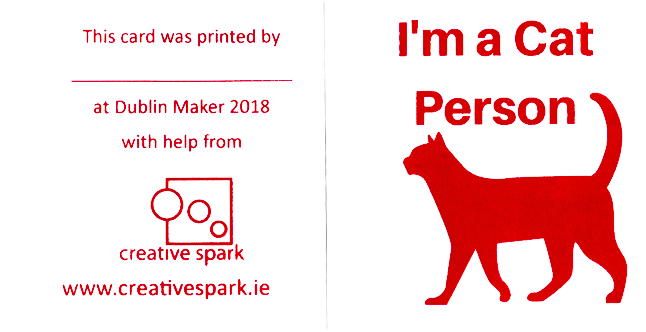


And the result, above, speaks for itself.


My attention was next drawn to the spinning wheel. They had two spinning wheels on display last year but I hadn't given them much attention. They have become something of a national symbol to be noted just. But in a world which increasingly emphasises the craft approach, be it to beer or fabrics, they have taken on a new sigificance.


So I stopped to talk to Grace O'Neill about how it all works. This not a post on spinning so I'll not dally with photos showing the original fleece and its carding prior to it being spun. You'll get the drift of the actual spinning from looking at Grace at work in the photo above. The wheel is driven by foot pedals, just like the harmonium or an older version Singers Sewing Machine, and the trick is to control its speed on the one hand and the tension in releasing the fleece on the other to produce exactly the result you want.


When I'd figured all this out, I was again thrown into confusion when the diplay switched from spinning plain yarn to the bouclé version. Fascinating stuff.

Check it out for yourself.


There was more 3D printing on show this year. The two printers I saw were going for small single colour objects.


This one was making a sort of cage which would end up with a freely moving object inside it. And don't forget that these objects are printed in one single go.

The trick is that they print in ascending layers. It always takes me a few seconds to get my head around this every time it comes up.

I was just thinking about a Schroedinger's Babushka, a series of Russian dolls contained within each other, only in this case there would be no way of opening them to check the output. Hmmm.


Next was this avuncular gent explaining electrical polarity to these clearly fascinated young lads.


Meanwhile, there was this semi-transparent lady perched on a workbench behind him. I didn't stay round long enough to see how she earned her living.


On to yet more participative stuff with no shortage of young takers.


This pair, with a little assistance, are making Galaxy Stones, or in this case pebbles. The idea is to coat one smooth surface of a stone in multi-coloured acrylic to represent a galaxy, or nebula, or whatever. You were invited to bring along your own stone if you wanted. Pebbles were provided on the spot.


As you can see, the results on these larger stones are very impressive. Unfortunately this presentation is in only two dimensions but these are real stones you see before you.


KNIT YOUR ROW

As you can see not everything here is hi-tech, though there is a fair amount of electronic stuff around, from variously controlled robots to flashing bulbs.

This is KNIT YOUR [OWN] ROW, but I didn't stay round long enough to fully tease it out. In any event it's a skill that's been around for a long time and handed down the generations - usually on the female side.

I learned to knit when I was young. Consumed I was at how my granny was producing knitted fabric from plain wool through a series of clickety clacks.

Me and the mother and the granny once knitted a school scarf. We took it in turns as and when time was available. The widest parts (most relaxed stitching) were the granny's and the narrowest mine (a combination of tension and, I'm sure, dropped stitches). The mother was somewhere in the middle.

I wonder how that lady did.


My general impression was that the attendance was greater than last year. It was sometimes difficult to get near some of the stands. Maybe the organisers might think of a two day event sometime in the future?


There was more than just the stands to the day's event. There were various food vans around the large open picnic space.


And Dublin City Rounders gave us great pulsating quality country from the hill.


Full marks to Rohan,


and brother Al.


Finally, leaving by the front entrance. Back next year.


Sunday, July 23, 2017

DUBLIN MAKER


Click on any image for a larger version

Yesterday my son brought me to DUBLIN MAKER in Merrion Square. This event has been going on for a few years but I had never made it until yesterday. It is for young and old alike. The only requirement is that you are curious and have, hopefully, not lost your initial sense of wonder at the magic of every day "science".

You could get lost here for a whole day. The exhibits are fascinating and the exhibitors are not only helpful and good humoured, most of them are young and all of them are nearly as excited by your interest as you are by their exhibits.

I've just picked out a few below to give you a flavour of my own experience.


I well remember making little stick men out of pipe cleaners. My Da smoked a pipe but you wouldn't dare interfere with his cleaners. You actually bought bunches of them for the express purpose. But life has moved on and the pipe cleaners have moved into high art. Simple to do but very effective, even after the Da gives up the pipe.


From the simple to the complex. This little guy is a 3D print. The arms can move. And he has been printed all in one go, ready assembled. Amazing. Until you realise that the printing is done by building up layers and so anything is possible.


You can programme this parrot with your own sound and it's beak moves as it speaks.

My perverse ambition would be to have it annunciate the sermon from Joyce's Portrait of the Artist as a Young Man when the Parish Priest came visiting, in the hope that the same sermon would scare the shit out of him as is did me when I was young and impressionable.

Only one flaw. The PP doesn't come visiting any more and if he did I could probably not resist the temptation of filling the parrot up with the foulest language at my disposal.


To prove that I am not just spectating and that I have never grown up I undertook to join up the dots myself. This is done with a pen and conducting ink, and they go from 1 to 23. The result is a visible circuit board which illustrates the required shape, in my case an airplane.


This is then plugged into the computer and an appropriate "working" image comes up on the screen. My prototype is unlikely to fly in real life, but it did clunk its way across the screen and, anyway, I'm only a novice.


Time for a beer break and the only cúpla focal I came across. It's a bit early in the day and I think the emphasis here is more on manufacture than on consumption.


This unlikely object is a trio harp. It's made out of piping, with builder's twine for the strings. I would consider it more an idea in the making than a final product. There is clearly scope for developing the strings, both in terms of material and variable tension. It might even be turnable into a mini orchestra with the addition of a fret board.


There is also a need for the development of the sound chamber and possible addition of further amplification. I suggested a microphone and speaker but that didn't go down well as it involved electricity and a departure from the homemade/discarded material approach. As an alternative I suggested some further piping/funnel work on the lines of His Master's Voice and I think this is being looked into.


This lady showed me a blindingly simple device. Suppose you are deaf but you have to get up early in the morning and are unlikely to hear your alarm going off.

In days gone by the hard of hearing or deep deep sleepers could always put the wind up alarm clock in a metal basin or bucket and the noise would bring the house down. But they don't make them like that any more and, anyway, if you are completely deaf it would be no use.

In today's world you simply put the red bracelet on your wrist, set your phone alarm, and Bluetooth does the rest. I tried it and the vibration on your wrist is guaranteed to bring the dead back to life.


I have blogged on MAKESHOP before so I didn't stay too long at their stand. They are an outreach of TCD's Science Gallery and are currently located in the old Lennox Chemicals building in Clare St. where I used to buy my bomb-making, stink bomb and amateur detective raw materials.


Not sure what these do. Maybe a fight to the death.


This is FABFOUNDATION IRELAND. They have a network of FabLabs throughout Ireland where people can come to learn and do stuff. They do all conceivable kinds of printing and the green robot above is one of theirs. Check out their video. Having said that they could do with some serious work on their website.


I'm sure most people have at least seen a picture of a spinning wheel. Many may even have seen the real thing in a museum or in one of Synge's plays. But what does this iconic piece of furniture do?


Well you can't knit with all those sheared pieces of wool. They have first to be turned into string (or knitting wool as we know it) and that's where the spinning wheel comes in.

But that's not the end of the story.

In the old days, when Clery's was Clery's, you used to buy wool in folded form which had then to be rolled into balls for knitting. I well remember holding my arms extended with the wool, until they ached, while the Mammy or the Granny rolled it into a ball.


This is paper folding with a vengeance. Just look at those pets, duly shot and mounted. Only joking. No pets have been hurt in the making. Check out Laura's blog post on DUBLIN MAKER.


Instead of hiring a magician for your children's parties why not hire a bus load of lego and let them at it. This just goes to prove there's always a niche in the market.

I could go on but I'm sure your attention is flagging at this stage. Best thing you could do is to go along next year and I'll guarantee you'll stay the day.

Saturday, July 23, 2016

PAINT BOX


Click on any image for a larger version

Dublin Canvas is an effort to brighten up the city, and its environs, by giving a new life to some of those old grey or green boxes you see sticking up out of the ground all over the place. Most of them turn out to be traffic light control boxes, and Raheny has one for every set of traffic lights in the village, of which there are many.


This is what you start with - a nondescript grey box on the inside of the pavement.

First you need an idea of what to decorate it with. In Raheny's case there is no shortage of heritage objects: the millennium clock, the old church and graveyard, the old parish pump, and so on.

Then you need an artist to do the job, and that's where local man Michael Gaffney steps up to the plate.

Then you need to get the whole plan agreed by the City Council who will then supply the materials for the job.


First on goes the base, and the thing is already looking the better for it. But you don't want to leave it too long like that as a possible source of temptation to the local creative youth.


So it's on with the first draft of the Millennium Clock.

Details of the clock are left aside for the moment while the background is filled in. This is the old church and graveyard which is to be seen behind the clock as you look down Station Road.

The site is said to have housed the old fort of Raheny and the location of a church there may go back to the 12th century or even way beyond. In any event it became the local Protestant church at the Reformation and remained in use until the "new" All Saints church was built by Lord Ardilaun in 1889. The graveyard is still full of lots of interesting people, some of whom once escaped into the outside world, but that's a story for another day.


Clutter

In the interest of simplicity, Michael has left out a load of modern clutter such as the traffic lights themselves, lamp posts, railings, and so on.


The clock itself is the tricky bit and Michael has made up some stencils to ensure he gets the lines and dimensions right.


Pure freehand here would be in danger of producing a slightly wonky result and squares, polygons, circles and ovals can be unforgiving.


Having laid the foundations, Michael now sets about carefully filling in the clock in black and white and gold.


Et voila, the final result, a wonder to behold encapsulating a millennium, and possibly more, of "village" life.


And the time on the clock? Nearly ten past ten.

I asked Michael about that and he said as far as he could see that was the time which most frequently appeared in ads for clocks and watches.

I subsequently looked it up and he was right. The reasons given were that it looked like a smile and also allowed the manufacturer's name to be clearly seen.


Michael's name, however, is proudly displayed on the side of the box. And it will be the first of many. Next comes the parish pump and who knows what after that.

Well done Michael.

Incidentally you may have noticed a slight difference in the location of the first two photos above and you'd be right. The first is at the Catholic church and is as yet untouched while the second is in front of the Watermill pub. The reason is simple. I only noticed the box which ended up with the clock when it was already half done and no way was I going to ask Micheal to start over from scratch !

So that's the box outside the library.


Meanwhile inside the library, the Raheny Active Retirement Group have their art exhibition so I popped in for a look.


And what did I find. Michael's clock as a piece of exhibition art. Oil on canvas in a conventional setting. So whoever ends up with this picture will not only have two pieces of Raheny heritage depicted on their wall, they will have a replica of those two pieces as depicted on the traffic light box outside the library.

You can hear an interview with Michael by NearFM here.

And see his page on Dublin Canvas here.