
The above book was launched on Tuesday (4/12/2018) in the "new" Irish Times office in Tara Street in town.

Mark O'Brien, Leo Varadkar, Joe Breen
Click on any image for a larger version
Joe Breen was researching the Sunday Review, published by the Irish Times from 1957 to 1963, when he realised that the Sunday papers as a category had been under-researched so he teamed up with Mark O'Brien and between them they have come up with this book, of which they are both editors and part contributors.

The contents sound pretty comprehensive.
This book includes chapters on the Sunday Freeman, 1913–16 (Felix M. Larkin); Sunday Independent, 1905–84 (Mark O’Brien); Sunday Press (Ray Burke); Sunday Review (Joe Breen); Sunday World (Siún Ní Dhuinn & Regina Uí Chollatáin); Sunday Journal (Mary Muldowney); Sunday Tribune (Pat Brennan & Brian Trench); Sunday Independent, 1984–2012 (Kevin Rafter); Sunday Business Post, 1989–2001 (Ed Mulhall); and Sunday Times (Michael Foley).

Taoiseach Leo Varadkar launched the book.
I'm not sure how he was chosen other than to raise the profile of the launch and of the book itself. Perhaps it was his preoccupation with communications as evidenced in his short lived Spin Unit or maybe he's just a good launcher
He took the opportunity to tell us that the Government has an enormous responsibility to protect the free press and democracy. I hope his conviction lasts and that he will welcome the press speaking truth to power even if it ends up having a crack at himself and his Government.
He mentioned Charlie Hebdo and brought to my mind the Je suis Charlie march in Paris of Heads of State and Government (HOSG) which included some of the most repressive leaders on the planet.

He also referred to what he termed the best historical slogan of a Sunday Paper: the Sunday World's "Are you getting it every Sunday?".
Oops, did I really say that?
Of course, he said, the Sunday World would not have gotten away with such a slogan in today's PC world.
My own favourite, which is not accompanied by a wink-wink is that of the now defunct Scéala Éireann: The Truth in the News. But that wasn't a Sunday Paper so he didn't need to cite it. Anyway, what would he be doing bringing Dev into the conversation and praising the Opposition when it was his night.
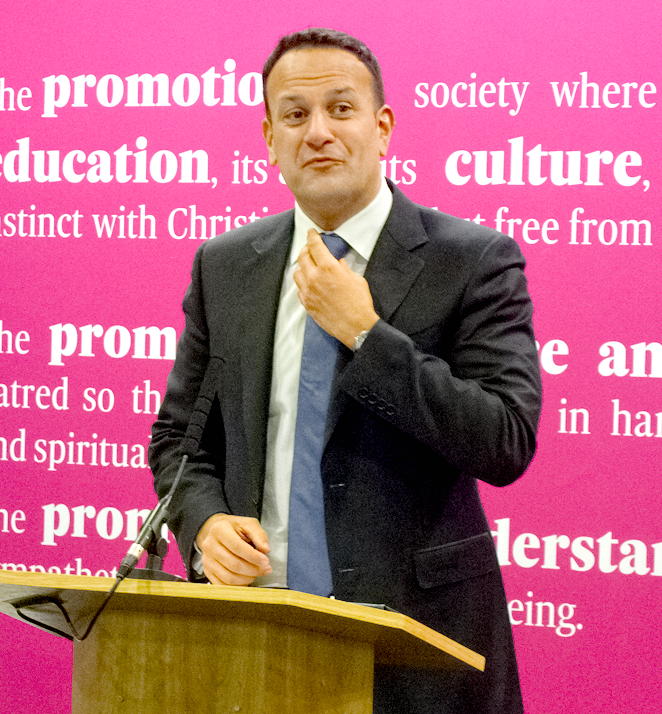
While stressing that journalists had a crucial role in scrutinising claims, whether they came from institutions or individuals, it was also up to the media to cover personal stories responsibly,
By their nature personal stories are compelling, and they help bring focus on issues and that’s why they need to be reported. But by their nature any story that is personal or emotive is subjective, and it is the journalist’s job to inject objectivity into it, so the public get the full story and not just one side of that story.

It was a polished performance, giving rise to whispers of "Patrick Geoghegan" circulating among the cognoscenti.
Anyway the book got launched which is what most of us were there for, and if you want to see what the Taoiseach really said check it out.

Mark thanked Leo for doing the needful, launching the book into the deep.

And he thanked everyone else for coming along

But seriously, though, this was a huge collaborative effort, and he was grateful to all who participated in it one way or another. Special mention was made of Four Courts Press who actually got it onto the streets (as they say in the newspaper business).
Photographers

In the beginning was the word, and then came the pictures.
I have never been at anything with as many photographers present. A murmuration comes to mind but that would be a gross exaggeration. Nevertheless there was enough of them for me to notice.


I managed to get in this shot of three of them which I have christened THE ADORATION OF THE MAGI.

But variety has its limits, and for this guy, it looks like it's all over. Every angle covered, terabytes notched up for processing, creativity spent.
Any chance Leo would do a handstand? Or Joe or Mark do some more speechifying in semaphore?
Not worth the wait. The editor only wants one shot for page three. Time to pack up and find the next gig.
Meanwhile the action goes on.
Signing

Haven't I seen you somewhere before?

Felix, is that Latin? Where are you from?

No, I mean where are you really from?

The cat that got the cream.
Out & About
I knew almost nobody at the do despite my own close connections with the business.
I was, myself, a class of a newspaper proprietor, editor and contributor in a past life, though admittedly on an ultra modest scale and long, long ago.
I have actually written for the Irish Times and ROSC (now defunct, I think).
I was even a sub-editor with the Welsh Nation, Plaid Cymru's English language newspaper, which incidentally seems to have packed up in 1978. That lasted for about ten minutes on the Eisteddfod field. But I did succeed in composing one headline to fill a specific place on the page, all under the expert tutelage of Clive Betts.
My close connection with Sunday papers over much of the 1950s and 1960s was through my mother's shop in Ballybrack (Killiney Bay) where we not only sold the Irish Sundays but much of the English filth which is recalled in more general histories of Sunday papers at large.
There was always a frisson of a Sunday morning as we waited to see how many and which of the English Sundays made it past the Customs and into the waiting vans of Dixons distributors. Purely incidentally, the man at Dixons was a Mr. Shakespeare. You couldn't make it up.
Then, of course there is blogging, a modern form of citizens' "newspapers" and I have been known to write the odd blog post on a Sunday, as I am doing at this very moment.
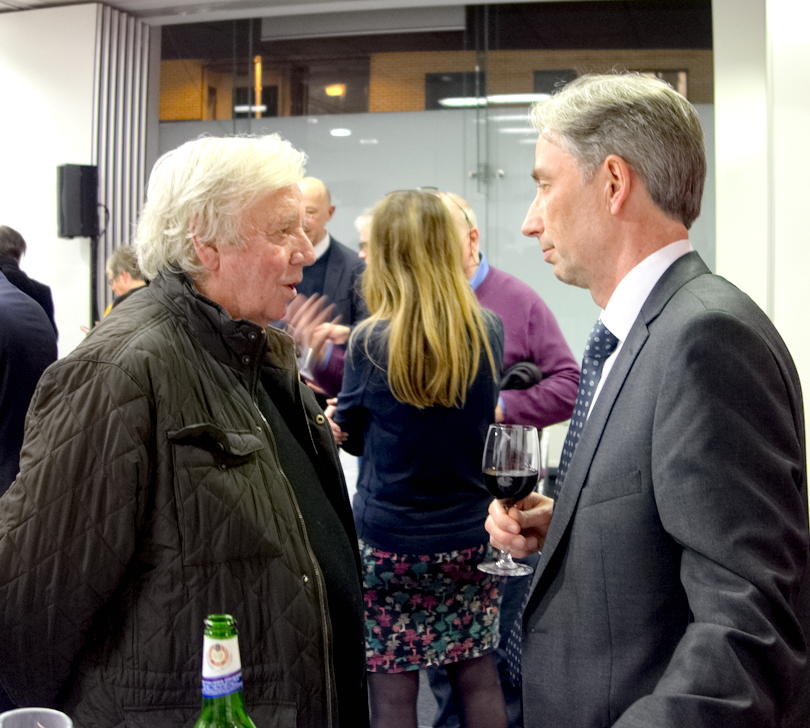
Anyway, as I said, I knew hardly anybody at the event, so I'll just throw in the photos below and you can see who you might recognise.


And we mustn't forget that the publishers need to sell their books to keep the flow coming.
There is a really amazing number of "serious" books being published in Ireland at the moment with Four Courts Press to the fore, if you'll pardon the weak golfing pun.
You can read the Irish Times report on the event for yourself.
There is also a short background piece by the book's editors in the Irish Times.


