Showing posts with label Irish Times. Show all posts

Sunday, December 09, 2018

THE SUNDAY PAPERS


The above book was launched on Tuesday (4/12/2018) in the "new" Irish Times office in Tara Street in town.


Mark O'Brien, Leo Varadkar, Joe Breen
Click on any image for a larger version

Joe Breen was researching the Sunday Review, published by the Irish Times from 1957 to 1963, when he realised that the Sunday papers as a category had been under-researched so he teamed up with Mark O'Brien and between them they have come up with this book, of which they are both editors and part contributors.


The contents sound pretty comprehensive.
This book includes chapters on the Sunday Freeman, 1913–16 (Felix M. Larkin); Sunday Independent, 1905–84 (Mark O’Brien); Sunday Press (Ray Burke); Sunday Review (Joe Breen); Sunday World (Siún Ní Dhuinn & Regina Uí Chollatáin); Sunday Journal (Mary Muldowney); Sunday Tribune (Pat Brennan & Brian Trench); Sunday Independent, 1984–2012 (Kevin Rafter); Sunday Business Post, 1989–2001 (Ed Mulhall); and Sunday Times (Michael Foley).


Taoiseach Leo Varadkar launched the book.

I'm not sure how he was chosen other than to raise the profile of the launch and of the book itself. Perhaps it was his preoccupation with communications as evidenced in his short lived Spin Unit or maybe he's just a good launcher

He took the opportunity to tell us that the Government has an enormous responsibility to protect the free press and democracy. I hope his conviction lasts and that he will welcome the press speaking truth to power even if it ends up having a crack at himself and his Government.

He mentioned Charlie Hebdo and brought to my mind the Je suis Charlie march in Paris of Heads of State and Government (HOSG) which included some of the most repressive leaders on the planet.


He also referred to what he termed the best historical slogan of a Sunday Paper: the Sunday World's "Are you getting it every Sunday?".

Oops, did I really say that?

Of course, he said, the Sunday World would not have gotten away with such a slogan in today's PC world.

My own favourite, which is not accompanied by a wink-wink is that of the now defunct Scéala Éireann: The Truth in the News. But that wasn't a Sunday Paper so he didn't need to cite it. Anyway, what would he be doing bringing Dev into the conversation and praising the Opposition when it was his night.
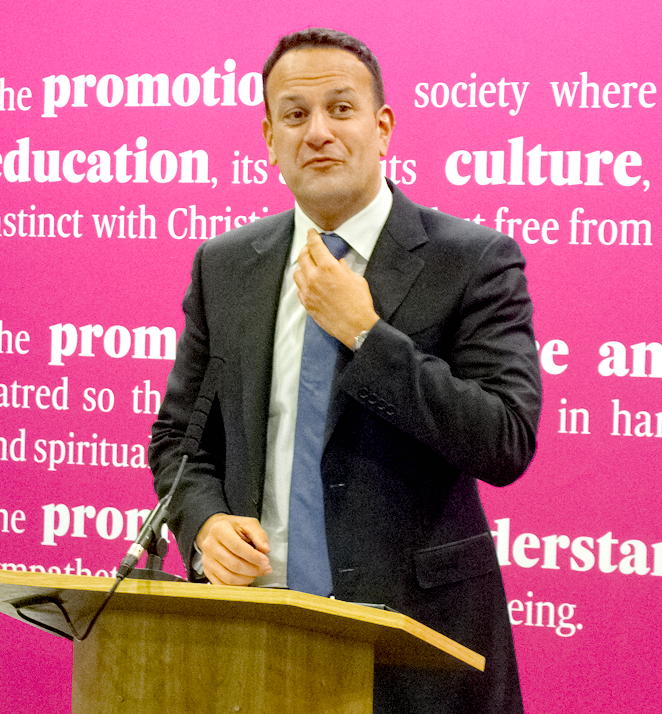


While stressing that journalists had a crucial role in scrutinising claims, whether they came from institutions or individuals, it was also up to the media to cover personal stories responsibly,
By their nature personal stories are compelling, and they help bring focus on issues and that’s why they need to be reported. But by their nature any story that is personal or emotive is subjective, and it is the journalist’s job to inject objectivity into it, so the public get the full story and not just one side of that story.


It was a polished performance, giving rise to whispers of "Patrick Geoghegan" circulating among the cognoscenti.

Anyway the book got launched which is what most of us were there for, and if you want to see what the Taoiseach really said check it out.


Mark thanked Leo for doing the needful, launching the book into the deep.


And he thanked everyone else for coming along


But seriously, though, this was a huge collaborative effort, and he was grateful to all who participated in it one way or another. Special mention was made of Four Courts Press who actually got it onto the streets (as they say in the newspaper business).


Photographers


In the beginning was the word, and then came the pictures.

I have never been at anything with as many photographers present. A murmuration comes to mind but that would be a gross exaggeration. Nevertheless there was enough of them for me to notice.


I managed to get in this shot of three of them which I have christened THE ADORATION OF THE MAGI.


But variety has its limits, and for this guy, it looks like it's all over. Every angle covered, terabytes notched up for processing, creativity spent.

Any chance Leo would do a handstand? Or Joe or Mark do some more speechifying in semaphore?

Not worth the wait. The editor only wants one shot for page three. Time to pack up and find the next gig.

Meanwhile the action goes on.

Signing


Haven't I seen you somewhere before?


Felix, is that Latin? Where are you from?


No, I mean where are you really from?


The cat that got the cream.

Out & About

I knew almost nobody at the do despite my own close connections with the business.

I was, myself, a class of a newspaper proprietor, editor and contributor in a past life, though admittedly on an ultra modest scale and long, long ago.

I have actually written for the Irish Times and ROSC (now defunct, I think).

I was even a sub-editor with the Welsh Nation, Plaid Cymru's English language newspaper, which incidentally seems to have packed up in 1978. That lasted for about ten minutes on the Eisteddfod field. But I did succeed in composing one headline to fill a specific place on the page, all under the expert tutelage of Clive Betts.

My close connection with Sunday papers over much of the 1950s and 1960s was through my mother's shop in Ballybrack (Killiney Bay) where we not only sold the Irish Sundays but much of the English filth which is recalled in more general histories of Sunday papers at large.

There was always a frisson of a Sunday morning as we waited to see how many and which of the English Sundays made it past the Customs and into the waiting vans of Dixons distributors. Purely incidentally, the man at Dixons was a Mr. Shakespeare. You couldn't make it up.

Then, of course there is blogging, a modern form of citizens' "newspapers" and I have been known to write the odd blog post on a Sunday, as I am doing at this very moment.

Anyway, as I said, I knew hardly anybody at the event, so I'll just throw in the photos below and you can see who you might recognise.
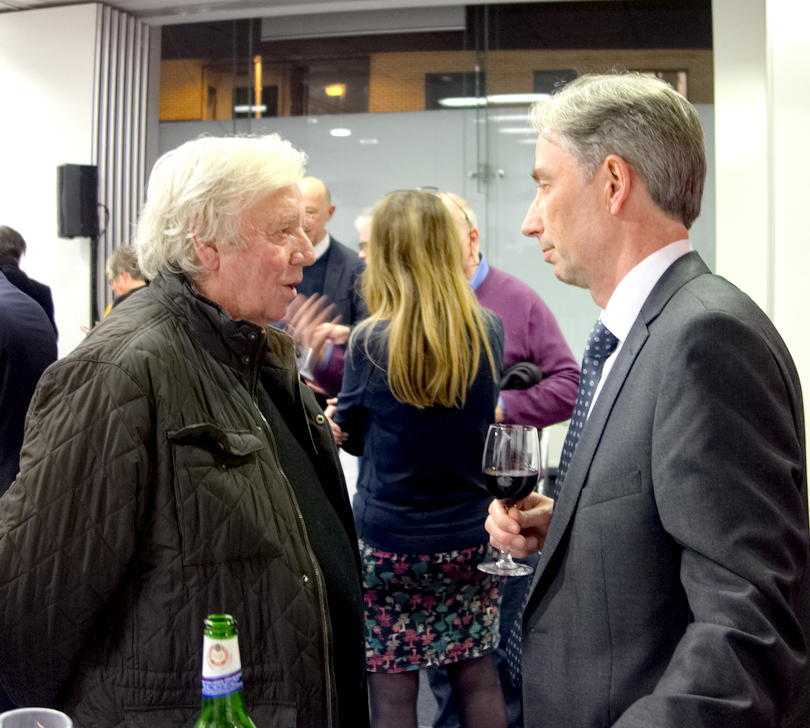


And we mustn't forget that the publishers need to sell their books to keep the flow coming.

There is a really amazing number of "serious" books being published in Ireland at the moment with Four Courts Press to the fore, if you'll pardon the weak golfing pun.

You can read the Irish Times report on the event for yourself.

There is also a short background piece by the book's editors in the Irish Times.

Wednesday, July 27, 2016

PLUNGING STANDARDS


Click on any image for a larger version

It was him what started it - Felix M Larkin - former public servant and now a historian of renown and writer of letters to the Irish Times (of which paper more later).

Well you can read it above for yourself. A test where only a true grammar nerd could get over 80% and Felix creamed it. Now I know he's good, but is he really that good?

My grammar's generally OK bar the absolute refusal to distinguish between the use of "shall" and "will" and a few other odd Hiberno English "lapses". Should I take the test and put my sanity on the hazard? What if I fail completely?


Then Vivion Mulcahy got 100%. But he's a nerd too, so what to do?

Finally the temptation became too much, so off to the test I went. I creamed it and got 100%. It was only then that I realised Felix had nicked the test's own header in his tweet and clearly put it forward tongue in cheek.


So I made a derogatory comment about the test, and a reply was not long coming.


Standards were not just slipping, they were plunging.

Then I read a depressing piece from Kevin Rafter in the Irish Times. The journalist demographic was hollowing out in the middle age ranges: at the top end we were left with a clatter of old lags whose anecdotage was one long context; and at the bottom end a clutch of young "journalism" graduates who had no context at all beyond being a qualified "journalist". No middle and no contextualising at all.

Then today I hit two striking examples.

The Irish Times (paper of record?) was reporting on a sculpture of Francis Ledwidge by Rory Breslin which was being unveiled by Martin McGuinness in Richmond Barracks where Ledwidge had served. And what was the accompanying illustration. An old stock photo of Francis Ledwidge. Where was Rory's work what it was all supposed to be about?

Then the Irish Times reported on the visit to Dublin (Sir John Rogerson's Quay) of the Argentinian frigate Libertad and great play was made of our connection with the Argentinian navy through Mayo born Admiral Brown who founded it. And what was the accompanying visual. There were two, actually. The first was a bockety picture of the ship at dock on the quay and the second a picture of the captain in his cabin with a portrait of Admiral Brown on the wall.

Meanwhile, within sight of the Libertad on Sir John Rogerson's quay stood a magnificent statue of Admiral Brown himself (below), which was completely ignored in both the visuals and the report.


Some contextualisation.

To be fair to the younger journalists it is difficult to see how they can be expected to replicate the contextualisation of their departed elder colleagues when you consider the conditions under which many of them work as set out in this article by Ciarán D'Arcy.

And, if you've now used up your weekly quota of free online pages from the Irish Times, don't blame me. So did I. And anyway be consoled when you think of what you're not missing.

Tuesday, August 06, 2013

I Love Lucy


A beautifully written piece in yesterday morning's Irish Times reminded me how much I loved Lucy over the last two decades.

In the course of my work, I kept an eye on the Financial Times. Heavy stuff. But a paper which, over the years, has had a higher standard of writing than many of its ostensibly literary counterparts. You could lift stuff out of it for a ministerial brief and find yourself an honorary member of Aos Dána before you knew it.

Then there was Lucy. In the middle of all the economic and financial chaos, pseudo-intellectualism and buzzword management, there was a sane world out there somewhere, even if it was only in Lucy's head.

She calmed you down, made you smile, and reminded you what was really important. She was ostensibly writing about management, but it was really a philosophy column to which anyone could relate. She had a lightness of touch and a lurking smile, and, God forbid, she wrote actual English. Real words strung together to actually mean something. And always a new angle to wake you up.

So I plunged into her piece in the paper and I wasn't disappointed. I'd say she was in her alley. The UK Civil Service was banning 30 ugly words, including the horrendous linguistic abuse "going forward". And not before its time.

The accretion of jargon, or lazy shortcut use of language, since I joined the Civil Service, 46 years ago, has been spectacular.

At that time, we were advised to procure a copy of Sir Ernest Gowers' The Complete Plain Words so that we could avoid such pitfalls and do language the honour of retaining its meaning. The book was produced by Her Majesty's Stationery Office and was available, to keep, from our own Registry. It became a constant companion and, along with a good dictionary, has stood me in good stead to this very day.

So, thank you Lucy for keeping me sane, at least in my own estimation.

And I can't blame the Irish Times for what I think is a wee typo in the piece. When I went to the Financial Times original, there is was again. The proof was in the pudding, as they are now wont to say.

Ah well, we can't all be perfect.

Monday, September 14, 2009

Serious Sub-editor

Gardai investigating discovery of body in Dublin

I have often given out about sub-editors who invent sound byte headlines, or whose headlines sometimes say the opposite of what is in the body of the report.

However, here is a sub-editor to admire. S/he successfully resisted the temptation of the cheap soundbyte headline.

The anniversary of this piece is approaching. All you sub-editors out there, please pay homage to this serious practitioner of your trade.

Standards, please.


Friday, February 27, 2009

Paper of Record


I have noticed for some time now that standards are slipping in the Paper of Record. I was tempted to start an Irish Times Watch, but the volume of material would probably get me down and I have better things to do with my time.

Instead I thought I'd just draw attention to the occasional snippet for the delectation/depression of my readers.


Mr O'Neill identified Mr Mackin as the man who shot Mr Burns and then shot him.
(final sentence of report)

Question: of the three men mentioned above who survived the encounter?


Parents of boy with autism seek meeting with Cowen on his education

Question: Whose education?


Elan net loss falls 82% on rising Tysabri sales
07:18 Pharmaceutical company Elan has reported a fall of 82 per cent in its net loss for 2008, helped by a strong fourth quarter performance and rising sales of its multiple sclerosis treatment Tysabri

Comment: Sub-editors should always avoid double negatives, even in the heat of breaking news. The item, when subsequently fleshed out for the real paper, read more sensibly:

The group said a deferred tax benefit of $236.6 million in the United States helped it record a net loss of $71 million last year versus a $405 million loss in 2007.

At least it made it clear that we were talking about a smaller loss, but, unlike the earlier upmarket version which attributed the improvement to a strong fourth quarter performance and rising sales, the later version attributed the major part of the improvement to a deferred tax benefit in 2008.


Satellite error caused delay in search for boat

Comment: Impression is given that the Satellite was at fault. In fact it was a clerical error by a human operative on the ground.


Limited consequences for ex-board members Former Anglo non-executive directors Senior Business Correspondent

Comment: What in God's holy name does that headline mean. Read the article and see if you agree with the Sub who composed the headline.


Chevalier de l’ordre Nationale de Merité
(3rd last para)

Comment: My early years in school predated the "cló Rómhanach" version of the Irish language. In order to cover ourselves in homework and exams, we used to introduce the "wandering buailte", a sort of a dot over a word that could be invoked as a lenition sign for any consanant which might subsequently prove to have needed it. The "errant fada", however, is a completely new one on me. And in French, no less. As for the possessive "de", this is always a problem for non-French speakers. Capitalisation is another matter entirely. Meanwhile the grammar defies exegesis.


The Irish Nationwide spokesman said last night he had received no response from the building society to a list of questions e-mailed to the mutual society by The Irish Times.

Comment: Surely it is the Irish Times which is expecting a response to its questions?


Derek Scally, reporting on remarks from Jurgen Stark (German member of ECB Council) penned the following the Irish Times (21/6/11):

The Central Bank saw upside risks to price stability indicating another imminent interest rate rise, but insisted the crisis remained contained in peripheral countries.


My first reaction was that surely he meant "downside" risks, as in a likely unfavourable outcome (being a rise in inflation). In other words down was up as far as I was concerned. But before I launched off into a diatribe here I thought I'd better look it up, and found the entry below in Wictionary

upside (plural upsides)

1. the highest or uppermost side or portion of something
2. a favourable aspect of something that also has an unfavourable aspect
3. an upward tendency, especially in a financial market etc


I still think I'm right when you actually parse what he said. Grammatically he was talking about the risk to price stability and not the fall or rise in prices. However the impression left is confusing. The tendency (in the indicator) is upside, but the risk is downside.

It is not clear whether the fault is Scally's or Stark's as the sentence is in indirect speech and not in quotation marks.

Eigher way that's what comes of not teaching grammar in the schools anymore.