Showing posts with label 1916 Rising. Show all posts
Saturday, September 29, 2018
LE GUNNA-SCRÉACH
Is there no end to it?
Happily, not.
Last night (28/9/2018) saw the launch of a most unusual book in the Oak Room of the Mansion House. The Decade of Centenaries (or whatever it's called) has seen the appearance of many books but this one must take the biscuit (apologies to Jacobs) for both its obscurity and its simplicity.
It covers the range of weapons used by both sides in the Rising and presents new insights into both what went right and what went wrong and reveals many ironies lurking beneath the surface.
It is published by Mícheál Ó Doibhilín's company Kilmainham Tales Teo and is a great addition to their range. Mícheál reminded us (he has told us before) that when he was workingg as a guide in Kilmainham Gaol he felt the need for books that explained Irish history in an authoritative but readable way, and this is what he has been doing for some years now. Maith thú.
I think he said this was his 25th title, but you can see the spread yourself in this display panel and go to the website to follow them up.
These occasions are great for networking and renewing old acquaintances and there was plenty of time for this while the attendance were waiting for the arrival of the Lord Mayor, Councillor Nial Ring, who was a full hour late. In fact we almost had another Rising until the order came through to prematurely break out the beer.
I'm sure the Mayor must have apologised to the organisers. It would have been nice of him to have included the audience. But as Mícheál remarked it was his house and we were his guests. Nevertheless.
Anyway, when he arrived and took to the podium he was both entertaining and brief, and he remembered to actually launch the book.
And then to the main act of the night. Kieran McMullen's talk effectively walked us through the book. Now you may think that a talk which went into the most obscure details of a wide range of weapons would end up being a bit of a bore for non-aficionados, but the way Kieran told it made for a fascinating tale and produced new insights into many aspects of the Rising.
Apart from the pure mechanics of the weapons themselves, which were really interesting, what struck me most was the intensity of the training of the Volunteers, the lack of it in the "new" British army, and the frequent mismatch between weapon and ammunition, all having serious consequences for how events played out.
I learned that there are different designs within the same calibre bullet and that the fixed sights on guns are calibrated for a particular design. Using the wrong bullet of the right calibre will have them going all over the place. This appears to have been a particular problem with the British army during the Rising. Also even very slight variations in manufacture can produce unpredictable results.
Kieran's talk was followed by some presentations. The Lord Mayor was presented with an imposing volume, the title of which I didn't catch. Mícheál assured him that it would be a great help to him in both his work and leisure.
Closer inspection revealed the book's secret.
Kieran's brother, Damon is Mayor of the village of Northport on the north shore of Manhattan Island since last April. He invested Nial as an honorary Mayor of the village, complete with imposing ID.
Kieran retired from the US army as a lieutenant colonel. He served in the Korean DMZ and in Desert Storm and went on to do a stint in the Fire Brigade and a further 12 years in law enforcement. You can read his bio and more besides on his website.
Sunday, April 22, 2018
I WAS IN THE GPO
So I was.
It's hard to know where to start with this excellent and engaging exhibition. It is centered around the 1916 Rising but also puts it in the context of the time.
A good place to start might be the innovative presentation of a dramatised version of the Easter Week Diary (above). This is a sort of wide-screen Cinemascope version of the progress of the rebellion in various critical locations across the city.
Continuity between the various locations is preserved by constant reference to an operations map of the city which is swooped into and out of after the fashion of the Google satellite map.
This may sound a bit scrappy but it works. We swoop in on the GPO, the Castle, the Shelbourne Hotel, Mount Street Bridge etc. to catch up with the ongoing action in each place. And the action moves at breakneck speed. You'd really want to watch the sequence a few times to make sure not to miss anything.
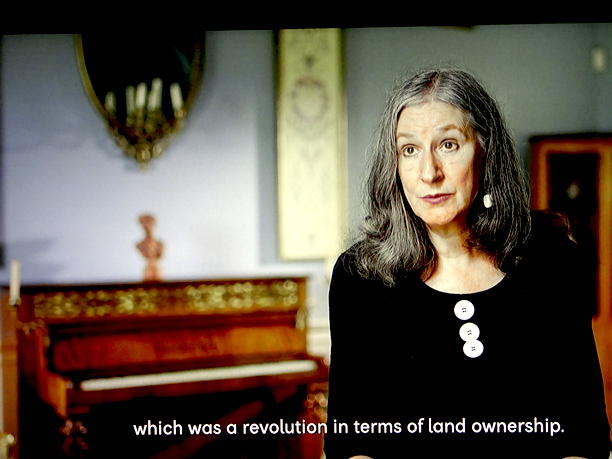
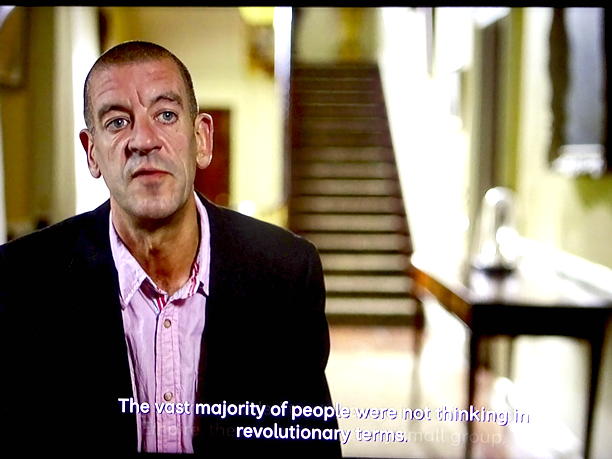
One of the first things to hit me on the way in was the on-screen commentaries from established scholars. These were very well edited, to the point, and presented a seamless introduction to what was to follow. I have referenced these below.
Fearghal has interrogated the Witness Statements comprehensively and in depth which has enabled him to evaluate the Rising from the perspective of the ordinary footsoldier.
Padraig has researched and written extensively on the revolutionary period from a social history point of view.
Catríona spent her career in the National Archives and her great legacy will be the 1901 and 1911 censuses online. She has also fought for women to be given their rightful place in the history of the time.
Joe is the grand=daddy of living Irish historians.
Diarmuid is a relative newcomer on the block and has spread himself quite widely. He is a savvy media presence.
Kevin has long campaigned for recognition for Irishmen who fought in WWI and has tended to downplay the Rising.
There are many well curated glass case exhibits covering both combatants and non-combatants in the Rising and those affected by related events of that time.
This messenger bike really took my fancy and I went over for a closer look at its contents.
I was paying great attention to the labels on the tins when I noticed the black pencil-like things sticking out of the top of them. It was only then that I realised that this was a consignment of lethal weaponry.
Needless to say the walls are replete with explanatory panels like the one above. Replica brick walls are also plastered with posters for everything from theatre performances to monster meetings.
Then there is a short on-wall exhibition upstairs bringing the story up to date.
The panel above gives me an opportunity to mention the one thing that jarred with me. The text panels are all bilingual and happily the Irish versions are fine as far as the content goes. But I found the combination of the earlier Gaelic font with the Roman spelling disorientating. I would have expected that font to include séimhiús or else have the Roman font with the "h"s.
It may well be that this disorientation applies only to those old enough to have used the Gaelic font extensively in their youth. And I can see that the organisers may want to have added an extra bit of "Irishness" to the Irish language text. Perhaps others may wish to comment on this.
All of the above is really only a teaser for the exhibition. I dropped in with just under an hour to kill while waiting for Felix Larkin's talk on Grace Gifford. But I'll need to go back myself and look at the vast array of interesting material in more detail. I'd be well advised to arrive early in the morning, take the tour and a short break for lunch in the onsite café, and then stay until closing time.
Anyway, I said at the outset that I was in the GPO. I hope I gave the impression that this had been in 1916 and that I was still drawing the military pension. This, of course, was just to mislead you in the interest of adding a bit of spice to my report.
I did think I had an uncle Michael in the Rising and, indeed, there was a Michael Dwyer in the GPO garrison but he wasn't my uncle. The uncle turned out to have been in Boland's Mills, but that wasn't in 1916. An interesting mini story which I will recount another time.
However I have been in the GPO and not just buying stamps or posting letters. I spent a lot of time there in my youth, on the third floor which then housed Radio Éireann.
I was reminded of this when being ushered out the side door after Felix's talk. That door used to be the way in to Radio Éireann.
Wednesday, November 16, 2016
IRISH ARCHIVES 2016
Last night saw the publication of IRISH ARCHIVES 2016. This is the annual journal of the Irish Society for Archives (ISA) which was founded by Robin Dudley Edwards in 1970, so it's been in existence for almost half a century at this stage.
The event took place at the newly refurbished reading room at the National Archives of Ireland.
Each year's edition concentrates on a particular theme and this year it was "Hidden Pages from the 1916 Rising". This recapped on a seminar held in February 2016 on this theme in St. Thomas and St. George's church in Cathal Brugha St.
As far as the theme was concerned, the idea was to present research on the Rising from lesser known archives. These included the St. John's Ambulance, the Post Office (GPO & London HQ), the Monica Roberts Collection (diaries and correspondence exchanged with the troops on the Western Front), the Irish Architectural Archive (damage to buildings) and the Co. Wexford Archive (contribution of three families to the Rising).
In an additional paper in IRISH ARCHIVES, which was not part of the original seminar, Church of Ireland parish documents from around the country, including newsletters, preachers books and correspondence, are drawn on.
The volume was launched by Lia Mills, whose book "Fallen" was chosen for this year's Dublin One City One Book Festival. Except this year it was two cities one book when Dublin readers were joined by those in Belfast. The story deals with conflicting loyalties in the twin conflicts of WWI and the Rising. So Lia was an excellent choice to launch the current volume.
She didn't mince her words in criticising what is effectively a decline in popular literacy with the current widespread debasement of words. She had me thinking once again of George Orwell's Newspeak.
She was also lavish in her praise of the vital role of the archivist in preserving past and present material and in presenting it in digestible form to the wider public.
So it's full marks to the ISA for a highly relevant publication in this year of commmoration of the Rising and for continuing to validate the role of the archivist as a pro-active guardian, not only of our history, but of the underpinnings of our civilisation and of who we are.
Copies of IRISH ARCHIVES 2006 can be purchased from Easons bookshops or by mailing Elizabeth McEvoy
Wednesday, October 05, 2016
RE-TUNING THE HARP

Felix awaits his moment
under the watchful eye of Stanislaus Joyce
Click any image for a larger version
The full title of the talk was Harped History: Joyce, 1916 & Revisionism
and it was given by Felix Larkin at the James Joyce Centre on North Great George's Street on Monday evening (3/10/2016). It was a ticket affair and delivered to a packed and highly attentive audience.
The introducer of the speaker was introduced by Mark Traynor, director of the James Joyce Centre.
Just a word first on the Centre: Number 35 was saved from demolition by Senator David Norris who lives on the street. With the help of many others and with funding from a variety of sources the building was renovated and the Centre opened in June 1996. For over ten years the Centre was run by members of the Joyce and Monaghan families, descendants of Joyce’s brother Charles Joyce and sister May Monaghan. It is now run as a limited company, with charity status, and the support of the Department of Arts, Heritage and the Gaeltacht.
It is, not only in title but in fact, the centre of Joycean activity in Dublin and a visit is a must for Joycean tourists.
But to more important matters. Felix was introduced by Anne Fogarty, Professor of James Joyce Studies in UCD. Apart from mentioning his accomplishments in the field of history, Anne revealed that Felix was a former civil servant. Now that is really something to have to live up to. I should know.
Didn't take a feather out of Felix, though, and he launched into a well crafted and controversial talk. Just for the avoidance of doubt, he first made it clear he was not a Joycean scholar. You can't be too careful when you're not sure who may be in the audience.
Felix started with Joyce, and painted him as a constitutional nationalist. And he did return to Joyce towards the end of the talk. But in between he dealt with a controversial issue that has been pre-occupying him during this year of commemoration: the morality, or otherwise, of the 1916 rising.
He ranged from quoting Eoin MacNeill, in the lead up to the Rising itself, to that great mendicant friar, historian and activist, F X Martin, at the time of the 50th anniversary of the Rising, to show that, whatever about the motives of those who organised it, the Rising itself was not morally justified. And lest anyone in the audience still harboured any doubts about it, he press ganged St. Thomas Aquinas into service in the cause.
He stressed the difference between collective memory, which is what we choose to remember and how we celebrate it, and history, which is an attempt to get at evidence based truth. Transitioning from the former to the latter, as we have hopefully been doing in the course of this year, is not revisionism as there was no real history to be revised, only discovered.
So that's the Joyce, the 1916 and the revisionism bits dealt with, but what of the harp in the title. Well, that has been invoked as a symbol of Ireland from way back and, with a bit of re-tuning, provides the required continuity through the centuries.
Felix graciously acknowledged an input of some photos from myself, which along with other visual material, including a fairly vicious and prophetic cartoon from Gordon Brewster, discreetly underscored the subject matter.
If you weren't there, you won't get to read the script just yet, as it will hopefully appear later in a hardcopy publication and take its place among the significant body of research and scholarship emanating from this year of commemoration.
The talk was followed by a lively question and answer session in which Felix held his own against some expert literary criticism.
He confessed afterwards that he had been apprehensive during the talk about how it was going down with this inscrutable audience, but the enthusiasm and volume of the applause when he finished will surely have reassured him on that score.
I had arrived a wee bit early as is my wont. I had in mind to discuss a few things with Felix but he was completely taken up with preparations for the talk. So I wandered into the room next door only to find a fascinating exhibition of Emma Byrne's illustrations of Ulysses.
Each illustration was accompanied by a relevant text but I have omitted the texts here, the better to illustrate the pictures in the small space available on screen.
Three of the illustrations especially caught my fancy. These were of locations in which I had a particular interest.
I have an interest in the Martello Towers around Dublin Bay, and those along Killiney Bay in particular. The network of Towers was built in 1804/5 as a defence against an expected French invasion. Some of them became private residences, as did the Joyce Tower though it is now a museum. Some were simply left derelict and a few have been restored in varying degrees.
I have an interest in the Pillar since I photographed its post-explosion demise in 1966 and had some of my photos published in a recent book on the subject.
My interest in this former church arises from my efforts to trace the memorials around the city to Richard Brewster, brother of Gordon the cartoonist. The city is fortunate to have found a purchaser for this former church in the person of Eugene O'Connor who has done an absolutely brilliant, albeit costly and lengthy, restoration.
Viewing these evocative sketches in advance heightened the atmospherics of Felix's talk and it's a big thanks to Emma Byrne for letting me reproduce them here.
Monday, August 29, 2016
EEC
With all the 1916 commemorations going on this year and all the talk of the path to sovereignty, or whatever you want to call it, I was reminded of a line from the protest song EEC:
Déanfaimís dearmad ar Pearse agus ConnollyThe song was written by Aodh Ó Domhnaill and sung by Na hUaisle.
In the course of the referendum campaign on Ireland joining the EEC in 1972 it blared from loudspeakers on top of the vans of those campaigning against our joining the Common Market and it opened many a protest meeting around the country.
It is a good song and has worn well through the years. It has a particular resonance in more recent times as the EU has lost its way and the arrogance of its élites becomes more insufferable by the day.
The song opens by pointing out that we really had no choice in the matter as we always follow the Brits. Ag sodar i ndiaidh na nUasal is a familiar version in Irish of this process. And here we are with the Brits supposed now to be pulling out and what are we going to do?
The chorus mentions Sicco Mansholt, who was the Agriculture Commissioner of the day, running the Common Agricultural Policy (CAP) which was the only actual policy the EEC had been able to cobble together in its 14 year existence up to then. Needless to say this policy appeared very attractive to Irish farmers as a way of escaping from England's Cheap Food Policy which had been limiting the expansion of Irish agriculture and denying a fair return to its producers for decades. In fact the then Irish Foreign Minister, Paddy Hillery, was campaigning for a YES vote on the basis of The CAP and the Long Runs the latter being the expected opportunities for Irish manufacturing in niche corners of the enormous EEC market.
The song goes on to take a poke at our TDs (parliamentarians) who are portrayed as already addicted to dinners of frogs and spaghetti, and who now speak Irish with a French accent. The farmers will be leaving the land for jobs in industry when full employment kicks in, by which time the Germans will have bought up all the land. Let's forget about Pearse and Connolly and all this national sovereignty lark and sell our souls for the thirty pieces of silver on offer. Sure aren't we all Europeans now.
Well I'll leave you to figure out for yourself how prophetic or otherwise the song is proving. You can hear the original below.
Labels:
1916 Rising,
1972 Referendum,
Connolly,
EEC,
Hillery,
Ireland,
Mansholt,
Pearse
Thursday, August 11, 2016
GRAVE MATTERS
My first contact with this book was in January last when one of the editors contacted me about photos of the funeral in 1960 of the victims of the Niemba ambush in the Congo.
I had done a blog post on this and Lisa came across it; she figured one of the photos might be worth including in the book in which a full chapter was being dedicated to this episode.
Thrilled I was and I was promised a copy of the book in return, which I collected at the launch last night but which I have not yet read.
So this post is on the launch rather than the book. However, from reading the articles and listening to the interviews I know I won't be able to put it down once I start into it.
Just to get you in the right humour, this is a view of a tiny portion of Glasnevin cemetery from the location of the book launch. It is looking out over the 1916 wall of names.
Speaking of 1916, I should say that this was my first opportunity to see the wall. In fact I hadn't seen (or noticed?) the administrative building for years despite having dead family sprinkled all over the cemetery. These start in 1861 in "The Garden" and have a foot (or two or six) in almost every section.
The building is really impressive as is the wall. I didn't have time for a coffee in the café as I spent much of the time before the launch exploring outside. I did, however, get a few minutes downstairs in the museum where it is quite spooky and I actually walked straight into a marble wall. Fortunately I later emerged unharmed into the light of day.
People will probably be more familiar with this end of the wall where the 1916 Rising deaths are inscribed in chronological order, mixing rebels, civilians, police and British army.
The notice on the grass reminds us not to walk on it. You never know who's underneath. I haven't re-watched the inauguration of the wall but I figure some very important people were ignoring the same notice on that day.
No matter.
We're here for a book launch so let's get on with it.
Oh dear. Surely there will be more than a handful turning up for such an auspicious occasion?
Fear not. The ante-room is already full to overflowing and soon there will be only standing room at the launch.
So off we go. Our MC for the night, no less a person than John Gibney, Glasnevin Trust Assistant Professor of Public History and Cultural Heritage at TCD. And he proved no ordinary MC. He had read the book and spent some time extolling its virtues before introducing the first speaker.
George McCullough is Chief Executive of the Glasnevin Trust which owns and manages a number of Dublin cemeteries. Of these Goldenbridge is the oldest but it is currently closed which leaves Glasnevin as the Trust's oldest operational cemetery.
He welcomed us all to our salubrious surroundings and reminded us of the cemeteries for which the Trust is responsible. He told us that there is a lot of work being undertaken at present to open up the cemeteries to the general public beyond the mere funeral day and subsequent graveside visits.
Glasnevin, and Goldenbridge, apart from their connections with Catholic Emancipation, were part of a movement of "garden cemeteries" where not only the dead, but the living could benefit from a structured leafy environment.
I was interested to hear that the Trust is working on opening up the closed Goldenbridge cemetery, beside Richmond Barracks, not just as a park but as a resource for historians and genealogists.
Next up to the plate was (recently retired) Dublin City Coroner, Dr. Brian Farrell, who had one job - to launch the book. He entertained us with stories and secrets to the point that I don't remember if he actually pronounced the book launched. John Gibney didn't either, so he added his own nihil obstat and imprimatur at the end of the session, just for the avoidance of doubt!
Some people may have thought it odd that the coroner would be called on to launch the book, but remembering the State pathologist, Marie Cassidy, launching Tim Carey's book on those hanged by the Irish State, I didn't feel it in the least bit odd.
I think Tim just wrote to Marie Cassidy and she said yes. I gather Brian Farrell, when approached, asked for an advance copy and agreed to do the launch subject to his liking the book.
Well, there wasn't much doubt about that bit of it. He couldn't praise it enough and had obviously enjoyed his advance read tremendously.
He commented seriatim on individual chapters and underlined their relevance to today's world. For example, commenting on the 1918-19 flu epidemic when the undertakers couldn't keep up with the required rate of burials, he revealed that, in the face of the recent threatened pandemic, some very advanced contingency planning had been undertaken to cater for possible extreme effects, including a breakdown in the whole health delivery system. Good to know we are in such safe hands.
Finally it was the turn of the editors.
Ciarán Wallace, currently from TCD, reassured us of the academic standard of the writing but also of its universal readability. This was a book which was a resource for academics and historians but it was also written in a style to enthrall the general reader.
It had grown out of a conference held in this very room and when his co-editor Lisa suggested a book, work had begun on filling in the remaining gaps and refining the material for this publication.
It fell to his co-editor, Lisa Marie Griffith, to thank all those who had contributed to the book in a wide variety of ways.
She told us that Four Courts Press had pushed very strongly for copious and quality illustrations. Rightly, as it turned out, as they not only add enormously to the quality and attractiveness of the book but they also serve to tempt those who might be flicking through it to stay with it and delve deeper into the text (and buy the book!).
I'm really looking forward to getting stuck into this book which promises to to be full of family resonances. For starters I have undertakers on both sides of my family and following my pursuit of my family history I am now aware of all manner of deaths, the deeper background to which I hope to find in the book.
Buy it, steal it, read it.
(with apologies to Julius Caesar)
[For a taster, check out Valerie's excellent interview with Lisa & Ciarán]
Update: since doing the above post I have read the book and left a review on Amazon and done a further post on some thoughts provoked by the book.
Subscribe to:
Posts (Atom)