Showing posts with label Central Model School. Show all posts

Wednesday, April 29, 2009

Leaving their mark ...


Since I retired my vision has improved enormously. I don't mean my eyes are working better, quite the reverse. But I am now using them differently. When I was working in the centre of Dublin city I saw nothing as I flitted between meetings, totally preoccupied with the inside of my head. Now I stroll the streets and see everything. And there are some amazing things to see.

I have already drawn attention to the beautiful roundels, commemorating Gullivers Travels, on a new public housing complex in the vicinity of St. Patrick's cathedral.

Well, I was walking up Gardiner Street early yesterday morning when my eye caught a similar looking plaque at the top of the Custom Hall apartment development. However this one was not immortalising any fictional or literary character. The plaques atop this complex immortalise the developers (Cosgrave Bros.) and the architects (Ambrose Kelly).

My initial reaction was that these plaques now look like gravestones, highlighting the current plight of the property developers whose more recent acquisitions have turned to dust and who look like saddling the taxpayer with a huge debt via the banks and their bailout by Government.

However, when I got back home I checked out the development and it appears that it was this project which kicked off the regeneration of Gardiner Street. Dubliners will remember that this street had turned into an appalling slum prior to the regeneration.

McDonald and Sheridan describe this area in their recent book on The Builders:
Custom Hall, in Gardiner Street on the north side of Dublin, is a humdrum piece of neoclassical pastiche, with five-storey blocks of smallish flats standing on stilts above basement car parking; but it took a lot of courage to build in Gardiner Street in the early 1990s. The junction with Sean McDermott Street was known as "Handbag Corner" because of the dexterity of local thieves in snatching bags from cars while women drivers were stopped at the traffic lights. Custom Hall pioneered the regeneration of Gardiner Street, changing the image of the area.
The Cosgraves' next effort was just across the road. The building which was once my grand uncle's pawn shop was demolished and became part of Gandon Hall with further Custom House resonances. My personal connection with Gardiner Street goes back to my teaching innings in the Central Model School which backs onto this street.

So, while these early regeneration projects undoubtedly made some contribution to the centre city, the enduring function of these plaques may well be as gravestones given the parlous state to which the nation has been brought by the combination of politicians, bankers and developers.


Saturday, November 04, 2006

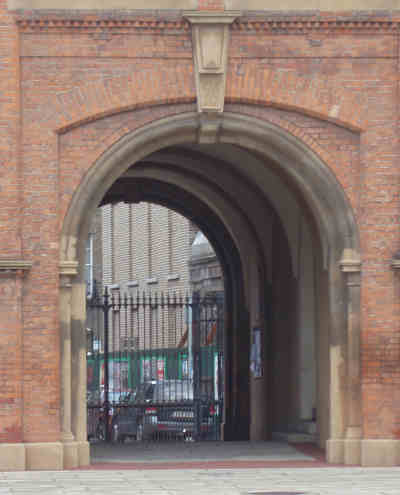
Central Model School


Having raised the subject of the Central Model School in Dublin's city centre in a post on George Bernard Shaw, I was invited by a commenter to expand on my association with this venerable institution, so, here goes.

I had just got my primary degree and had no particular plans for the summer when a fellow student asked me if I would do him a favour. He had a friend who had secured a job as a teacher in the Central Model School, but the friend still had some practical exams to do and would not be available until ten days after the start of term. Would I stand in for him for those ten days?

Whatever about initiative, I still had a sense of adventure in those far gone days and I rose to the challenge.

When I arrived on my first day everything looked normal and under control. I was given a class; I think it was fifth class which would have meant about 11 year olds.

I was full of great ideas about getting and holding the pupils' interest and presenting the subjects in the most interesting way possible.

My first instruction from the head teacher was to give a child a shilling and send him down to Capel Street to buy a bamboo cane. This was to be my symbol of authority and the instrument of retribution on any pupil who chose not to obey instructions, who was lazy, or who did not adequately focus his mind on the learning process. I must say this was not quite what I had in mind, but I forked out the shilling and got the cane.

My second surprise was the range of ability in the class. This ranged from very intelligent children who were anxious and willing to learn to those whom I felt should have been in a special school which would cater directly for their learning disabilities, or a reformatory which might remedy their insolence or sheer disobedience.

There were two brothers in the class, one at either end of the scale. The less well endowed one used to take off at lunchtime to Woolworths department store, nick a load of little plastic boats, and spend the afternoon loudly pulling them apart at the bottom of the class. When I suggested he lay off the noise, his brother, who turned out to be his minder, threatened to get his bigger brother to sort me out. Given the flats in which the family lived, this was a consummation devoutly to be avoided.

Another little fellow came up to me a half hour before the official lunchtime with a request. "Please sir, can I go early. Me mammy's sick an' I have to do the messages before lunch". "OK" said I and saw him out the door. About ten minutes later there was a knock on the class door and a procession entered: in the lead, the headmaster, followed by the lollipop man who was dragging my little fellow by the ear. "This (unmentionable) says you said he could go home early" said the head, fully expecting that I would contradict this outlandish story. The little fellow had been caught shinning down the rear spiked gate by the lollipop man who was coming on duty for the lunch break. Imagine the head's incredulity and frustration when I confirmed the little fellow's story.

I eventually gave up trying to teach anything and contented myself with simply holding their attention with stories and demonstrations of primary scientific phenomena. My successor could concentrate on improving their lot - after all that is what he was trained to do.

Meanwhile, I woke up each morning in a cold sweat at the thought of battling through another day in this bootcamp.

I did learn one thing from this "teaching" experience. Insofar as I had any competence as a teacher it was purely to teach the "willing to learn". Perhaps, it wasn't quite as bad as that. I subsequently found out that the particular class I had been allocated had borne the brunt of teacher changes in the immediately preceding years and this, no doubt, contributed to their, and my, difficulty.


There is an unexpected postscript to this adventure. I was in the habit of eating in Gaj's restaurant at teatime on those evenings I stayed in town after work. Gaj's was not only the most socialist restaurant in town, it was also the most sociable. It was a hotbed of constitutional revolution and civil disobedience in the cause of advancing the lot of the working class. Anti-establishment activists, such as Máirín de Búrca, of the Dublin Housing Action Committee, frequented the place. You went in and sat at any table and struck up with the most unlikely bedfellows. I once met a man there who was ashamed to have come from Mayo. God Help Us!

Anyway, the point of my dragging Gaj's into this post is that, one evening, I was coming out of the place, and on the pavement by the doorway was a young fellow playing the tin whistle. Nothing strange in that, you might think. But this guy had his manager/impressario at his side, and who was it? Yes, the guy who broke up the boats in class.

So I also learned that performance and behaviour in class is a poor predictor of success in the commercial end of the arts at any rate.