
Click on any image for a larger version
This is the third prong of the Helen Hooker O'Malley triad on show in Dublin at the moment. I have already posted on the launch of the NLI & GOP elements both of which relate to her photography. This is something completely different.
Helen founded the Players Theatre in 1945, in collaboration with Liam Redmond and Gerard Healy. She had trained as a graphic designer and became the stage and costume designer for Players hence the sets maquettes, ten of which have been donated to the Dublin City Archive by her son Cormac.
Looking at the photo of the stage set above you could imagine it was a full size set. But the maquettes are tiny and the details in them are amazing.

Anne Marie Kelly
First the formalities of the launch of this exhibition on 26 June 2019 at the Dublin City Libraries and Archive in Pearse Street.
Anne Marie is responsible for development and marketing on the library development team.
The exhibition had been mounted in close collaboration with Liz D'Arcy, who did an unbelievable job on reconstructing and conserving these little masterpieces, and Cormac O'Malley who donated them.

Mary Clarke
Mary, as City Archivist, was the recipient of the donation and she was right pleased.

Liz D'Arcy
Liz has the magic touch, though it sounds far too simple when you put it like that.

She gave us some idea of the painstaking process of sorting all the bits and pieces in the pile into their separate sets, then restoring them individually and reconstructing the set. The level of detail here, and in such tiny sizes, was amazing, right down to the individual twigs in the fireplace and the underlying ash. We're talking 3D here and not just a paint job, though that too.
Liz explained the intensive ongoing contact between herself and Cormac in the USA via emails, photos etc. as all the elements (including the tiniest) of the sets were identified, restored, and put in place. At the end they discovered that the leftover pieces actually made up another set.
You might take a moment to check out Liz's video from her Facebook page.

Cormac Hooker O'Malley
Cormac was so engaged and passionate about the project that he called for a pause while he explained further minute details in the set.
I really felt thrilled to be present at this unveiling of a piece of history.

Lord Mayor Paul McAuliffe
The formal launch of the exhibition fell to the newly elected Lord Mayor of Dublin. Paul has many local connections, and he departed from his script, I should really say abandoned it, to identify with at least one of the locations represented by a maquette.

Cormac then spoke about his mother and the later fate of the maquettes which, of necessity, were just crudely folded up and packed into a suitcase as he travelled the world. Needless to say, under these conditions, they just fell more and more apart.
But that is not the whole story. He commented that the mould which Liz had to get off them had been picked up from various locations and a forensic study of this in itself would tell an interesting story.
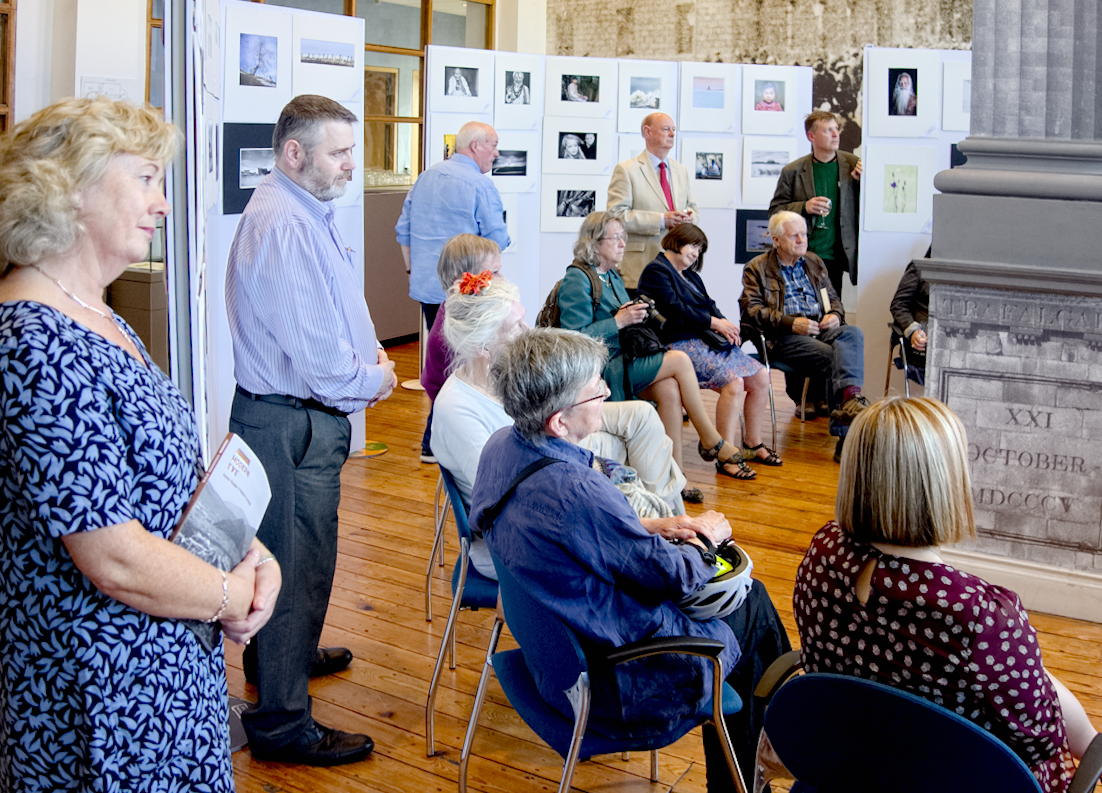

I think Cormac is filling the Lord Mayor in on some further details.

So we get to the point where the Lord Mayor feels confident enough to tell us what it's all about.

This is a photo that Cormac wanted taken to pay tribute to his and Liz's intensive trans-Atlantic cooperation on the restoration and reconstruction. Congratulations to you both.

Cormac, Anne Marie & Mairead Owens
Mairead is the recently appointed Dublin City Librarian. She has had an impressively varied career and came from her most recent post as librarian at the Lexicon in Dún Laoghaire.
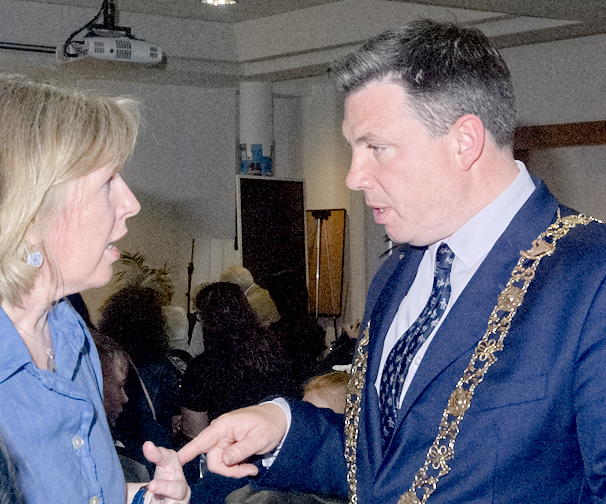

Liz, Gavin D'Arcy, Raymond Refaussé
Gavin is Liz's other half and Raymond is recently retired Librarian & Archivist at the Church of Ireland Representative Church Body Library.

Étáin Hooker O'Mallley
Étáin is Cormac's sister.

Diarmuid Peavoy
Diarmuid is a former classmate of mine.

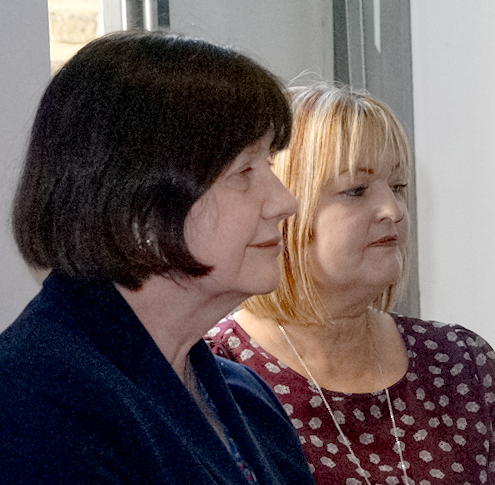
Tanya Kiang
Tanya is the Director of the Gallery of Photography in Temple Bar which is hosting another leg of the triad.
I'm looking at a few more maquettes below, but first a recap on a "before and after" from Liz's Facebook page to remind you of the miracle.


An unexpected bonus, two of Helen's sketches for further sets found among the material.


I'm sorry to have to write this part of the post and I hope it doesn't deter anyone from coming to visit these miniature masterpieces with their more than colourful history.
When I arrived first, I thought I'd come on the wrong day as the Dublin Camera Club exhibition was still up and running.

I eventually realised that the maquettes were in the glass cases around the wall.
I had been expecting them centre stage, so to speak. I do realise that their small size would make it difficult for them to command immediate attention without the addition of a lot of back up material such as timelines, posters of the restoration process and perhaps the odd photo of a set on stage during a run in the Players' Theatre if such exists.
However that wasn't the problem. It was one of timing. The space is usually booked about 18 months in advance. I'm well aware of this as it came up when I was discussing the possibility of a photo exhibition of my own with Máire Kennedy way back. There used to be times when the space was empty for weeks but no more it seems.
Then, Liz only got the first set (Black Stranger) in December and the following nine sets in February. She began returning them, on a phased basis from the end of May. So there was huge time pressure and she put in a lot of additional hours at weekends and evenings.
In the normal course of events we'd be talking about an exhibition in early 2021. However the opportunity was seized to exhibit the sets at the same time as the Temple Bar exhibition and, fortunately, the Dublin Camera Club were not using the display cases. Had things turned out otherwise we might not have seen them at all at this stage. So full marks to Mary Clarke for not allowing the perfect to be the enemy of the excellent on this occasion and to Liz for rising to the occasion.
I asked Liz and she confirmed that this was one of the jobs of which she is most proud.
I do hope there will be another exhibition of the sets in the future along the lines I was expecting above. They are really fabulous and deserve to be appreciated against their full background. There is fabulous article by Aura McMenamin in the Dublin Inquirer setting out the background to the Players Theatre and the restoration and a promise of more to come.
And one final subversive remark - I think it's time Admiral Nelson called it a day. I know his head is upstairs but the Pillar does limit flexibility when planning exhibitions in this space. [Update 17/9/2019: Oops! I now realise that the (underlying) pillar is structural and its removal would bring the house down, and not in the theatrical sense of the phrase. Ah well, we have to work with what we've got.]

Do come in to see these maquettes. It is an opportunity not to be missed. The exhibition continues up to the end of July and I gather there will be a video in place shortly illustrating the restoration process (ie Liz at work). The Dublin Camera Club exhibition is due to be replaced by one on Tony Gregory.
The other two elements of the Hooker triad, in Meeting House Square in Temple Bar, are also well worth a visit. The Gallery of Photography leg continues till 1st September and the NLI Photo Archive leg until 1st November.

Photo courtesy of Diarmuid Peavoy


