Showing posts with label Gilbert Lecture. Show all posts

Friday, January 25, 2019

MEDIATRIX


Click on any image for a larger version

This was the 22nd annual Gilbert Lecture in Dublin City Library and Archive in Pearse Street.

The lecture series is named after John Thomas Gilbert (1829-1898) who did much to chart the history of Dublin. His valuable library of books and manuscripts, relating to Dublin and Ireland, was bought by Dublin Corporation after his death and this forms the nucleus of the special collections in Dublin City Library.

It is an honour to be invited to give the Gilbert Lecture and this year that honour fell to Marie-Louise Coolahan, Professor of English Literature at NUI Galway. Her lecture was titled:
"as was taken out of his own mouth in Dublin":
Autobiography and Life Writing in Early Modern Ireland


The day was organised by Enda Leaney, Senior Librarian, seen here in his Clarke Kent outfit. Enda has taken over from Máire Kennedy, to whom I am grateful for her many invitations for me to give (ordinary) talks there over the last decade.


Brendan Teeling, Acting City Librarian, gave us a rundown on the Library and on the Gilbert Lectures. He had much praise for Dublin's public libraries and their dedicated staffs. The libraries provide a wide variety of essential services to the public free at the point of use and it is vital that this be maintained.

Speaking as a former inhabitant of the Department of Finance, I know that the libraries were always at the top of the list for cuts in times of stringency and it is nothing short of a miracle that the free service has been maintained over the years.


Dermot Lacey was representing the Lord Mayor, and no better man for an entertaining master of ceremonies. And he didn't disappoint.

He recounted how he nearly didn't make it as he had to visit his dentist with a sore tooth (him not the dentist). After the procedure the dentist remarked that he had a very small mouth. This brought forth a burst of laughter from the audience who had come to know Dermot well over the years.


Anyway his first duty was to present Professor Michael Griffin, who gave last year's Gilbert Lecture, with a copy of the lecture in book form. Each year the Gilbert Lecture is turned into a book and published on the occasion of the following year's lecture.

And then it was down to business with Marie-Louise.


It was the word "autobiography" in the title combined with the status of the lecture which brought me along. As usual I hadn't read the title carefully and thought I might get a few hints for writing my own autobiography, assuming I last another few years.

Well the talk turned out to be more interesting than that. Marie-Louise was looking at the emergence of autobiographical and life writing in the sixteenth and seventeenth centuries.

She examined the motivation, format and content of a wide variety of texts. Now, this is not my period and I am not a historian, but one thing emerged clearly to me. All this writing was mediated. None of it was unrestrained stream of consciousness. Each item was defined by its context. Texts were backing up favours sought, exculpation of past misdeeds and so on. They each had a clearly defined purpose. So presentation of autobiographical information was mediated to suit the purpose at hand.

A bit like the way the winners write the history or the church mediated reporting of the Knock apparition of 1879.

So a timely warning to historians to always be aware of the agenda. There is always an agenda.

I have titled this post "Mediatrix" because the lecture was about mediation and it was itself mediated with extraordinary vivacity. If you don't believe me, just skim down the series of photos of Marie-Louise in action below.
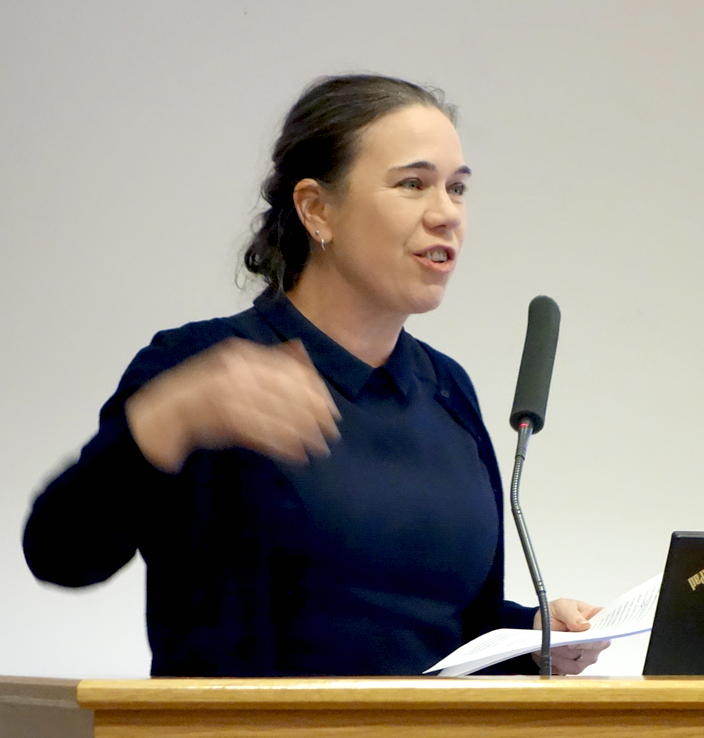


The audience listened and watched with rapt attention.


This included Dermot ...


... and Máire Kennedy herself ...


... and Enda.


And all too soon it was over and time for posed photos.

Marie-Louise, with Dermot (and the book), and Michael Griffin (the author).
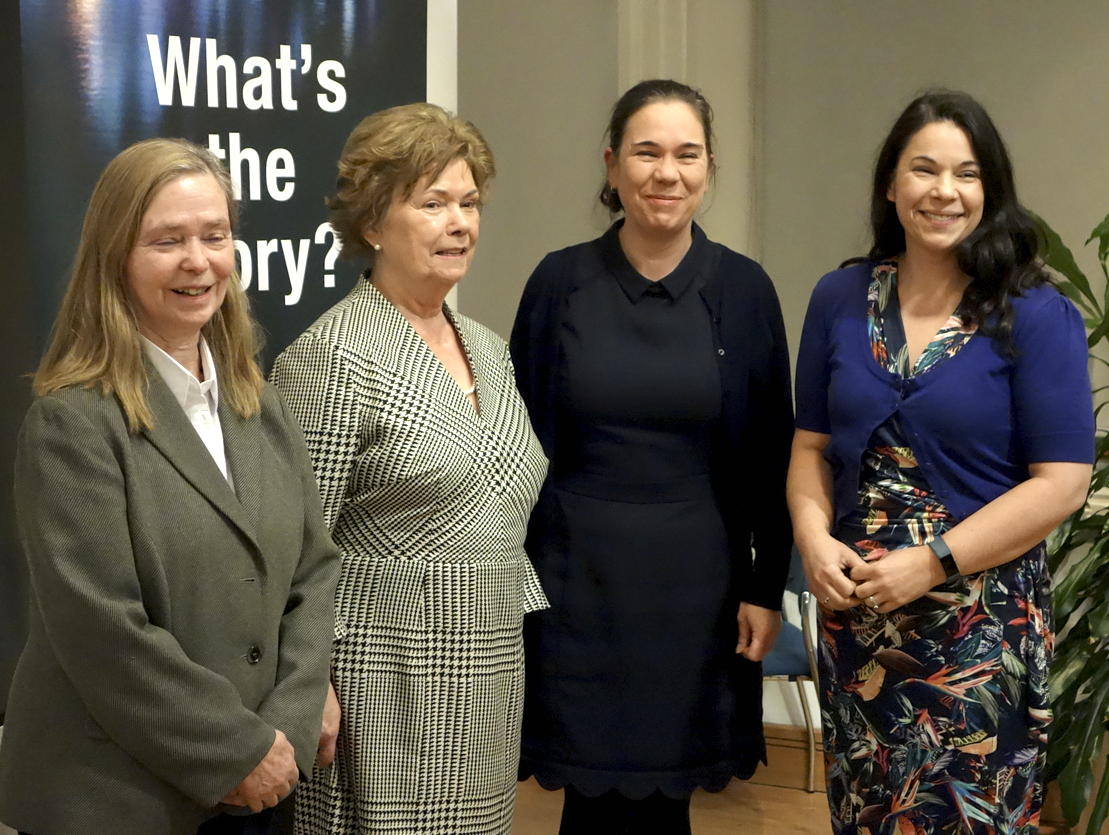


(l-r) Deirdre Ellis King (former Dublin City Librarian),
Mary Coolahan (mother), Marie-Louise and Iseult (sister)
.
I hadn't realised until much later that Marie-Louise was John Coolahan's daughter. I had been at John's talk, on the undenominationalising of the primary schools, in the Patrick Finn Lecture series, in St Mary's, Haddington Road, a few years ago. It was an excellent lecture which I reported on at the time, and for which I attracted some flack from the RCC rearguard.

Sadly, John died last June, RIP

Friday, January 22, 2016

THE WOMEN WERE WORSE


Padraig Yeates giving this year's Gilbert Lecture

Padraig Yeates used the provocative title "The Women were worse than the Men" for his Gilbert Lecture in the Dublin City Library and Archive on 21/1/2016. The talk was on crime statistics for Dublin in 1916 and the conclusion, among others, was that it was mostly the women who were up to no good that year.

No doubt that will bring howls of protest from the resident feminazis who can point to all sorts of qualifications applying to the statistics and, indeed, Padraig hopefully pre-empted much of this gender indignation by outlining these qualifications himself.

If that's not enough, we can, of course, take refuge in the traditional ballad which long ago told us:
So it's true that the women are worse than the men,
For they went down to Hell and were sent back again.
However, it would be doing Padraig an injustice to just concentrate on the women. The talk was actually about overall crime in the city during the year and the statistics were sourced from the DMP prison books. The books are currently housed on the 15th floor of Liberty Hall but will go into the custody of the Garda Museum once they are put on line by UCD in March.


The talk's title didn't seem to take a feather out Lord Mayor, Críona Ní Dhálaigh, who gave us a litany of Padraig's writings and books, before introducing him as speaker for the night.


Having taken his life in his hands at the outset, Padraig did produce copious evidence of the predominance of women in the crime statistics of that year.

He nevertheless covered various other categories of crime, high among which was desertion from the British army. He mentioned one Englishman who deserted thinking that, because he was in Ireland and because conscription had not been introduced here, he oould get away with it. He soon learned to his cost that it was not so. I could have warned the poor man that even Irishmen who were resident in Britain were being conscripted.

A lot of the women in the crime statistics were involved with looting one way or another. Some had actually nicked stuff while others, like Dickens's Fagan, had bands of youngsters doing the heavy work for them while they either used or flogged the fruits of the labours of youth.

Padraig mentioned that, where there was a choice, the authorities usually went for the lesser charges in the case of women - mere possession rather than the more serious breaking and entering or destruction of property. He also reminded us that children as young as six years of age also figured in the statistics. In those days, a crime was a crime irrespective of the age of who committed it.


[front row r-l] Padraig Yeates, Críona Ní Dhálaigh & Kevin Whelan

There was a packed attendance, though clearly a few VIPs had not turned up and, like the men in the porch at Sunday mass, those standing at the back were reluctant to plonk themselves on what were clearly designated as VIP seats.


Críona Ní Dhálaigh presents book to Kevin Whelan

One VIP who definitely did turn up was Kevin Whelan, who gave last year's Gilbert Lecture. The way it works is that, at each occasion of the annual Gilbert Lecture, a book containing the previous year's talk is published and a copy presented to the author.


[l-r] Brendan Teeling, Críona Ní Dhálaigh & Padraig Yeates

Posing for the obligatory photo. Brendan Teeling is the Deputy City Libarian. He had apologised at the outset for the absence of the City Librarian, and promptly kicked off the evening in his usually ebullient manner.


After the talk, there were refreshments and lots of chat and informal networking. This space is currently taken up by the library's excellent 1916 exhibition which both leans toward the Rising action in the vicinity and uses lots of material from the Dublin City Archive upstairs.

I hope to do a post on this exhibition which runs till June. Meanwhile I have tweeted a few photos.

Friday, January 23, 2015

Tracking Dublin


Kevin Whelan
Click any image for larger version

The 2015 Gilbert Lecture, in Dublin City Library and Archive, was given this year by Kevin Whelan. The subject was Dublin as a Global City but this formal title gave little indication of the roller coaster ride that was to follow.

The angle was the waxing and waning of Dublin over time, but from a global perspective. The question asked was, how important was Dublin on the world scene and why.


Roman Times

Kevin started way back before Roman times when we really didn't figure at all. When the Romans finally got as far as Britain, it seems they didn't fancy going any further into what was to them a hostile and cold environment compared with the Mediterranean. And, anyway, if they overshot they might fall off the edge of the flat earth of its day.

It was only with the coming of the Vikings that Dublin assumed a global importance, becoming a hub for their conquests and trade along the west coast of Europe. In recent times there has been a tendency to stress the benefits of the arrival of the Vikings, but Kevin left us under no illusions. These guys were slavers and ruthless. They considered themselves superior, under Thor, to the milksop Christians they encountered along the way. Generally speaking they killed the men and took the women home as slaves. Hence the high proportion of Irish DNA in Iceland, for example.

The Viking empire waned during the 11th century (and, despite the speed and broad scope of his talk, Kevin even managed to mention Diarmat mac Máel na mBó and the Cavanaughs.)

When the Normans came (1169), the focus turned from being outward and coastal to fixating on Britain and to some extent Europe beyond it.

The next point of inflexion was after 1492 when Ireland became a link between Europe and "newly discovered" America.

After 1800 its importance faded as the focus shifted to London as capital of the UK and as trade/transport restrictions were imposed on seagoing traffic.

There was a further recovery after 1900, both in global transport and also in the city's world image through its literary figures who part colonised the English language and turned it into something of their own.

Finally, Dublin opened up again as a Euro/American hub as US giants set up European headquarters here in their commercial/digital assault on Europe. And, Dublin now ranks well in many international league tables even despite the recent crisis/downturn.


Larry O'Toole

I haven't really summarised the presentation but rather given a small flavour.

Kevin was introduced by Deputy Lord Mayor, Larry O'Toole, who (humorously) compared Kevin's many qualifications and achievements to his own "two years in a tech". Larry not only enlivened his own introduction but carried on from the sidelines providing a foil to Kevin's many humorous references to Dublin's distant southside. Larry is from Wicklow and Kevin from Wexford, but no doubt they both consider themselves honorary Dubs at this stage.


Margaret Hayes

In opening the proceedings earlier in the evening, City Librarian Margaret Hayes gave us a rundown on the Library Service's packed programme of events for the year. She then handed over to Larry to launch the book version of last year's Gilbert Lecture.


Larry O'Toole

Larry then did a great promo for the library service and promptly launched the book.


Séamas Ó Maitiú & Larry O'Toole

Last year's lecture was entitled Alleys, annals and anecdotes: a new look at Gilbert's History of Dublin. It was given by Séamas Ó Maitiú, and, if you are interested, you can see it and some previous Gilbert Lectures here.

[Update - 22/4/2015: The audio of Kevin Whelan's presentation is up on the above site].

L-R: Máire Kennedy, Librarian Dublin & Irish Collections;
Kevin Whelan, Michael Smurfitt Director of the Keough Notre
Dame Centre Dublin;
Mary Hanafin, Councillor, Dún Laoghaire-Rathdown;
Margaret Hayes, City Librarian;
Larry O'Toole, Deputy Lord Mayor & City Councillor.