Showing posts with label family. Show all posts

Saturday, December 01, 2007

Shoots, Leaves and Branches


It's time again to report progress on growing the family tree. I have been solidly hacking at it now for almost two years and am amazed and fascinated by what has emerged in that time.

I was relatively (no pun intended) ignorant when I started out. I had met some family members and had bits of paper and photos relating to others, but in the overall I was very vague on the whole thing. I now know a lot more about the family, including more about the members of some of the far flung branches than they know themselves. Tricky that.

There are now over 500 people, between living and dead, entered in the tree. At some points it spans 9 generations and the earliest births are around 1800. I should really be concentrating on going back further, at least as far as my own ancestors are concerned, but I have found so much fascinating material on the way that I have allowed myself to be seduced into filling out the blanks on those I have already discovered, and moving sideways rather than backwards as my curiosity about some of these people is aroused.

Occurrences

In the tree generally, and not confined strictly to ancestors, I have 3 drownings, 4 generations of coopers (5 coopers in all), 4 members of the Royal Irish Constabulary, 3 British Army (including one who died on the Somme in WWI), and for balance one rebel sentenced to death by the British, commuted to 15 years penal servitude, released within months on the signing of the Treaty, took up arms against the new Irish Government and spent most of the rest of his life interned by his own.

I have 3 native Irish speaking ancestors.

The tree now covers 18 of the 26 counties and among the 70 separate occupations identified so far some of the more esoteric are: Attorney General, Alderman, Blacksmith, Barman, Dance Instructor, Detective, Fireman (railway steam engine), Lock-keeper (Grand Canal), Neurosurgeon, Pawnbroker, Royalette (Theatre Royal dancing chorus), Signalman (railway), Timekeeper (?), TD (Member of Irish Parliament) and Silkweaver.

Some deaths are memorable: in one case a mother and two daughters-in-law died from the same kidney complaint which can be caused, inter alia, by mercury poisoning; in another case the death certificate records the cause of death of an 89 year old female ancestor as old age - without dementia. I'd say she gave the Lord a run for his money when she turned up on his doorstep.

I have also met family members I didn't know I had. One of these found me when he put his Granny's name into Google and got one hit - my website, where his past was all laid out before him, like one of those TV chefs taking a dish out of the oven which they just happen to have put in earlier.

Background
Pursuing the tree has given me an interest in subjects which passed me by in the past:

  • the functions and history of Dublin Corporation (now Dublin City Council). The Council has a long and chequered history, including in relation to the national struggle, and I had an Alderman relation on the Council during some of its most turbulent years in the early 20th Century, when it was even abolished for a number of years.

  • the history and geography of Dublin city. This includes urban planning in general and, in particular, water supply and sewerage systems in which James's St. was central for a period. There are plans underway for regenerating the Liberties, including the old harbour and basin area behind James's St. and I have been following, and participating in, the recent the planning consultations for this project.
  • Guinness has been a significant player in the development of not only the area around James's St., but of Dublin in general as far as employee social welfare and housing were concerned. The company has opened its personnel archive to interested parties and I have got the employee records of three out of the five coopers so far.
  • the RIC, while operating as a native police force, was also the ears, eyes and arms of the Crown and many of its members found themselves in tricky situations as a result.
  • WWI had more or less passed me by until I found that an uncle had died in a botched operation on the Somme and a grand uncle, while injured, had survived the war and returned to hard times in Dublin.
  • Catholic Emancipation more or less passed me by in the history class in school, but in real life it may well have opened up opportunities for my ancestors and their relations and I can't get away from Glasnevin cemetery (the dead centre of Dublin) where many of my relatives are buried. Daniel O'Connell got this non-denominational cemetery established to facilitate Catholics (mainly) who were subject to a certain amount of harassment at funerals to Established Church graveyards.
  • my faith in the Divine Database has unfortunately been shattered by this exercise. The system where you had to produce a recently issued baptism cert to get married and where the marriage was then entered on the original baptism register, looked, on the face of it, like a beautifully closed system which protected against bigamy. However, when you factored in human behaviour the system proved to be full of holes. Pity, it looked great on paper, so to speak.
  • I have also learned the irrelevance of administrative boundaries when it comes to settlement. People may get very attached to their county football team, and you may be lucky to live under a County Council which provides a better service than others, but when you are tracing back family origins and attempting to disentangle the cousins from one another, such boundries are irrelevant. For example, East Limerick and North Tipperary are all the one, genealogically speaking, and it is sometimes not even clear which county a particular village is in, or at least to which it owes its primary allegiance.

Techniques
The exercise has also put pressure on my own technical competence, in a very constructive way:
  • I can be a bit scattered so I was using a free family tree computer programme to store, manipulate and report my findings. I was getting so much material and my ambitions for presenting it were increasing at such a rate that I invested in a more advanced programme which is great but where I am still on a sharp learning curve.
  • I have always enjoyed taking photos and this venture has put me, my new digital camera, and my photo processing package through our paces.
  • I originally put up a page on my website to carry family material and this has now grown to over half the site. I can practically talk HTML in my sleep at this stage, but the presentation of the material still continues to be challenging and puts pressure on me to master new techniques. I have also enlisted the help of Feedblitz which emails interested parties when I update the site, and have managed to tweak the system so as not to send out alerts for trivial updates.
  • and finally, the most recent technical addition to my armoury - Google maps. I had intended, from the beginning, producing a map showing the geographical spread of the family, particularly in Dublin city itself. However, hardcopy versions become quickly outdated and are not scaleable. Enter Google maps and a little bit of code-nicking and hey presto!

Sources
I have had great fun following up sources and squeezing them dry. I exaggerate - so far I have only creamed the surface. I have pored over indexes of births, deaths and marriages and then over the certs themselves. I have read wills that would make you weep. I have visited graves that would bring tears to your eyes, both of sadness and anger, and sometimes even a wry smile. I have got eyestrain from the small and often fudgy print in newspapers, not to mention the microfilm version of them. I have cursed the sloppy digital archiving of newspapers and despaired at the wanton destruction of housing rent records and photo-archives. I have enjoyed picking up on oral history from family members, both old and new. And I look forward to the promised unveiling of the 1911 Census (Dublin) online in the next few days.

You can catch up on all of this, as well as staying in touch with future developments, here.


Monday, October 22, 2007

A Prophet in his own land ...

In the course of my family history research, in Dublin's Coombe area this afternoon, I was trying to pin down the exact location of 15 Donore Avenue where Old Nick Fleming lived around 1898. I had it figured and was just about to take a photo when I noticed three tiny gurriers, who'd been trying to kick in a shuttered window, drift over in my direction.

One of them shouts at me

"Hey Mista, ya can't take photographs here".

"Feck off" sez I.

Then, "Go back to your own country!" yells another.

"My people were round here before you scutties were even thought of" sez I, followed by a menacing glance at which they scattered and from a safe distance they delivered a stream of standard Dublin invective:

"Speccy four eyes!", "F*** you!"

Irony or what?

Monday, November 13, 2006

Dublin in the rare oul times


I recently came across an exhibition celebrating the life and death of Dublin's Theatre Royal which closed after 141 years on 30th June 1962. I enjoyed many pantos and films in the Royal, which was the largest theatre in Ireland.

I didn't know it at the time, but I was a first cousin, once removed, and by marriage, to one of the Royalettes - the resident troupe of dancing girls.

The demise of this iconic premises was seen by many as the beginning of the end of "the rare oul times". This magnificent living and breathing theatre was replaced by a plastic-and-glass box full of civil servants.

It got me thinking about the nature of change and development.

Sure, you can't keep everything the same forever, but things can often change for the worse. The picture above is typical of many of the city centre façades today, as dereliction reigns while developers assemble propeties to build yet more anonymous glass edifices.

Dirty old town

I felt an affinity with the older Dublin.

I went to school in Parnell Square, walking up every day from Tara St. station, through O'Connell St. with its monuments, or Moore St. with its street sellers, and coming back through Liffey St., for a dalliance in Hector Grey's "emporium of all a young boy ever wanted", even if the most of it was cheap imitative manufacture from Japan. I bought my first guitar there for £3, or was it 30/- ?

The Pillar, dead centre of the city, site of the old tram terminus, meeting point for city dwellers and visiting country folk alike, is now gone. Replaced by a shining needle without a haystack. A modern version of Jack's beanstalk.

Real estate

Since I started delving into my family history I have been taking a greater personal interest in various parts of Dublin and the fate which has befallen some of its lesser known buildings.

The premises in which my great grandfather worked as a shoemaker in the 1860s is now the site of vast new Civic Offices. Yes, you guessed it: Wood Quay. At that time 15 of the Quay's 22 premises housed shoemakers.

When the area was being controversially redeveloped in the 1960s I had no idea of any family links with the site.

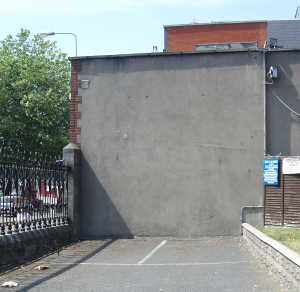
This may, however, have been a better fate than befell the premises in which he first opened his own business, in 1873, at 122 James's St. just in front of St. James's (Protestant) church.

It fell into ruin around 1884; was demolished around 1900; and finally finished up as a parking space in the church grounds. As a further twist, the church closed for business in 1963 and the addresses of the former Nos. 121 and 122 have been appropriated by the lighting emporium which now trades from the old church premises.

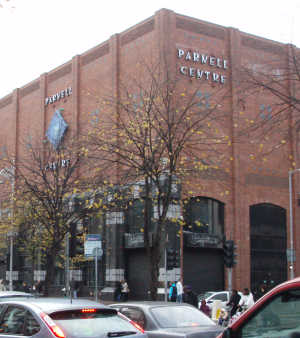
Parnell St. has changed radically. The premises in which my great grandmother was in domestic service, in the household of Sir John Barrington, sometime Lord Mayor of Dublin, is now part of the Parnell Centre: the precise part which was, recently, and briefly, the site of Peter Stringfellow's unsuccessful foray into Dublin's "nightclub" scene. A different sort of domestic service entirely from that provided by great grandmother Sarah Rankin.


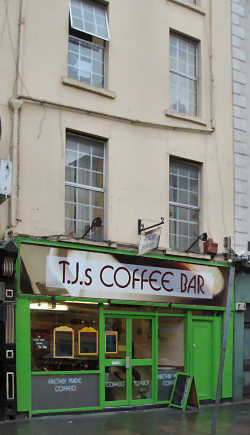
Meanwhile, still in Parnell St., but just on the other side of O'Connell St., another great grandmother worked in Ellen Berry's milliner and dressmaking establishment. Mary Anne Connely, as she then was, surely had no idea that, some forty years later, she would be related by marriage to Sarah Rankin from the other end of the street, when her son, Patrick Mortimer, married Sarah Rankin's daughter, Sarah Burgess. Ellen Berry's shop is now a coffee bar.

Both these great grandmothers had the distinction of being married in the Pro Cathedral, not due to their exalted status but because it was their local parish church.

Little did I know when I was in school in Parnell Square, that I was only a stone's throw from where two of my great grandmothers lived and worked.

The other side

There were some aspects of the rare oul times that could have done with being a little rarer.

This is Eden Quay on the north side of Dublin's River Liffey. It was here that my grandfather was found drowned in 1918.

From my reading of the newspapers of the day, along with a clatter of Coroner's reports, it seems that drownings were two-a-penny in those days. While that may have been less subversive of society than today's murder-a-day, it is still a dark side which should temper our often unquestioning nostalgia for things past.


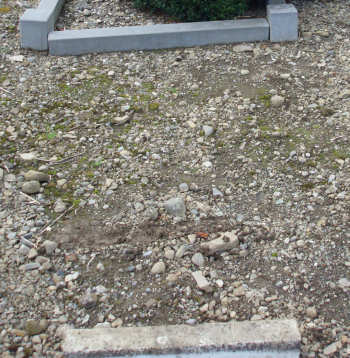
This is great grandfather Joseph the Carpenter's unmarked grave in Glasnevin.

Joseph and Mary Anne (see above) were married in 1861, presumably with some expectations of being happy ever after.

Before the end of that year they had lost a newborn baby, and by the time Joseph died some 14 years later, they had lost two more children, each just over a year old, due to infant cholera and teething inflammation.

A living city

So now, when I walk the streets of Dublin, they come alive with the ghosts of my ancestors and their families. The more I delve, the more streets come alive.

It doesn't really change the present and it can give rise to a spurious sentimentality, but it is nice to know a little of what was going on before you came along and it can help keep your feet on the ground.

No man is an island, but beware the Tsunami !

Wednesday, October 18, 2006

My Tachondria and other trivia.

Up to now I had been looking on my family history quest as learning about other people, albeit my own ancestors. I then started thinking a bit about how some of this background might have influenced my own attitudes and genes.

North side/south side

There is a northside/southside thing in Dublin city. The southside is traditionally the posh side and many southsiders consider the northside to be inhabited by tribes of subhuman proles.

Over time this clear distinction has been eroded somewhat by (i) the public authorities locating tracts of public housing on the southside, (ii) the existence of some posh areas on the northside, (iii) the emergence of an east/west split, and (iv) the inevitable movement south of some northsiders in search of status, or property values, or just to get away from their savage neighbours.

I always knew I had a foot in both camps as I started on the northside (Howth), spent half my life on the southside (Orwell Gardens and Ballybrack), and returned to the northside when I got married (Raheny). I now find that one of my great grandfathers appeared on the northside (Glasnevin) around 1860, while another great grandfather appeared on the southside (Thomas St.)around the same time.

Various counties


My mother had always told me, or at least had given me the impression, that her family, on her mother's side, went way back in Dublin. However, my probings revealed that her grandfather came from Wicklow and her grandmother from Laois (Queen's County in those days).

Equally, on my father's side, I knew he was born in Ballyhaunis in Co. Mayo, and thought his father might have been from Tipperary as Dwyer was a Tipperary name. However, I now find that one of his grandfathers was from Co. Limerick, and the other from Co. Sligo.

If we count temporary residences, we can add: Longford and Offaly. Mind you, it's still only eight out of twenty six counties.


Republican/BA/RIC


Another division in Irish society is between those with republican credentials and those more closely associated with the (former British) establishment.

In this respect I am in deficit on the republican side where my only (uncorroborated) claim to fame is my uncle having been a runner for Michael Collins in London – and for this revelation I rely entirely on one of my country cousins.

On the other side I have: relatives who fought, and died, in the British Army (including at the Somme in 1916); constables in the Royal Irish Constabulary; and a bootmaker and a caterer for the British Army.

The balance is pretty definitely one way.

Genes

And what of the gene pool?

While I can list the various illnesses which are stated to have killed my ancestors and their immediate families, I am not sure how relevant some of these are to the gene pool. Anyway, here's a recital from death certs in my possession :
acute peretonitis; asphyxia – result of immersion; asthma; bronchitis; cancer; cardiac failure; coronary thrombosis; exhaustion; gout; infantile cholera; inflammation from teething; parkinsons; tuberculosis
A number of these conditions are cited in multiple cases.

Tradesmen/clerks

The variety of career backgrounds also proved interesting. I had known about some of them but the full range surprised me. Many of these also have multiple instances:
ancestors
bootmaker; carpenter; civil servant; clerk; constable; domestic servant; farmer; labourer; manager; salesperson; shopkeeper

family
air hostess; auctioneer; barperson; businessman; carer; civil servant; comptometer instructor; cooper; counsellor; court clerk; dressmaker; engineer; hairdresser; journalist; lawyer; machinist; priest; professor; receptionist; soldier; teacher; undertaker

Sunday, October 01, 2006

From small acorns

I recently started some work on my family tree and the results are here.

My interest in getting a more comprehsive picture than the vague bits of knowledge that had been floating around was sparked by three things. (i) I had got a free family tree programme with a computer magazine and in order to try it out I had to enter in some data. This made me aware of the big gaps in my knowledge of my family background. (ii) I had photos from my mother of her grandfather and some of his family and, in particular, his shoe and boot shop in James's Street, in the centre of Dublin, taken around the beginning of the last century. (iii) Having retired from the day job I had more time to follow up leads and assemble the bits of the jigsaw.

Raiders of the lost ark
I had no idea of the public sources available nor of the amount of time required to follow up tenuous leads. Neither did I have any idea of how personally involved you can get in this stuff and of how emotionally you can react to the things you find out.

An archivist whom I met in the course of my expeditions said she often thought that people should go into therapy before embarking on this type of quest. I can now see what she meant.

Nevertheless it is an interesting voyage of discovery but one to which there is no end this side of the grave.

- sources: It is quite amazing the extent of the sources of information that are out there in the public domain. Today we are used to this and expect to find out all sorts of things about people by just putting them into Google. We don't expect there to be much out there about our own family over the last 150 years, unless, that is, we come from a particularly famous or notorious background. You would be amazed, however, at what can be gleaned from indexes of births, deaths and marriages and from the actual certificates themselves, all of which are in the public domain (sometimes for a fee!). Street directories can trace family movement; census returns can fill in a mountain of detail; and even poring over maps and photographs can bring its own form of enlightenment.

- shocks: But be warned. This can be a dangerously revealing exercise, exposing not only the white, but the big black family lies and concealments. Not for the fainthearted to be sure. So far I have unearthed a grandfather who was found drowned in Dublin's River Liffey after having gone missing for a week, and a grand aunt who died in an institution in which she had apparently resided for about 30 years.

- discoveries: I also discovered that one of my grandfathers was a twin; that I had British Army and RIC connections on both sides of the family; and that people either lied about, or were sublimely unaware of, not only the ages of those around them but their own age as well.

- lacunae: Clearly much historical source material has been lost or destroyed over the years. We Irish bemoan the destruction of the Public Records Office in the course of the civil war. This destroyed a vast amount of pre-1922 material, including, to my own cost, coroners' inquest reports. At least most Irish people are aware of this problem from the outset. It is, however, disturbing to discover that photographic archives in private hands are either incomplete or have been dumped. It is also annoying to find that the rent/rates records of occupancy of the Dublin Artisans Dwelling Company which built half of Dublin, in the late 1800s and early 1900s, have been unceremoniously skipped as recently as the 1980s. These records were a vital complement to the existing Dublin street directories for the period, as the directories do not record individual occupancy for these estates and Dublin Corporation did not keep any record of occupant's names.


Rewriting history
In any event, I think I made my own small contribution to history along the way.

I arrived at my grand uncle John's grave in Glasnevin expecting to find John, his wife Tess and their son Matthew. This expectation was based on the cemetery's computer records which I had been given at the entrance. Imagine my surprise when I found the tombstone recorded an additional occupant, a daughter who was buried as recently as 1996. I informed the administration who promptly (electronically) exhumed her from the non-existant grave in which she was recorded as reposing and reinterred her in the correct location. Can I now claim to have rescued someone from Limbo. I hope so.

In exploring the photos in the Irish Architectural Archive I found them a bit sparse on older photos of James's Street so I donated a copy of the photo of my great grandfather's boot and shoe shop which will now be available to other researchers.


Professional help

I would like to record that the staff in the archives I have consulted have been extremely helpful and courteous, not to mention tolerant in the extreme. They must be fed up with the enthusiastic "Eurekas" and expressions of frustration of individual researchers, but they don't show it and even evince an interest in the researcher's progress towards the ultimate goal of enlightenment.

Fellow researchers
You keep meeting the same people as you progress around the various archives. Some are young and have a specific and limited purpose. Others, like myself, are having a general poke at their families' past and appear to be going through some sort of a belated mid-life crisis.

Still, exchanging experiences and tips is a constructive experience, and this support group is probably some substitute for the more formal therapy envisaged by my archivist friend at the outset.

Monday, July 17, 2006

Traitors All!

It has taken a long time for the Irish to come to terms with those of their numbers who were involved in any way with the pre-independence British régime, and more particularly those who volunteered to join the British army, some of them inspired, no doubt, by the call to "defend the rights of small nations", however ironic that might seem to us in retrospect.

The dead of 1916, of the subseqent War of Independence, and even of the previous Fenian generations, overshadowed their "shameful deeds" and relegated them to a convenient oblivion. Even the oblivious souls in Limbo had more claim to our attention and pity and were released into Heaven before the memories of those Irish who died in the service of the British army were begun to be resurrected.

I was brought up in a fairly republican tradition which saw de Valera as the quintessence of Irishness. My teachers taught me to rejoice, in 1952, on the death of the English King, the presumed inheritor of the odium due to his Imperial predecessors and the monarch with ultimate responsibility at the time for the ongoing British occupation of Northern Ireland. He turned out to be also the head of my neighbour's church, but that is another story.

Yet, when I look into my background I find another side to the story.

On my mother's side, her maternal grandfather made boots for the British army, among other clients presumably. A relation on her father's side died in Ranikhet, in India, in 1892, while serving in the British army.


On my father's side, his father was an RIC man and his brother was killed in France, serving in the British army, in WW1.

In today's terms this was serious collaboration with the enemy, at least in the eyes of Sinn Féin/IRA who have a history of murdering such people, even, in some cases, where they are "collaborating" with the modern Irish democaratic state.

Brian Lynch, in his poem "Pity the Wicked" has savagely, and rightly, attacked the arrogation by Sinn Féin/IRA unto itself of the divine prerogative over life and death. He instances the case of Pat Gillespie, turned into a human bomb by the IRA. His crime? He was a chef for the British army. And the scrubbers in Aldershot. A mop was now a lethal weapon, a WMD, the possession of which justified invasion of their workplace and blowing them to kindgom come.

If that approach had been adopted towards my family I wouldn't be here now, on either my father's or my mother's side!

The current state of play in my pursuit of my family history is here.