Showing posts with label Northern Ireland. Show all posts

Tuesday, May 28, 2019

AR SCÁTH A CHÉILE


Click on any image for a larger version

If there were two key words that came out of the launch of Seamus Mallon's memoir at the Irish Architectural Archive (23/5/19) they were integrity and interdependence.

The latter was well captured in the Irish language saying Ar scáth a chéile a mhaireann na daoine. In the course of his passionate address Seamus offered this saying as a guiding light in any consideration of the future in store for Northern Ireland. Or as he put it in the form of a brutally challenging question Are we going to do to them what they did to us?.

The theme is further rammed home in the title of his memoir A Shared Home Place. This is the calibre of the man we are dealing with here. Always constructive but with an eye on the longer term.

And the second key word integrity was much bandied about on the night, but nobody challenged the fact that Seamus Mallon personified it.

But I'm probably getting ahead of myself here.


Tim O'Connor

Tim was the first speaker. He is a diplomat much of whose career was taken up with Northern Ireland. He spoke of working with Seamus and of the work relationship developing into a friendship. This allowed him to slip in a reference to bunkers. Not just a golfing term but a politico/military one as Tim had been involved in the bunker in Belfast's Maryfield which had been the secretariat to the Anglo-Irish Intergovernmental Council in the period 1985 to 1998.

The term bunker will give you an idea of the environment in which the secretariat operated. A bit like the space station - careful preparations were needed before stepping outside.

He referred to how huge an undertaking it is to write and publish a book like this. Many a one has proclaimed their intention to produce such a book only to fall at the first fence.

Someone else mentioned that it was Tim who suggested that Andy Pollak should help Seamus with the book, and what we heard was that were it not for Andy's slave driving, among other things, there would have been no book.


Tim testified to Seamus's integrity and Seamus picked Brian to launch his book.

Now, Brian has had his share of criticism for both his actions and inaction in public life, but it is clear from Seamus that he acted with integrity and skill relating to Northern Ireland in the period following the adoption of the Good Friday Agreement when aspects of its implementation had gone into foot-dragging slow motion.

Brian was Minister for Foreign Affairs from 2000 to 2004 and Taoiseach from 2008 to 2011, though I'm sure he had more than Northern Ireland on his mind during the latter period.

I have to say that Brian amazed me by knowing my name. I am retired now some 13 years and I had very little contact with him when he was Minister for Finance. This memory for names seems to come naturally, or maybe of necessity, to politicians. I suggested to him that he must have a memory chip embedded in his head. He muttered something back which sounded like a mnemonic which I didn't quite catch.


He never gives up, and he's still at it. Telling it like it is, was, and hopefully never shall be, amen.

He recounted how, during the Good Friday negotiations, he asked Tony Blair why, given that the SDLP was the largest nationalist party, he was negotiating behind their backs with the smaller nationalist party (Sinn Féin).

Seamus describes Blair's reply as breathtaking and a seminal moment: "The trouble with you fellows, Seamus, is that you have no guns".

Indeed it was. The attitude it revealed as underpinning the Good Friday Agreement has led us to where we are today.

Seamus is, of course, hoping and working for a united Ireland. And the Good Friday Agreement contains a provision for the Secretary of State for Northern Ireland to call a border poll if they judge the time right. And at this present time we are at the tipping point of the Catholics outbreeding the Protestants, so is this the time?

Seamus's test goes beyond mere demographics. His question is "are we ready for a united Ireland?". For example, does the South know what it's getting into? Are we going to attempt to replace one reluctant/resistant minority (Catholics in NI) with another (Northern Protestants in a united Ireland)? Important as the demographics may be, reconciliation and mutual respect are more important as a foundation for unity.

The test relates to the timing, but Seamus gave us a quote on the inevitability of a united Ireland:
In this island we cannot always live separated from one another. We are too small to be apart or for the border to be there for all time. The change will not come in my time but it will come.
And another one on its desirability:
There is no one in the world who will be more pleased to see an absolute unity in Ireland than I would.
He then took us by surprise, as I'm sure he regularly did his Unionist friends, by pointing out that the first quote was from Northern Ireland's first Prime Minister, James Craig, and the second from the notorious Edward Carson.

However, the Shinners, as he pointed out, want an early border poll for party interest above that of country. For this reason, he said, they must be stopped.

As for Blair and his guns, if you check out my encounter with John Hume below, you'll see that the SDLP, or at least some of them, did have guns, but, presumably they weren't using them to shoot the right people.

Seamus is known for his alleged description of the Good Friday Agreement as Sunningdale for slow learners, and there is a lot of truth in that. That doesn't mean he regards the Agreement as the be all and end all. I think he sees it as a stepping stone along the way, though it may not be his ideal stepping stone given his exchange with Blair above.

Seamus would like to develop the Agreement which has its flaws as the current political paralysis in the North illustrates. This, of course, unlike a hard Brexit is a question of building on the Agreement rather than betraying it.

Such was the passion in Seamus's speech that you could hear a pin drop.


I was pleased to meet Seamus whom I had not met before.

I had met John Hume once way back. At that time the UK Treasury had introduced a piece of legislation formalising the annual determination of monies for Northern Ireland. I was dealing with this area in the Department of Finance at the time and Michael Lillis from Department of Foreign Affairs asked for my opinion on how the new legislation might affect the flow of funds to Northern Ireland. I said it would make no difference.

Now Foreign Affairs were liaising closely with the SDLP at the time and I was asked if I would brief John Hume on the matter. I said this wasn't really necessary in the circumstances. They could just tell John it would make no difference. That wasn't acceptable and I was press ganged into accompanying Michael to meet John.

We duly reached the appointed location and were admitted following a special knock on the door. I was invited to sit in a soft chair facing John who was sitting on a sofa. I was introduced, much to my embarrassment, as some sort of financial expert in these matters and invited to brief John. So I just simply said that the whole thing made no difference whatsoever. They would still just have to lobby Whitehall for the dosh as they had been doing up to then.

Now, as we know, John Hume did not like guns, but Northern security insisted that he carry one, and it was only as I was speaking to him I noticed he had removed the gun from his person and laid it, still in its transparent wrapping, on the couch, pointing straight at me.

I'm glad to say that this is as near as I came to being a target in my dealings with Northern Ireland over the years.


Liz O'Donnell and Seamus Mallon

I also met Liz for the first time. She had been on the Irish team negotiating the Good Friday Agreement and, if I'm not mistaken, is in one of the photos in Seamus's book.

I was once close to becoming collateral damage in a political scrap between herself and Charlie McCreevy.

I gave her my view of the PD supporters at that time: one half admired Dessie and the other half fancied Liz. To the best of my recollection I had a foot in both camps myself.
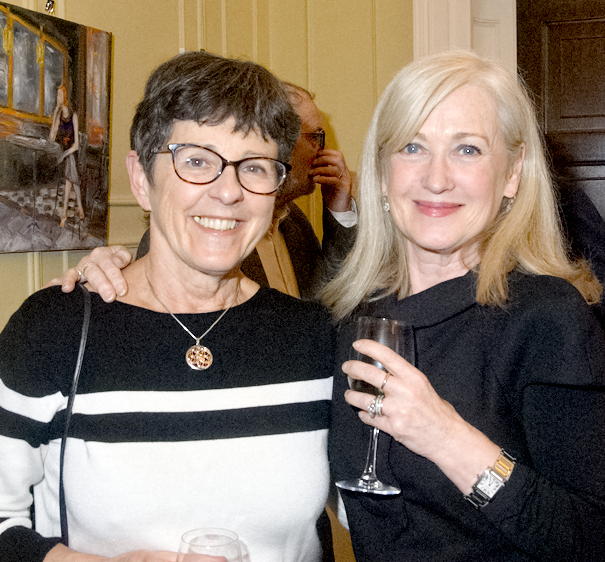


Doireann Ní Bhriain and Esther McCarthy

She hadn't known it until I told her. Doireann is my sometime therapist.

Every time I travel on the LUAS and hear her announcing the stops and where to shop, my blood pressure eases, as does my pulse, and I luxuriate in the glorious intonation of Gaeilge Chorca Dhuibhne transported a million miles from the dystopian land of Myles's Corca Dorcha.

And it's not just me. Doireann told me how an autistic child became entranced with her voice which always calmed him down when he heard it. She ended up recording his favourite story for him.

As for Esther, I have almost fond memories of her chasing me round the block over some overdue Freedom of Information reply, or am I just imagining it? Sounds good at this remove and she takes a compliment well.


As mentioned above, Andy was chosen to help Seamus with the book. He was eminently qualified to do so, with a strong journalistic background and involvement in Northern and cross-border affairs.

He is married to Doireann and both their children were at the launch: Sorcha who is a journalist and author herself, and Grainne, who is an executive and production assistant at the Gate. I will include a picture in response to overwhelming demand if it materialises.

Rory was a border TD which meant he had a good appreciation of what went on in the North. He has been Minister for Health, and for Environment, and Ceann Comhairle (Speaker) in the Dáil. Ardal O'Hanlon is a son.


Wally Kirwan

Wally was one of my earliest bosses in the Department of Finance. He was a marathon worker. At the time we were an AP/AO unit sitting across the table from each other.

I remember one occasion when Wally wrote a medium term economic model for the economy, virtually non-stop off the top of his head. I was almost afraid to take a break to the loo, such was Wally's dynamic pace.

His output was prodigious and the rise of Maurice Doyle to Secretary of the Department was not unrelated to Wally's supporting work, particularly in relation to Maurice's participation in the OECD's Working Party Two. This Working Party was the principal focus for economic work in the Organisation and performance there could make or break reputations.

Wally was seen by some as being prolix. This was a Civil Service curse word at the time and one of the criteria it was fatal to score highly on in your evaluation form. It means going on at length but it also suggests low grade content.

Now this never applied to Wally. His briefs were thick, but if you took the trouble to read them you would then know what you were talking about. Needless to say this didn't suit everyone at the time. At a later stage in my career we were down to one page briefing notes for the Minister.

Wally went from the Department of Finance to Taoiseach's where he worked on Northern Ireland matters. His nationalist sentiments, though they never interfered with the professionalism of his work, were sometimes not appreciated particularly in periods of Blueshirt government. The paranoia of some of the politicos at the time is well illustrated by my run in with John Kelly.


Robert Schmuhl & Felix Larkin


Felix is a former colleague, friend, and mentor. He turns up at a lot of the things I do and many more that I don't. Felix sees himself primarily as a historian, I think, and his output is top class. His particular interest includes the Freeman's Journal and everywhere that leads him.

Bob is Retired Professor of American Studies and Head of the School of Journalism at Notre Dame University in Indiana. He is a regular contributor to “Morning Ireland” on RTÉ1.


The Offaly Camp

The father in law of the man in the pink shirt next to Brian Cowen is a cousin of Seamus's and the man himself is from Offaly. So he has two separate feet firmly in tonight's event.

We had a very productive discussion on how to crash events. In fact, I was going to crash this one but lost my nerve and wangled an invite earlier in the day
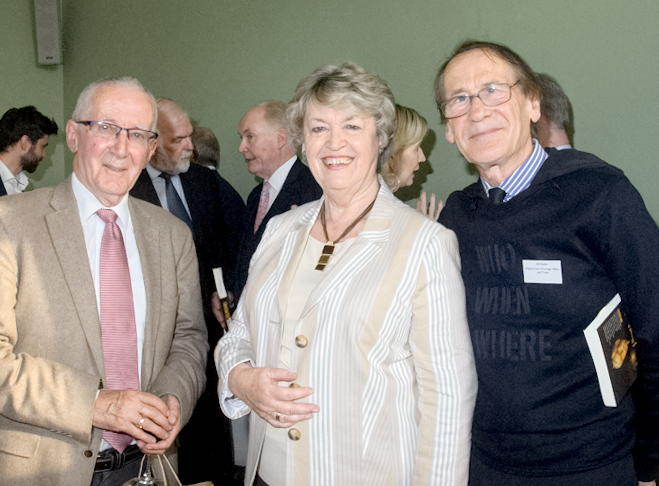


XX, Nora Owen & Bill Nolan

One of the problems at these functions is that you think you recognise faces but you haven't the faintest idea who they are. That applies to the man on the left. Answers welcome on the back of a postcard or in the comments below. I didn't know the man on the right but he's wearing a badge that tells me he's Bill from Foreign Affairs.

And all this is irrelevant as I took the photo of Nora Owen who was Minister for Justice in the critical period 1994 to 1997. One minute we have a Cease Fire (1994) and the next we don't (1996) and then, just after you go, we have the Good Friday Agreement (1998).

I remember vividly the night the Cease Fire broke down at Canary Wharf. But that's another story.

Nora is a grandniece of Michael Collins.


Tom Arnold & Tim

This is what Professor Jim Phelan said about Tom on Bloomsday 2010:
Praesento vobis hunc meum filium, quem scio tam moribus quam doctrina habilem et idoneum esse qui admittatur, honoris causa, ad gradum Doctoratus in Scientiae; idque tibi fide mea testor ac spondeo, totique Academiae.

And that was only one of the honours Tom picked up in a long career as economist and leader of projects, both national and international.

Tom was chair of the Constitutional Convention in 2012. The Convention membership included four members of the Northern Ireland Assembly of which Martin McGuinness was one.

Tom had a plan to smuggle me in to the launch, but, as I said above, I lost my nerve and sought an invite.


Austin was one of the people who sparked off the civil rights movement in the North when he squatted in a house in Dungannon which had been allocated by the local council to a Protestant unmarried mother, daughter of a local politician, over the heads of what he considered more deserving cases.

Housing discrimination was endemic in Northern Ireland and it was a similar incident which catapulted Seamus himself into politics.

Austin spent many years as a member of the Stormont paliament and subsequently moved south serving as a TD for many further years. Fine Gael put him up as a presidential candidate in 1990 but he did not succeed in stopping Mary Robinson's gallop.


I also met Colm Larkin for the first time though I felt I sort of knew him through my friend Cathal Cavanagh with whom he is friendly.


Conor has strong Northern connections having been born in Belfast and graduating from Queen's. He may be more recognised by the general public for his reporting from New York during and after 9/11 and also from Moscow.

Everytime I see the title of his latest book The Shoemaker and his Daughter I jump. I have a talk on one side of my family which I had called The Shoemaker's Daughters. And there the similarity ends.

I wasn't talking to Conor but I did meet him once about twenty years ago when he was advising my Minister that China was the coming thing and Ireland should be pulling out all the stops to develop markets there.


I gathered there were also people there who I would have captured on film except I didn't even see them. I had placed myself up front to take photos and wasn't always conscious of who was behind me.

One of these was David Andrews. David had been Minister for Foreign Affairs at the time of the Good Friday Agreement.

He had been my local TD in the 1960s and was instrumental in getting me a certificate to import four banned books on the eve of the reformation of the State's book censorship regime in 1967. You can read the correspondence here.

I saw Noel Dorr in the distance but didn't catch him.

I gathered Seán Donlon was there too but I didn't even catch sight of him. Seán spent some time on the board of the EBRD where I had been many years earlier, but that too is another story.

I also missed seeing Daithí Ó Ceallaigh and I don't know was Michael Lillis there at all.


Before I leave Seamus, I think it is important to say that, at the outset, he said he regretted that John Hume could not be there. John, as the world knows, is not well.

The two men have had their differences and strikingly so. Seamus said that John was a loner and it is clear that Seamus felt that Sinn Féin/IRA had too many concessions embedded in the Good Friday Agreement.

But he acknowledged John's place in the Nationalist Pantheon and made a point of doing so.


So, to sum up, I enjoyed the night immensely. Seamus was full of sensible passion and it was great to meet him after my being involved on and off in Northern affairs down through the years. I also enjoyed meeting old friends and maybe making one or two new ones.

I bought Seamus's book and look forward to reading it. I've only got as far as reading the introduction by Andy Pollak and this promises a lot.

Finally, thanks to Lilliput Press for inviting me after I had the cheek to ask.

Sunday, December 31, 2017

EU/NI PEACE PROGRAMME 1995-99


As the Irish border is back in the news, thanks to the folly that is Brexit, I thought it an opportune moment to share some reflections on the first EU Peace Programme which covered the full area of Northern Ireland and the border counties of Ireland (South!).

The programme was sort of up and running when it hit my desk in early 1996. It had been approved by the EU on 28 July 1995 following years of work and the proximate catalyst of the 1994 ceasefires.

The basic rationale of the programme was to encourage the economic and social development of Northern Ireland as a means of cementing peace in the longer term. The emphasis in the programme was on cross-community and cross-border activities, the latter attempting both to compensate border areas for their artificially enforced peripherality and to improve north/south relationships.

I should nail my colours to the mast at this point and say that, despite many, and some justified, criticisms of the programme, my view is that it was a spectacular success.

It is important to distinguish this first Peace Programme from its successors. This one was pathbreaking in many respects while its successors both had something already in place to build on and in the normal course of such matters became more structured and bureaucratised. PEACE I (and II) were funded from across the EU structural funds, each of which also had its own protocols and regulations.

The Name


I don't know just how the Peace Programme got its name but there is a rumour that the initial working title was Special Northern Ireland Programme for Economic Recovery.

If that was the case, it clearly got nipped in the bud as soon as it was reduced to an acronym.

Canary Wharf


I was just in the process of taking over the southern end of the programme when the IRA ceasefire blew up in Canary Wharf in London's docklands. This was a huge shock to the system and it looked like curtains for the programme.

But I remember Inez McCormack from ICTU reporting to a subsequent Monitoring Committee meeting that, while new cross-community contacts were out of the question for the moment, those that had been established before the breakdown were holding. This was very encouraging.

North vs South


The northern and southern sides had significantly divergent views in how they approached implementing the Peace Programme, and this most particularly regarding EU oversight and control.

As far as the northern side was concerned, they viewed funding essentially coming from London rather than Brussels and they resented the EU Commission telling them how to spend it and holding them to account after the event. The UK was a net contributor to the EU budget, so it was their money that was involved.


In contrast, the southern side was a net beneficiary from the EU budget and we more readily accepted the Commission's right to "interfere" in the programme's implementation. We didn't always go the whole hog with them but we put up with a lot to get our hands on the dosh.

You can see echoes of the northern attitude in the current goings-on over Brexit if you look hard enough.

I should mention another difference between north and south which impinged to some extent on the operation of the programme. The locus of responsibility for the programme in the civil service was in the Department of Finance and Personnel in the north and in the Department of Finance in the south.

That may seem on the surface like a perfect match but the northerners were always conscious of an additional layer lurking in the background. Ireland is a sovereign state and deals directly with EU Councils. Northern Ireland is a regional administration and responsibility for EU affairs ultimately lies with the UK, which is the EU Member State. Responsibility at the UK end ultimately rested with the Department of Trade and Industry.

This was less of a problem in the actual implementation of the programme as opposed to its negotiation but it was often lurking in the background.

Spend, Spend, Spend


Another tension arose from within the EU structures themselves. Once a budget and a multi-annual spending profile had been agreed, the relevant section in the EU Commission saw itself on the line to deliver, so they were constantly putting pressure on the Irish, north and south, to spend up to the "targets".

In some ways this was understandable as funding for the programme had been hard fought for at EU level and leaving part of it unspent would not reflect well on the Commission.

However, in the prevailing environment in the north and the border counties it was not always easy to identify projects on which spending could be subsequently justified.

And there's the rub. However much the relevant Commission section was happy to see money spent, and however much they leaned on the authorities to spend it, their say-so was a poor defence when the financial control side of the Commission subsequently arrived to inspect and audit the books. Their judgement was completely independent of all that went before and the national authorities were on their own here.

And even if that hurdle was overcome you then had the EU Court of Auditors arriving on the warpath to flush out every hint of possibly "unjustified" expenditure to feed their bureaucratic empire-building campaign. You really couldn't win.

Product versus Process


To add to all of this, there were strong views on product versus process. There was a bit of a bricks and mortar mentality in the Commission, particularly at the financial control end. By this I mean they liked to see physically measurable results - in other words, a product.

The northern authorities also shared this attitude to some extent.

But this exercise was as much about process as product and this was much less measurable in any truly relevant sense. You could count up the numbers of cross-community projects, or even meetings, but eliciting their true meaning and potential sustainability boiled down to subjective, albeit informed, judgement.

Administrative Peace and Reconciliation


As far as process goes, I didn't myself have direct experience of it on the ground at the level of individual projects, but I did experience it at the level of those running the programme.

For example, I had no real experience of dealing with northerners at official level. My experience of the north consisted of (i) spending a holiday in Bangor when I was small, when post-war rationing was still in force and when the comic strip of Mandrake the Magician in the local paper was some six months ahead of the Dublin Evening Mail, (ii) passing through the north going to and coming from Donegal, and (iii) making an LP with Tŷ Bach in Billy McBurney's studio in the centre of Belfast.

Now I was dealing not only with my counterpart in the northern Department of Finance and Personnel but with officials from other northern departments and with implementing organisations and NGOs from both sides of the border.

There was some perceptible rapprochement there over the period when I was involved in the programme. I even got to a stage of informality which allowed me, at a conference we were organising in Ballybofey in Donegal, to welcome the northern participants to Ulster. I must say, it took most of them a few moments for that one to sink in.

As far as the central authorities and the NGOs were concerned, I think a mutual understanding slowly developed of where the other side were coming from and that it was possible for both sides to be operating in good faith.

A Lesson in Geography


A significant feature of the programme, at least for those administering it, was the Monitoring Committee meetings being held in different locations, alternating between both sides of the border.

The Monitoring Committee was not just an academic exercise after the event. It was a quasi-cross-border implementing authority where the major players were held to account in real time. It was co-chaired by the north and/or south depending on which side of the border the meeting was taking place.

I was the southern chair and Jack Layberry from NI DFP was the northern chair. We held our first Monitoring Committee meeting in the Folk Park in Omagh. I'm sure there is some symbolism lurking there but I haven't yet fully figured it out.

The full significance of holding meetings on alternate sides of the border may be lost on the current generation of young people. I know that one member of my staff became quite nervous as we crossed the border heading north and didn't relax until we crossed it again on the way back.

Some people saw our chairing of the Monitoring Committee as involving a conflict of interest as the Department of Finance in the south and the Department of Finance and Personnel in the north were the locus of funding and control within our respective administrations. I can understand such a view and might have sympathy with it in other circumstances. In this case I think the Committee was chaired in a reasonably objective manner and a similar situation still pertains with the Special EU Programmes Body (SEUPB) alternatively known as Boord O Owre Ocht UE Projecks.

A Roman Conspiracy


At one stage I got very alarmed when I heard that Ian Paisley claimed that the programme was a sham and the Catholics were getting all the money.

I wasn't the only one worried by this claim and a study was quickly commissioned to find out if it was true.

Our alarm escalated to defcon panic status when the study reported that it was indeed true. The Catholics were not getting all the money but they were getting a hell of a lot more than the Protestants.

Was this another potential death blow for a programme that was supposed to be promoting cross-community cooperation and inclusiveness?

Well, further research turned up some very interesting results.

It appeared that both Catholic and Protestant applications had the same rate of success (phew!) but that there were far more applications from the Catholic than from the Protestant side. So the programme itself was not biased. There was no papal conspiracy. The programme simply reflected one of the underlying features of the society of the day.

The reason for the disparity in applications seems to have arisen because Catholic communities were more organised on the ground, having been in a minority and having had to fight all the way for anything they ever got, while the Protestant communities were under the illusion that their own were looking after them anyway and so didn't need to be pressured to do so.

These results, in my book, certainly validated the politico/class analysis advanced over earlier decades by the likes of Michael Farrell.

Good Friday


Former US Senator George Mitchell, who chaired the talks leading to the Belfast Agreement in 1998 has said that "the European Union played a part in thawing relations between the Republic and Britain, which enabled the peace process and was central to the Good Friday Agreement".

The Peace Programme was clearly a significant element in this process.

Consider Michel Barnier who is currently the European Commission’s chief Brexit negotiator. He has a long history in both French national and European politics. He was EU Commissioner for Regional policy from 1999 to 2004 and as such gained good insight into the legacy of PEACE I and the Belfast Agreement of 1998.

He has said that the programme “is one of the very important instruments that has contributed towards the Good Friday agreement”.

Sadly, continued funding of the programme is in jeopardy if the UK sticks to its Brexit red lines.

Here We Go Again?


Sunday, March 19, 2017

GORDON BREWSTER & NORN IRON


Link
Click on any image for a larger version

The above was the classic Catholic view, both north and south, of the Northern Ireland régime when I was growing up. Community relations up there broke out in sporadic violence from time to time, customs posts were regularly blown up and there was an overwhelming sense of grievance, particularly on the part of the Catholic population.

This was also the case in the first ten years of the Free State, 1922-32, the period covered by the wonderful collection of cartoons by Gordon Brewster hosted by the National Library of Ireland. Although the cartoons are specific to that period many of them have uncanny resonances right up to this day.

I am taking a brief romp below through most of his Northern Ireland cartoons as part of a series of thematic reviews of the overall collection. In each case I give a link to the original online version in the National Library. Some of those are accompanied by notes which further elaborate the circumstances surrounding the originals.

The cartoon above is pretty savage, showing Northern Prime Minister Craig holding a girl, representing the Catholic community, in bondgage. Bad enough you might think, but it gets worse. Brewster's signature acknowledges this as a homage cartoon which he has modeled on one by the Dutch cartoonist Raemaekers. The latter was famous for his savage cartoons of German atrocities in Belgium during WWI.


Raemaeker's own cartoon shows that Brewster has made very little change to the original. The poses are exactly the same, with the vicious looking leering German soldier replaced by Craig. The only other change is an acknowledgement by Brewster of the sensitivities of his own readers by covering up the original girl's naked breast.


You can see all this more clearly with the two cartoons side by side. Clicking on the image will give you a larger version.


There is no doubt that the Northern régime were running a police state. While they were subject overall to Westminister and the Monarch, security and policing was a devolved function and they made full use of their powers in this area. The odious Special Powers Act was well known throughout the island.


There was a devolved parliament, which was supposed to govern in the interest of the whole community. However, Craig's view of it as a "Protestant Parliament for a Protestant People" made it quite clear that Catholics/Nationalists were not going to have any say. The mountain might roar but all the Catholics got out of it was a ridiculous wee mouse.


Any gestures towards them were only empty gestures for consumption by a wider public.


While Brewster here seems to be implying a shaky passage through the icebergs for the Northern Government, there was no effective opposition and this was particularly true any time the "constitutional question" (ie the status of Northern Ireland) came to the fore. There was, admittedly some doubt about the precise geographical extent of a permanent Northern Ireland up to 1925 when the Boundary Commission was wound up.


There was a brief moment of anxiety for the régime when the Liberal party issued its manifesto, depicted here as a brick punching a hole in the orange drum.


But the drum was soon mended and things carried on as before.


This one is titled "A dustman's surprise" and I'm not sure whether the drum has been beaten to death and a new one purchased or whether the orangemen might have been thought to be giving up their oul sins. In any event, and despite the dustman's surprise, matters continued as before.


While Belfast had been a booming industrial city in the past, there was always a question hanging over the economic viability of Northern Ireland as then constituted. Even into my own time Charlie Haughey used to relish referring to it as a "failed entity".

But virtually throughout its whole existence public income was never sufficient to finance the required (or entitled) level of public expenditure.


This expenditure was, in any event, skewed towards maintaining the régime itself.


The resultant pressure showed up in high rates of unemployment mainly among Catholics.


This in turn put enormous pressure on the Northern Ireland Unemployment Insurance Fund.


The régime eventually had to turn to Westminster for help in shoring up the fund. Over the years this fund was then used to channel the bulk of what became known as the "British Subsidy" into Northern Ireland.


But apart from supporting them financially, the UK administration effectively ignored Northern Ireland. There was a rule in the UK parliament that Northern Ireland matters could not be raised as the area had a devolved administration and they should be left to get on with it (whatever it turned out to be).

But as they were effectively completely dependent on Westminster's for funding, the UK government did feel entitled to interfere in any matter which might have a bearing on the UK exchequer. And to add insult to injury, during the period to which this cartoon applies, this was a UK Labour government.


In 1931 the Northern régime did not take too kindly to being more or less ordered by the UK treasury to undertake a complete revaluation of the Province. This was done every five years in Britain but Northern Ireland was still operating on the basis of a valuation carried out for Belfast in 1900-1906 and for the rest of the province in 1852.

The UK Treasury had in fact been trying to get them to do this since 1923 but finally lost patience in 1931. It appears that the business community, in particular, were most unhappy with the Northern Ireland Valuation Bill of 1931 but they were not calling the shots.


They had to swallow a bit more than their pride at this stage.


Gordon was continually taking pots at local authority jobbery and wasteful spending north and south, but it probably irked the Northerners particularly when criticism of their side was coming from down south.


It is no exaggeration to say that Gordon abhorred the Northern régime. That much is sort of obvious from his cartoons. But what may not be so well known is that he was absolutely persona non grata north of the border and was, on one occasion, escorted by the RUC from Belfast back to the border and thrown out of Northern Ireland.


There were occasions when the government needed to project an image of everything being rosy in the garden and I am always tickled by this image of an angelic Craig gamboling with the lamb. Your image wouldn't long survive a cartoon like that.


This image of all-island peace and harmony also tickles my fancy. Note that the two heads of government are wearing masks, and do the shadows remind you of anything?


I'm sure this one drove Craig apoplectic as it was no doubt designed to do. Brewster is comparing the North to communist Russia on the basis that these were the only two administrations in the world which discriminated against their own citizens on the basis of religion. An exaggeration perhaps, but there's no mitigating the sting.


Finally, with a hard Brexit on the horizon, I leave the final thought with Gordon.