Showing posts with label Cork University Press. Show all posts

Saturday, April 07, 2018

GEORGIAN DUBLIN'S UNDERBELLY


Click on any image for a larger version

The occasion was a talk by Diarmuid Ó Gráda on Georgian Dublin - The Forces that shaped the City and it took place in the Royal Dublin Society (RDS) library on 4 April 2018.

The illustration above is of the cover of Diarmuid's book which was published by Cork University Press and launched in the Royal Irish Academy by then Lord Mayor, Críona Ní Dhálaigh, in 2015. I mention this because Diarmuid's talk proved to be a wonderful skim through his book, all 390 pages of it.


Lord Chesterfield

I had not attended a function in these premises before and if I had let myself I could have found my surroundings quite intimidating. There is that hush of entitlement where members silently glide about the place while visitors are afraid to audibly clear their throats lest they draw attention to themselves.

I could have been put off when I encountered Lord Chesterfield, former Lord Lieutenant of Ireland and President of the RDS, on my way to the loo (Gentlemen's Cloakroom to you).


However, as guests began to arrive, I was reassured to see the good lord bend his dignity to take on cloakroom duties and serve as a hatstand for the duration. A sign, no doubt, if one was needed, of the ongoing democratisation of this venerable royal institution.

So I felt quite at home and relaxed when I entered the magnificent spacious library where the talk was to take place. In any event, hadn't I been to school all those years ago with the speaker's older brother.


David Dickson

The talk was introduced by David Dickson, whose own magnificent magnum opus Dublin - The Making of a Capital City had been launched in the Dublin City Library and Archive in 2014.

David was lavish in his praise of Diarrmuid's work and in passing drew attention to copies on sale at the back of the hall. Diarmuid, in the course of his talk, reciprocated, praising David's book and acknowledging his debt to David's work.

If you were brought up like me where history is definitive and you just have to learn it off and regurgitate it as appropriate, you could be forgiven for your amazement at how much new work is being undertaken and published on this hitherto "settled" subject.

In the political sphere much of it is unfairly disparaged as revisionism whereas in the archeological and social sphere it is classed as enrichment. In any event, much modern historical research is leading us to question who we are and this, while sometimes quite disturbing, is also very exciting.

David specifically mentioned a collection of drawings of Dublin street scenes from 1760 entitled The Cries of Dublin by Irish painter Hugh Douglas Hamilton which were only discovered in 2002 and were published a year later.


Diarmuid soon got into his stride and took off on a whistlestop tour of Georgian Dublin. He must have been very happy to have had his book published by Cork University Press and launched in the RIA, and now this talk in the RDS.

Before I forget I should say that the place was packed. And I should take the opportunity to compliment the RDS on the wonderful venue and on the high quality sound, including Diarmuid's head-mic which allowed him move about and physically point out things on the big screen.


Diarmuid Ó Gráda

I have referred above to Georgian Dublin's underbelly and that may be a bit contentious as Diarmuid deals with a wide range of aspects of Georgian Dublin. But what his book, and the talk, bring to the table is the result of a career of research on how the man in the street fared in this city, the second in the Empire.

Much has been written on the architecture of the period, on the doings of important people, and on the very dramatic politics of the period. But what was it like for the ordinary citizen, for the artisans or casual traders, for women and for blaggards?

This is all explored in great detail and with great accompanying illustrations.


A Crippled Beggar
from Hugh Douglas Hamilton 1760 (private collection)

Looking at the beggar, you wonder how he got to his present state. Perhaps he lost his legs in a war? Diarmuid then draws our attention to his two hand grips. These allow him to move along without his flesh coming into contact with the dirty, and perhaps diseased, street.


A Parish Watchman
from The Cries of Dublin

There wasn't much of a police force in those days. Each parish had to organise its own watchmen and the smaller and poorer parishes could not afford much on this front. The job could also prove quite dangerous for the watchman.


Drunken grandees attacking the parish watch in Dame St.
from A Real Paddy [Pierce Egan] Real Life in Ireland 1821

It appears that a regular sport among the grandees was beating up the parish watch. Clearly a policeman's lot was not a happy one.


Three Papist Criminals going to Execution
from Hugh Douglas Hamilton 1760 (private collection)

Nevertheless, "justice" was done after a fashion. These three ladies are handcuffed and praying to the Lord on their way to their deaths.


Robert Emmet's Execution
by F W Byrne 1877 (private collection)

And, speaking of execution, here is the Bould Robert Emmet.

If this is the same famous painting I have seen many times before, then I'm staggered. I have only been familiar with it in black and white and this coloured original is amazing. There are all sorts of details standing out, including the huge military presence and the way they are keeping the crowd at bay, mounted horsemen with drawn swords.

Diarmuid made an interesting point in relation to the choice of location for the execution. Apparently criminals were often executed at the scene of their crime.


Although Diarmuid didn't, I couldn't resist showing this detail from the painting. Emmet has clearly been hanged and cut down, decapitated on the block and awaiting his quartering, after which his quarters would be dispatched to the four quarters of the Empire.

If you get a chance do examine this painting in detail.

This is probably the place to mention the excellent quality of the illustrations. It is one thing to have quality digital illustrations on a screen, as we had, but a significant feature of the book is the quality of the illustrations, as you can probably gather from those I have reproduced here. I have taken them directly from the book but only used those which Diarmuid used in his talk.


Displaying the Hat
from James Malton,
A Picturesque and Descriptive View of the City of Dublin 1799

A shopkeeper brings out a hat to show to the lady in her carriage. Quite apart from any class angles involved, the lady will not leave the carriage for fear of soiling her clothes on the dirty street.


A Chimney Sweep
from Hugh Douglas Hamilton (private collection)

This wee boy, unlike his master, does not look in great shape. These children were actually sent up chimneys, often while there were still embers in the fire below. Many of them eventually died of diseases, including cancer, from inhaling the fumes.


Looking South from O'Connell St.
by Henry Brocas

Always the town planner, Diarmuid included this view of the work of the Wide Streets Commissionners. Of course the balance they achieved has since been broken by the construction of O'Connell Bridge House on the corner of Burgh Quay and Dolier Street.


Dublin Brothels 1747 - 1800

Diarmuid has listed all the brothels between 1747 and 1800, giving us the name of the madame, the year(s) of operation, the location, and notes on happenings. The map above gives a graphic representation of locations.

Diarmuid's only comment on this was to mention Temple Bar. I could think of a few more.


This model illustrates the forces influencing urban expansion.


So, if you were offered a choice, would you really like to go back and live in Georgian Dublin?

Not me, certainly not after Diarmuid's talk, and, of course, having read the book.


It is a tribute to Diarmuid's holding power that he did not lose the attention of a single member of his audience despite the hanky panky going on in the aisle thoughout his talk.

Wednesday, December 23, 2015

The Irish Dancing


I've just started into this book, and it's a great read. Seriously thought provoking and a wonderful idea. Barbara O'Connor is using dancing as a prism to analyse the evolution of certain attitudes and values in Irish society.

I knew about Irish dancing. I grew up with it. But it never struck me to think about it or to wonder how it got to be what it is. In latter days I have an interest in it from a family history point of view as a relation (first cousin of the husband of a grandaunt, if you must know) was an innovative teacher of Irish dancing in the first half of the twentieth century.

The bits I've read so far include the gradually evolving role of dance in the underpinnings of the Irish struggle for independence. There is also the role of dance in gender stereotyping. And I'm now getting to the bit where the wrong type of dancing is seen as challenging the hegemony of the Irish Catholic Church's vice-like grip over Irish society.

Can't wait to get stuck further into this book over the Christmas.

Meanwhile a few wee observations.

One of the preoccupations of the clergy was with the purity of the swing in Irish dance. Two are mentioned in the book, one of which I'm familiar with but but then there's one on the cover of the book that I was not familiar with. The full picture is (i) the gentle swing on the cover where only the hands touch, (ii) the somewhat more violent swing which is stabilised by hand and elbow gripping, and (iii) the one the clergy forbade, hand to hand and hand to waist. The last two could achieve supersonic speeds and lead to serious dizzy spells if you were not used to them. And there was a certain advance in intimacy between (ii) and (iii) which the clergy viewed with abhorrence but which was a consummation devoutly to be wished on the part of the (male?) dancers.

I was very taken with a quote in the book which I came across just earlier today. It is from a guy called John Northbrook and dates from 1577. He felt that "through this dauncing many meydens have been unmeydened, whereby, I may say, it is the storehouse and nurserie of bastardie". Unfortunately I never had any luck in that department in my Irish dancing days.

I learned that " 'Foreign' dance came to be seen as a contamination to the purity of Irish culture and, as such, was a source of concern to the cultural and moral arbiters of appropriate movement". Now that did ring a loud bell. In my innocent youth I ran a series of céilís in a Dublin suburb. But being young and in the age of rock I alternated the dances between pure Irish and jive. One father forbade his daughter to attend on precisely the grounds set out above.

And, finally for now, I wonder what the author would have made of the all male céilís in the Gaeltacht summer schools run by Ógra Éireann. Maybe Barbara will get to it later in the book. If not I'll have to write and tell her all about it.

The book is published by Cork University Press

Thursday, October 22, 2015

Georgian Dublin


The Ma always said we were Dublin from way back, and on the face of it that seemed reasonable. Her Ma was born in James's St. and her Da in Glasnevin. That covered the Liberties (more or less) and one of the then outer suburbs. However when I started poking around in the family history I found that none of my four maternal great-grandparents were from Dublin. My origins on that side of the family were in Wicklow, Meath, King's County and Galway, this last being just round the corner from Rosmuc and in the heart of the Connemara Gaeltacht.

So my past reflected the nineteenth century migration into the capital from the countryside, but the roots of the general migration into the capital went even further back, into the eighteenth century. And that is one of the key factors in the story told in this book. Georgian for us has all the connotations of the elite and their lifestyle, but the city had a more chaotic underbelly as it tried to cope with the vast influx of people from the countryside. The extent of law and order, for example, fluctuated as the civic institutions came under extreme strain. And it is this side of the picture that forms a major part of the net contribution of this book to the currently available literature.


It was fitting, nevertheless, that we kicked off with a bit of civilisation courtesy of Bach, Handel and others and classily rendered by the lady in the picture.


As first citizen, the Lord Mayor got a preview of the book and I'd swear he's showing her the Martello Tower on page 106.


Frank McDonald was MC for the launch and no better man. He has been writing about Dublin in many of its aspects for a good few years both in the Irish Times and in books, so his compliments for the book, in its depth of research, introduction of hitherto largely unseen illustrations and its fine presentation, were all well taken. For some reason he got a lot of mileage from the fact that there is a whole chapter on prostitution, though he didn't mention the handy guide to the location of all the brothels in the city in one of the annexes.


Next up was the Lord Mayor, Críona Ní Dhálaigh. I'd say it was a great occasion for her to be involved in the launch of a fine book on the city over which she is presiding. But there were deeper connections. Both her father, Seán Ó Dálaigh and Diarmuid's father, Mathúin Ó Gráda, where highly involved in the Irish language movement and were among the founders of Club an Chonartha, in Uimhir a Sé, Sráid Fhearchair, a building with a long and honourable republican history.

I'm not sure if her references to Georginian Dublin were part of a gender agenda or, like my Sussex (Sioux) Indians, a carry over from a mispronounced youth. In either case, I'm with her all the way.

Needless to say, given her family background, she made some of her contribution in Irish.


The formal task of launching the book fell to James Reilly, current Minister for Children, former Minister for Health and, most importantly, Diarmuid's brother in law. As he mentioned the words "cúpla focal" while extracting a piece of paper from his pocket, I thought we were in for another burst of the first national language.

But it was not to be. He stuck to the second national language and was lavish in his praise of the book, and justifiably so. He was particularly interested in the chapter on public health, from his profession and earlier ministerial responsibilities, and in the Foundling Hospital which related to his current job.


In his response, Diarmuid thanked all those who made the book possible. Well, not all of them, for, as he said, it was a product of his whole career and that involved a whole lot of people. However, Cork University Press came in for a lot of praise for a beautiful production and he did mention a fair few names, some of which I recognised.

I noticed that there was no specific acknowledgements section in the book. Presumably it would have doubled the book's size and there are already 50 pages of bibliography and endnotes for the discerning reader.


Then there was the thankfully inevitable interview with the lady from the Irish Times, which produced a short piece for the moment. No doubt there will be a proper review later which I will link to when it appears.


There was a huge crowd packed into the room in the Royal Irish Academy, including family members and the man from Kiltimagh (above), and a sea of faces of which I recognised only a very few.


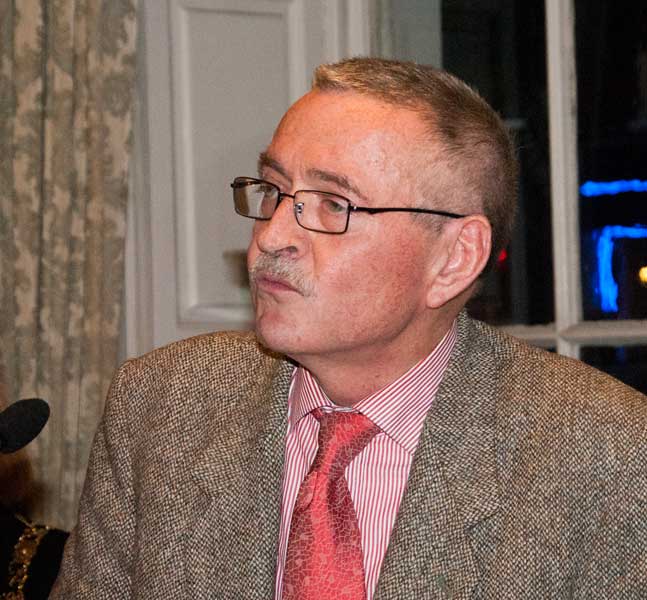
Above all else, Dublin is a small town. The man at the centre of the picture above was unknown to me. I just snapped him in passing.

The following day I was out at the Martello Tower in Killiney to meet Bill Hastings who, I was told, had some very interesting material on the early days of the railways there. When Bill, whom I had never met before, turned up, there was something uncannily familiar about him. It turned out to have been that his face was on my computer screen at home at 3am that morning as I processed photos from the book launch. Yes, the man in the photo turned out to be Bill Hastings, or vice versa if you prefer. And yes he did have some fascinating material on the beginnings of the railway in Killiney bay and on some other aspects of the history of the area and beyond.


Finally, Diarmuid was running a serious risk of RSI as he spent much of the rest of the evening signing copies of the book. Further information on the book can be found here.

Update 23/10/2015: Diarmuid had better get down to the gym fast and work out that RSI. More signings are in prospect as I gather the first print run of 1,000 copies has now sold out, within a week of launch, and a second print will be available next week. Well done.

Update 5/12/2015: You can now read Frank McDonald's very favourable review of the book in the Irish Times.