Wednesday, December 28, 2016
STONES OF DUBLIN
Why did I buy this book and me already with a pile of unread books stretching from floor to ceiling.
Well, I got a present of a substantial book token and I had read and enjoyed immensely Lisa's (and Ciarán Wallace's) book, Grave Matters. Not only was that one full of resonances for me but Lisa had included one of my photos in it. On top of which, she was on the team which hosted a contribution from me on that wonderful blog Pue's Occurrences (now sadly no longer active but still hosting a series of fabulous posts online).
I was also a bit intrigued as to what an introduction to Dublin through ten buildings would amount to. Would it be all architectural or a sort of dry partial history hitting the place in spots.
I need not have worried. This is a fabulous book about Dublin. The idea of using ten prominent sites as anchors for exploring the many dimensions of Dublin's history and present situation works like a dream. Not at all obvious at the outset until you see how skillfully the fabric is woven and how bright are the colours of the dyes.
The style of writing is easy and engaging and the production values are high, from the front to the back covers and in between. A quick look at the bibliography tells you how deep and wide the story goes and the copious footnotes are well laid out and include chapter headings which make them quickly findable.
It really is a page turner and you end up even more fond of Dublin than when you started.
I'm going to list the sites and I'll bet you'll wonder how you could make a comprehensive and balanced history out this lot:
1. Christ Church Cathedral
2. Dublin Castle
3. Trinity College Dublin
4. Parliament House (now Bank of Ireland)
5. Dublin City Hall
6. St. James's Gate Brewery
7. Kilmainham Gaol
8. General Post Office (GPO)
9. The Abbey Theatre
10. Croke Park
There, I told you. A patchy lot they look, don't they?
But the skill is not only in the choosing but in the telling. Each site, apart from its own intrinsic merit, is just a kicking off point for a ramble through a series of interconnected aspects of Dublin history. Not only will you be entertained and educated over this vast canvas but you will never pass any of these sites again without its history jumping out and grabbing you by the neck.
There is real pleasure in watching each of these sites develop against a wider historical backdrop and in realising how the actual outcomes were just one among many possible alternatives.
In other words the Stones of Dublin were not actually set in stone from the outset. Things could have been very different from what they are. And it is this tension that the book captures so well and holds your attention.
The type font is also very relaxing on the eye. I knew it wasn't Times Roman and found on the flyleaf, or whatever that page is called, that it is Berkeley. Lets have a bit more of it.
I won't spoil the book for you by going on any more about it. Get a copy and read it for yourself.
Monday, December 26, 2016
Jersey Abuse Inquiry
Now that we are in the run up to the appearance of the report of the "Independent Jersey Care Inquiry" into child abuse on the island, it might be an idea to review some aspects of the Inquiry itself to date in order to set a context for evaluating the report.
This inquiry was called for as far back as 2008 and it is only due to sustained pressure from a few States Deputies and bloggers that anything at all has happened. The jury is still out on whether the inquiry is actually independent of the authorities and others whom it is supposed to be investigating.
There have been a number of disquieting developments/events in the period since the Inquiry was set up which would lead to a negative opinion of its competence and good faith.
- under the legislation setting it up it was obliged to consult with the States (parliament) on the finalisation of its terms of reference. It failed to do so and just went on its merry (predetermined?) way with amazing impunity. If you really want to pursue this aspect in depth, check out this VFC post from 2014 as the public hearings were about to commence. I understand Daniel Wimberly never got a satisfactory response to his questions. The main question here was the Inquiry itself restricting its remit in defiance of the wishes of parliament
- it located itself in premises beside those occupied by a law firm which risked being called to account in the course of the inquiry. It used a similar law firm as its agent for the Inquiry itself
- it accepted the Government appointing people, to collate and forward required official documentation, who were themselves liable to investigation by the inquiry
- it facilitated the creation of false impressions from the evidence submitted by allowing alleged perpetrators to appear under multiple identities
- it denied a principal potential witness independent legal advice which led, at least in part, to his not appearing. It then refused to subpoena him. It also, not very subtly, attempted to hide its ruling in this matter on its website
- it refused to use its full powers to acquire official documentation in a timely manner. This resulted in some witnesses being quizzed on documents that they had barely seen, to the detriment of a probing of their more substantial contribution.
- it did not permit cross examination of witnesses, either by the Inquiry's lawyers or other parties. Questioning was limited to clarifying the content of witness statements.
- it apparently permitted a private meeting with a former bailiff/current foreign minister or his representative when the person in question was to appear as a witness.
- it limited press room access to "accredited media" ignoring the central role in this matter played by bloggers on the island. This simply underlined the Inquiry's complete (wilful?) ignorance of the situation on the island where the mainstream media have been complicit in the cover up of abuse.
- it sent highly explosive and confidential documentation in the ordinary post where it subsequently showed signs of having possibly been interfered with
- it refused absolutely to engage via social media when material failed to appear on its website, or appeared and then disappeared, only to subsequently reappear with slightly different meta-data. It never explained or apologised properly for downtime of its website. These may appear small things but they are vital in an environment where there is a lack of trust
- it has made no reference to the fact that in the oral session of Mr. K (an alleged abuser), reference is made to his written statement, but there is no sign of any such statement on the Inquiry's site. Mr. K, who is rumoured to be a friend of William Bailhache (currently Bailiff but then Attorney General), had a prosecution against him dropped by the Attorney General, on grounds that were subsequently shown to be false and so known by the Attorney General at that time. Surely in an atmosphere of lack of trust, precisely the wrong witness statement to be missing from the Inquiry's website?
- initially at least there was a lack of counselling backup for abuse survivors giving testimony. This surely is standard practice these days
- it redacted published evidence to protect the identities of both alleged abusers and abused alike. But it did so in a manner that shows it hasn't the faintest conception of the environment in which it is operating. I have given a blatant example of this in an earlier blog post
And it is even claimed that the Inquiry itself has no legal standing due to the way it was set up and its continuing misbehaviour - a non-vires extension of the Potemkin Village that is the Jersey justice system.
So what does that suggest we will get from the report of the Inquiry when it finally sees the light of day?
I suspect it will be very much a general critique of the appalling system that pertained in Jersey, with no one living individual held to account. This will likely be followed by an enumeration of lessons learned and some admission that there may be more to do to ensure the future safety of the island's children. There will be no condemnation of the illegal suspension of the police chief in 2008. No mention of the lack of separation of powers on the island which has facilitated the continuation of abuse and cover up. No mention of the vicious circle of Jersey "justice" where complaints to Her Majesty's Privy Council arising from the system are simply referred back to that same system to be dealt with. No reference to the fact that the ultimate aim of the Jersey "justice" system is the preservation of the island's financial sector from shafting by abused citizens.
Plus ça change ... ? On verra.
Friday, December 23, 2016
BADGED
I heard the clatter of the envelope in the porch. The postman. More Christmas cards to feed my guilt at not having sent any - hardcopy that is. Maybe a bill or two, just in time for Christmas.
There turned out to be just one envelope in the porch. The logo told me it was from UCD Alumni Relations. Oh dear, so they're still looking for money and hoping to catch me in the Christmas spirit. When they come on the phone they sound like they want to listen to your life story - make you feel important and wanted. Then the penny is gently dropped and it's just another appeal.
I eventually got round to opening the envelope and took out the letter, which looked remarkably short for an appeal.
Well, it wasn't an appeal.
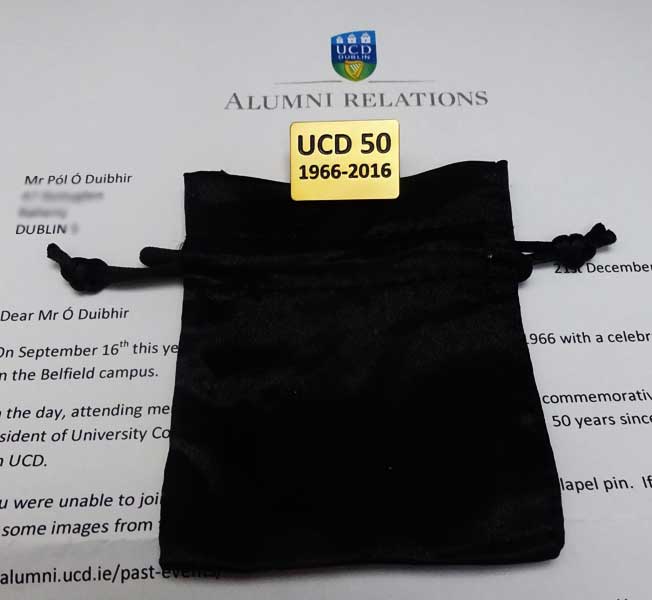
It opened by recalling that there had been a celebration of the Golden Jubilee of the class of 1966 last September at which the President of the College presented attendees with "a commemorative pin acknowledging 50 years since graduation". Whatever about the graduation itself, surviving it for 50 years must be being seen as some sort of achievement. Looking back on it I think I might see what they mean. We had some very odd lecturers in those days and surviving them for this long is probably an achievement of sorts.
Then I felt a roughness inside the envelope as I read that, as I was not present at said commemoration, my presidential award was enclosed. I could see photos of those who turned up for the event on the website (see below) and Alumni Relations hoped I had a very Happy Christmas.
The pin itself came in a little black bag and you can see the whole thing above.
Not exactly my long awaited Légion d'Honneur but some small consolation in the meantime.
Now, who can I impress by wearing this and where and when? Suggestions on a plain postcard please.
Monday, December 19, 2016
INVENTION OF JOURNALISM
Full marks to the Royal Irish Academy for hosting, and to Marsh's Library and UCD for sponsoring, Andrew Pettegree's talk on "The Invention of Journalism" (23/11/2016).
It was a fascinating insight into the evolution of modern media, through the golden age of the newspaper which in turn evolved from the hand copied manuscript news notes which mainly served to inform those involved in distant commerce.
I'm not going to go through the material as the full talk is now podcast here.
At the end of the fifteenth century we had commercialised news in the form of manuscript copied notes which gradually grew in size and eventually grew into the earlier form of newspapers. Whereas the notes were brief and factual, and their continued success relied on their reputation for accuracy, the newspapers introduced an editorial line.
This could be obvious in advocating a particular cause or political party, for instance, or it could be more subtle and implemented through the choice of what news to report and what to reject.
Andrew reminded us that, down the ages, it was the choice of what "news" to omit that constituted the real power of the papers. He recounted how some newspapers would investigate a scandal and then offer to suppress its publication for a fee.
The nineteenth century was the heyday in the development and expansion of the newspaper, but you had always to remember to ask yourself about the agenda behind any publication. Clearly that remains the case today.
Media proprietors, journalists and those involved in social & citizens' media would do well to listen to this relatively short(36 minute) podcast and check out where they are placed on this big historical canvas, particularly where ethics are concerned.
Friday, December 16, 2016
DRAWING FREELY
Philippe is the Director of the Alliance Française (until next August when his term ends). He is clearly very proud to host this exhibition in a particularly French setting. It had run previously in the EU Commission Office but has been extended to run at the Alliance until 18 January 2017.
The exhibition itself comprises 12 panels of cartoons by nearly 50 cartoonists from around the world. Each panel is devoted to a specific topic linked to freedom of expression: censorship, internet, corruption, women’s rights, rebellions, racism… All of the drawings were published in local papers.
One of the panels is devoted to reactions to the Charlie Hebdo murders. Charlie Hebdo may be at the outer margins of free speech and not everyone's cup of tea but it does provide a focus for the debate even if Charlie itself is the product of a particular French configuration.
The exhibition is presented by the Institut Français and the Courrier International. It comes under the framework of the Franco-German Cultural Fund 2016, with the support of the Embassy of France in Ireland, the Embassy of Germany in Ireland and the Goethe-Institut.
Of the 50 Cartoonists none is French or German.
The objective of the exhibition is to promote debate on free speech.
Séamus is the Secretary of the National Union of Journalists and it is therefore no surprise to find which side of the free speech argument he is on. He was the ideal person to launch the exhibition in the Alliance and he gave a rousing speech kicking a few butts along the way.
He had been in the #JeSuisCharlie march in Paris following the murders and it was good to hear someone who genuinely identified with the hashtag speak on the subject. That march badly needed redeeming, populated as it was with many Heads of State and Government who were busy locking up their political opponents at home while they barefacedly paraded the streets of Paris in solidarity with just about the most extreme form of free speech there is. Make your blood boil. So, good to listen to the genuine article.
Séamus mentioned the Dublin Opinion, and Felix Larkin's excellent study of this now almost forgotten satirical magazine. The Dublin Opinion got away with murder in its day. All the more surprising as it was produced by a senior civil servant. However, most politicians were probably happy to see themselves in it on the basis that some publicity is better than no publicity. Nevertheless, it was not a magazine that pulled its punches, it just delivered them in a deceptively mild manner. Seán T O'Kelly once praised it for “pouring, month after month, the balm of laughter on our wounds”, and Séamus actually used that quote in his speech.
He also found occasion to refer to Jim Larkin's paper The Irish Worker to which Ernest Kavanagh contributed some savage cartoons, not least of which was the depiction of William Martin Murphy as a bloodthirsty vulture preying on the workers (see cartoon below). William Martin Murphy was the proprietor of the Irish Independent during the 1913 lockout. Séamus referred to a big notice from that time in the Irish Worker advertising a production of Ali Baba and the Forty Thieves which depicted William Martin Murphy in the lead role.
Séamus, who is currently up to his neck in the war with Independent Newspapers over their raiding of the workers' pensions, remarked that however bad the Independent's role in the past they never touched the workers' pensions.
For the avoidance of doubt, and no doubt many other consequences, I have to report that Denis O'Brien's name was not mentioned.
Séamus had an interesting story about taking a taxi to the Charlie Hebdo office in Paris at the time of the march. Security was mad and they were stopped numerous times and had to take a circuitous route to get there, and the same on the way back. All the more frustrating when they found afterwards that they hadn't been all that far from the office in the first place. But during the trip they were watching the meter mount. When they had finished and were attempting to pay the Muslim taxi driver he would not hear of it. By then he knew why they were there. Some genuine solidarity for a change.
Séamus also took a pot at the current Irish blasphemy law which is effectively so extreme it is unlikely ever to be enforced. He did remark, however, that Charlie Hebdo, were it publishing in Ireland would run foul of the law.
John Horgan, a former journalist, senator and press ombudsman, reminded Séamus of some reported advice given to Minister Dermot Ahern in 2009 when he introduced a new drastic blasphemy law. This despite a recommendation by the Law Reform Commission which said in 1991 that there was no place for such an offence in a society which respects freedom of speech.
To give Ahern his due, I think there was a little Constitutional complication here and we are all aware of the dangers of any government putting itself on the hazard of a referendum, particularly when times are bad.
Another heavy hitter at the event was Joe Mulholland, a veteran of many roles within RTÉ, including Managing Director of RTÉ television. Joe is probably best know these days in his role as the Director of the prestigious McGill Summer School.
Séamus mentioned that there was no Irish cartoonist included in the exhibition. As he referred to William Martin Murphy, I thought I would perform the honours for Ernest Kavanagh, at least as far as this blog post is concerned.
You could not get a more vicious cartoon than this depiction by Ernest Kavanagh of William Martin Murphy during the 1913 lockout. He is depicted as a vulture on the pillar of the gate of his house, Dartry Hall, crowing over the bodies of those workers killed in baton charges during the Lockout.
Not surprising then that The Irish Worker was shut down many times by the authorities only to re-emerge under a slight variant of its original name.
As I mentioned, there is no French cartoonist included in the exhibition so I just thought to mention here my own favourite cartoon from Charlie Hebdo itself. This is the two Jihadists arriving in Paradise and looking for the promised virgins only to find the team from Charlie Hebdo, who they had sent ahead of them, had already collared the market in virgins.
Needless to say, Charlie, as well as having a go at the Muslims also directed its talents towards the Roman Catholic church. This extremely offensive cover is aimed at the Cardinal Bishop of Paris, André Vingt-Trois, who opposed same sex marriage, and should really have changed his name by deed poll at an earlier age. It's not exactly "soixante-neuf" but the phrase in Italian slang, "venti tre", denotes an arse. So it's all a matter of context.
Neither of the two cartoons above are included in the exhibition, which, while invoking Charlie Hebdo, makes no attempt to match it in sheer offensiveness.
So what have they got?
I'm including a few of my favourites below to give a flavour of the exhibition which is well worth a visit. I'm also saying why these particular ones appealed to me. None of this rules out the possibility of me having got the wrong end of the stick entirely.
Perhaps the message here is a simple one. People are engrossed in their own personal electronic worlds and are heedless of the suffering around them.
But when I see that little radio logo my head goes into a spin. Perhaps the beggar is to be commended for using the latest technology to assist people to donate with minimum effort. Perhaps he's raiding the bank accounts of every one who passes by. Perhaps one of them is stealing his day's takings while the other two are having electronic tantric sex.
Anyway I instinctively liked this one as soon as I saw it.
And the function of a free press? Shining the light of publicity on the abuse of power. But there is also a hidden layer here. You have to trust your medium and there are recent disturbing accusations of Facebook engaging in censorship. So even within the amorphous realm of the "free press" there is a constant need for self-critique and renewal.
So, is this an environmentalist figuring we are doing less damage to the planet than previously? Or is it someone who is in favour of more/higher growth and is at least consoled by the retention of the terminology?
This is a tricky one which raises the question of the limits of free speech. Facts may be facts but if the theatre is really on fire do we really want to add to the panic. Should we not keep our mouth shut until we are all safely evacuated.
And to what extent should we try to keep up with the PC bandwagon. I'm fed up hearing the tag "community" attached to every reference to an ethnic group. Where are the Jews, the Muslims, the Catholics etc.? All replaced by "communities", to soften the blow, or what?
I've seen a number of inventive uses of barcodes in art and in advertising, but what have we here? The commoditisation of women. A league table of legs? People-trafficking?
This one shows that you don't have to be able to draw to produce a good cartoon. It's the thought that counts. For someone who can't draw for nuts this is very reassuring.
But to return to the content, this is like a modern version of 1984 where you resist group-think and Newspeak at your peril.
Back to the unambiguous direct cartoon. No room for multiple interpretations here.
And, penultimately, you can't be much more direct than this one included in the Charlie Hebdo panel. Avatar material
Anyway, I hope that you have gathered the importance of context from all of the above and that you will drop into the exhibition and make up your own mind about the limits of free speech and how well or otherwise the full set of cartoons has tackled this.
This is one of two cartoon chosen for the promotional literature. It is self explanatory.
Wednesday, December 14, 2016
FRONGOCH: Y WEFAN
I have an interest in Frongoch about which I have already blogged. But that is the hardcopy, so to speak. The above invite is to the launching of Frongoch on the Digital Repository of Ireland's (DRI) website as part of their Inspiring Ireland project.
So I turned up early at Collins Barracks and on my way in briefly joined a group of Cork students in the yard. They were getting an introduction to the museum from one of their lecturers before going on in to see the 1916 exhibition.
He was not only giving a virtuoso performance in deconstructing Irish history but he was very strongly making the point that the students should not just take at face value the objects presented to them in the displays. They should interrogate them - asking themselves why particular objects had been chosen for display, who chose them and what was the agenda.
It was the first time I heard that approach applied to a general national museum. It reminded me of how the newpapers make the news: whatever they choose to cover is news, the rest just didn't happen. I must say, seeing the museum presented in this way to students gave me some hope for the future both of the students and of the museum itself.
Anyway, that's not what we're here for. The Museum's director, Raghnall Ó Floinn, kicked off the proceedings, welcoming all to this great location and outlining the main features of the launch and the role of the National Museum of Ireland. He was anxious, as usual, to stress that the museum was not just a collection of individual static objects. It was living history where the objects had a context. This context was a dynamic one influenced by research carried out by the museum itself, by the latest third party research in the area and not least by the reactions of the visiting public.
Natali Harrower, DRI's director, explained what The Digital Repository of Ireland is all about. It is a really massive collaborative effort and deserves every encouragement and support.
It is built by a consortium of research partners: RIA (lead institution), MU, TCD, DIT, NUIG and NCAD. DRI is also supported by a network of academic, cultural, social, and industry partners, including NLI, NAI and RTÉ.
The idea is to preserve in digital form the life and heritage of the nation. You can get the long version here.
I'm sure Caitríona Crowe won't mind me describing her as a veteran. She has been in the wars, fighting to preserve the country's heritage in the National Archives of Ireland and making sure the public have free access to it. It seems to me that she has won her wars and gloriously so.
The digitisation of the 1901 and 1911 Censuses of Ireland and their free availability was not only a major feat on her part but the product itself is a thing of beauty.
Caitríona has just retired from the National Archives but I trust she will continue to be as busy in retirement. Her country needs her.
Her main concern in her talk at the launch was the need to ensure that the more modern material is preserved for the future. Much, if not most, of this stuff is purely digital and could become inaccessible through the march of technology (help I can't read my floppy disc) and inadequate collection and storage. At least with the paper stuff someone has to actively shred or skip it. The digital stuff could just vanish without anyone noticing in the absence of adequate protocols for collection, preservation and access.
[Caitríona didn't say this, but if Trump pushes the button, the resultant EMP will solve all our digital problems permanently, not to mention that there will be few if any of us left to worry about it.]
Sandra Collins is the Director of the National Library of Ireland and she has a background in the digital world. Her concerns very much mirror those of Caitríona, and her institution, like the National Archives, and a number of other institutions I haven't mentioned, have been playing a blinder in digitising their existing hardcopy/physical material and making it available to the public.
She has given a recent TedxUCD talk on this very subject.
A unique feature of the Frongoch project is the cooperation between the DRI and the National Library of Wales. That library is also heavily involved in digitising and in crowdsourcing new material through The People's Collection project. The Frongoch project has also received funding from the Welsh Government's programme remembering WWI, Cymru yn Cofio / Wales Remembers.
Linda, who is Director of the National Library of Wales, topped and tailed her enthusiastic presentation with just a few words of Welsh, but probably more than the Prince of Wales has spoken in the last decade.
Caroline has curated this site for the RIA/DRI and I have a feeling it was a labour of love. Apart from its excellent content, which will no doubt be expanding over time, I am impressed with the readiness of the team to deal constructively with feedback (from me !) and to accept suggestions from visitors (me again !) to improve the whole experience and integrate the exhibition more tightly into the overall repository.
As it happened, in subsequent contact with Caroline, it turned out we both had an interest in an eight decade old gruesome murder commited on the southside. Amazing who you meet at these events.
Rhian Davies is the artistic director of the Gregynog Festival, Wales's oldest classical music festival which is held at Gregynog in mid-Wales every year.
For this year's theme she has chosen Éire to commemorate 1916. As part of this commemoration she has commissioned a work from Sam Perkin. Sam's suite, Freakshow, is inspired by life in the Frongoch camp as portrayed in Lyn Ebenezer's book, and in particular the story of the Circus of Rats. One of the prisoners used to go to great lengths to capture rats and put on a show for his fellow inmates. You can get a flavour of the work in this mini documentary.
Martin Mansergh putting the stamp of history on the occasion. Apart from his interest in this area as a historian, he has been a Minister of State at the Department of Finance with special responsibility for the Office of Public Works, as well as Minister of State at the Department of Arts, Sport and Tourism with special responsibility for the Arts.
I once saw him appear on Scottish TV where his English was subtitled for non-Ghàidhlig speakers.
Lisa is with the Bureau of Military History. The Bureau has recently made an enormous contribution to the available source material for Irish history in the revolutionary period with the digitisation of its Witness Statements. Liz has written extensively on this period with particular emphasis on the role of women. She and I have a shared interest in the Custom House raid of 1921. (Congrats Liz on your spectacular wedding in City Hall in this centenary year :)
Mícheál, apart from being a product of the same school as myself, has made a name for himself in latter years as a publisher of note dealing mainly with Irish history with an emphasis on the republican tradition.
He once gave his name to the hottest curry in Dublin but, due to the closure of the Taj Mahal, you now have to travel to Cork to taste it.
Big discussion with Raghnall and the photographer on how best to preserve the lovely Caitríona in the Repository.
The Welsh Connection
Before signing off, I would just like to make a few comments on the Welsh connection. You would think, given our proximity to Wales, that there would have been fairly intensive interaction between the two countries over the years. But, in fact, this has been very limited. I suspect that most people in Ireland, with the exception of those with a particular interest in rugby or matters Celtic, would lump England and Wales in together. I know I certainly did in the beginning and was quickly corrected by a Welsh attendant as the Irish Mail sped its way through the Welsh countryside.
Since then I have developed an interest in matters Welsh, Welsh-Welsh that is.
I've been to a few Eisteddfodau and learned a little of the language.
I co-chaired a meeting of EU INTERREG on Anglesea some years back and pulled a wee stroke on my DTI co-chair from London by throwing in a little Welsh in this heartland of Welsh-Wales.
For those who don't want to travel that far, there is the remains of a Welsh Chapel in Talbot St. in Dublin though its extensively graffiti'd exterior would see you pass it without as much as blessing yourself.
Hopefully Frongoch, in this year of heightened general perception of the revolutionary period will make Ireland more aware of how much we have in common with Welsh Wales. After all, the Fiannaíocht and the Mabinogion are two sides of the same story.
Subscribe to:
Comments (Atom)