Friday, May 29, 2015
What Constitution?
I see it all as very straightforward.
RTÉ wanted to publish some details of an arrangement Denis O'Brien had with IBRC (formerly Anglo Irish Bank). Neither O'Brien nor IBRC wanted the information published, on the grounds that it would damage his/their commercial interests, and they got a court injunction prohibiting RTÉ from publishing it.
Clear so far.
Catherine Murphy, TD, subsequently stated in the Dáil (Irish lower house of Parliament) that O'Brien had been getting significant loans at below market rates and, as IBRC was owned by the State, that this amounted to a massive taxpayer subsidy.
O'Brien's lawyer immediately requested most of the media not to publish Murphy's remarks as either the information was already injuncted or he would obtain an injunction to prohibit publication (I haven't seen the letter so I don't know its precise wording).
Most of the media reacted by pulling any copy which contained the controversial information. For example, the Irish Times had already published it online but quickly pulled the item and a sanitised version was not issued until some seven hours later. This is the paper that not so long ago consciously broke the law to protect its sources.
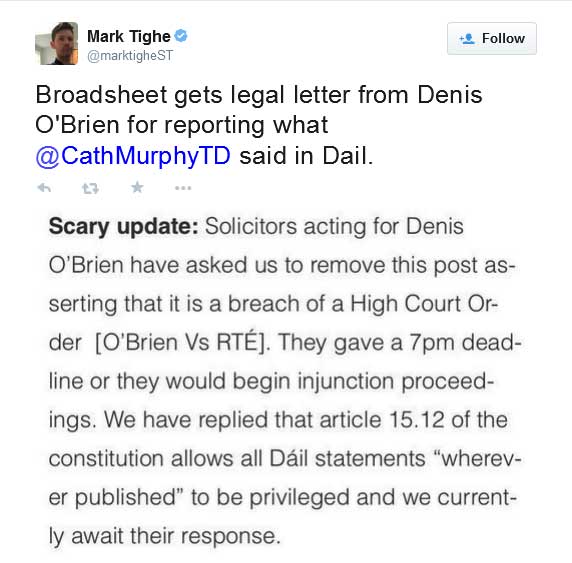
Broadsheet.ie, on the other hand, stood its ground. It also revealed that it had received a legal letter from the O'Brien camp.
And Peter Murtagh, of the Irish Times, did the clever thing late last night and tweeted a link to the Dáil transcript on the Oireachtas website.
Personally, I think the issue is still very clear. Words spoken in the Dáil are guaranteed absolute privilege under the Constitution as is their reporting. Therefore no lawyer or judge can stop the media reporting Murphy's words in parliament. And that includes RTÉ.
The injunction, whatever its merits otherwise, is not relevant to the reporting of Parliament and the constitutional guarantee trumps any court decision. The only relevance of the existing injunction in this case was whether Murphy would give any weight to it in deciding whether or not to say her piece in Parliament. Once it was said it was protected.
So I'm still very clear on the matter (though admittedly I am not an authority in this area).
What disturbs me is how the bulk of the media immediately ran for cover when they got the legal letter. These are the organs on which we depend to defend our right to information and our freedom of speech. If they can be upset that easily they are clearly not up to the job.
Some politicians have called for the Dáil to be recalled to debate the matter, but it seems to me that it is not a matter for Parliament at this stage. It is a matter for those media who have buckled under a piece of legal blustering and fallen down on their duty to report faithfully what goes on in Parliament. Such reporting has a specific constitutional guarantee, for God's sake.
It is up to Parliament itself to deal with the issue of whether if feels Murphy's statement constituted an abuse of privilege or not.
I would be very interested to see the justification, if any, for the issue of the legal letter and to see its precise wording. I would also like to see whatever legal advice the media got which led them to pull their copy. There is something not very right going on here and it needs the light of day shone on it fast.
Brian Lucey has an interesting nuance in his latest blog post. The implication is that if this were to become a regular occurrence and people's reputations were being destroyed by false accusations rather than by revelations in the public interest, something would have to be done about it. Possibly, but that's for another day.
Thursday, May 28, 2015
HEAD 7
Following the passing of the same sex marriage referendum the next stage will be the drawing up and implementation of the required legislation.
One of the controversial aspects of the campaign was the position of religious ministers as solemnisers of civil marriages. At present, in the Roman Catholic Church, for example, the religious ceremony has the corresponding civil ceremony tagged on to it, so to speak. From the couple's point of view, this simply involves them signing the civil register in the sacristy after the religious ceremony. The priest is a registered civil solemniser and so the marriage is thereby recognised and recorded by the State. In my day we all knew that the couple adjourned to the sacristy "to sign the register", but I am sure very few of us, me included, ever fully appreciated the niceties of what was happening.
Bringing in civil same sex marriage created a potential problem for the Church. In fulfilling his civil function a priest would now be performing a marriage which, while it would only involve a heterosexual couple in this case, did include in its remit the marriage of same sex couples. This led the Church to threaten to withdraw their priests from the solemnising of all civil marriages if the same sex marriage referendum was passed.
Even worse, the Church feared that the inclusion of same sex unions in the civil definition of marriage might result in their members being obliged to solemnise such unions on behalf of the State. So the Government promised them an exemption and this is reflected in Head 7 of the proposed draft legislation above.
However, the whole area of exceptions has the potential for opening up a can of worms as illustrated in a recent case in Northern Ireland where a bakery refused, on religious grounds, to supply a cake with a pro same sex marriage slogan on it. The bakery has been found guilty of infringing equality legislation. This has made the church in the south very nervous as the solemnisers' exemption is simply being proposed in law and is not enshrined in the constitutional amendment.
This all provoked me into wondering what other exceptions might need to be provided for. And what other, even tenuously related, issues might be lying around which could be tidied up by tagging them onto the proposed legislation. There is a tradition in Government of tagging even unrelated outstanding issues onto legislation which happens to be going through the Oireachtas. The Attorney General's people don't like this as it leads to very confusing legislation afterwards but it is not always their call.
Now would be the time to sort all this out as the relevant legislation is about to be rushed through the Oireachtas before the summer break.
Bakeries and other such product and service providers would be one area for consideration.
But what about Gerry Adams's same sex teddies. What if Gerry were to turn up before a solemniser with Tom in one hand and Ted in the other and ask that solemniser, politely one hopes, to perform a union. What then?
Or, leaving same sex aside and just considering creature comfort, and possibly even a bit of heterosexual hanky panky, what about those old folk in Father Scully House who are currently denied double beds?
I'm sure the list is endless.
Saturday, May 23, 2015
Áine
Sadly, Áine died this morning.
So I finally have to forgive her for her one indiscretion that I know of personally.
In the early 1950s she revealed to me that there was no Santy Clause. I don't remember if I was devastated or if I'd had my suspicions, but it is an event that I still remember. Mind you, she must have been very convincing as I had received an actual letter from Santy himself only a year or two previously.
But then, you could always believe Áine. A feisty woman with a great sense of humour and a twinkle in her eye, but straight as a die.
I got to know Áine when she was our next door neighbour at No. 41 Orwell Gardens in the early 1950s. We were staying with my granny then, and my mother and Áine became friends and, as I remember, attended the Rathmines Tech together for a period.
The Ó Súilleabháins were the cause of me going to Coláiste Mhuire after my ignominious rejection by Synge Street.
.
After we moved to Ballybrack, I still had contact with the family through Áine's husband Donnchadh, who was General Secretary of Conradh na Gaeilge and Secretary of the Oireachtas (now Oireachtas na Gaeilge to distinguish it from the national parliament). Donnchadh died unexpectedly in 1989. I also maintained contact with her daughter Bríd through our common involvement with the theatre and beyond.
Sad to say, I did not keep up any regular contact with Áine, all my own fault, though I did meet her a few years back and she was in fighting form.
She was 96.
Sympathies to Bríd, Gerry and family.
May she rest in peace.
Sunday, May 17, 2015
Where is it ? No. 37
To see all the quiz items click on the "Where?" tag below.
To see all the unsolved quiz items click on the "unsolved" tag below.
Damn him. He's done it again. Felix Larkin gets the prize. The cheque is in the post.
But I have solved the mystery. He is the only person who reads my blog and when I post one of these quiz items he races out of the house and walk the streets of Dublin till he finds the answer.
Well done Felix.
Saturday, May 16, 2015
Michael Edwards 2015
Michael Edwards has done it again. And this time the exhibition in the Donaghmede Shopping Centre has a slight change of style.
This year we have a series of exhibitions each from a different photo club. Currently on display are photos from St. Benedict's club in Kilbarrack. The standard is very high and there are some really fabulous shots.
The scheme works as follows. The studio invited 6 camera groups to exhibit for 4 weeks each. The public will view and vote for 10 out of each group. At the end they will exhibit the top ten from each group and these will be judged for The Michael Edwards Trophy 2015 and finalists 1 to 10.
The exhibition is run in association with the shopping centre and sponsored by Dublin City Council, who, incidentally, are doing great work promoting culture all round the city and right through the year.
So, if you're in the area, do drop in, checkout these great photos and leave your vote.
Sunday, May 10, 2015
Liberation Day
Yesterday, 9th May, was Liberation Day in the Channel Islands. This is when islanders celebrate the end of the Nazi occupation in 1945. The islands were unique in being the only part of the "British Isles" to have been occupied by the Nazis during WWII. The occupation had its brutal elements and the Nazis turned the islands, and Jersey in particular, into a huge fortress with massive surface and underground defences, mostly built by very badly treated POWs.
So the people of Jersey, the island with which I am most familiar, had much to celebrate on this day in each year following the end of WWII. This year was special as the 70th anniversary and it was seen as marking perhaps the end of those celebrations in which aging survivors of the occupation could take part in any numbers.
So I tweeted my friends in Jersey a happy Liberation Day and I meant it. What follows refers to Jersey alone.
It seemed a good day, without hopefully spoiling the party, to recall some unfinished business left over from the liberation. There was an opportunity then to revamp the whole system and also free the islands, and Jersey in particular, from a much more embedded occupation dating from previous centuries.
The island is a Crown Dependency, which means it is directly governed by the Queen who appoints its principal officers. It has appropriated much of the nomenclature of a modern democracy but its structures remain essentially feudal. Asserting one's human rights under the present system is somewhat haphazard in its results and can depend very much on the proximity of one's association with the ruling clique.
The montage above is of Philip Bailhache, the more prominent of the Bailhache brothers, both of whom have held most of the island's major offices over recent decades. Philip, a former Bailiff and currently Senator and Foreign Minister, is seen as the puppetmaster though it is clear that there are others pulling his strings.
His most recent contribution to good governance on the island was to try and sabotage the current inquiry into decades of child abuse and cover-up, an area in which he is seriously conflicted himself.
This is Philip's brother William. Currently Bailiff, he was previously Attorney General during a period when many prosecutions of alleged child abusers were either dropped or refused. His period in office at that time will hopefully come up for review in the course of the current inquiry into child abuse on the island.
The policing function on the island is complex. Each of the twelve island parishes has its own police force and it is only in more recent times that an all-island force has been developed to any significant degree. There are serious contraints on the all-island force, including political ones, and recent years have seen these exercised aggressively by the establishment when it illegaly sacked the police chief and smeared the senior investigating officer as their inquiries into earlier child abuse were getting too close to the bone.
A more compliant central policing régime was then recruited, the current head of which is Mike Bowron (above), renowned for chatting to ordinary people in the street and ignoring them when they come as supplicants to his office. The wide discretion available to the policing function in Jersey (there is no separate independent prosecution function) means that whether you are charged with an offence or not frequently depends on who you are.
The reference in the caption is to Philip Bailhache, then Bailiff and Speaker in the States (Parliament), turning off the microphone of the then Health Minister, Stuart Syvret, as he tried to raise the question of child abuse in the House on an earlier Liberation Day.
Emma Martins is the Data Protection Commissioner. Her principal contribution to the island to date seems to have been (i) to support the "Gang of Four" in their effort to have Stuart Syvret brought before the courts (another partial institution) for publishing information which was clearly in the public interest and (ii) to have Stuart's blog taken down from Blogger/Google on spurious legal grounds.
It would be unfair to leave out Emma's daddy, John Nettles aka Bergerac, whose BBC TV series was set in the island and was shooting footage at Haut de la Garenne (the notorious centre of child abuse) while there were still children resident on the premises. BBC have recently called off a rerun of the series in the face of public protest. In recent times Nettles has attempted to downplay the significance of the centre. I really couldn't leave him out as Emma has declared that she frequently takes her daddy's advice.
The above are most of the tweets I tweeted yesterday for Liberation Day.
I couldn't finish, however, without recalling this event from the obverse of the liberation coin. Arising directly from his principled conflict with this deficient system of administration and justice, Stuart Syvret has already done a few stints of porridge and may yet come to do more.
So let us wish a happy LIBERATION PHASE 2 to the people of this beautiful island.
Note: you can see all the tweets here. You may have to click "Show photo" to see individual images.
Wednesday, May 06, 2015
Prince Arthur's Sword
The National Library's lecture theatre at about a quarter to one today (6/5/2015). Very much the calm before the storm. The room started filling up and at about five past one the storm broke.
Mark Leslie, second in succession to the Leslie Baronetcy currently held by his uncle Jack, launched us into his family's tempestuous history, peppered with fascinating stories and all the while way up the social ladder.
It all revolved around the family home, Castle Leslie in Glaslough Co. Monaghan, now a very high class hotel and equestrian centre.
The title of Mark's talk was "Norman Leslie and the Sword of Prince Arthur". Norman was Mark's grand-uncle who had a very colourful career in the British Army, so much so that he was awarded a specially inscribed sword by Prince Arthur, first Duke of Connaught.
Norman died at the Western Front in 1914 while leading his men in a charge and holding the sword aloft as befitted an officer. While his body was subsequently located and buried, the sword could not be found.
Many years later, a Belgian farmer, ploughing his field, unearthed the sword and seeing the inscription returned it to the War Office who returned it to the Duke of Connaught, who in turn returned it to the family. It is a treasured heirloom which now surfaces on important family occasions.
So that explains the title of the talk. Norman had also been probably the last British Army soldier to engage in an officially approved duel. That arose out of his womanising and he was lucky to survive it.
We heard about Mark's antecedents, including a bishop who defied Cromwell, and in more modern times, a relation who got away with wearing a tiara which was bigger than the Queen's at a royal reception in Buck House.
If I were to recount the many other great stories I'd be here all night so I'll just say that this was one of the, if not the, best talks I've ever been at, and if it ever comes to a location near you in the future make sure not to miss it.
And if it doesn't and is being given in a faraway place, make sure you travel to it.
You won't regret it.
Saturday, May 02, 2015
Photographing Children
A recent trip to TESCO found this man in the foyer. He was offering photos in period costumes for children and families. I thought it was a great idea and asked him if he'd mind me photographing him and his stand for a blog post. No problem.
So I took the photo above. I was immediately approached by a security man who told me photos were not allowed in the foyer. I explained that the man was quite happy having his photo taken. Made no difference. Photos were not allowed in the foyer. People might not want their photo taken.
This gave rise to a maelstrom of speculation in my head. Might I have incidentally included a couple who were having a clandestine affair. Might someone have pulled a sickie and gone on a shopping expedition. Might some proud Southsider fear being seen on the Northside. The possibilities were endless.
Anyway, I put away the camera (with its precious photo) and took a shot of the other side of the stand, with the rack of period clothes, on my way out. Where was the security man then? Just between ourselves, he's half way down the foyer behind the dresses. As obscured from me as I from him.
I am not against data protection, but really, when it's carried this far it's just plain nuts.
I was in my local village one day a good while ago when I spotted a procession of kids passing through. On closer inspection they had horror masks and painted faces and a variety of spooky costumes. It was apparently a school spookwalk for charity. I thought it would be nice to blog a photo of such an interesting happening and took out my camera. This was immediately spotted by the kids who started playing up to it. All good humoured. I even gave my card to one of teachers and said I was thinking of blogging a photo.
Imagine my surprise and horror when I subsequently got a phone call from the school principal, who turned out to be as embarrassed as I was, but "would I please not use the photos". Apparently the Principal would have had to get releases signed by all the parents and that would be another big task on top of the already overloaded day job. I had no problem laying off the blog post and sent copies of the photos to the Principal for use in the school.
But I really thought it was all going a bit far and that it was such a pity that the great sense of fun, innocence, enthusiasm and happiness of these kids was being overshadowed by such an all-pervasive sense of fear on the part of the adults. Anyway, not my call.
It is a bit unnerving though to think that I and all those around me are walking around inside a cocoon of copyright. Maybe I should stop saying hello to people in the street in case I inadvertently burst their cocoon.
Then I read in today's paper about new RC Church rules on parents taking photos of their children on church property during Confirmation. Worth your while to read the piece. Not only do the restrictions appear unnecessary, they are positively cruel in this digital day and age. It is one thing to ask people not to disrupt or distract from the ceremony when taking photos, but another to prohibit them altogether.
Anyway, I'm making my personal protest below in visual form. This is my first holy communion day in 1951. So there.
Subscribe to:
Comments (Atom)


