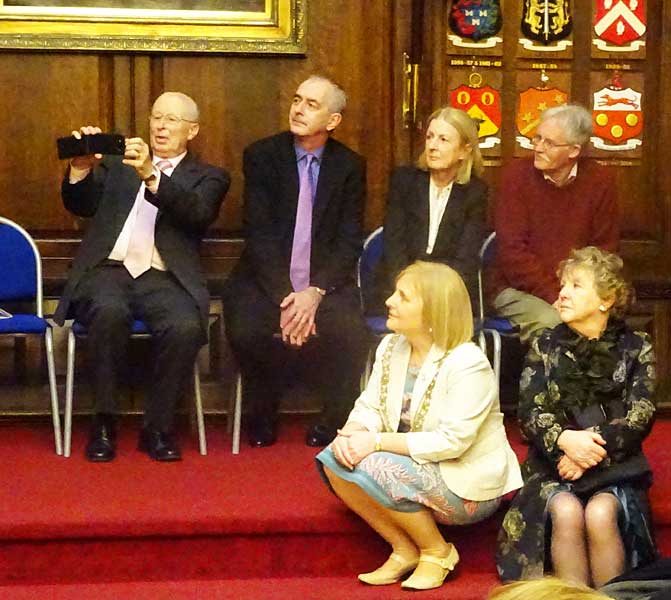
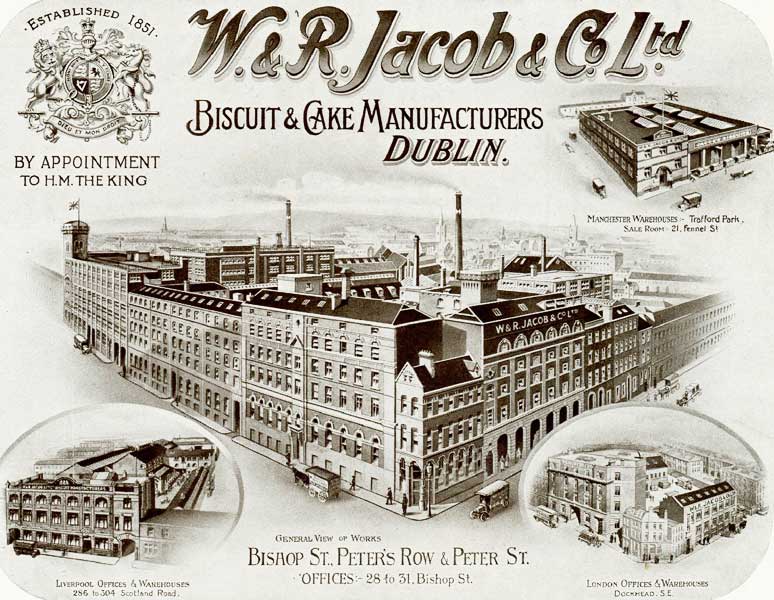
Click on image for a larger version
I turned up early, thinking it would be quiet in the exhibition space and I could get a load of photos in before the launch. But they wouldn't let me in. I was locked out as people like RTÉ's master documentary maker, Philip Bromwell, did their professional thing inside.
A blessing in disguise really. As I reflected outside it occurred to me to set myself a challenge. When they let me in I would go hunting for broken biscuits. Not that I thought they'd serve up the real thing, but among the exhibition's copious illustrations.
I'm not sure why, but I did not expect to find any. These were the poor person's biscuits at the complete opposite end of the scale from the various posh/royal collections.
They used to be sold out of a big tin and in brown paper bags. When we lived with my granny she used to sit at table secreting a bag on her knee and discreetly munching the ones with icing and chocolate, leaving the plain ones for the rest of us.
But I was wrong. There was the label, every bit as large as all the others. The granny would have enjoyed that.

Brendan Teeling, Deputy Chief Librararian
Brendan welcomed us all and did his usual great job of animated MCing.

Margaret Hayes, Chief Librarian
Margaret introduced the exhibition and conveyed the Library's thanks to all who had laboured so hard to bring this magnificent project to fruition.

Douglas Appleyard, former Jacobs employee, collector, compiler, donor.
Douglas gave us some of the background, recalling how, as an employee, he had been asked to sort out some filing cabinets and came upon what can only be described as gold dust.
That's how the archive was started and it now contains a vast array of material from company documents to memorabilia. In parallel with the compilation of the archive, Douglas himself has been collecting all sorts of Jacobs objects and he has donated this collection to the Library to accompany the archive proper.

So why is it here. Jacobs was not just a Dublin but a national institution with a history not limited to biscuit production. Its headquarters in Bishop Street was one of the 1916 rebel outposts which not only made it part of national political history but also a player in the development of the trade union movement of the time.
Douglas is not a man to settle for second best. He had three requirements of whoever got to house the archive and related collection: (i) they would have to take the lot - no cherry picking; (ii) it would have to be housed in a way that made it accessible to the public; and (iii) they would have to undertake to organise exhibitions.
Dublin City Library and Archive, of which I am a big fan, was the only institution to meet his three requirements in full, and this exhibition in this place is part of the outcome.

Ardmhéara, Mícheál MacDonncha
The exhibition was to be launched by the Lord Mayor Mícheál, whom I caught making last minute alterations to his script as he waited to take the floor.
But that was not so much what caught my attention as the juxtapostion of his gold Fáinne with the head of King Billy on the mayoral chain of office. We have come a long way since 1691 - I hope!.

As first citizen of the urbs (g. urbus!) Mícheál welcomed us all and took great pride in declaring the exhibition formally oscailte.

Wendy Williams, Curator & Design Historian
The Library farmed out curation of the exhibition to Wendy Williams and she did a magnificent job. The panels are attractive, well laid out and highly informative. And the timeline of Jacobs labels was a great idea. It is well presented, no easy task, and I'm sure it may well turn out the hit of the exhibition, at least for us senior citizens.
It evokes memories with the intensity of a smell or a piece of music and at the same time astounds with the amazing variety of labels, many of which were never seen in recent times and which in their own way bear witness to the company's colourful and sometimes controversial past.
My own advice to my contemporaries is not to come alone. Bring along someone from your own era to share this trip down memory lane with. Just for the record I'm one of the last of the war babies (not saying which war).

Wendy Williams, Séamas Ó Maitiú & Ellen Murphy
There would be no exhibition without the archive in the first place. Séamas has written the book on Jacobs which has formalised a vast amount of research which fed into the exhibition.
Ellen Murphy is the senior archivist who is responsible for the archive and collection in their current home. She and her team (I hope she has a team in these straitened times) have been responsible for housing, preserving, cataloguing and digitising the archive and collection since the Dublin City Library and Archive accepted them from Douglas and the current brand inheritors Valeo Foods in February 2016.
MY PHOTO

MY PHOTO
This is one of my photos from that occasion on display on the panel dealing with the archive as such. Always as well to declare an interest before you're blindsided.

EXHIBITION CREDITS
The list of credits on this panel is worth a read. Those above refer to the exhibition as such.
AN GHAEILGE

BRIOSCAÍ
I was very taken with the creative and informative use of Irish in the exhibition. There isn't much of it but what there is made me feel at home.
These days coming across Irish in any public place is more often than not an excruciating experience. It is carelessly flung about and misused in all sorts of signage and on air.
This was different. If you go back and look at the poster at the launch you'll see Monarcha Brioscaí agus Baile Átha Cliath - Fite Fuaite lena Chéile. A perfect description.
If you compare the Irish and English versions of the panel heading above you'll see the Irish has a slightly different emphasis and resonance. Biscuits at the front is one thing. Brioscaí i mBéal an Chatha has a resonance of biscuits under fire and in the heat of battle.

CARTLANN
The Irish version here is not a slavish or pedestrian translation of the English but contains additional information.
I have expanded on this subject in a separate post.
TINS & LABELS

Marietta
Let's take a look at some of the individual labels in the timeline.
Marietta, the plainest of the plain. Wendy has mentioned how people used to put butter between two of them and how it came out through the holes when you compressed the sandwich.

USA 1
Then there were the tins of assorted biscuits, evoking exotic lands and people. I'm not sure if this lady could be classed a Southern Belle or not?

USA 2
But in a later version she is clearly firmly stitched into the Union.

IFS
And drawing on that design Jacobs brought us an IRISH FREE STATE assortment. You'd want to be a lot older than me to remember that one.

AN TÓSTAL
An Tóstal was not allowed to pass without a special issue. I have always loved the distinctive Tóstal harp. We used to draw it on our school copy books all the time.

FAIRY PUFFS
I doubt if this one would pass today's PC brigade, but it is from an era when gay was just jolly.
POLITICAL

ULSTER
Biscuits might sound like a neutral or safe kind of product, but Jacobs did come up with some products which could cause offence in some quarters.
This Ulster Assorted is clearly not aimed at the province but at Northern Ireland as the profusion of crowns makes clear. I wonder did they market this one south of the border?

ROYAL AFTERNOON TEA
I have to be careful what I say about the British Monarchy. Despite eight hundred years of occupation and a vicious War of Independence, soon to be commemorated, there has always been a grá for the monarchy around the place.
However this emphasis on royalty and things British didn't go down well everywhere. A member of the Jacobs family told me that the company had come under fire from the Workers Party no less for having in the past been involved in supplying biscuits to the British Army.

25TH JUBILEE 1935
George V's twenty fifth jubilee. Little did they know what was round the corner within the year. I remember him from the old worn pennies that were still in circulation in my day.

CORONATION 1937
The present Queen's daddy. Pushed into service after his brother Edward VIII abdicated in 1936 over his love for a divorced American lady.
BREXIT

LETTER TO EMPLOYEES
Click image for a larger version
I'm going to indulge in a bit of conflating and counterfactual histrionics here.
The above is a letter from Jacobs to its employees warning them of the difficulties that would be caused for the company's activities should Ireland leave the British Commonwealth of Nations. The fear at that point was of Fianna Fáil pulling the plug, but, of course it was the other crowd what did it in the long run.
The letter points out that much of the company's produce would become subject to prohibitive tariffs, with the implication that some half of their output would have to be transferred to their British factory with a devastating effect on employment at the Dublin end.
You will notice that the firm is described as W & R Jacob & Co., just a single company. With Irish independence in 1922 the company was split in two for tax reasons. The Dublin end retained the name W & R Jacob & Co but you will frequently see also W & R Jacob & Co's, presumably referring to both companies. Not quite sure what the apostrophy was doing there, but never mind.

BROKEN BREXIT
Anyway you can see why it brought Brexit to mind, and in honour of our curreent predicament I have come up with my own biscuit label, as I'm sure Jacobs would have, had they still been around. It mightn't be quite like mine, but every man to his own.
TELLY

Jim Figgerty
You can watch and listen to some of the Jacobs TV advertising campaigns on the video viewer. This one is probably the most famous - the hunt for Jim Figgerty, the man with the secret of how the figs get into the fig rolls.
DISTINGUISHED GUESTS

Former Jacobs worker, Ann Rogers, 96
Ann, now 96 years of age, worked in Jacobs. She was much in demand at the launch and looked like she was having a ball. Her favourite biscuits? Goldgrain and Marietta.

Mark Merrigan's entry in the visitors' book
Ann didn't get round to signing the visitors' book on the day but her grandson, Mark, was back on 13/9/17 and entered her name in a comment.

Michael Jenkins, member of Jacobs family
Michael is a member of the Jacobs family, his grandmother having been a Jacob.
He pointed out, here on the timeline, how the company had got in a consultant to redesign the logo in the 1960s. This led to an overall simplification and the incorporation of the shamrock. That logo has since been abandoned.

Douglas Appleyard
Without Douglas there would be no archive, no collection of memorabilia, and Dublin would be the poorer.
So, in my book, Douglas takes the biscuit (aaaggghhh!)
There is a good review of the exhibition in the journal.ie and you can book a tour here.