
Click on any image for a larger version
Just looking at their Twitter account, The Long Room Hub is an intellectual and visual ferment 24/7. And why not. It is a great facility and it's in a university.
I ended up there last Wednesday (11/4/2018) at a talk on the very provocative subject you see illustrated on the opening screen in the illustration above. I was certainly looking forward to the talk. The assimilation of Southern Protestants, or what's left of them, is truly a saga in itself. But how I came to be there has a much more obscure cause, or more properly causes.

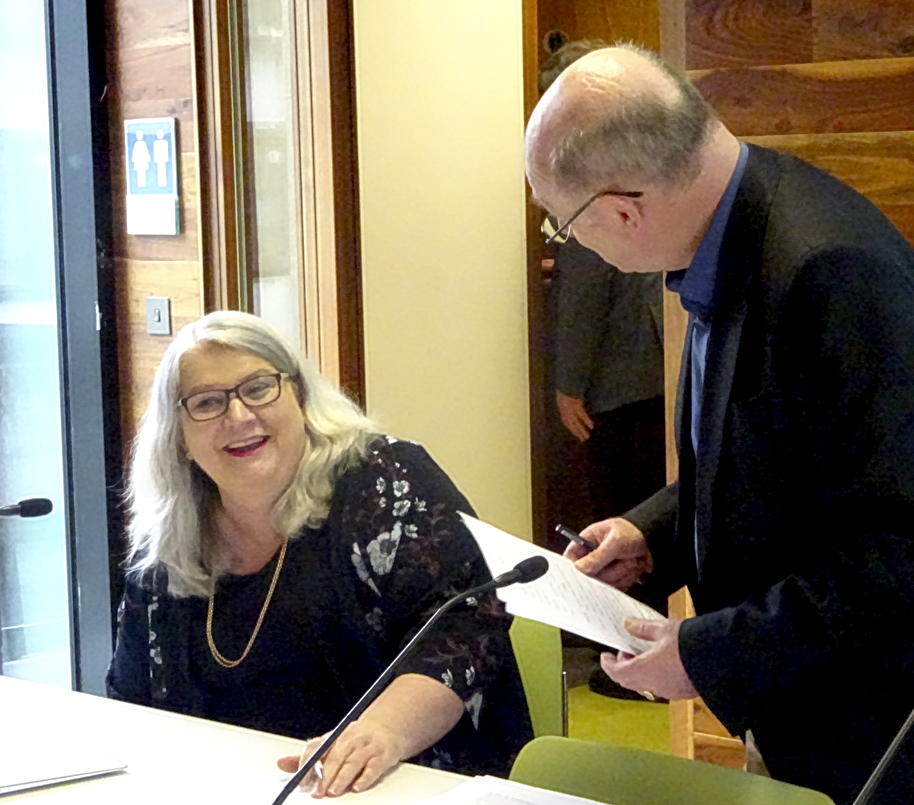
Ida Milne & Ian d'Alton
I worked with Ian d'Alton in the long defunct Department of Economic Planning at the end of the 1970s. I lost contact with him when that Department was beheaded by Charlie Haughey though I have been aware of his distinguished public service career since. It is only in very recent times that I have bumped into him again and it was this that led me to his talk in the Hub rather than the subject matter as such.
Ida is a different kettle of fish. I had never heard of Ida until recently, when I learned of her forthcoming book, Stacking the Coffins, which deals with the 1918 flu epidemic. I am working on a talk which takes a whimsical look at death in my family. I have infant death, TB, drownings (plural), war and even a possible double poisoning. My plan is to talk about these causes of death in a thematic way and illustrate this with family examples. It was only when I learned of Ida's forthcoming book that I realised I had no examples of flu deaths in the family despite the prevalence of the epidemic at the time.
So my real reason for being in the Hub was Ian and Ida rather than the Southern Protestants as such. But thinking on the matter I figured who better to give a talk on Southern Protestants than two Southern Protestants.
The term Southern Protestants is a contested one. Referring to the Republic as the South has many adverse connotations which it might be wise to avoid, but then what do you say? The Free State has a cut off point in 1937 and the Twenty Six Counties is clumsy, not to mention it reminding us forcibly of the other six. So, as Ian says, Southern is a term of convenience and we'll stick with it.
The talk was a teaser/trailer for a book that is in gestation, or possibly in the labour ward. It's title is Protestant and Irish and it consists of more than a dozen essays dealing with the Southern Protestant experience, many of them case histories.

Eunan O'Halpin
The session was introduced by Eunan O'Halpin who is Professor of Contemporary History in TCD.
I'm not going to go through the talk seriatim. In fact I may say very little about the talk itself as an audio podcast will be available on the Hub's Soundcloud page shortly. [Update 15/1/2019: for technical reasons the podcast never appeared.]

The method of delivery was one I had not come across before. It wasn't quite a duet as the two presenters did not both speak at the same time. More like an agallamh beirte where they alternated covering a few paragraphs at a time. I've no clue how this alternation related to content or authorship. Suffice it to say it gave them both a crack of the whip while the audience got a seamless presentation. Some lessons here for Stormont maybe.
The book's contributions are grouped under three themes: belonging, engaging, and other(ness).

Protestants spanned the full range of Irish life but generally at the top of the heap. Today's generation may well be unaware of this, being less preoccupied with the other person's religion, if any.
The slide above gives some idea of this spread. Some of the names will be familiar but their religion less so.

It is very easy at this remove to underestimate the shock of Southern Independence to Southern Protestants. Could they succeed in belonging to this new, somewhat alien, entity? Did they even want to? How best to engage with it? To what extent would they remain "other"?
How these questions were answered would have implications right down to my own time.
Before the talk, in conversation with Ian, I mentioned the hate counter in Hodges Figgis which was there up to the start of the 1970s. This was an obscure corner at the back end of the shop which was packed with anti Roman Catholic literature. Ian had been totally unaware of it. Mind you it didn't last long after Michael Viney's exposé in the Irish Times but it was interesting that it had survived unscathed for so long.
I picked up a pamphlet advising Protestants never to marry a Roman Catholic. I don't think that would be viewed too kindly today but you could see where it was coming from. The Protestant community was a tiny minority and the Roman Catholic Church insisted that all children of (religiously) mixed marriages should be raised as Catholics.

There was a famous, or rather infamous, case in the 1950s in Fethard on Sea, which is Ida's part of the country. The whole saga was very confrontational across the religious divide and even RC Bishop Michael Browne, or cross Michael as he was known, got involved though Fethard is far from his Galway bishopric. He was one of the terrible trio of his day with Connie Lucy in Cork and John Charles McQuaid in Dublin.
Whatever about the formal confrontation which involved a boycott of Protestant businesses, Ida suggests that there was a much more live and let live process attempting to break out behind the scenes.
Ida mentioned that as far back as 1798 when Protestant ascendancy landowners were being burned out of the big house, her own people were saved by local Catholic neighbours.

I always knew that the GAA was a force for community development but I also thought of it as Catholic. It had not occurred to me that it was also a force for integration across the religious divide.
For historical reasons the business class in Ireland tended to be Protestant at least at the level of management and that took a long time to normalise. Guinness and Dockrell come most immediately to my mind.
If I can be excused a little bit of celebrity puff here to mention Bono. His parents had a mixed marriage (in fact two of them) in 1950 and it did not seem to go down too well with either family. Despite having been married in the Protestant church in Drumcondra, the local curate in Dolphin's Barn dragooned them into a second marriage in his church which he duly registered with the State making them doubly civilly married, a process for which there is not yet a word in the English language, as far as I know. I'm suggesting bonomy.

As far as the rural scene is concerned I'd just mention the experience of Colm Ó Gaora in Bangor Erris in Co. Mayo in the early 20th century.
Colm O'Gaora was a young teacher and a timire for Conradh na Gaeilge. He was new to the Irish speaking Bangor Erris disrict in Co. Mayo when he met a man along the road. "Dia dhuit" (God be with you) says he, in the traditional Irish greeting. The immediate and vehement reply took him aback: "May God and Mary bless you and may bad luck strike you down you dirty old Protestant".It's a lovely story and it illustrates the depth of feeling across the religious divide in some rural areas. If you want to get the key to the "conversation", and my little bit of "poetic licence", have a look at my review of Colm's book.

There was a fairly lively Q&A after the talk with many contributions and questions from a packed, and in parts, distinguished audience.
I know I haven't done the talk justice and have rambled all over the place. But I'm in my anecdotage and there is nothing stopping you listening to the whole thing once the podcast goes up, and you can read the book once it hits the streets. [Update 15/1/2019: for technical reasons the podcast never appeared. However the book will hit the streets shortly.]


