
Click on any image for a larger version
My first duty is to thank the BBC for giving me a front row seat, and more, at the chairing ceremony at this year's National Eisteddfod of Wales. The Welsh version of their caption denotes a seat in the pavilion, and a first class seat it was.
I hope this effusive outburst will allow them to forgive me for nicking a load of their shots of the ceremony for this post. Or to put it another way, the photos in this post are courtesy of the BBC.
I had to start, as they did, with an outside shot of the pavilion. When I first started attending the festival this was a wooden structure and the talk was of replacing it but it took a while for the pavilion to evolve into its current form.

Anyway, we are here to follow the ceremony of the Chairing of the Bard, which event is for most aficionados the peak of the week, so to speak. The Chair is awarded for the best poem in cynghanedd, a strict traditional metre.
The event is replete with ceremony, as it is not only an Eisteddfod competition; it is also a major event in the calendar of the Gorsedd which really notches it up the ceremonial rankings.
Nuff guff and back to the event. The Corn Gwlad (two of them!) summons the audience from the four corners of the earth. This is even better than the trumpets at the 1969 investiture in Caernarfon Castle. Believe me.

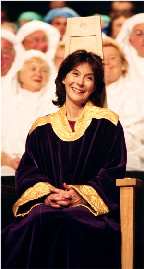
Next, the Archdruid welcomes the assembly and introduces the ceremony. Christine James is the first ever female archdruid and this event will mark the end of her three year term. The election of a female to this office was long overdue. There was a serious glass ceiling here and another ceiling below it. Nominees for archdruid must be winners of the Chair, Crown or Prose Medal and women were scarce in these ranks up to recent times.
The first woman ever to win a chair was Mererid Hopwood in Denbigh in 2001. I have written about that chairing elsewhere.

And who pops up to read the adjudication on behalf of the three person jury but Mererid herself.
I should mention that she not only won the chair in 2001, but two years later also won the crown. She launched into a lively adjudication as the tension mounted in the pavilion. I should make two points here. The judges only know the competitors by their pen names, so the judging is absolutely fair. And, there is an absolute standard to be achieved for the award.
In recent times, in 2009 and 2013, the chair was not awarded as the required standard was not reached. The phrase in Welsh, "neb yn deilwng" (no one worthy), is one to send an audience's collective heart down into the pits. Without the award the bottom falls out of the ceremony. And, don't forget, each chair is specially commissioned for each particular eisteddfod. It is made of local materials and by a local artist. So there are many levels of potential disappointment here.

As I watch Mererid's lively and sometimes amusing adjudication my heart starts rising. Her enthusiasm is tangible. There must certainly be a chair this year.
And so there is. The winner is called by his pen name and asked to stand as the searchlights sweep the audience. Suddenly applause breaks out in one corner of the crowd; on this cue the searchlights converge.

The camera finally picks out the winner in the crowd. Everyone is wildly curious to know who he is but they'll have to wait awhile until he is vested and led to the stage.
He turns out to be Hywel Meilyr Griffiths, from Talybont in Cardiganshire, and a previous winner of the crown in 2008.

Once he is comfortably seated in his new chair the honours begin.

The traditional song of praise is sung. "Henffych i'n Prifardd ...", the first words of which I have taken for the title of this post: Hail to our chaired poet ...

He is then read a witty poem in his honour, which an accomplished and clever poet has personalised at the last moment.

Then we have the first of the local elements. Dawns y Blodau, the flower dance, is performed by a bevy of very young local schoolgirls. It is very impressive and is a touch added by Cynan way back in 1936 when he reformed what was a stodgy old show and turned it into a modern performance.

Next, the Aberthged, the offering of the fruits of the earth, is presented by a local young girl.

The Corn Hirlas, or horn of plenty, is presented by a local married woman.

And, finally, the Archdruid wraps it up, and, on this occasion, seeing as she is bowing out, thanks all and sundry for their help and cooperation during the three years of her reign.

A rousing version of Hen Wlad fy Nhadau swells from the audience, ably channeled by the Gorsedd choirmaster.

And this finds its echoes on stage.

After which the Gorsedd and all its pomps goes to ground until next year's event.
This year's eisteddfod was in Meifod (near Welshpool) and next year it will visit Caldicot (near Cardiff).
I had a go at tweeting the ceremony live from the pavilion (via BBC) and you can see the results here. It turned out to be a bit frantic but it was fun. Unfortunately there's a serious typo in Mererid's name (blot on copybook). But otherwise it worked out OK. Start from the bottom.
 I have been involved with the Welsh National Eisteddfod since the Investiture of the Prince of Wales in 1969. "Eisteddfod yr Arwisgiad" if I remember correctly.
 The Eisteddfod is a fantastic festival. It is a concentrated outpouring of Welshness over one week in August. It is the pinnacle of a vast range of cultural activity which goes on throughout the preceding year. You can get a flavour in my report of the
  Dillwyn Miles has had a long and productive association with the Eisteddfod. He was for many years the Herald Bard, in a costume of his own design, and he has written what is effectively the public
  The highlight of the 2001 Eisteddfod was the winning of the chair by Mererid Hopwood, the first woman ever to do so. Well, six years later she retains this distinction.
  A new Archdruid starts a three year term next year and has already been chosen. He is Dic Jones (Dic Yr Hendre) who won the chair as far back as 1966.